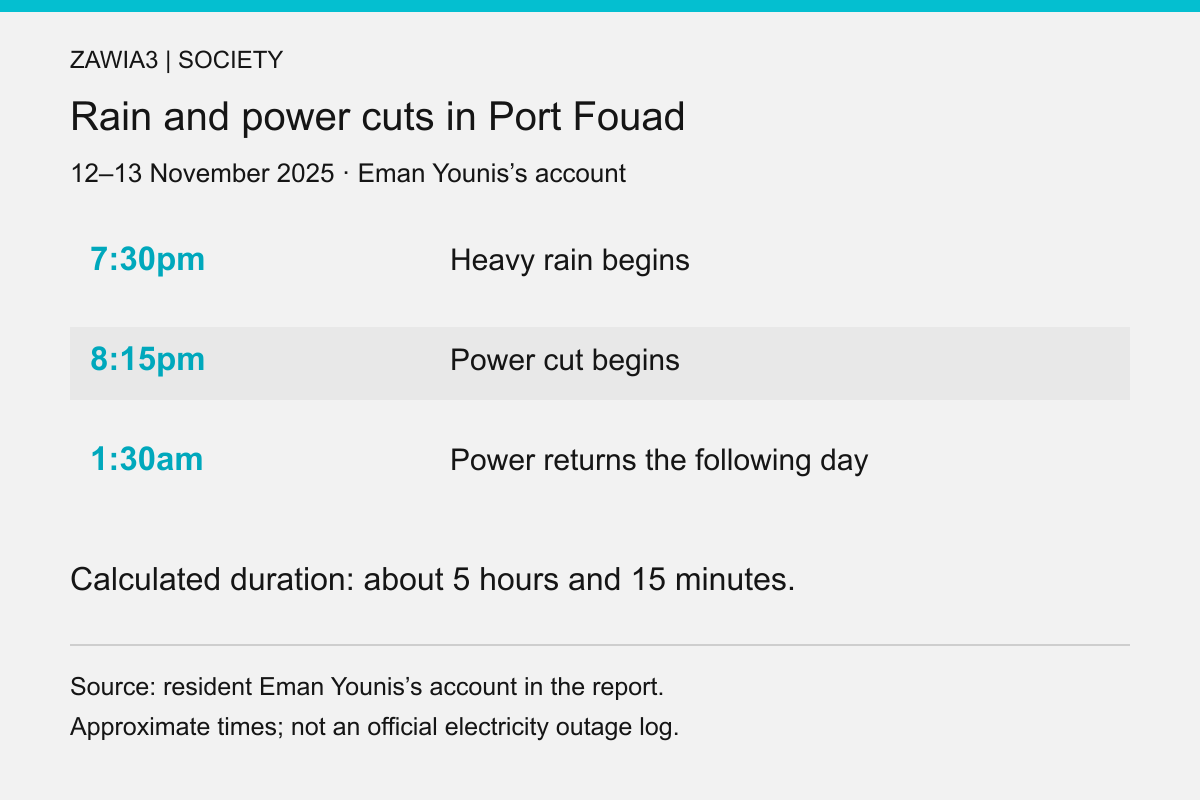
At exactly 7:30 pm on 12 November, heavy rain began to fall on Port Said Governorate, and within about an hour the water had completely flooded the streets because of shortcomings in the drainage system, before the electricity supply was cut off completely from specific areas of the district, including Al-Harafiyeen, Al-Maashat, the 11 Buildings area and the surroundings of the university. The outage lasted about five and a quarter continuous hours, from 8:15 pm until 1:30 after midnight, and during this period residents also suffered repeated cuts to drinking water.
Over the past months, the executive authorities and the district administration carried out extensive digging and breaking works in almost half of the city’s streets, on the pretext of “preparing for the winter season”. These preparations were expected to include improving the drainage networks and installing new drain grates, but the surprise was that the first wave of rain this season revealed the complete failure of these “preparations” and flooded the city, causing severe damage: the water level rose to cover car tyres, moving through the streets became more like swimming, and some ground-floor homes were flooded by the water, which continued to accumulate in most of the affected areas for three days, cutting citizens off from their work and schools, as recounted by Iman Younis, a resident of the Port Fouad district of Port Said.
Iman recalls that this tragic scene is not new, as rain of the same intensity occurred in 2019, which confirms that the basic problem in the infrastructure has not been solved, and she considers that the responsibility lies entirely with the officials who failed to provide sound infrastructure that prepares the city to receive the rainy season.
She tells Zawia3: “In fact, the water suction trucks started work as soon as the crisis began, but they were not enough to deal with the volume of rainwater. After two days of suffering, residents, organised by community activists such as Mr Mina Adel through the ‘Sawt Port Fouad’ group, took the initiative to go down into the streets and help the district workers in the efforts to remove the water.”
The suffering was greater for Mohamed El-Zeiny, a resident of the new Al-Fayrouz area in Port Fouad, as rainwater completely submerged his car within just one hour on Wednesday evening, which damaged the car’s electronic control unit, whose cost is estimated at EGP 25,000, in addition to other damage.
El-Zeiny points out that the Al-Fayrouz area, a social housing project affiliated with the Governor of Port Said, lacks basic infrastructure and rainwater drainage networks, describing the situation as catastrophic, as the streets remained submerged in water for several days without intervention from the responsible authorities to pump out the water. He also criticises the construction quality of the housing units, which caused rainwater to leak heavily through light fittings and fans in the ceilings of some flats, posing an imminent danger to residents.
He tells Zawia3: “The car was below my home at the moment the rain fell, and I did not expect this amount of water to pour down within one hour. Rain in previous years did not cause similar damage. The streets around us are still flooded, and the water has not been pumped out yet inside the Al-Fayrouz district. The suction trucks only moved in the vital areas within Port Said, while none of them reached the Al-Fayrouz district.”

El-Zeiny expresses his fear that the same tragedy will be repeated during the winter season, wondering whether the governorate will pay compensation to residents whose cars or home furniture were damaged because of the accumulation of rainwater in the streets, and noting that he had to dismantle the car completely to dry it after it had turned into a pool of water.
For her part, Salma Fahmy, a resident of the city of Port Fouad in Port Said Governorate, had never witnessed rain of this intensity in Port Said, to a degree that exceeded the residents’ ability to deal with it; residents suffered major damage after water entered a number of homes and flooded many shops, causing widespread losses in several areas.
She tells Zawia3: “The city was not prepared to face such a situation. I asked the building’s doorman to open the drain, but he replied that the solid iron cover could not be opened. The surrounding residential towers, the Sadat villas and the Suez Canal Authority turned into something like pools of water, because there is no drainage infrastructure able to absorb the quantities of rain. Residents reported other dangers, including electrical sparks coming from some lampposts during the rain, which poses a great danger to passers-by.”
Salma points out that a group of young people stepped in with water pumps to help with the pumping operations in Port Fouad, and the next day the head of the district came and supervised the efforts to remove the water in response to the appeals of residents whose homes had been damaged. She appeals to the officials of Port Said Governorate to put in place a clear plan to face the heavy rain likely during the winter season, including inspecting the drainage network, determining its absorption capacity and making sure it is ready.

Their testimonies intersect with the account of Hany Tantawy, a resident of the city of Port Fouad, about the wave of heavy rain that Port Said Governorate witnessed last week, which continued over Wednesday and Thursday and caused widespread flooding in the streets at unusual levels, making it difficult to reach homes in some areas, especially inside the apartment buildings, which filled with water and completely obstructed movement.
Tantawy explains that the old housing in Port Fouad was the most affected, as water seeped into the basements and reached about half the height of some flats, causing heavy losses for residents, stressing that the Port Fouad district had announced its readiness and preparations before the rain fell, but what happened revealed the opposite.
He tells Zawia3: “The damage was not limited to the streets; it also reached shops that were badly damaged, in addition to homes that were flooded and whose contents were damaged, which made the situation almost catastrophic, even though residents had previously heard promises to improve the infrastructure and develop the drainage networks, and the former governor, Major General Adel El-Ghadban, had confirmed that these plans would be implemented.”
He adds that “the water pumping work began on the night after the rain, but the work continued for three or four full days because of the density of the water accumulations, and the Suez Canal Authority stepped in with its trucks and equipment to help pump out the water and bring the situation under control.”
Tantawy believes that periodic maintenance of the drains is supposed to be carried out before the winter season, including a practical test by pumping water to make sure the drainage is efficient, but these measures were not implemented. And although some streets were recently paved, the paving was done with a slope that pushed rainwater directly towards the entrances of the apartment buildings, causing them to flood, and he stresses that if the situation continues like this, the crisis will be repeated a third and a fourth time.
For his part, Ziad Baghdadi, who lives in the “Protex” area in the Al-Dawahy district of Port Said, believes that the response by officials in the district where he lives was quick after the water heavily flooded the streets, as the local authorities managed to pump it out and dry the main street, which he photographed, the very next day.
Despite this, Ziad affirms that many of the governorate’s streets, especially in the Port Fouad district, were not equipped to absorb this quantity of water, and that he saw cars broken down because of it, affirming to Zawia3 that this problem has recurred because the drainage networks are not ready or need maintenance.
Since 12 November, Port Said Governorate has witnessed a state of atmospheric instability that lasted about 72 hours, interspersed with heavy, intermittent rain that affected various areas, leading to the flooding of main and side streets in the Al-Arab, Al-Sharq and Port Fouad districts, with water entering a number of shops and homes and traffic being disrupted, which resulted in scattered accidents, while official sources attributed the causes of the flooding to quantities of rain that exceeded the operational capacity of the sewage networks and stations, including the 23 July and Port Fouad stations, as well as the breakdown of some stations as a result of power cuts.
Streets Flooded Despite Their Development
For her part, Aya Essam El-Din, Secretary for Political Affairs at the Central Secretariat of the Homat Watan Party in Port Said, considers that what Port Said Governorate witnessed during the recent wave of rain is not linked to the strength of the downpour so much as it reflects shortcomings in the preparations of the local bodies. She affirms that over the past years Port Said has witnessed extensive development of its streets and roads and the construction of new housing for young people, alongside national and tourism projects that put the city on the world tourism map, but what happened recently revealed a defect in management, even though Port Said is a coastal city historically accustomed to rainfall, and what it faced was the first rain at the beginning of winter, at a moderate level that cannot be compared with what the city may witness during the coming storms.
She tells Zawia3: “The phenomenon of flooded streets used to happen in the past, when development rates were lower than they are now, but its recurrence today in areas that have seen major development, including the most upscale streets of Port Fouad and the Al-Sharq district, and the most densely populated districts such as Al-Dawahy, Al-Zohour, Al-Manakh and Al-Arab, is strange and raises questions about the level of readiness.”
The Secretary for Political Affairs of the Homat Watan Party in Port Said affirms that the lack of good preparation was the main cause of what happened, pointing to the existence of departments specialised in crisis management in every institution, which were supposed to be alert to the possibility of a similar crisis and to work on taking preventive measures in advance. She considers that the most important step in this context is cleaning the streets and clearing the drains, which did not happen, leading to their blockage, the overflowing of water and the flooding of main and side streets, schools, homes and shops.
She points out that the poor management of the situation prevented a large number of students from going to school and stopped many citizens from reaching their work, in addition to the losses suffered by shops and restaurants and the disruption of traffic within the city of Port Fouad, where microbuses stopped before midnight and taxis disappeared, causing an almost complete paralysis of movement, noting that power cuts lasting hours without warning aggravated the residents’ suffering.
Aya holds the heads of the districts and the head of the Port Fouad City Council responsible, demanding that the cleanliness file in Port Said be given urgent priority, that the number of rubbish bins be increased, and that solutions be found to the phenomenon of scavengers and the sorting of rubbish in the streets. She calls for training sanitation workers in proper collection methods and for working to restore the household collection system, which stopped during the coronavirus pandemic and used to help limit the spread of rubbish in the streets, stressing the need to clear and unblock the drains regularly and to develop them so that their openings are not wide enough to let waste enter them, and affirming that early preparation has become necessary to avoid a repeat of the crisis during the coming storms and to ensure the protection of residents and their property.
According to a statement issued by Port Said Governorate on 14 November, the executive bodies of Port Said Governorate continued their deployment on the ground to deal with the effects of the wave of unstable weather the governorate is witnessing, by removing and pumping out accumulations of rainwater from various areas, and Dr Amr Othman, the Deputy Governor, supervised on the ground the efforts to remove the water and ease traffic. The governorate deployed jetting trucks and transport vehicles, alongside the districts’ equipment and staff, to reinforce the field work and speed up the removal of water from the streets.
Major General Moheb Habashy, Governor of Port Said, announced that all the technical teams were working at full capacity and that the governorate had raised the level of preparedness to the maximum until the weather conditions stabilised, calling for coordination between the operations rooms in the governorate, the districts and the city of Port Fouad, in addition to the Holding Company for Water and Wastewater, to ensure an immediate response to any reports.
Climate Change
In the same context, Dr Abdullah Abu Khadra, Professor of Transport and Road Engineering at Beni Suef University, explains that dealing with rainwater in cities, especially coastal ones, begins with carrying out a hydrological study before implementing any new project, noting that this study relies on analysing historical rainfall data, measuring the rates at which water accumulates during storms and determining the directions of its flow, which makes it possible to design drainage networks capable of absorbing rain and directing it so that it can be put to use instead of turning into a source of threat to the infrastructure.
Abu Khadra warns that global climate change now has a direct impact on Egypt, as rainfall patterns have changed in recent years in terms of timing and quantity, which requires a reassessment of the engineering designs of existing and new projects; climate change has therefore become a basic factor that must be taken into account in urban and engineering planning.
He tells Zawia3: “Since 2014 the state has made hydrological and environmental studies mandatory in all projects, with the aim of assessing the impact of projects on the environment and ensuring maximum benefit from rainwater. The past years have seen the implementation of a number of successful models, especially in areas such as Safaga and Ras Gharib, where dams and facilities dedicated to collecting and storing rainwater were built, which helped limit the effects of the torrential floods that used to cause heavy losses in the past. Managing rainwater is no longer only a matter of protection; it has become part of a broader policy to confront climate change and strengthen water security in Egypt.”
The professor of transport and road engineering addresses the crisis of encroachment on flood channels, affirming that low rainfall rates in earlier periods encouraged some residents to build inside the torrent courses, which led to disasters, most notably what happened in Upper Egypt in 2008. He affirms that the state is currently working to remove these encroachments and to carry out periodic maintenance of the channels to ensure they are ready to face any waves of torrential floods.
He stresses the need to direct rainwater towards beneficial use, pointing out that the scarcity of water resources in Egypt requires maximising the benefit from every available source, including rainwater, and explaining that a number of modern agricultural projects already rely on diverse sources, such as reusing agricultural drainage water and groundwater, alongside collecting rainwater in the western, eastern and northern regions to cultivate new areas.
In 2024, the city of Port Fouad in Port Said Governorate saw paving works and upgrades to its main roads, including Al-Abbas Ibn Abdel Muttalib Street, 700 metres long, and Nour Al-Islam Street, 800 metres long, with traffic expansions carried out, parking spaces allocated and rain drain networks reinforced. The plan included the construction of a new sewage network serving 118 buildings and the removal of visual distortions.
Last August, the governorate announced a comprehensive plan to restore the civilised face of the National Party housing estate at a cost of EGP 100 million, alongside upgrading the sewage and water networks and building chambers and drains to carry off rainwater in districts such as Al-Zohour, Al-Dawahy and Al-Manakh, as well as levelling pavements and improving traffic flow. Last September, the governorate announced improvements to the infrastructure of the 9000 Project housing, by paving the streets with interlock tiles after replacing and renewing the water, sewage and electricity networks, as part of turning the area into an integrated urban environment.
A Colder and Rainier Winter
Meanwhile, physics and meteorology researcher Ahmed Said, reveals that the heavy rain witnessed in Port Said and Alexandria was the result of the interaction of a set of simultaneous climatic factors, which led to a state of atmospheric instability on the northern coast. He explains that Egypt was affected by the presence of a cold trough in the upper atmosphere, which coincided with a cold low-pressure system of polar origin that was centred over central Turkey, pushing masses of cold air towards the region, and there was also sufficient structural moisture in the middle layers of the atmosphere at the 700 and 850 hectopascal levels, which is an essential element for cloud formation.
The researcher explains that there was notable cooling in the upper layers of the atmosphere at the 500 hectopascal level, where temperatures ranged between minus 15 and minus 19 degrees Celsius over the coasts, which helped strengthen the formation of cumulus clouds. The region was also subject to rising air currents that helped lift moist air upwards, in addition to a convergence of isobars being observed in the upper layers, which increased the intensity of the instability.
He tells Zawia3: “The notable difference in the amount of rain between Port Said and Alexandria is due to the fact that the convergence of the upper-wind pressure lines was stronger over Port Said, which led to the formation of denser thunderclouds and heavier rainfall compared with Alexandria, which witnessed a less severe situation. The warmth of the Mediterranean Sea’s waters also played a pivotal role in strengthening the weather system, as the passage of cold air over the warm sea surface increased evaporation rates and the formation of thermal bubbles, which help raise the convective load and increase the condensation of thunderclouds.”
He adds: “The forecasts indicated that the cold low-pressure system would move from Turkey towards the south of Cyprus, which would have doubled the amounts of rain on the Egyptian coasts, but the low veered east, which reduced its direct impact and made the rain fall in a scattered manner. The latest event was a clear example of a complex interaction between multiple weather factors, including cold lows, moisture, rising currents and the warmth of the sea water, which explains the intensity of the rain, especially in Port Said.”
The researcher expects temperatures during the remaining period of autumn to be around normal or slightly above, with chances of sporadic rain. As for the winter season, he affirms that initial indicators suggest it will be colder and rainier than last winter, with the return of passing cold lows and the recording of pressure distributions closer to the traditional winter pattern, unlike the previous winter, which had a character closer to autumn.
The latest wave of rain in Port Said, with the flooded streets, broken-down cars and water-invaded homes it left behind, revealed that the problem was not so much the amount of rainfall as the absence of real readiness of the infrastructure, despite the development projects announced in past years, while the testimonies of residents from the Port Fouad, Al-Zohour and Al-Fayrouz districts painted a single picture of a city taken by surprise by a crisis for which it was supposed to have prepared in advance. Experts affirm that what happened reflects shortcomings in planning, maintenance and utilities management, along with ignoring the effects of climate change, which now impose new standards for dealing with rain.
And while the executive bodies later hurried to remove the water and reopen the roads, the residents’ fears remained unresolved: will the disaster be repeated with the first wave of bad weather or the next storm? And are the announced promises and plans enough to guarantee the protection of their homes and property every winter season?
In conclusion, it can be said that this week’s experience was not merely a passing weather incident, but a clear warning that the infrastructure in Port Said needs a comprehensive review, and that real preparation begins before the rain falls, by clearing the drains, inspecting the drainage networks, applying accurate hydrological studies and planning that takes climate change seriously. Until that happens, the residents of Port Said will continue to watch the sky anxiously every time the clouds gather.
Editorial correction: An earlier version of this report said that the power cut lasted about six continuous hours; in fact, it lasted about five and a quarter hours, from 8:15 pm until 1:30 after midnight.