
“I am only looking for clothes I can dress my children in, and the problem is that before coming here I had to sell a heater and two pieces of last year’s winter clothing through one of the selling groups on Facebook, so that I could put together the amount with which to buy these clothes.”
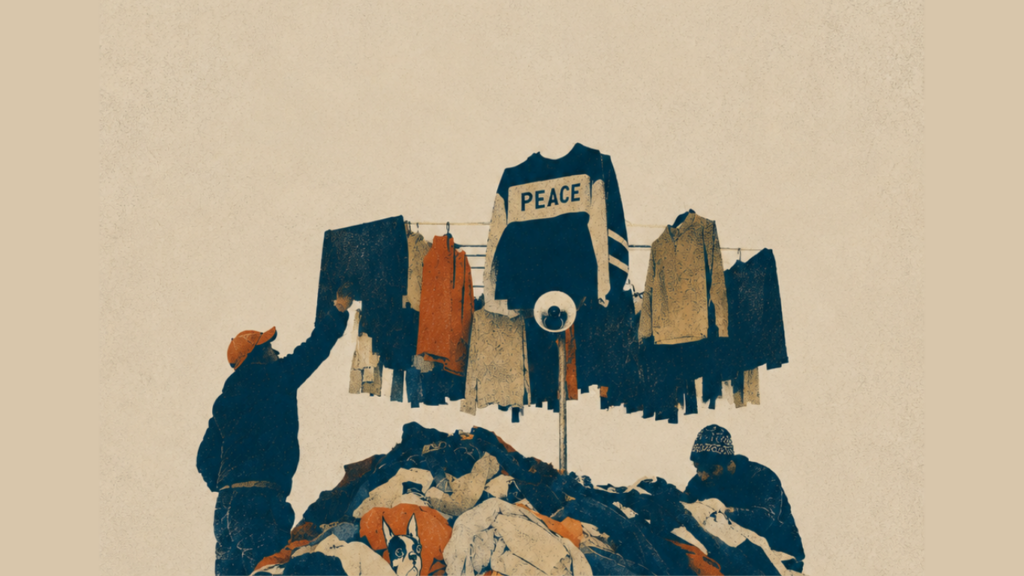
This is how “Umm Hossam”, a housewife and mother of three children, begins her conversation with Zawia3, in front of one of the wooden tables piled with second-hand clothes, as she turns the pieces over carefully and examines their fabric.
The woman’s words sum up a new economic reality, in which some families sell their old clothes to obtain cash that enables them to buy other second-hand clothes, in an attempt to preserve the bare minimum of their needs.
Rates of inflation are no longer merely figures that appear in official data; they have become a reality reflected in the details of daily life, amid expectations that the annual inflation rate in July would reach 15.6%, after it had stood at 14.3%.
Buying new clothes has thus turned into a burden that consumes a large part of household income, with the rising costs of food, electricity, housing and transport, and clothing has therefore become one of the first items to be cut back or for which cheaper alternatives are sought.
Spending linked to the desire to keep up with fashion or to buy for the sake of change has also declined, and its place has been taken by what could be called the “value-recovery economy“, as preserving the value of clothes and reselling them has become part of how limited-income households manage their spending.
Egyptians’ consumer behaviour is changing under the impact of inflation: a study indicates that successive price rises have pushed citizens to reduce their purchases and look for cheaper alternatives, as purchasing power has declined owing to the fall in the value of the pound. The middle class is the most affected by waves of inflation, which has pushed it to change its spending patterns and turn towards lower-priced goods to preserve the household budget.
Professor of sociology at Mansoura University Dr Marwa El-Sharkawy says that the effects of the recent waves of inflation have not been limited to the decline in purchasing power; they have reshaped the consumer behaviour of Egyptian households, especially the middle class, which has begun looking for cheaper alternatives after its real incomes eroded.
She adds that what is happening today reflects a shift in the nature of consumption, as households have moved from consumption based on choice to what could be described as “workaround consumption“, resorting to postponing the purchase of new clothes, repairing old clothes or turning to second-hand clothing markets as an alternative that meets basic needs at the lowest cost.
She points out that this behaviour can be explained in light of the “risk society” theory of the German sociologist Ulrich Beck, which posits that in times of prolonged crisis societies rearrange their priorities under the pressure of fear of the future and uncertainty, so that preserving basic needs becomes the primary goal, even if this requires abandoning consumption patterns that previously formed part of social status.
She notes that continuing economic pressures have also led to a decline in the social embarrassment associated with buying second-hand clothes, after the crisis came to affect a broad sector of society; turning to “bala” or reselling clothes is no longer seen as evidence of low social standing, but as a strategy for adapting to the rising cost of living.
As proof that a large segment of the population has lost its purchasing power, the Alternative Policy Solutions centre issued the “Chicken Index” to measure the purchasing power of Egyptians at large on the basis of chicken prices, since chicken is among the cheapest types of protein, particularly after Prime Minister Mostafa Madbouly announced the raising of the minimum wage to EGP 8,000.
According to the index, the purchasing-power results showed that a worker earning the minimum wage became able to buy about 84.8 kilograms of chicken in 2026, and that he needs more than two hours of work to buy a single kilogram of chicken at the retail price, a longer period than in many countries. According to the index, had purchasing power risen at the same rate as the growth of the minimum wage, the minimum wage would have reached about EGP 19,000.
Beyond Egypt’s Growth Figures: Are Egyptians Getting Decent Jobs?
Wekalet El-Balah… New Customers and a Different Market
At the stall of one of the second-hand clothes sellers in Wekalet El-Balah, the stall’s owner, “Gouda”, says: “The nature of the customers has changed a lot. In the past, people on limited incomes used to come to us, but today we see employees of government bodies, teachers and families whose financial circumstances appear good.”
He adds to Zawia3 that turnout has become greater than in previous years, but sales have become slower, because the prices of second-hand clothes themselves have risen.
“Gouda” is not talking about the prices of imported second-hand clothes, “bala”; he is referring to the clothes that he himself buys from Egyptians and sells to Egyptians as well.
Member of the Egyptian Society for Political Economy Dr Hazem Hassanein tells Zawia3 that the Egyptian street is witnessing a clear change in the social map of the second-hand clothing market, as buying such clothes no longer causes embarrassment among the middle class, but has come to be seen as a rational means of managing spending under the current economic conditions.
He adds that the fact that many households direct the largest part of their remaining budget to buying children’s clothes is due to children’s rapid growth and their constant need to change sizes, while fathers and mothers postpone buying their own personal needs.
Despite the increase in the rate of consumer spending in Egypt, reality attests to society’s division into upper groups that have the means to spend, facing a broad segment of the lower classes that cannot find enough to stave off hunger.
Data from the Ministry of Planning and Economic Development showed a decline in consumer spending in Egypt during the first quarter of 2026, to EGP 1.99 trillion, compared with EGP 2.12 trillion in the last quarter of 2025, a decrease of about EGP 131.1 billion, equivalent to 6.2% on a quarterly basis.
Professor of anthropology at Suez University Dr Gaballah Salman says that successive waves of inflation have not only raised prices but brought about a deep transformation in Egyptians’ consumer culture, after pushing households to rearrange their priorities, so that the functional dimension of a product has become more important than the brand or its symbolic value.
He explains to Zawia3 that the study he conducted reveals that turning to second-hand clothing markets has become one of the strategies for adapting to the erosion of purchasing power, as the indicator of turning to the second-hand market to buy clothes recorded more than 49% among members of the study sample, drawn from different social segments and not only the lowest-income groups.
He adds that the middle class has begun looking for the best balance between quality and price, so many have turned to buying second-hand clothes from international brands, or what are known as “stocks”, to obtain a suitable appearance at a lower cost. Budgets for children’s clothes have also shrunk, as some households have made do with buying one outfit for each child during the season, after they used to buy several outfits, while new clothes have become limited to special occasions and feasts.
From Popular Markets to Digital Platforms
The phenomenon of buying second-hand clothes is no longer limited to traditional markets; it extends to apps and social media platforms specialising in selling second-hand clothes.
Interior designer “Sara Abdullah” tells Zawia3: “I no longer sell my old clothes the way I used to in the past; instead, I cover part of one of the instalments from the proceeds of the sale, or I use them to buy the new season’s clothes. For many in the middle class, the apps have become a small market that helps them secure cash and cope with rising prices.”
“Hazem Hassanein” says that this behaviour reveals a shift in the function of reselling clothes: it is no longer a means of getting rid of unused pieces, but has become a tool for managing liquidity within the household and easing the impact of the decline in purchasing power.
A study indicates that the high waves of inflation that followed the “economic reform” of 2016 transformed household consumption, as clothing and footwear became among the goods whose purchase households can easily postpone or on which they can easily cut spending when real income declines, which was reflected in a fall in spending on clothing among the poor and middle classes and even the high-income classes, with a larger share of the budget directed to food and basic needs.
Professor of sociology at Damietta University Dr Riman Khaled says that the middle class was the most affected by the inflationary shifts, as economic pressures forced it to adopt new consumption patterns that help it reconcile a limited income with the desire to maintain a decent social appearance, and that households responsible for supporting children have become the ones most in search of these alternatives amid the rising cost of living.
She adds to Zawia3 that some higher-income groups have also resorted to rearranging their resources, taking advantage of apps and platforms for selling second-hand clothes to obtain cash or finance new purchases, which reflects a change in the methods of managing spending and not merely a change in purchasing preferences.
In explaining these shifts she draws on a number of social theories, explaining that the “presentation of self” theory of the sociologist Erving Goffman explains individuals’ efforts to maintain an acceptable social image despite economic pressures.
She notes that the economic crisis has changed the philosophy of consumption within society: buying second-hand clothes is no longer seen as behaviour associated with poverty, but has become a rational strategy adopted by broad sectors of the middle class to preserve their purchasing power amid continuing economic pressures.
For his part, “Gaballah Salman” points out that the economic crisis has contributed to “breaking the social embarrassment” associated with buying second-hand clothes, as searching for the cheapest option has come to be seen as rational behaviour in managing resources, not a sign of poverty, pointing to the emergence of what he describes as a “culture of concealment”.
“Salman” points out that consumption in Egypt is no longer based on freedom of choice but has become governed by economic necessity, as price has turned into the most influential factor in the purchasing decision, noting that the trend towards buying second-hand clothes has no relation to different educational levels, since the phenomenon has become more widespread within society.
He explains that higher-income groups still seek to maintain their social appearance, but have come to rely on more flexible strategies, such as reusing clothes, repairing them or selling some of them to obtain cash, which helps them maintain their lifestyle without excessive spending.
In the end, behind every second-hand piece lies the story of a family trying to adapt to a harsher economic reality, to obtain cash or ease the burden of living, as high prices have reshaped Egyptians’ priorities, and clothes have turned from a consumer good into a tool for managing the household budget and preserving the minimum of a dignified life.
“Umm Hossam” leaves Wekalet El-Balah carrying a plastic bag containing two outfits for her children, after managing to bring the price down by a few pounds. She smiles a smile overcome by exhaustion and thanks God, saying: “The clothes that don’t fit Hossam will be used by his younger brother, and the most important thing is that we will get through the summer at the lowest cost.”