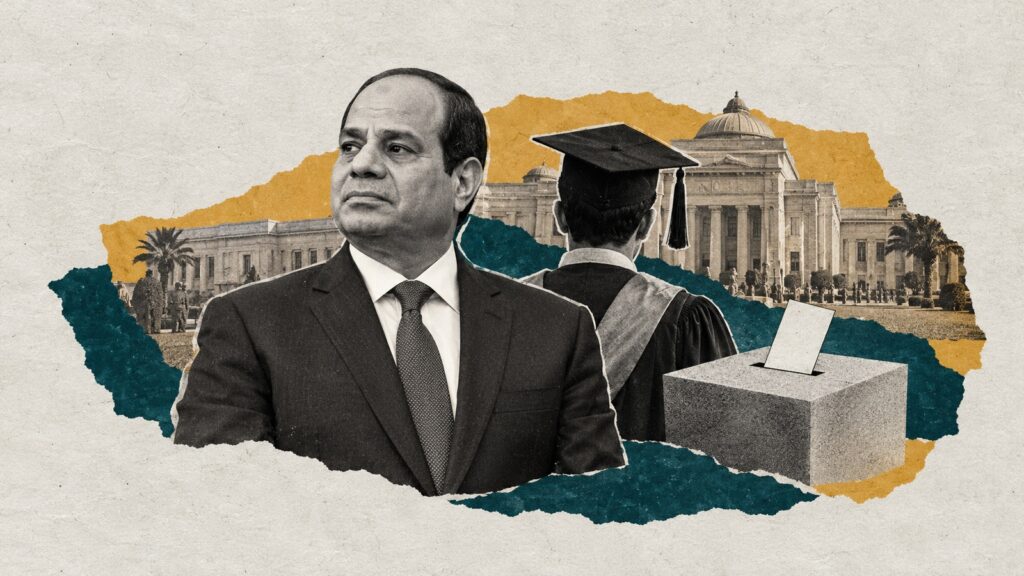

At a graduation ceremony at the military academy in the New Administrative Capital on Saturday, 17 October 2026, President Abdel Fattah al-Sisi proposed a programme to train PhD holders aged between forty and fifty inside the academy for thirty months, allowing Egyptians to choose a president from among them after his term ends in 2030, an outcome he described as “completely settled”.
Would completing the programme become a condition for standing for election? The president made both statements. On the one hand, he said: “We will not prevent anyone, but from this group you might choose those who assume responsibility in the Egyptian state,” and: “This elite that joins will give the Egyptian people an opportunity to elect and choose from among them.” On the other, he spoke of a committee drafting “a law regulating the election of those who meet the conditions I am talking about”, said: “We should not hand it to just anyone; not anyone who says a few well-arranged words should step forward to lead the Egyptian state,” and referred to “this condition”, from which “anyone who has served in a ministry for six years or more” would be exempt, according to the full transcript published by Youm7.
The controversy turns on the gap between these statements. Parties in the parliamentary majority welcomed the proposal that same day. MP Salah Fawzi, a professor of constitutional law, believes the training “could be introduced as a condition through a new law”, provided it does not conflict with the constitution. Three politicians, however, tell Zawia3 that making the programme mandatory would clash with Articles 141 and 142 of the constitution and open the country’s highest office to legal challenges.
What exactly did the president say?
The proposal came in the president’s Saturday morning address at the graduation of new cohorts from the Egyptian Military Academy and military colleges in 2026. He said there were “approximately forty-three months from now, God willing, until 2030”, and spoke of “thirty months of preparation for PhD holders, whether from reputable Egyptian universities or reputable foreign universities”. He said he was announcing it “more than forty months before the end of the term so that no one can make accusations and say he is grooming someone, his family or relatives”.
The president outlined the programme as follows: “An integrated mechanism whose preparation will be overseen by the speaker of the Egyptian parliament, alongside a group of trusted thinkers and politicians, as well as the minister of higher education and the minister of justice, so that a law is drafted regulating the election of those who meet the conditions I am talking about: 200, 300, 500 or 1,000 people. They will spend thirty months here at the academy, learning what a state is, what its resources and capabilities are, and how to preserve them.” He added that there would be “admission tests” for people aged “forty to fifty”, that the programme would involve “more than 7,500 hours”, and that “whatever it costs, the armed forces will bear the expense”.
The president estimated the cost himself: “Whether there are 400, 500 or 600, and each person costs three, four or five million a year, we will pay.” Zawia3 calculates an annual bill ranging from EGP 1.2 billion (about $24.8 million), for 400 trainees at EGP 3 million each, to EGP 3 billion (about $62.1 million), for 600 trainees at EGP 5 million each. That would mean between EGP 3 billion and EGP 7.5 billion ($62 million to $155 million) over the thirty months, at an exchange rate of EGP 48.30 to the dollar.
The programme is not confined to the presidency. The president said: “I need your support in preparing people to lead the state, not only in the presidency, but across all specialisms: ministers and deputies in the various ministries, governors and deputies in the governorates, and in important and vital institutions. We cannot say we will bring someone in to experiment and learn on the job. That is unacceptable, even in ministries.” He then made an exception: “I imagine that anyone who has served in a ministry for six years or more would be exempt from this condition. Someone who has worked in ministries for six years or more has gained experience that qualifies them to take responsibility for a state, another ministry, or even the premiership.”
He concluded: “Egypt is not incapable of producing someone a hundred times better than me,” and: “Under the constitutional provision I have just read, no malicious person, traitor or criminal will assume responsibility.”
A constitutional provision from 2019, not 2014
The president based his proposal on a constitutional provision he read to the audience, stating that “the armed forces belong to the people; their duty is to protect the country, preserve its security and territorial integrity, safeguard the constitution and democracy, preserve the basic foundations and structure of the state, the people’s gains, and individuals’ rights and freedoms”. He said: “When we came to draw up the constitution in 2014, I insisted that a paragraph be included. There was discussion in the constitution-drafting committee about that particular paragraph, and I told them: no, this paragraph must be there, so that the armed forces, a trusted national institution, are responsible for the capabilities of this state and for preventing violations of the constitution or democracy.”
However, the phrase “safeguard the constitution and democracy” did not appear in the original wording of Article 200 of the 2014 constitution, which referred only to “protecting the country and preserving its security and territorial integrity”. It was added through the constitutional amendments approved in the April 2019 referendum. Those same amendments extended presidential terms from four years to six and enabled the president to run for a third term ending in 2030, under the amended Article 140.
On that term, the president said he had spoken days earlier at the Police Academy and at the armed forces’ educational symposium marking the anniversary of the October War: “I said that the Egyptian constitution would not be touched. While we were at the Police Academy, two media figures whom I value, Nashat al-Dehi and Mostafa Bakry, spoke to me. They said: ‘What happens next? Are you reassured that this is the right step?’ I told them: ‘Yes, this is the right step, and 2030 will mark the end of my presidency of the state, if I live that long. This is completely settled and will not be discussed.’” This followed weeks of social media reports about a possible constitutional amendment in 2027 that would allow him another term, according to Al Jazeera. It also followed calls documented by Zawia3 in an earlier report from figures close to the authorities, including Free Egyptians Party leader and senator Essam Khalil, for a new constitution.
A requirement or an option? What the constitution and the law say
Article 141 of the constitution sets out the conditions for presidential candidacy: candidates must be Egyptian, born to Egyptian parents; neither they, either parent nor their spouse may have held another country’s nationality; they must enjoy their civil and political rights; they must have completed military service or been legally exempted; and they must be at least forty when nominations open. It then leaves “other conditions for candidacy” to legislation. Article 142 requires candidates to obtain endorsements from at least twenty MPs or support from 25,000 citizens in at least fifteen governorates, with a minimum of 1,000 supporters in each.
Legislators used that referral in Presidential Elections Law No. 22 of 2014, adding two requirements: a higher education qualification, and the absence of any physical or mental illness affecting the performance of presidential duties. MP Salah Fawzi, a constitutional law professor and member of the House of Representatives’ legislative committee, explained this in an interview with Al-Shorouk on Sunday.
Fawzi believes academy training “could be introduced as a condition through a new law, provided this occurs within a framework that does not conflict with existing constitutional provisions”. He explained that a bill could be submitted by the president, the cabinet or at least sixty MPs, then referred directly to the relevant committee to assess its constitutionality before it is put before a plenary session.
By contrast, former MP Talaat Khalil tells Zawia3 that Articles 141 and 142 “conclusively determined the conditions and rules for running for president. When the constitution referred to legislation to add other conditions, the established constitutional principle requires that the additional legal provisions do not conflict with or contradict the principal conditions set out in the constitutional document itself.” He adds that the constitution set forty as a minimum age without an upper limit, and that introducing a maximum age through legislation “could raise concerns of conflict with the constitution”.
There is a judicial precedent for this debate: on 14 June 2012, the Supreme Constitutional Court ruled unconstitutional the “political exclusion” law passed by the People’s Assembly to prevent leading figures from the Mubarak regime from running for office. Ahmed Shafik therefore remained in the presidential race, according to Al Jazeera.
Parties: “A continuation of the 3 July address”
In the hours after the speech, parties in the majority declared their support. The Mostaqbal Watan Party, which holds the parliamentary majority, said the initiative would develop the mechanisms of state administration “through precise scientific criteria that prevent randomness and favouritism”. The Free Egyptians Party described the address as “a historic milestone complementing the 3 July 2013 speech”, arguing that qualification requirements delivered through “a disciplined institution such as the military academy” would close loopholes against “attempts to drag the country into the unknown or chaos”. The Homeland Protectors Party praised the decision to entrust the academy with the training as “an investment in human development and in preparing national elites aware of the scale of regional threats and challenges”.
The welcome extended to parties regarded as part of the parliamentary opposition, although it focused on the 2030 announcement rather than the programme. The political bureau of the Justice Party sent a message thanking the president for his commitment to ending his term on schedule, while simultaneously instructing its parliamentary bloc to “respond swiftly” to the request for authorisation concerning regional defence. The Awareness Party called for a consultative meeting between the presidency and political parties “to develop frameworks for coordinating the post-2030 phase”.
Inside parliament, MP Ayman Mohasseb said involving the military academy in training state leaders “does not conflict with the civilian character” of the state, but instead strengthens “concepts of discipline and national security among future decision-makers”.
Al-Bayadi: Legitimacy comes from voters, not the academy
MP Freddy al-Bayadi of the Egyptian Social Democratic Party believes developing capable leaders “is necessary”, but objects to turning training programmes into a mandatory condition for candidacy, or giving any state body the power to decide who is fit to compete. He tells Zawia3 that such programmes “can be discussed if they remain optional and accessible under fair and transparent criteria, but become unacceptable if they turn into a tool for restricting the right to stand for election or excluding competitors”.
Al-Bayadi adds that a president’s legitimacy “derives from citizens’ choice”, and that candidates should be assessed on their programmes, experience and ability to win voters’ trust, “not on particular academic qualifications”. A PhD, “despite its scholarly value, is not in itself a measure of competence in running the state”. In his view, preparing political leaders begins with opening up public life, strengthening political parties, ensuring freedom of access to the media and holding competitive elections, “while respecting the military institution’s role and responsibilities”.
Khalil: “Whose interests does this confusion serve?”
Talaat Khalil rejects requiring a PhD or completion of a military academy programme to contest elections. He argues that this “imposes unconstitutional restrictions on the right to stand for election and opens the door to challenges to the constitutionality of the rules governing the electoral process, with implications for the legitimacy of competition for the presidency”. It also creates “unjustified” discrimination between citizens who wish to stand, contrary to the principles of equality and equal opportunity.
Khalil asks: “Whose interests are served by creating this confusion and exposing the highest and most important office in the Egyptian state to doubts about constitutionality and to court challenges?” He believes the challenge goes beyond the soundness of procedures to “allowing space for political competition and the peaceful transfer of power”. He says: “Egypt needs to move genuinely towards the peaceful transfer of power, away from policies of twisting facts or manufacturing tailor-made candidates. This is a path that is neither welcomed nor nationally acceptable.”
Al-Adl: “The people do not need assessment committees”
Shadi al-Adl, leader of the Egyptian Liberal Party, believes the president’s announcement that the constitution will not be amended “is neither a favour nor a gift deserving excessive celebration. Following the 2019 amendments, the constitutional text already gave the president an extended period totalling sixteen years rather than eight under the original 2014 constitution. Observing the end date is therefore a binding constitutional obligation, and thanking a politician for performing his constitutional duty confuses the basic concepts of public life.”
Al-Adl tells Zawia3 that “the Egyptian people, who took to the streets of their own free will and brought about change when they saw things going wrong, do not need assessment committees to decide who is fit to govern them”. He says “requiring candidates to pass through an academy affiliated with state institutions destroys the principle of equal opportunity, gives one party an unfair advantage that entrenches appointment rather than election, and creates different classes of citizens in violation of constitutional principles”. He adds: “If the aim is protection against those who cannot be trusted with the state, where are the state bodies responsible for oversight and investigation under the strict candidacy criteria the constitution already establishes? Great political figures are not measured by titles. Egypt’s history is full of people who led political and popular movements without doctorates, while other experiences in government have shown that a higher qualification alone does not guarantee competence in running the state.”
Al-Adl criticises parliament’s rapid response to presidential signals: “It is unacceptable for any passing signal or statement by the president to become swift decisions and authorisations passed within hours, without allowing specialised committees, such as the Defence and National Security Committee, or the National Defence Council, to perform their constitutional roles.” He is referring to the president’s request, in the same speech, for authorisation to take “any measure” to protect Saudi Arabia should it request that. The House of Representatives convened an emergency closed session at noon on Sunday to consider that request, hours after a National Defence Council meeting chaired by the president that morning, under Article 152 of the constitution, which requires a two-thirds majority to send forces on combat missions abroad. Parliament had granted the president similar authorisation in a closed session on 20 July 2020 concerning the western strategic direction, Libya, according to Al-Watan.
Al-Adl believes Egyptians “are living through extremely complex and difficult economic circumstances, yet they endure out of fear for their country and concern for its stability, not because they are satisfied with economic or administrative performance”. This people, he says, “deserves political leadership that respects its awareness, unleashes its energies and gives it the right to choose its president with complete integrity and freedom in 2030, away from any tutelary frameworks that take us back decades”.
The National Academy precedent: Why the military this time?
This is not the first time the presidency has proposed a leadership training programme. The Presidential Leadership Programme was launched in September 2015, after which the president established the National Training Academy by Presidential Decree No. 434 of 2017 to run it. In the July 2024 government appointments, eighteen academy graduates took executive posts, including Beheira governor Jacqueline Azer and Beni Suef governor Mohamed Hani, according to Al-Watan.
The new proposal differs in three respects: its implementing body is a military rather than a civilian academy; it targets the presidency rather than intermediate executive posts; and its framework is being established by law rather than administrative decision. The pool from which participants would be selected is inherently narrow. Egyptian universities awarded 122,000 postgraduate qualifications across all levels, diplomas, master’s degrees and doctorates, in 2022. PhD students accounted for only 14.8 percent of the total 210,500 postgraduate students, according to data from the Central Agency for Public Mobilization and Statistics, or approximately 31,000 students by Zawia3’s calculations. The state does not publish a figure for PhD holders aged between forty and fifty.
What happens next?
The first step is to form the committee overseen by the speaker of the House of Representatives, followed by a bill taking one of the three routes identified by Salah Fawzi. The timetable is tight: of the forty-three months remaining until 2030, according to the president’s own calculation, the programme would take thirty. That leaves only around one year to draft and pass the law, form the committee and hold admission tests, by Zawia3’s calculations, if the first cohort is to graduate before the elections due at the end of the current term in April 2030.
Those elections will take place against the backdrop of December 2023, when the president won a third term with 89.6 percent of valid votes against three candidates, Hazem Omar, Farid Zahran and Abdel Sanad Yamama, according to the result announced by the National Election Authority and published by Youm7. Potential candidate Ahmed Tantawi, meanwhile, was unable to obtain the 25,000 endorsements required by Article 142, in a contest whose details Zawia3 documented.
The question will be settled by the law’s wording, not the speech: will the military academy remain an optional route that adds names to the race, as “we will not prevent anyone” suggests, or become its only gateway, as suggested by “a law regulating the election of those who meet the conditions”? The distance between those two statements is what the committee will traverse in the coming months.