On 10 September, the Central Administration for Teachers’ Affairs announced that 43,400 applicants had passed the fifth round of the ‘30,000 Teachers’ recruitment competition and would take up posts in primary schools. This came eight months after Prime Minister Mostafa Madbouly approved the start of procedures to appoint 72,000 teachers in a single intake. (Source 1; Source 2; Source 3)
The difference between the two figures is 28,600 jobs, according to Zawia3’s calculations. In a statement issued on 13 September, the Egyptian Initiative for Personal Rights (EIPR) described these as ‘around 29,000 positions excluded from the appointments list’. It suggested that those who would have filled them were excluded under a criterion called ‘specific weight’, applied with a new minimum score despite their having passed the Central Agency for Organization and Administration’s examinations. Over the following five weeks, at least eight parliamentarians submitted briefing requests questioning the basis of this criterion and when it was adopted, without a single public statement from the body applying it. (Source)
What goes into the score?
‘Specific weight’, as defined by EIPR, does not mean body weight. It is an assistant-teacher applicant’s overall score out of 100, assigned by the Military Academy’s examination committee on the basis of their average academic grade, medical examination, physical fitness test and assessment interview. Teachers reported, according to the same statement, that the minimum passing score in the fifth intake had become 71. Meanwhile, Senator Ayman al-Safti told Nevine Mansour’s television programme ‘From the Beginning’ that the same criterion had been applied in the previous four rounds with a threshold of 65%, and that no one had explained why it was raised. (Source 1; Source 2)
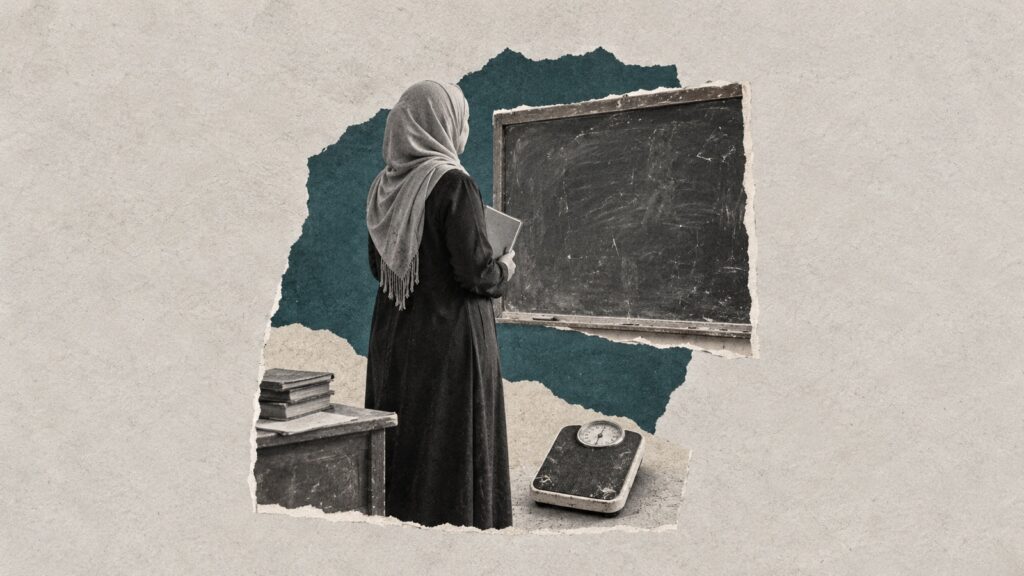
Body weight nevertheless enters the same assessment through the interview stage. According to EIPR, the new requirement is that applicants must not exceed their ‘ideal weight’ by more than five kilograms, whereas previous intakes allowed up to 20 kilograms above it. This is documented in the examination instructions published by EIPR in its report ‘On the Scales of Discrimination’, released last February. A new fee of EGP 1,008, approximately $21, was also introduced for the Academy’s medical examination, which had previously been free. (Source)
One point
Sabreen Ibrahim, a social studies teacher from Fayoum, tells Zawia3 that she passed every examination, from the academic assessment to the medical, physical fitness and interview stages, only to fall short of the overall threshold by one point: ‘My specific-weight score is 70, and the threshold was raised to 71. This is the first time this has happened. Previous intakes passed with 65 and 61.’
Mona al-Sayed, a mathematics teacher who has taught for 11 years, recounted her experience in two posts on her own page. She took the Central Agency’s examinations in the New Administrative Capital less than two weeks after giving birth, attended pedagogical training carrying her baby, who was not yet six months old, and paid EGP 1,008 for the medical examination that had been free for earlier applicants. Her weight had risen from 52 kilograms before pregnancy to 83 afterwards. While breastfeeding, she followed a severe diet for five months until she reached 58 kilograms at the medical examination, which allowed 10 kilograms above ideal weight. She then scored 10 out of 40 in running, jumping and zigzag exercises. At the assessment interview, she learned that the limit was 57 kilograms and that every kilogram above 52 cost her a point. She reduced her weight to 55, only to be shocked by her rejection after all of this. (Source 1; Source 2)
EIPR describes this pattern as a direct consequence of the new condition: rapid weight-loss diets cause anaemia in some applicants, who are then excluded at the medical examination because of what they did to pass the assessment interview. Pages representing rejected applicants circulated collective and individual appeals calling for an investigation into their files and disclosure of the legal and technical grounds for their exclusion. Others demanded changes to the weight requirement. The official response, according to Al-Watan, was that medical and physical fitness assessments are conducted by bodies for which the Ministry of Education is not responsible. (Source 1; Source 2; Source 3; Source 4)
Three bodies, no answer
According to EIPR’s documentation, an applicant passes through three successive bodies: the Central Agency for Organization and Administration, which administers electronic, subject-specialist and pedagogical examinations and announces the conditions; the Ministry of Education, which handles pedagogical training; and the Military Academy, which conducts medical examinations, physical fitness tests and assessment interviews in the presence of military commanders and representatives of the ministry and the agency. The Academy was not mentioned in the first competition announcement, published by the agency on 2 July 2022. According to the same report, those who passed its examinations were surprised to receive messages instructing them to attend additional tests at the Academy. (Source)
Education expert Refaat Fayyad tells Zawia3 that, since the presidential initiative to recruit 150,000 teachers was launched in 2022, selecting candidates has no longer been the Education Ministry’s responsibility. Instead, it is handled by the Central Agency for Organization and Administration and the Military Academy, while the ministry ‘is only informed of the number suitable for appointment’. He regards selecting teachers solely on competence as an older approach, dating from the period when education-faculty graduates were assigned jobs on the basis of their qualifications without consideration of health, fitness or appearance. Today, he says, the state’s approach to public employment is to ensure applicants are fit for their positions and capable of performing them. He adds that previous rounds excluded pregnant and overweight applicants ‘because they could not fully perform their duties, and because pregnant women take long periods of leave’.
This is precisely the explanation EIPR has challenged since 2023. It argues that excluding pregnant women, women who have recently given birth and overweight applicants violates Articles 9, 11, 12 and 53 of the Constitution, which require the state to guarantee equal opportunities and prevent discrimination. Civil Service Law No. 81 of 2016 requires medical fitness for employment to be certified by the competent medical council. Applicants already obtain that certificate at Health Ministry hospitals before the Academy’s examinations are added to the process.
The ministry’s position today is no different from what it said in October 2023: the competition follows its governing rules and law; the ministry’s remit is limited to evaluating teachers’ technical abilities, while the ‘competent bodies’ conduct physical and mental fitness assessments. On 7 September, three days before the results were announced, the Central Administration for Teachers’ Affairs merely said that appeals against the fitness test would be possible after the results, without identifying an authority or a deadline. Zawia3 contacted Shady Zalta, spokesperson for the Ministry of Education and Technical Education, but received no response by publication. Neither the Central Agency for Organization and Administration nor the Military Academy had publicly commented on raising the threshold to 71 at the time of writing. (Source 1; Source 2)
Eight parliamentarians, one question
The question reached Parliament two weeks after the results. On 27 September, al-Safti said that excluding around 30,000 applicants was inconsistent with the purpose of a competition originally announced to address a teacher shortage. If budget constraints were the reason, he said, they did not justify exclusions after the prime minister had announced plans to recruit 72,000 teachers in coordination with the finance minister to secure their salaries. On 1 October, MP Yasser Arafa submitted a briefing request to the prime minister, education minister and head of the Central Agency for Organization and Administration about the selection criteria, the basis of the 71% threshold and the position of applicants who had passed advanced stages. On 5 October, Nour Party MP Mahmoud Rashad Habib requested a review of the percentage, its reduction to the level used in previous rounds, and the placement of excluded candidates on waiting lists rather than requiring them to apply again. (Source 1; Source 2; Source 3; Source 4; Source 5)
On 7 October, MP Mohamed Sami Shahda asked about the legal basis of ‘specific weight’, the authority that approved it, the date of approval and whether it had been announced before the examinations. He demanded publication of applicant and pass numbers at every stage and an appeals process allowing each rejected candidate to see their scores and ranking. MP Mohamed Abdallah Zein al-Din requested an impartial investigation into the distribution of successful applicants across Beheira governorate’s education districts. On 13 October, Yasser al-Hodeiby, deputy chair of the Human Rights Committee, Mohamed Abdel Alim Dawoud and Bassam al-Sawwaf submitted three requests asking how the criterion was calculated, when it was applied and how many applicants reached the interview stage before being rejected. In televised remarks, Sanaa al-Saeed, a member of the Education and Scientific Research Committee, also suggested that the budget might be one factor determining the number accepted. She said the criteria should have been set beforehand in line with the target number, rather than admitting large numbers and introducing additional criteria at the final stages to reduce them. (Source 1; Source 2; Source 3)
The 2023 precedent: From exclusion to detention
This is not the first time. Around 110,000 people applied for the first competition announced by the Central Agency in July 2022. Of these, 28,170 passed its examinations and the medical check, and 27,853 registered for the Military Academy’s tests. Yet the ministry appointed only 15,902 under Ministerial Decision No. 190, issued by then-minister Reda Hegazy on 4 October 2023, excluding 11,951, according to EIPR’s report. Parliamentarians accused the government of lacking seriousness about recruiting the required number and submitted briefing requests over the exclusion of applicants who had passed examinations and borne the hardship and cost of travel. (Source 1; Source 2; Source 3; Source 4)
On 15 October 2023, dozens of successful applicants demonstrated outside the ministry’s headquarters in the New Administrative Capital, objecting to the appointment of some candidates but not others. Fourteen were arrested and remained in pretrial detention until their release in February 2024, according to EIPR. In December 2023, EIPR brought challenges before the State Council’s Administrative Court on behalf of 106 rejected applicants, 94 women and 12 men from 17 governorates. Fifty had been excluded because of weight, 28 because of pregnancy and 28 because of the medical examination. Zawia3 documented their stories in April 2024. The court referred the cases to the State Commissioners Authority in February 2024. In April, the authority recommended recognising the applicants’ entitlement to appointment and overturning the minister’s decision. However, the Administrative Court dismissed the cases in November 2024, stating only in its reasoning that ‘no contract may be concluded until the training specified by the Minister of Education and Technical Education has been passed, and only in accordance with the attached contract form’. It did not examine the constitutionality of exclusion on grounds of appearance or pregnancy. The Supreme Administrative Court subsequently rejected the appeal on the same grounds. (Source 1; Source 2; Source 3)
In its report, based on 34 interviews with excluded male and female teachers, EIPR concluded that the conditions published on the Central Agency’s website contained no discrimination. Yet applicants waited months after each stage without being told what came next, and the Academy’s examinations excluded them on grounds of weight without considering obesity in a country where poverty reached 34% in 2021/2022, according to unpublished Central Agency for Public Mobilization and Statistics data seen by Mada Masr. (Source)
A country where half of women live with obesity
The examinations make applicants bear the burden of national health statistics. According to World Obesity Federation data for 2022 cited in EIPR’s report, obesity prevalence in Egypt is 55.8% among women and 24.8% among men. A study titled ‘The Burden of Obesity in Egypt’, published in Frontiers in Public Health in August 2021 by researchers from Cairo, Alexandria and Menoufia universities and the Health Ministry, with researchers from Novo Nordisk, estimated from the 2019 ‘100 Million Healthy Lives’ survey that 39.82% of adults had obesity: 49.49% of women and 29.51% of men. In October 2023, Health Minister Khaled Abdel Ghaffar said that 40% of Egyptian adults had obesity, half of them women. In a competition where 94 of every 106 excluded applicants are women, the five-kilogram requirement means ruling out a large segment of female applicants before their files are even read. (Source 1; Source 2; Source 3)
Education expert Mohamed Khairy tells Zawia3 that using weight to select government employees is not new. The state addressed obesity through the ‘100 Million Healthy Lives’ initiative, he says, and President Abdel Fattah al-Sisi has previously spoken, in his account, about the need for appropriate body weights among public employees. Khairy says that while working in some Gulf countries he observed teaching applicants being rejected because of weight despite their competence. However, he believes these criteria should have been clearly announced before the competition began, rather than applied at its final stages. Permanent exclusion was not the only option: applicants could have been given time to meet the requirements instead of being sent back to per-lesson teaching and made to start from scratch. ‘Among those excluded are teachers with long experience and a strong standing among students and parents,’ he says.
A half-million shortfall and a budget at a quarter of the constitutional requirement
These examinations take place in a country whose minister acknowledges a teacher shortage exceeding half a million. Education Minister Mohamed Abdel Latif told Al-Nahar’s ‘Al-Soura’ programme in December 2025 that the shortfall had reached 469,000 teachers against a workforce of 830,000, after estimating it at more than 665,000 in October 2024. He said the ministry had addressed it by extending the school year and transferring pupils from overcrowded schools, rather than through recruitment. Last June, Zawia3 reported, citing a ministry source, that the number actually appointed from the competition’s launch through its fifth round did not exceed 60,000 to 62,000 of the targeted 150,000 teachers. (Source 1; Source 2; Source 3)
According to EIPR’s report, the break in recruitment predates the competition by decades. The system of assigning education-faculty graduates to teaching posts ended in 1997 under Prime Minister Kamal al-Ganzouri, on the grounds that budget allocations were unavailable. Subsequent governments resorted to competitions, per-lesson employment and volunteering. Recruitment across the entire government apparatus then stopped in 2014. Today, a per-lesson teacher receives EGP 50, about one dollar, per lesson, with a maximum of 24 lessons weekly. That means EGP 4,800 a month, approximately $99, in the best case, below the EGP 7,000 minimum wage.
The 2026/2027 fiscal-year budget allocated EGP 367.3 billion, approximately $7.6 billion, to education, compared with EGP 315.9 billion the previous year. Of this, EGP 251.3 billion was allocated to wages and employee compensation. Yet EIPR’s budget analysis shows that the 16.6% increase does not prevent education’s share of GDP from falling to 1.49%, a quarter of the constitutional obligation set by Articles 19 and 21 at 4% for pre-university education and 2% for higher education. The ministry has not stated in any announcement that the budget caused the reduction in appointments. Nevertheless, the first intake itself was shifted from the 2022/2023 budget to 2023/2024 because no allocations were available without Finance Ministry approval, according to Al-Quds Al-Arabi’s July 2023 reporting from Taha Abul Fadl, head of the Conservatives Party’s Education Committee. Article 22 of the Constitution, meanwhile, states that teachers are ‘the fundamental pillar of education’ and that the state guarantees the development of their skills and protection of their rights. (Source 1; Source 2; Source 3; Source 4)
Between the body that sets the score without announcing it, the ministry that is informed of the number rather than deciding it, and the Parliament whose questions go unanswered, Sabreen Ibrahim returns to Fayoum with 70 out of 100 to teach on a per-lesson basis in the very schools that need her. She awaits a sixth competition whose passing score, too, may be set after the examination.