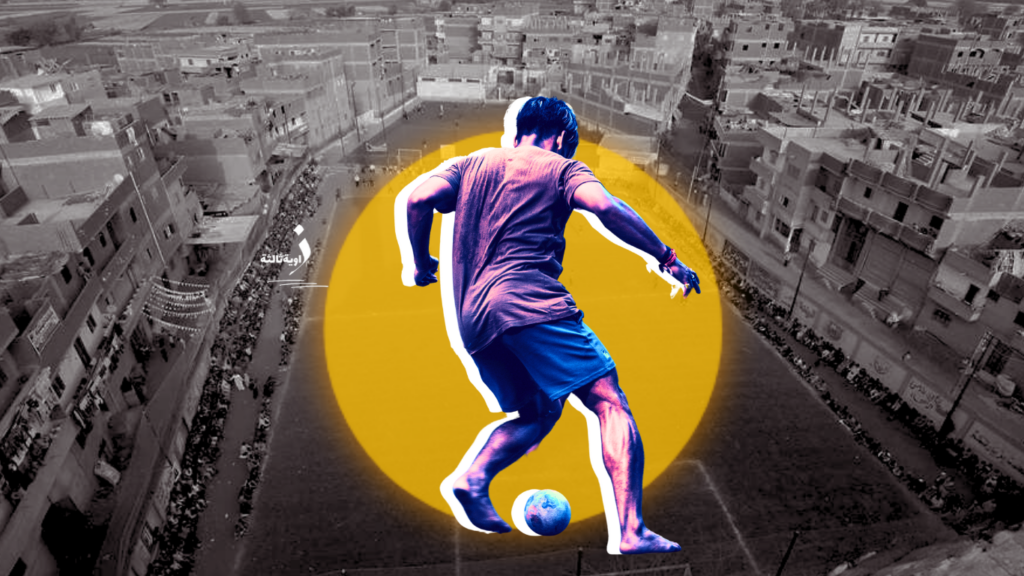
An overhead shot from above: the camera moves in a circular motion to cover all sides of the pitch. Below is a pitch whose ground is covered with dirt instead of grass, its edges marked with white lime, with some people in the middle preparing to put on a show, while spectators sit on the ground on all sides of the pitch, waiting for the event they came for.
Welcome: you are now at the opening of one of the Ramadan football tournaments in the village of Qashtoukh in Menoufia Governorate. We know this is not a new scene to you wherever you are; if you travelled the length and breadth of Egypt, you would probably find it repeated every year at the same time, specifically in the month of Ramadan.
The question now is: how did these Ramadan tournaments begin? And what is the secret of the momentum these tournaments carry, able to captivate such huge crowds of all kinds and cultures?
An Art from the Heart of the Street
When talking about Ramadan tournaments, and about football for Egyptians in general, we must begin with art, for art was and remains the basic nucleus of the components of human culture, simply because it gives people the ability to formulate their ideas and present them to the world.
Egyptians found nothing more fitting than football to consider the mother of the arts, and perhaps their only means of expressing themselves and creating a common language of dialogue among themselves on the one hand, and between them and the world on the other. For this very reason, the Ramadan tournaments came into being.
For more than five decades, these tournaments have been one of the most important features of the holy month. The whole story begins with a group of young people who wanted to create something to express themselves and to entertain themselves during the hours of fasting. Football was their first and last refuge, as it always has been, and the street from which we all spring was the most suitable place to host these competitions.
Ramadan tournaments began in the heart of Cairo’s streets and neighbourhoods, played without set rules, as each area set its rules as it saw fit, and without a set time, though usually during fasting hours. The competitions lasted until the end of Ramadan, and the format was determined according to what the participating teams agreed on. In the end there would inevitably be a winner, who would receive a symbolic prize, but one that held for them a value and magic equal to the World Cup.
These tournaments end with the end of Ramadan, leaving behind stories and tales on the lips of participants and followers that will occupy their conversations until the holy month returns the following year.
With the growing fame of these tournaments and their spread from Cairo and its suburbs to the rest of the villages and cities, more organisation was needed. Let us follow along.
More Organised
By 2000, with increasing construction of housing units, especially in densely populated working-class areas where the population grows day by day, the shrinking street was no longer a suitable place to hold Ramadan tournaments, and as the competitions grew in popularity they needed more organisation.
The solution to keep these tournaments going was to entrust them to organisers who set fixed rules for them in terms of match times, the venues where matches would be played, which were mostly youth centres, the entry fee each team would pay, the competition format up to the final, and the prizes the top finishers would receive.
Thanks to this popular organisation, Ramadan tournaments lived their golden age, becoming a precious opportunity for ordinary people to shine and appear before the eyes of club scouts, who travelled the country east and west searching for the hidden talents that fill Egypt’s streets.
From the Street to Politicisation
French political sociologist Jacques Lagroye believes that:
“Politicisation is a requalification of the most diverse social activities, resulting from a practical agreement among social actors who are inclined, for multiple reasons, to transgress or question the differentiation of spaces of activity”.
With popular consensus around the Ramadan tournaments, it was inevitable that politicians would find a way into them, and through them to the audience gathered around them, as happens with football in most countries.
Politicians, businessmen and political parties found ways into the Ramadan tournaments by all means: one sponsors a tournament and names it after himself, and so is present on the final day of the championship, hands out the prizes and takes the photo opportunity he will exploit one way or another, whether inside or outside the political arena.
The words of French sociologist Jacques Lagroye are confirmed in the differentiation and expansion of the purposes of social activities, in what he called the process of “diverting the purpose”, when we see political parties and candidates for the People’s Assembly or local councils organising their own Ramadan tournaments, played in their names.
But the question now is: did this benefit the Ramadan tournaments?
The Lights Dimmed
When football is linked to politics, it goes far beyond sport, to the point that it has come to be linked to the political and economic public life of certain countries, and this is not limited to shaping the political identity of fans’ public opinion.
This is precisely the reason behind the decline in the popularity of Ramadan tournaments over the last decade: with attempts to link them to politics, and with people’s aversion to political events recently, people turned away from Ramadan tournaments with that political flavour.
This is in addition to the decline in the quality of Egyptian football over the last decade: after these tournaments had been a golden opportunity for talent to emerge in working-class areas, clubs turned their attention to academy youngsters and sports talent programmes such as “Capitano Masr” and the like.
But before talking about lost talent, let us see how these tournaments, despite what they suffer, still reveal the state of Egyptian football.
A Full House
Despite everything that has befallen the Ramadan tournaments and the fading they have suffered recently, a scene like the one we presented at the beginning, of the Qashtoukh village tournament in Ramadan 2023, remains revealing of the state Egyptian football has reached.
The scene of a pitch surrounded by spectators on all sides has become a strange sight for Egyptian football, which is played behind closed doors except on rare occasions.
The momentum the opening video of the Qashtoukh tournament gained also reveals the fans’ thirst for football that resembles them, the football that used to be played in the street and export its talents to the biggest clubs, whose talent capital now comes from the children of employees and former players.
Ramadan Tournaments: “Capitano Masr” Is More Important
Have we gone on too long? We ask you to stay with us a little longer. We ask you to go to the “Google” search engine and search, for example, for the Egyptian Football Association’s interest in Ramadan tournaments.
Assuming you kindly went and searched, we know you are now frustrated by the search results; and assuming you did not, let us tell you that you will not find any result related to what we asked you to search for. It is a simple test through which you can learn what state Egyptian football has reached.
In the era before the dramatic development football has witnessed, these Ramadan tournaments and school tournaments were enough to produce competent players and send them to Premier League teams, who would later become the backbone of the national team in continental championships, and they served the purpose.
But with the development football has witnessed in the last two decades, and with countries such as Morocco, Senegal and others adopting scientific plans to produce youth players and professionals who form the core of their national teams, we had no choice but to take the same path, or at least preserve the resource that used to produce players for us in the past.
But the opposite happened: clubs turned their eyes away from these Ramadan tournaments, and instead of the Football Association strengthening these tournaments and giving them the necessary support, it turned to projects whose results no one has heard of, such as the “Thousand Professionals” project and the “Capitano Masr” programme.
Finally, Ramadan tournaments have represented something far beyond mere football competitions, and the proof is the welcome they still receive today, despite everything that has befallen them. We believe the state of Egyptian football will not return to what it once was unless officials and clubs look seriously again at these tournaments, which sprang from the heart of the street and are represented by its heroes, who were always the real heroes of football, far from the falseness of these days.