
Fans of singer Samo Zaen were surprised by the news that he had been barred from returning to Egypt, the country where his artistic career was linked to great successes and where he lived for 30 years.
Zaen expressed his shock at the decision in a statement he issued on social media, in which he confirmed that he was surprised to be barred while trying to return to Egypt after completing a concert tour abroad. He said: “Egypt is not just a country for me; it is my second home, from which I set out into the artistic world, and I cannot comprehend that I am barred from returning to it in this way.”
The decision sparked a wide wave of solidarity with Samo Zaen among his fans and colleagues in the artistic community, who called on the authorities to review the decision, and many artists pointed to the importance of taking into account the artist’s humanitarian and legal circumstances, especially since Egypt has always been a centre of artistic creativity and a magnet for talent from various countries.
The Syrian artist was not alone in this crisis, as reports have recently increased of tight restrictions being imposed on Syrians entering Egypt, especially Syrians coming to its territory from other countries, who now must obtain prior security approval in addition to an entry visa, ending the previous exemptions that allowed Syrians coming from the Gulf states, Europe and the United States to enter without additional complications.
This is in addition to the steep rise in residency fees and their renewal, from EGP 2,100 to EGP 7,000, as well as the recent deportation of a number of Syrians for links to groups affecting Egyptian national security, as the Egyptian government announced last September. These developments, which the authorities justify on grounds of public security and national security, shed light on the suffering of thousands of Syrians who have become stuck between strict legal requirements and increasingly difficult living conditions, in a country that was once a safe haven for them.
This prompted us at Zawia3 to look into what lies behind these decisions, their reasons and backgrounds, as they came directly after the fall of Bashar al-Assad’s regime in Syria; but it is the suffering Syrians now face and the confusion that accompanied these decisions that may need some remedies from the government.
Refugees in Egypt
Ammar*, the owner of a Syrian food shop in Giza governorate, came to Egypt with his family at the beginning of 2012 after the conflict in Syria intensified, and since then he has not seen his homeland: the area where he lived witnessed a major attack by the warring armed forces, and he was consequently forced to flee Syria to Egypt.
He tells us that he founded this shop specialising in Syrian food together with many of his relatives. Ammar explains that since coming to Egypt he has been keen to follow all the laws and to obtain licences and official papers for his and his family’s residency and for establishing his business, expressing his deep gratitude to Egypt and its people, which embraced him when his homeland became too narrow for him, as he put it.
He explains that he has not yet decided to return to Syria, especially as the Syrian situation is still unclear and matters regarding stability and calm have not yet become clear, adding that if the situation stabilises he will move regularly between Egypt and Syria if the laws and circumstances allow.
The Syrian citizen is reserved in commenting on the new procedures and laws adopted by the official authorities in Egypt regarding the restrictions imposed on returning to Syria or entering Egypt. He says: “Every country works to preserve its security and safety by taking the measures it deems appropriate, and that is its right,” hoping that the situation will calm down in all Arab countries, and that he will return to his homeland, Syria, with his family after it becomes better than it was.
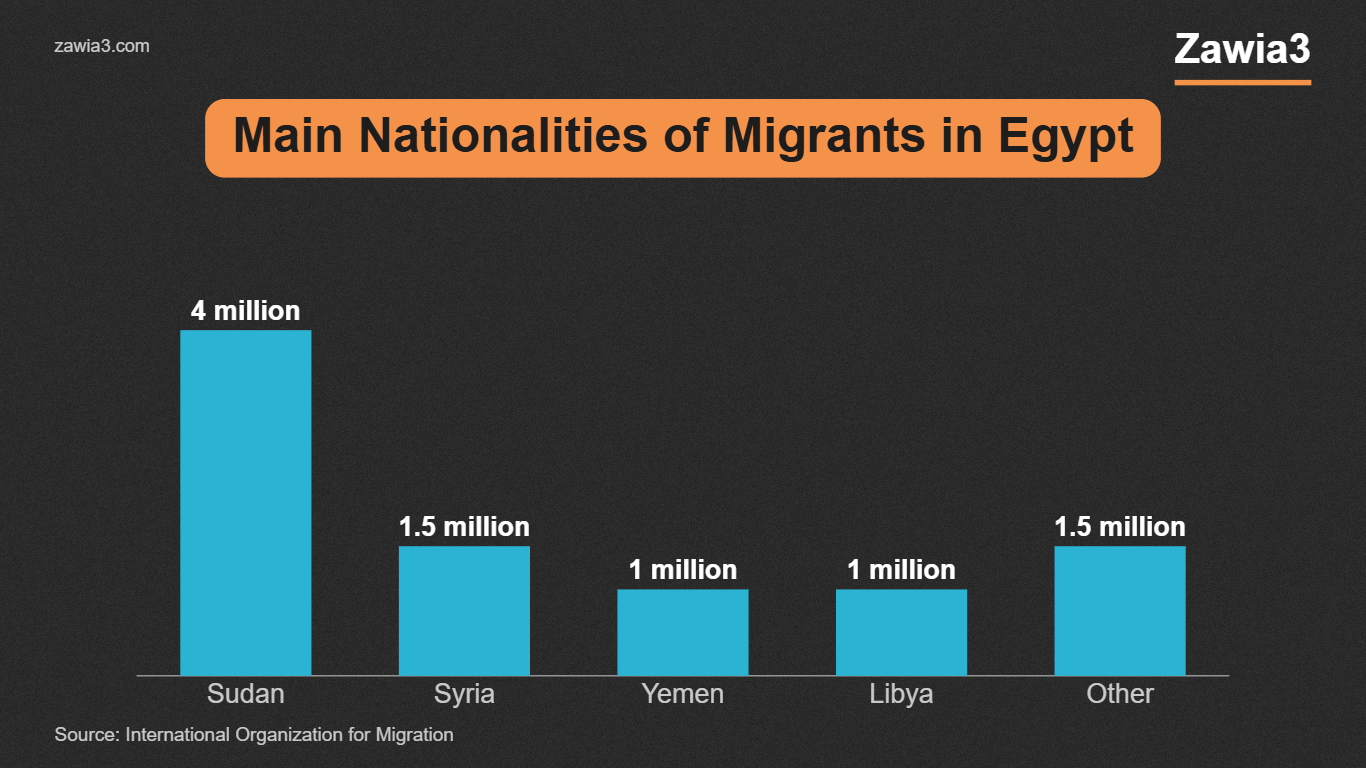
The International Organization for Migration announced that the current number of international migrants residing in Egypt has reached nine million migrants and refugees. Khairat Barakat, head of the Central Agency for Public Mobilization and Statistics, revealed that official figures on the number of refugees in Egypt indicate the presence of about nine million people on Egyptian territory, including four million Sudanese citizens, followed by 1.5 million Syrian citizens, according to the latest count before the recent Sudanese crisis, which is equivalent to the population of three to four European countries.
There are no comprehensive official statistics on the number of refugees residing in Egypt, as most of them live and work outside formal systems, but local estimates indicate that the figures may have reached 12 million refugees or more, and may even exceed that, driven by the many crises, conflicts and regional disputes witnessed by a number of countries in the region neighbouring Egypt.
The head of the statistics agency added, on the sidelines of the conference launching the diagnostic study on mechanisms for collecting labour migration data in Egypt, that the number is likely to increase by about two million additional refugees after the Sudanese crisis, stressing that the growing number of refugees puts pressure on the Egyptian economy in terms of demand for goods and services, in addition to its effects on the Egyptian labour market.
After President Abdel Fattah al-Sisi ratified the law on the asylum of foreigners, the UN Committee on the Protection of the Rights of All Migrant Workers expressed concern about Egypt’s delay in adopting labour laws relating to migrants and the lack of legal guarantees for entry, residence and work permits, while it praised Egypt’s efforts to combat human trafficking and to strengthen accountability for acts of violence against migrants.
The committee called on Egypt to improve its legislation to comply with the international convention and to clarify the legal framework for migrant workers and their families. It also expressed concern about what it said was a rise in cases of arbitrary arrests of migrants and collective expulsions after the issuing of the new residency regulations in 2023, and urged Egypt to prevent them, to guarantee due process and to investigate them.
Syrians reside in Egypt on a temporary tourist visa, as refugees, as students or with a work permit. Holders of a tourist visa and refugees cannot open a bank account or obtain a mobile phone number, while those who wish to obtain a work permit face complex security and administrative procedures.
The Suffering of Syrians after the New Decisions
Ahmed*, a Syrian national, says: “I have lived in Egypt, in the October area, for five years, and I work as a ‘worker’ in a small clothes shop. Since the new residency decisions began to be applied, life has become more complicated. When renewing my residency, I was surprised by the fees rising to figures I cannot afford, and I can no longer work freely as before because the authorities have started demanding additional permits; even the shop I work in has come under pressure to regularise its status. This made me feel that these measures are weighing us down and making us live under constant pressure, especially as we are still afraid to return to our beloved homeland, Syria. We hope the Egyptian authorities will reconsider for our sake.”
Doctor Rawan, who now works as a secretary at a clinic in Giza after coming from Syria without papers allowing her to work in her profession, tells Zawia3 of her suffering: she was looking for a suitable school for her children and was surprised that some schools now require recent residency papers for admission, which is difficult for them, as she put it, because of the high fees and the new complications.
She explains: “I tried to obtain residency, but the procedures have become longer and harder, and require a great deal of time and effort. I am worried about my children’s future here, because everything has become complicated, from residency to education and even treatment in hospitals, especially diabetes medicines, which have become hard to obtain after UNHCR stopped receiving them from one of the companies and ended its dealings with it, not to mention the shortage of medicines, which has become something terrifying in Egypt.”
In his testimony, Samer, owner of a Syrian restaurant who lives in Al-Hosary in October, recounts his attempts to return to Syria after the recent events. He says: “I started thinking seriously about leaving Egypt because of the growing difficulties, but when I went to ask about the procedures required for travel, I learned that any Syrian who wants to leave must first settle all the fines owed by him, whether because of residency or any violations related to trade or work, and must go back to the Passports, Immigration and Nationality Administration in Abbasiya to settle all dues before being allowed to travel from the airport. If that does not happen, he cannot leave Egypt, which means more time, money and procedures, something that further complicates matters.
This has contributed to the spread of intermediary companies that make it easier for Syrians to travel and return via Lebanon at lower prices, and some people offer these services as a temporary solution to escape the fines and strict procedures. The problem is that these options are not always safe, and are sometimes more expensive than expected, which has left us stuck between limited options without control over our situation.”
Syrians’ Investments
Hagar El-Shamy* is one of the Egyptian women who married, several months ago, a Syrian man residing in Egypt. “I met him by chance, and afterwards he proposed to me and we married according to Syrian customs, with the husband bearing all the expenses and also preparing the marital home. He holds a residency permit and all the legal papers that qualified him to complete the marriage officially,” Hagar says.
She continues, speaking to Zawia3, that her husband came to Egypt with his family more than ten years ago following the outbreak of war in his country, and since settling in Egypt they have been keen to regularise their status and establish their own business so that they can cover their basic living expenses.
She points out that although the political situation in Syria has recently changed, this has not pushed them to return hastily until matters there become clear, expressing her concern in case her husband decides to return, which is something they did not agree on before marriage, and hoping to settle in Egypt with her husband and for him to visit his country from time to time after the situation stabilises.
She comments on the new measures being taken towards Syrian refugees in Egypt: “A distinction must be made in dealing with refugees who abide by all the laws, are present officially and hold residency permits, and those present irregularly, especially as many of them have families and children with Egyptian nationals, so their situation must be arranged with consideration so that these families, resident in Egypt for years, are not harmed.”
Data issued by the General Authority for Investment and Free Zones indicate that Syrians’ investments in Egypt exceed USD 800 million. These investments have been diversified across many sectors, such as food industries, real estate, textiles and pharmaceuticals. The number of Syrian investors in Egypt has reached about 40,000, with investments of about USD 23 billion. These investments include restaurants and service activities, some food industries, clothing and footwear, and fixed assets. It also indicates that there are between eight and ten thousand factories run by Syrian investors, pumping about 120 million production units a month into the Egyptian market.
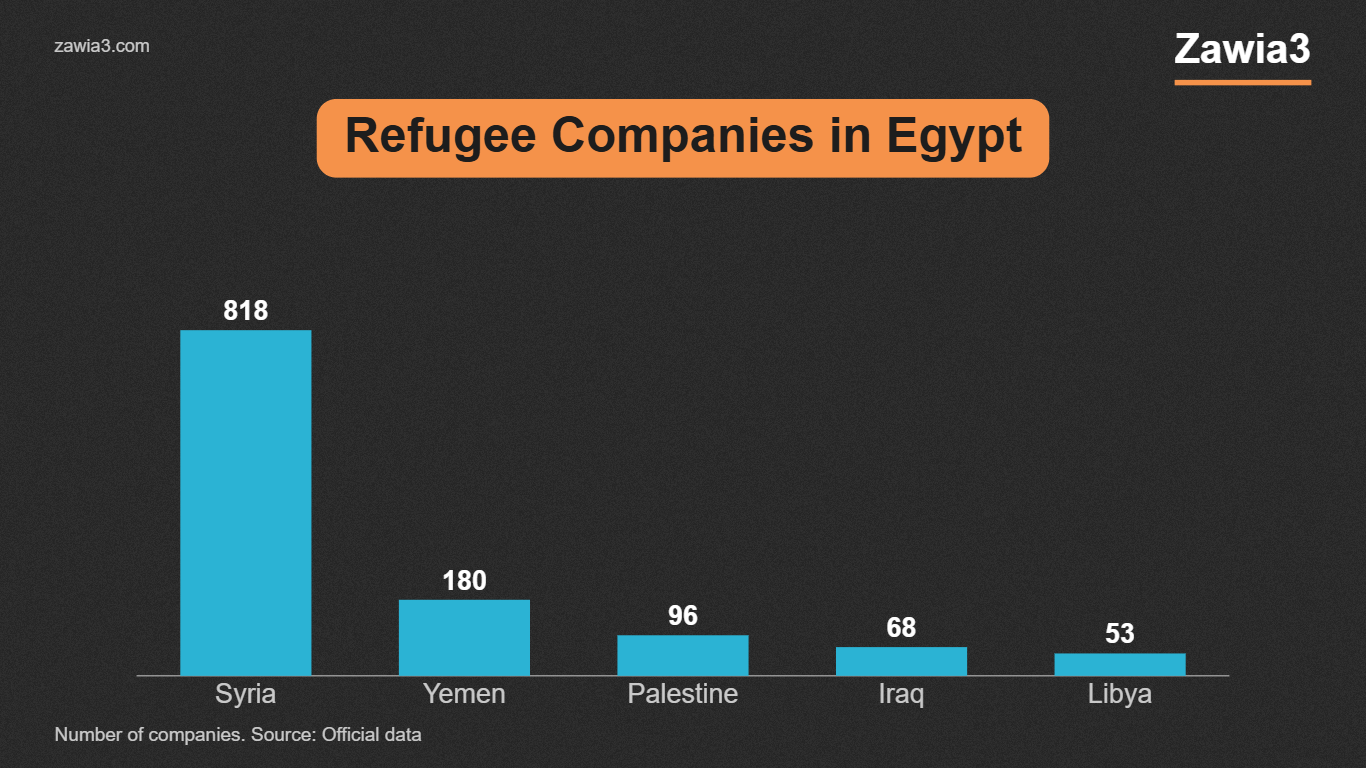
The government has noted the growth of refugee investments in Egypt, led by Syrians, whose companies number 818, followed by companies owned by Yemenis, numbering 180, with Palestinian companies in third place with 96 companies, then 68 companies for Iraqis and finally 53 companies for Libyans.
Syrian investors are represented before the Egyptian government by two business organisations: the first is the “Syrian Businessmen Group”, headed by Khaldoun Al-Mouqe’, and the second is the “Egyptian-Syrian Friendship Association”, headed by Talal Al-Attar.
In this regard, Alaa El-Askary, professor of economics and actuarial science at Al-Azhar University, says that the new decisions related to regularising the status of Syrians in Egypt, whether regarding residency procedures or the increase in their fees, have multiple dimensions that include significant benefits for the state.
According to El-Askary, “Syrians work in the informal economy, which has harmed the Egyptian economy and contributed to raising the prices of some goods and services, such as real estate prices”. He added that the state provides Syrians with the same support that Egyptian citizens receive, of electricity, gas, health and education services, while the Egyptian citizen participates in building his country and pays taxes; “therefore, Syrians must also participate in paying taxes as long as they benefit from this support”.
When asked about the impact of Syrians returning to their country on the Egyptian economy, especially regarding withdrawing dollars from the market and raising their price, he confirms that this may indeed happen, explaining that sudden deportations of Syrians may prevent them from using their money on the black market, but if they leave voluntarily, this may increase demand for the dollar and raise its value in the Egyptian market.
Between decisions Syrians see as complicated and overly strict, and obligations the Egyptian authorities see as necessary to preserve Egyptian security and order, millions of Syrians who have not yet decided to leave Egypt remain perplexed, amid mounting questions and an unclear scene.