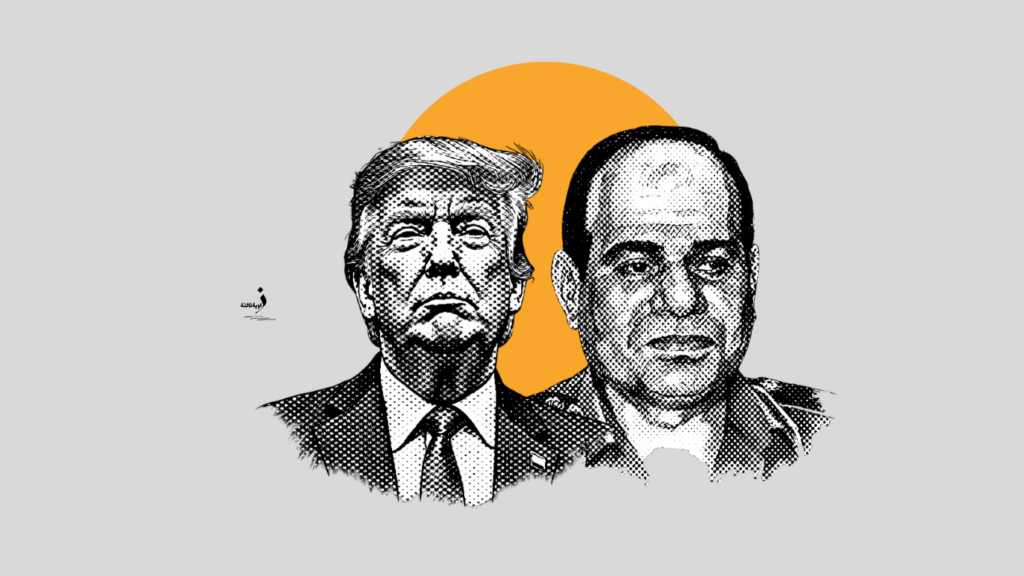
Donald Trump’s victory in the US presidential election came loaded with Egyptian aspirations to strengthen the strategic partnership between the two sides and to work together to achieve regional peace, as expressed by Egyptian President Abdel Fattah al-Sisi in a post on his official account on “X” after the US election ended. He said: “We look forward to achieving peace together and maintaining regional peace and stability. The two countries have always presented a model of cooperation and have succeeded together in achieving common interests,” stressing his aspiration to continue this model in the delicate circumstances the world is going through.
Egypt and the United States have been linked by relations unaffected by the change of successive US administrations, as they are based on partnership to achieve both sides’ mutual goals. While the United States holds the leading role in global and regional issues, Egypt has its pivotal role in the Middle East and Africa. This is according to a study titled “Egypt’s Relations With the Major Powers: Continued Balance”, issued by the Egyptian Center for Strategic Studies.
The study explained that Egypt’s strategy towards the United States is based on preserving the strategic interests of each: Egypt seeks to maintain the strategic balance in the region, including its plan to preserve its right to develop its military and economic capabilities that enable it to fight terrorism, while the United States wants to maintain the facilities it obtains in transiting the Suez Canal to reach its theatres of operation in the region, especially the Gulf and the Indian Ocean, in addition to the shared keenness to preserve peace with Tel Aviv.
Despite this, relations between Egypt and the United States have passed through different stages of strength and coolness depending on the situation in the region and also on the policies adopted by governments and presidents.
Sisi’s Meetings With Trump
President Abdel Fattah al-Sisi met US President Donald Trump several times during his presidency between 2017 and 2021. The first was in April 2017, their first meeting at the White House, where they discussed strengthening the strategic partnership between Egypt and the United States, focusing on cooperation in combating terrorism and supporting economic stability in Egypt. The second meeting, in September 2018, came during the United Nations General Assembly, where Trump stressed his support for security and stability in Cairo, and the focus was on issues of religious freedom, including the situation of Coptic Christians. The third meeting was in April 2019 at the White House, when Trump praised the economic and security policies led by Sisi, and they discussed developments in the Middle East and issues related to regional security.
Egyptian-American relations during Trump’s first term were characterised by a strong convergence of views between the two sides in many areas, most importantly combating terrorism worldwide, resolving the Palestinian issue, and constantly stressing that Egypt is an important and influential strategic ally of the United States of America in the Middle East. This was clear in their close positions on these issues in international forums, according to what was explained by political science researcher Mohamed Maged Behery in a study in Al-Siyassa Al-Dawliya, the periodical specialising in international affairs.
Behery described that stage as “the stage of attraction” because of the clear agreement between the two countries and the affirmation of the strategies related to both sides’ visions of international positions.
Mohamed Tawfik, Egypt’s former ambassador to Washington, said in his analysis of the US election and its impact on Egyptian interests that the difference in the two administrations’ policies, which may affect Egyptian interests fundamentally, lies in their position on the new variable pressing on US policy in the Middle East, unleashed by Hamas’s operation on 7 October last year and the war Tel Aviv waged on Gaza, which brought the Palestinian issue back to the forefront of international and regional politics. He went on: “Egyptian foreign policy has no choice but to hold on to achieving strategic independence and maintaining and deepening balanced relations with the active international powers, while at the same time seeking to affirm the points where Egyptian and American interests in particular converge at the various bilateral, regional and international levels.”
In the same context, Akram Abdel Kader Badr El-Din, professor of political science at Cairo University, explains, speaking to Zawia3, that Egyptian-American relations are strong at the official level, on regional issues and also at the level of bilateral relations, whether in economic, security or military cooperation, especially with the joint exercises between the two armies, in addition to the aid provided by the US side to Egypt following the Camp David Accords.
He explains that Egyptian-American relations are stable, whether the US president is from the Republican or Democratic party, because this constitutes a kind of continuity of the strategic relations and common interests of the two sides, noting that there is a permanent tendency on both sides to support these relations and keep them vitally connected.
The Return of US Aid
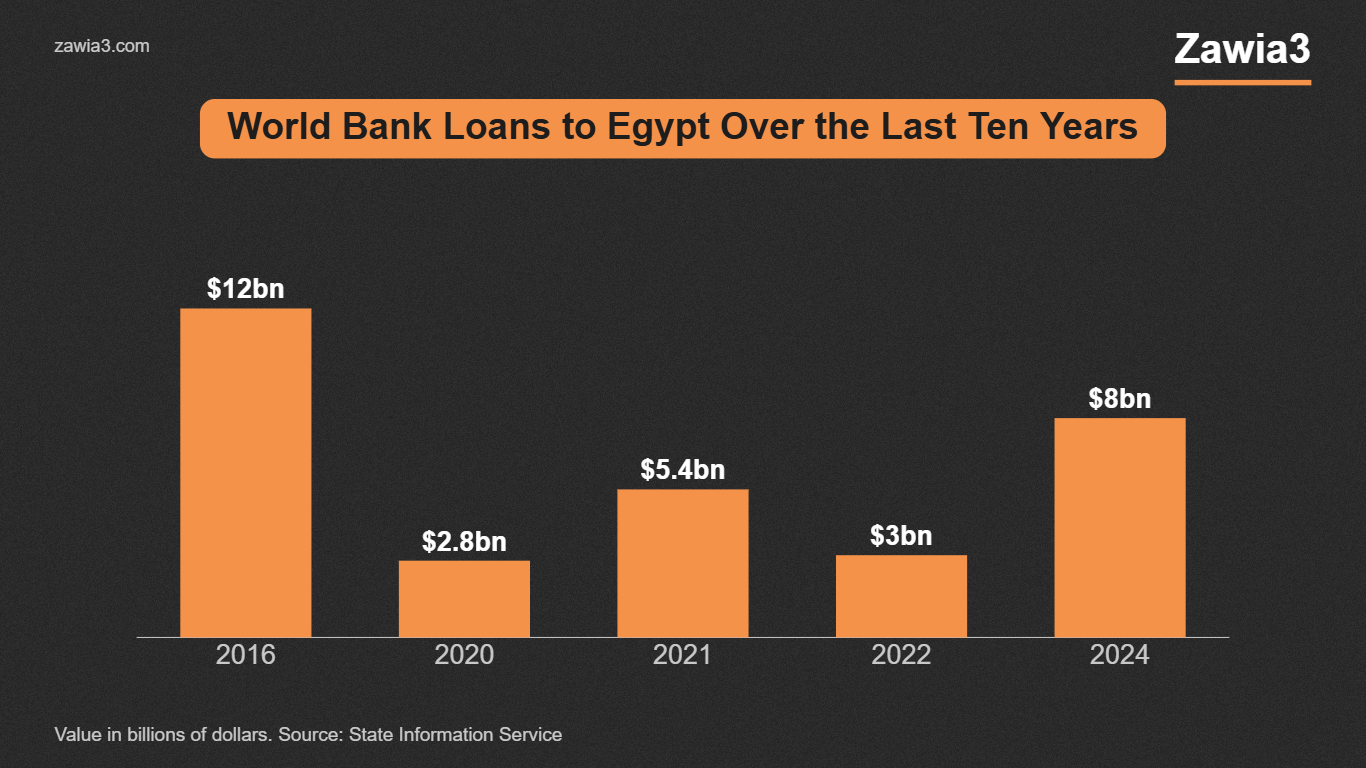
The war on Gaza changed the course of political and also economic affairs, as it made it easier for Cairo to obtain huge financial assistance from the International Monetary Fund and the World Bank, and the US administration announced the release of the full military aid to Egypt without restrictions or conditions.
US aid is a fixed annual amount Egypt has received from the United States of America since the signing of the Egyptian-Israeli peace treaty in 1979, when then US President Jimmy Carter announced annual economic and military aid to both Egypt and Tel Aviv, which since 1982 has turned into non-repayable grants of USD 3 billion for the Israeli occupation and USD 2.1 billion for Egypt, of which USD 815 million is economic aid and USD 1.3 billion military aid. The total Egypt has received over these past decades since the signing of the peace agreement is about USD 80 billion.
The United States of America has often used this aid as a pressure card on Egypt, especially by linking part of it to meeting human rights conditions. Since the Biden administration took office, Congress has placed restrictions on a quarter of US aid to Egypt, which was decided within the framework of conditioning on Egypt’s progress on human rights. This issue was raised every year, and part of the aid was cut or transferred to other countries.
With the decline of Egypt’s strategic role in the region, Washington began to consider reducing military aid because of Egypt’s diminishing importance in the Arab-Israeli conflict, especially after the rise of countries such as the UAE and Saudi Arabia. Although economic aid declined over the past decades, military aid continued. At the end of the Clinton era, economic aid fell to between USD 100 and 200 million, which affected the Egyptian economy. Nevertheless, military aid continued to make up a third of the Egyptian military budget, used to buy weapons and aircraft.
In a different vein, the US State Department decided last September to exempt Egypt from the human rights conditions linked to military aid and to grant Cairo the full military aid of USD 1.3 billion for this year without any deductions, for the sake of “US national security interests”, according to a statement by the State Department spokesperson. The United States always uses the human rights file and military aid at times as a means to achieve specific aims from countries with which it has interests, and at other times puts other interests ahead of the rights file whenever necessary.
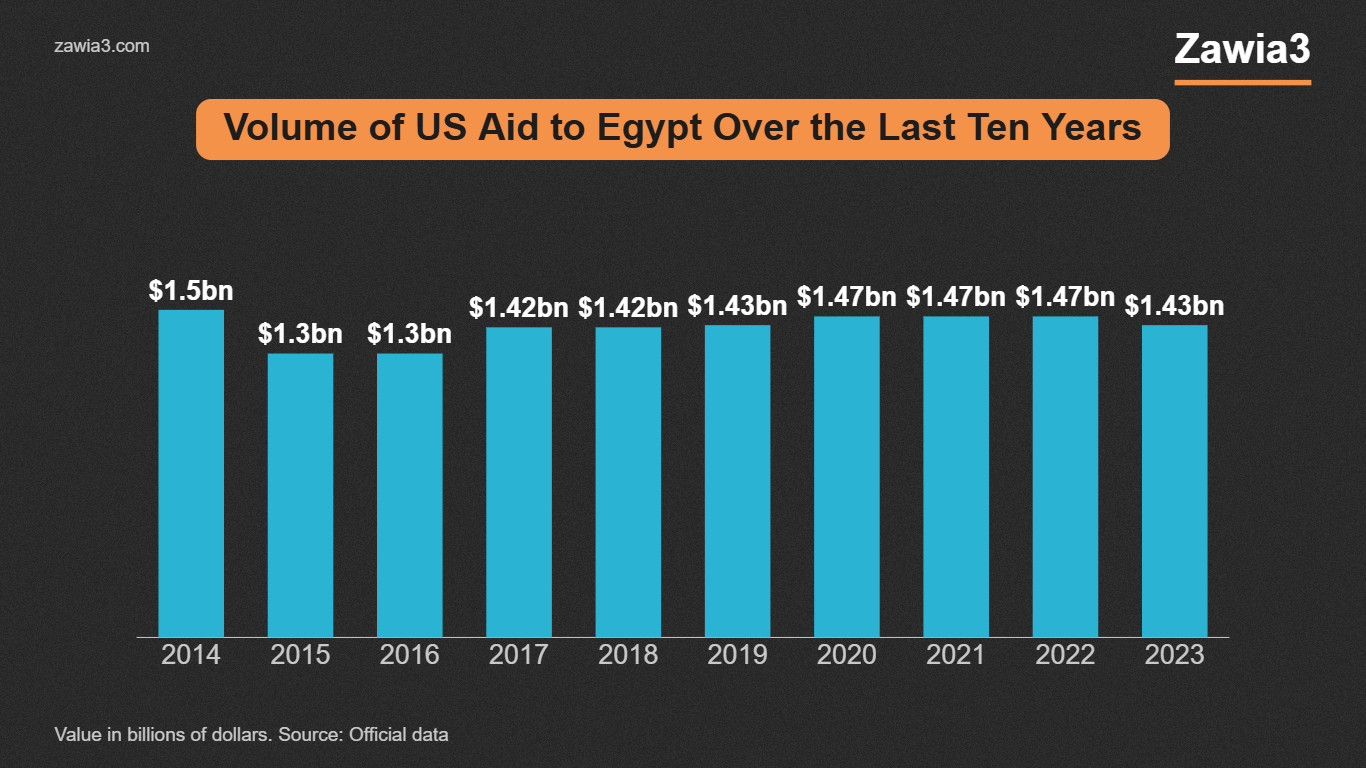
For his part, Akram Abdel Kader Badr El-Din explains to us that the aid provided to Egypt is subject to the international Camp David agreement, which obliges the United States of America to provide USD 1.3 billion annually in the form of military and economic aid, noting that it is reduced by the US side for various reasons, but this aid is not tied to rulers and regimes, especially as it is linked to the international agreement between both the Egyptian and Israeli sides and the US side. US aid to Egypt represents 57% of the total international aid and grants it receives from the European Union, Japan and other countries, and the aid amount does not exceed 2% of Egypt’s gross national income.
The professor of political science at Cairo University adds that on issues of common interest that touch both sides’ interests but are not of a direct nature for either, the two sides agree on consolidating these issues in a way that preserves their relationship and the region’s security, foremost among them issues related to the Middle East, which has recently witnessed many regional tensions in several Arab countries. Egypt enjoys a sovereign role among these countries, which strengthens its position before the United States of America, especially as Trump announced during his election campaign that he seeks to calm the situation in the region as US interests are threatened by these conflicts, which requires joint cooperation between the two countries to reduce the intensity of the raging conflicts.
Abdel Kader cites the impact of the disputes that broke out in the Red Sea area in the recent period, which harmed the interests of many countries of the world, as requiring a joint policy to resolve these conflicts in a way that ensures the achievement of common interests.
As for the fears Cairo may face as a result of Trump taking power again, and expectations of an absence of US support for strategic issues that threaten Egyptian interests, the professor of political science at Cairo University explains that the tensions the region is witnessing are prompting all the world’s major powers, represented by the United States of America and others, to be keen to support Egypt and strengthen its regional role, which represents the balance required for the region, especially at the present time, when the region is ablaze with conflicts and wars.
As for investment, he says that Egypt and the United States are committed to working to strengthen bilateral economic cooperation for mutual benefit, including by expanding trade, increasing private sector investment and cooperating on clean energy and climate technology.
The United States invested USD 600 million to digitise Egypt’s telecommunications sector, and Egypt imported USD 5.9 billion from the United States to build, expand and modernise Egyptian infrastructure to meet the needs of its growing population. As it continues to face the global repercussions of the Russian-Ukrainian war and the resulting food insecurity, the United States commends Egypt for concluding an agreement with the International Monetary Fund on 16 December 2022, which is crucial to stabilising its economy and enabling vital reforms. The United States and Egypt have committed to establishing a joint economic commission aimed at deepening cooperation on all economic and trade issues.
Economic Relations
On the economic level, the value of trade between Egypt and the United States of America fell in 2023 to about USD 7.3 billion, compared with USD 9.2 billion in 2022, a decline of 20.6%, according to the bulletin “Economic Relations Between Egypt and the United States of America” issued by the Central Agency for Public Mobilisation and Statistics. It showed that the value of Egyptian exports to the United States of America fell to about USD 1.9 billion in 2023, representing 4.6% of Egypt’s exports to the world, compared with USD 2.3 billion in 2022, a decrease of 15.5%.
Commenting on Trump’s win of a new presidential term, Rashad Abdo, an international economic expert and head of the Egyptian Forum for Economic Studies, tells us that various international relations are fundamentally based on the policies of the state and are not directly linked to rulers. Even if this has a slight effect on the nature and orientations of relations, it is no longer the main factor in the nature of the relationship itself, which is linked to regional and international agreements and treaties as well as political conditions that are closely tied to the shaping of economic relations between countries.
He states that a country that manages to follow successful and stable economic policies and pass legislation that advances investment and industrial interests in a way that ensures the development of its conditions, these are the ways that enable countries to support their position towards the great international powers, and save them from falling under the weight of international control and hegemony driven primarily by political regimes.
He agrees with the previous view that Trump’s arrival at the White House will not change much in the patterns of international dealings in the Middle East in general and the Arab region in particular, in an attempt to achieve regional stability that supports US interests. He added that US support for the strategic issues threatening Egypt’s national security in the coming period requires officials and ministers who plan well to exploit the current situation to support the regional issues threatening Egypt in coordination with the US side, which seeks this.
With Trump arriving at the White House once again, many questions remain awaiting an answer from the US position towards Egypt: is the real value of Egyptian-American relations limited to USD 1.3 billion a year? Does this relationship provide Egypt with sufficient support on strategic issues such as the Grand Ethiopian Renaissance Dam or the crises in Sudan and Libya? And will the conflicts and wars the Middle East is currently witnessing play a role in reshaping relations between the two countries?