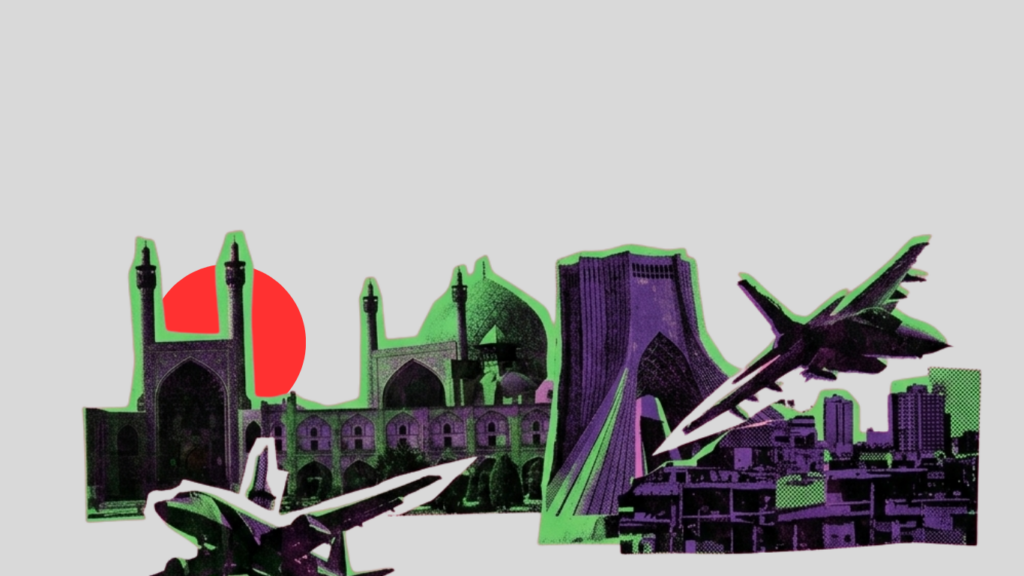

International tensions intensified on Saturday, 28 February 2026, after large-scale US and Israeli strikes on Iran. Tehran responded by attacking Israel and US bases in Gulf countries, including Saudi Arabia, Qatar, the UAE, Bahrain and Kuwait. Attacks were continuing as this report was written, raising concerns about consequences for the Middle East, particularly Egypt and the Gulf, and for the wider world.
The assault followed weeks of US threats of military action and the deployment of additional American forces to the Middle East.
Strikes concentrated on Tehran and its surroundings. Reports described attacks on the supreme leader Ali Khamenei’s office compound and sites in Isfahan, Karaj, Kermanshah and Bushehr, where sensitive installations are located. The extent of damage to nuclear infrastructure was not yet clear. Explosions and smoke were reported in several areas, and Iran closed its airspace and issued emergency aviation warnings.
Iranian state television, citing a local official in Hormozgan province, initially reported that an attack on a girls’ primary school in southern Iran had killed 57 pupils. Local sources quoted by Russia Today subsequently reported 85 deaths and 92 injuries. These were the differing figures available when the Arabic report was published.
In a video address, US President Donald Trump announced major combat operations in Iran, saying the aim was to defend Americans by eliminating what he described as imminent threats from the Iranian government. He said Iran could not be allowed to acquire a nuclear weapon and denounced its leadership.
Trump said the operation would destroy Iran’s missiles, missile industry and naval capabilities. He offered Iranian armed forces a choice between immunity and death, while telling Iranians that freedom was within reach and urging them to take control of their government.
Israeli Prime Minister Benjamin Netanyahu likewise described the joint operation as an effort to eliminate an existential threat and called on Iranians to challenge the system established after the 1979 revolution.
Iran announced counterattacks, firing missiles towards several locations in Israel. Explosions were heard in Jerusalem after air-raid sirens sounded.
The Emirates News Agency reported Iranian missile attacks on UAE territory and one death after missile debris fell on a residential area in Abu Dhabi.
The Islamic Revolutionary Guard Corps said it had targeted US bases in Qatar and the UAE and military and security sites in Israel. In a subsequent statement, it said missiles and drones had hit the headquarters of the US Fifth Fleet in Bahrain. Explosions were also heard there; Bahrain’s Interior Ministry activated sirens and instructed residents to seek safety.
Iran’s Supreme National Security Council promised a forceful response, saying it would use its defensive and military capabilities in self-defence to protect territorial integrity. It later urged people to leave Tehran for safer areas.
Foreign Minister Abbas Araghchi held urgent calls with officials in Saudi Arabia, the UAE, Qatar, Bahrain and Iraq. He said Iran would respond and warned against allowing their territory or bases to launch further attacks, asserting that they would bear legal responsibility for such use. Iranian security officials also said Tehran had warned beforehand of a severe response.
Israel closed its airspace to civilian flights and declared an emergency as officials anticipated further Iranian missile and drone salvos.
Gulf Arab governments reacted with concern and efforts to avoid being drawn directly into the confrontation. Reports from Doha, Dubai and Kuwait described explosions and air-defence operations in Qatar, the UAE, Kuwait, Bahrain and Jordan against missiles reportedly fired from Iran towards sites potentially hosting US forces. Several governments affirmed their right to self-defence.
Two scenarios were central to Gulf concerns: an expansion of Iran’s targets to oil, gas, electricity and liquefied natural gas facilities, and threats to shipping through the Strait of Hormuz. Both could severely affect energy markets and supply security.
Arab assessments also warned that the collapse of the Iranian government after a prolonged campaign could trigger displacement, weapons flows and cross-border armed groups, creating additional threats to regional security.
Egypt condemned Iranian attacks on Arab states’ territorial integrity and sovereignty on Saturday and warned that the region could descend into widespread chaos.
The Egyptian Foreign Ministry expressed concern about dangerous military escalation and the risk of expanding conflict, with potentially catastrophic consequences for regional and international peace, security and stability.
Cairo reiterated the importance of peaceful political solutions. Military action would produce further violence and bloodshed, it said, while diplomacy and dialogue offered the route to security and stability.
Egypt’s Civil Aviation Ministry said it was closely monitoring developments and their possible effects on Middle Eastern air traffic. It reported coordination with regional and international aviation authorities to protect flight safety and urged passengers to check schedules amid airspace closures in Iran and Israel and suspended movement over Iraq.
European responses emphasised restraint and avoiding a full regional confrontation. Governments involved in nuclear diplomacy feared the attacks could destroy remaining negotiating prospects, strengthen hardliners in Iran and accelerate a regional nuclear and missile arms race.
Russia’s Foreign Ministry condemned the attacks as an unjustified armed operation against a sovereign state. It accused Washington and Israel of seeking regime change under the pretext of Iran’s nuclear programme and called for an immediate halt and a return to diplomacy.
China rejected violations of Iran’s sovereignty and territorial integrity and warned that military action could spiral out of control and damage peaceful efforts to resolve the nuclear dispute.
Observers expected further emergency Security Council meetings, amid divisions between states supporting the US-Israeli operation and those viewing it as a breach of the UN Charter and a threat to international peace.
How Is Tehran Approaching the War?
Iranian political researcher Mohamed Rahmani tells Zawia3 that war was not unexpected given the previous escalation between Iran and Israel. The earlier confrontation, lasting approximately 12 days, exposed a gap between declared objectives and results: Israeli leaders spoke of curbing Iran’s regional influence and sometimes of bringing down its government, but those aims were not achieved as presented.
Claims of undisclosed agreements during the lull had produced no real negotiating progress, Rahmani says. Talks remained stalled, while Tehran made its own decisions about its regional deployments and avoidance of some forms of direct involvement. In the absence of a political breakthrough, renewed war became increasingly likely.
Iran broadened its threats to include Qatar, Bahrain, Saudi Arabia and the UAE by attacking, or threatening to attack, military bases and interests associated with the United States and its allies, he says.
By contrast, Rahmani notes that Tehran had avoided direct threats to Turkey and Azerbaijan at the time of the interview. He attributes this to Iran’s ethnic sensitivities, given its millions of Azerbaijani Turks and the potential domestic costs of confrontation with Ankara or Baku.
He believes US and Israeli references to final objectives go beyond deterrence and encompass Iran’s strategic infrastructure, including nuclear facilities, armament centres and other foundations of state power.
Public attitudes in Iran are complex and divided, Rahmani says. Significant sections oppose the government, and repeated protests in recent years have faced severe security repression. Continued external pressure, especially alongside worsening economic and security conditions, could create conditions for renewed demonstrations.
Tehran had promised a strong response to direct attack, including wide-ranging threats against Israel. Rahmani doubts that it can fully deliver on those threats, arguing that much of its missile capacity was used in earlier rounds. He expects Iran’s scope for offensive escalation to narrow as military pressure increases and strategic options diminish.
Dr Sara Kira, director of the European North African Center for Strategic Studies, views the fighting as a continuation of the earlier 12-day confrontation, but with different objectives and stakes. In her assessment, the immediate goal is to bring down Iran’s government rather than merely contain its regional conduct.
Kira tells Zawia3 that the dispute centres on Iran’s nuclear and ballistic missile programmes. She argues that Washington and Israel will not accept an advanced nuclear programme under the system of clerical rule. She cites Western assessments suggesting that enrichment has progressed further than publicly declared levels indicate; these are assessments she references, rather than independently established findings of this report.
Washington previously sought political settlements or internal arrangements that would alter Iran’s leadership or governing structure, Kira argues. Their failure has made regime change a prominent option. If operations continue at their current pace, she believes the war may persist until the governing structure is fundamentally altered.
The Gulf would face the most direct effects, including higher oil prices, disrupted trade and threats to US military bases, she says. Extensive Gulf defence spending has not provided complete protection against escalation.
Egypt’s immediate exposure may be smaller because of its position in the crisis, Kira adds, but major disruption to energy markets and shipping would have indirect effects across the regional economy.
She expects Iran to fight for as long as possible, drawing on military and logistical support from allies, including drones and advanced weaponry. At the same time, sustained strikes could produce internal fractures within the governing system and accelerate change from within.
Kira sees Washington, historically influential in Iran’s balance of power, as seeking to reshape its political landscape. She describes the current trajectory as an open-ended conflict aimed at political change in Tehran.
Oil Markets and the Risks of Escalation
The strikes threaten to increase tension in the world’s principal oil-producing region. Their market impact would be transmitted through a risk premium and the possibility of disrupted supplies, with outcomes dependent on the course of escalation.
The short-term scenarios discussed in the report anticipate sharp price increases and greater daily volatility as traders price in possible losses of Iranian or Gulf exports, even without direct attacks on energy facilities. Wider fighting or strikes near oilfields and export terminals could increase that premium and push prices towards USD 100 a barrel or beyond if shipping is threatened.
The Strait of Hormuz, carrying roughly one-fifth of global oil trade, is the most sensitive point. Threats to close it or attack shipping raise fears of partial or temporary disruption to 15–20 million barrels a day. Earlier scenario estimates by market analysts suggested that threats alone could add USD 10–25 a barrel. These are scenario estimates, not observed price movements or assured forecasts.
If exchanges remain away from energy infrastructure and the strait, observers cited in the report envisage elevated but more manageable prices, with Brent around USD 75–85 a barrel and some easing if mediation or a ceasefire becomes plausible.
A worse scenario involving Gulf or Iranian energy facilities, pipelines, ports or an effective closure of Hormuz would constitute a genuine supply shock. Some investment-bank scenarios discussed in the report put prices at USD 100–120 a barrel or higher if disruption persists.
How Could Cairo Be Affected?
The possible effects on Cairo fall into four connected areas: economic and financial pressures; the Suez Canal and shipping; domestic and regional security; and political and diplomatic room for manoeuvre.
A major oil-price increase would raise Egypt’s import bill and pressure its balance of payments. It could increase energy, transport and electricity subsidy costs and add inflationary pressure to an economy already facing price and exchange-rate difficulties.
A higher regional risk premium could also make international borrowing more expensive and heighten investor sensitivity to adverse news, potentially encouraging some short-term capital outflows or postponing investment decisions.
Threats to Hormuz or renewed attacks on Red Sea shipping, by the Houthis or other actors, would affect routes between the Gulf and the Mediterranean. If shipping companies divert because of insurance and security risks, Suez Canal traffic and dollar revenues could decline, adding pressure to a major source of foreign currency and to public finances.
On security, escalation could activate networks aligned with Iran or its adversaries near Egypt, including in Gaza, Sinai, Libya and the eastern Mediterranean. Potential concerns include increased arms smuggling across the Gaza border, infiltration by extremist groups exploiting disorder, or indirect use of Egyptian territory in reciprocal operations or signalling.
Such risks could entail tighter security along borders and in Sinai, the Red Sea and Taba. A substantial shift in the regional balance towards Israel would also raise Egyptian concerns about Gaza and the wider strategic framework underpinning peace.
Diplomatically, Cairo seeks to oppose military escalation and support a negotiated solution while preserving channels with Tehran and its essential relationships with Washington and Gulf capitals.
A wider war or an attempt to bring down Iran’s government would confront Egypt with new distributions of regional influence, possible refugee movements, shifting alliances and increased US-Israeli pressure on issues such as Gaza and the eastern Mediterranean.
Egyptian regional security and terrorism researcher Ahmed Sultan tells Zawia3 that the confrontation is a battle within a wider war that Washington and Israel intend to make decisive. Its consequences, he argues, extend beyond the Middle East to the international order.
History, especially the modern period, shows that middle powers can play decisive roles in reshaping the international system, Sultan says. He views the moment as a potential restructuring of both regional balances and the broader global order.
He calls Washington’s decision a strategic gamble based on biased calculations. Iran’s resilience, adaptation to attacks and ability to sustain counterpressure will reveal the limits of those calculations. War is a contest of wills before it is a military contest, he argues.
Developments remain at an early stage and escalation may lack a clear ceiling. US bases in Gulf states were targeted in the opening hours, but if Iran concludes that its government’s survival is at stake, Sultan believes its response could lose remaining restraints and spread conflict across the region.
Hormuz could become a central arena if fighting continues, affecting world oil supplies and Gulf exports. Egypt could also suffer from a renewed maritime blockade attempted by the Houthis: despite limited capabilities, they can create strategic disruption, he says. He notes that global shipping companies had already diverted towards the Cape of Good Hope.
The scope of strikes and escalation depends on the belligerents’ understanding of the war, Sultan stresses. A limited confrontation leaves relatively constrained instruments; a comprehensive campaign for regime change could drive each side towards maximum escalation as survival becomes the governing calculation.
He sees the region facing a decisive test and a period of restructuring, potentially producing new alignments, movement away from the US orbit and greater openings for other powers, notably China. In his assessment, the transformation concerns the international system as well as the region.
The confrontation appears capable of reshaping Middle Eastern influence and alliances rather than ending as another brief exchange. Expanding strikes and rhetoric of decisive victory and regime change increase fears of a wider war beyond conventional deterrence calculations.
With vulnerable energy markets, sensitive shipping routes and overlapping international interests, governments face a difficult choice between open escalation and a political track that appeared increasingly distant at the time of reporting. Containing the conflict could prevent its expansion; failure could produce a prolonged struggle with enduring consequences for the balance of power.