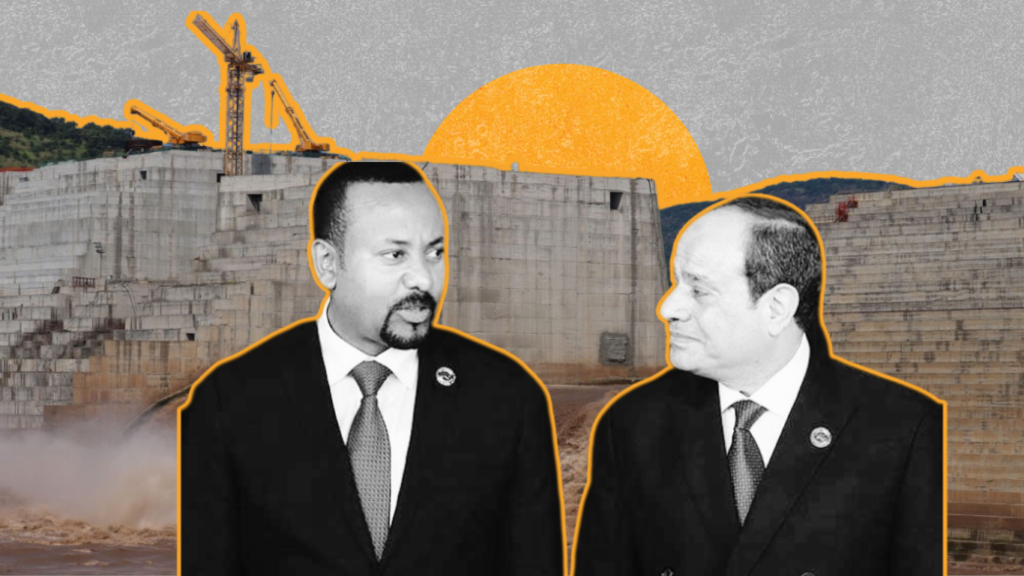

On the sidelines of the G7 summit in Évian, France, in mid-June, US President Donald Trump addressed the Grand Ethiopian Renaissance Dam dispute in the presence of President Abdel Fattah El-Sisi. He promised to help Egypt, saying Ethiopia had acted unfairly and the dam was causing major problems. Trump said he had previously reached a settlement before another administration took office, and would explore whether a resolution could now be achieved.
Experts describe these remarks as a revival of discussions that previously produced no tangible results. Mokhtar Ghobashy, secretary-general of the Al-Farabi Centre for Political and Strategic Studies, considers them moral support for Egypt’s historic claim to Nile water, rather than a breakthrough. The United States and World Bank had already brought the three countries to negotiations, he notes, but Ethiopia declined to attend the final signing and Washington could not compel it. During Trump’s first term, talks produced the February 2020 Washington document, initialled by Egypt but not signed by Ethiopia. In his second term, Trump made similar statements in July 2025 and January 2026. The dam was officially inaugurated in September 2025; the source article cites a reservoir volume of 42 billion cubic metres.
Mediation has been tried before
US mediation followed El-Sisi’s address to the 74th United Nations General Assembly in September 2019, after Egyptian–Ethiopian negotiations reached an impasse. He described the Nile as a matter of life and existence for Egypt, while recognising Ethiopia’s right to development and calling for a fair, balanced agreement protecting all parties’ rights.
El-Sisi urged the international community to play a constructive role in encouraging flexibility and an agreement acceptable to everyone. Intensive discussions with international partners followed, paving the way for Trump’s administration to sponsor trilateral talks involving Egypt, Sudan and Ethiopia in November 2019.
Trump directed the US Treasury and World Bank to support negotiating rounds toward a comprehensive, binding agreement. The rounds ended with the February 2020 Washington document setting rules for filling and operating the dam. Egypt initialled it, but Ethiopia did not attend the signing, and the process stalled.
In September 2020, the US State Department announced that the Trump administration would suspend some aid to Ethiopia because of the lack of progress in talks with Egypt and Sudan. Some reports estimated the withheld assistance at less than $130 million.
In October 2020, near the end of his first term, Trump described the situation as extremely dangerous and suggested Egypt might eventually destroy the dam if no agreement was reached. Ethiopia angrily responded that no force could stop it building and operating the project.
After returning to office, Trump made further statements. In July 2025, at a news conference with NATO’s secretary-general, he said the US administration was working with Ethiopia to resolve the dispute.
Following the dam’s official inauguration in September 2025, Trump claimed to have prevented a possible war between Egypt and Ethiopia. He described the dam’s impact on the Nile as a major problem.
In January 2026, he again proposed mediation. In a letter to the Egyptian president posted on Truth Social, he offered to resume US efforts to reach a lasting, responsible arrangement for sharing Nile water.
Does Washington have leverage over Ethiopia?
Gamal Zahran, professor of political science and international relations, regards Trump’s latest statements as empty words with no influence over Ethiopia. If Washington possessed that influence, he argues, earlier interventions would have produced results.
Zahran tells Zawia3 that Prime Minister Abiy Ahmed’s Prosperity Party won about 90% of parliamentary seats in the latest election, which he interprets as broad popular support. The dam is a national project for Ethiopians, he says. In his view, Egypt accepted construction at the outset; an earlier military response would have been possible, whereas one now would be disastrous.
The source article reports the reservoir’s water level at roughly 625 metres above sea level and storage of 42 billion cubic metres. It describes risks to Egypt and Sudan from large stored volumes, citing the severe flooding across several Sudanese states during the 2025 flood season. These concerns extend beyond reduced flows during drought to flood risks during the rainy season. After the September 2025 inauguration, Egypt’s Ministry of Water Resources and Irrigation warned that unilateral dam operation posed continuing risks to downstream countries in both drought and flood conditions.
Zahran says Lake Nasser behind the Aswan High Dam has so far cushioned Egyptians against shortfalls in Egypt’s annual Nile allocation, put at 55.5 billion cubic metres. He warns that the public would feel the effects of drought if that buffer were depleted or reached a critical level.
He points to what he calls contradictory policies. He alleges that some Arab countries, including the United Arab Emirates, finance Ethiopia and act against Egyptian interests in Sudan, while Egypt offers them ports, airports and companies. He says he cannot understand these contradictions and regards them as pressures on national security, including water security. In his assessment, insufficient political will to defend that security will affect water supplies, sooner or later.
Zahran argues that Egypt helped create its own predicament by signing the 2015 Declaration of Principles without public or parliamentary scrutiny. Egypt subsequently accused Ethiopia of breaching that agreement. Appealing to Washington, he says, carries a price: Gaza, Israeli gas and Gulf arms supplies are among the difficult issues through which the US could exert pressure on Egypt.
He concludes that Washington has no effective leverage over Ethiopia, while Egypt lacks leverage over Washington to compel a solution binding on all parties.
Economic pressure as the remaining option
Political sociology professor Said Sadek agrees that US statements during both Trump terms have not translated into specific policies. Yet unlike Zahran, he believes Washington could pressure Ethiopia, given its many difficulties. His question is why the US should act when the countries directly concerned do not.
Sadek tells Zawia3 that many countries have voiced support for Egypt without acting on it. The European Union maintains strong relations with Cairo but has not halted trade with Ethiopia, and Gulf countries continue to invest there. The dispute reached the UN Security Council twice—an arduous step described as a political victory—but, in his view, the efforts failed because Russia and China resisted escalation owing to their investments in Addis Ababa.
He considers the original mistake to have been signing the Declaration of Principles. Without it, he argues, Ethiopia would not have obtained international and technological support on the same scale, as companies would have feared legal disputes. In his view, economic pressure is now the remaining instrument, with military action ruled out.
Sadek says Egypt continues to rely on diplomacy and patience while pursuing another tactic: opposing Ethiopian access to a Red Sea port. He believes Cairo could seek to persuade other states to restrict trade with Ethiopia. He also discusses proposals to stop Ethiopian exports passing through the Suez Canal, but acknowledges that treaty obligations constrain this option. The convention does not provide a blanket wartime right to close the canal.
Ethiopia has sought access to the sea since becoming landlocked in 1993. Egypt has countered with regional diplomacy, including meetings with officials in Eritrea, Ethiopia’s northern neighbour, and Yemen, a strategically important Red Sea state. Cairo has opposed a role for non-littoral states on national-security grounds.
In January 2024, Ethiopia signed a memorandum with Somaliland concerning access to a stretch of coast of roughly 20 kilometres—more than 12 miles—for a reported fifty-year period and possible naval and commercial use. The arrangement was tied to prospective recognition; it should not be presented as a completed Ethiopian recognition of Somaliland’s independence. Egypt opposed unilateral measures that could heighten tensions and threaten regional interests and security.
In the December 2024 Ankara Declaration, Ethiopia and Somalia subsequently reaffirmed respect for each other’s sovereignty and territorial integrity and agreed to pursue commercial arrangements for Ethiopian access to the sea under Somalia’s sovereign authority. This provides important context for the earlier memorandum.
Ethiopia currently relies primarily on Djibouti for maritime trade. The 1888 Constantinople Convention protects free use of the Suez Canal in war and peace and prohibits blockade. Article X preserves certain measures for the defence of Egypt and public order, but Article XI states that measures taken under Articles IX and X must not interfere with free use of the canal. These provisions do not amount to an unrestricted authority to halt Ethiopian trade.
The latest US statements show the dam dispute remains on the international agenda, but offer insufficient evidence that negotiations capable of breaking the long impasse are about to resume. With construction completed and the dam operating, Cairo’s options are more complicated. Diplomatic and economic pressure, together with regional engagement, remain the most realistic avenues described by the interviewees, amid the exclusion of military options and the absence of international willingness to impose a binding settlement.