


In November 2025, Giza governorate announced a programme to replace tuk-tuks with small Bajaj Qute vehicles. Officials presented the alternative as safer and better suited to an orderly transport system, citing traffic obstruction and difficulties identifying some tuk-tuk drivers.
The first phase covered El-Haram, El-Agouza, 6 October City and October Gardens, with an assessment planned before wider rollout. The announcement unsettled drivers, dealers, spare-parts sellers and repair workshops. They wanted to know what would happen to their vehicles and investments, whether replacement would become compulsory and how families dependent on tuk-tuk earnings would cope.
Giza’s assistant secretary-general, Mohamed Marei, told Zawia3 that participation was entirely voluntary. The interviews nevertheless reveal concerns about affordability, licensing, maintenance and the future of an extensive informal transport economy.
Nader Ali, a driver in his twenties, doubts that the proposed alternative suits the unpaved side roads where he works. He anticipates more expensive spare parts and higher operating and maintenance costs, and questions the vehicle’s durability and comfort.
Ali began driving a tuk-tuk in 2021 after failing to find suitable work with his commercial technical diploma. He is still paying for the vehicle, which supports his mother and helps him save for marriage.
“How can drivers be asked to give up their tuk-tuks and move to a new vehicle when they have not finished paying for the first one?” Ali asks.
He says some drivers bought on instalments at prices exceeding EGP 250,000. For them, another financed purchase would add a burden to an existing debt.
Ali argues that tuk-tuks fill a genuine gap in public transport, particularly for older residents and people living in narrow alleys that larger vehicles struggle to reach. He favours licensing and regulation rather than a ban.
His proposals include driving licences, drug testing and criminal-record checks to prevent unqualified drivers, especially children, from operating vehicles and to identify stolen tuk-tuks. He says many drivers complied with district identification-number schemes, but those numbers were no substitute for formal licensing.
He also reports vehicles being impounded when drivers enter main roads, sometimes for one or two months before owners recover them after paying fines. In his view, the solution is to address unsafe practices rather than remove a source of employment.
Mohamed Nasr El-Din, a driver in his thirties working between Cairo and Giza, also favours licensing. He says he and other drivers already hold traffic licences, while he remains unconvinced that repair centres and spare parts for the alternative are sufficiently available.
Nasr El-Din begins work at about 6am and often continues until 11pm to meet household expenses and vehicle instalments. At the time of the interview, he had roughly eight months of payments remaining.
He worries that replacement plans could undermine thousands of families’ main source of income. Drivers already carrying substantial instalments, he argues, cannot easily take on new financing.
“There is an entire sector behind tuk-tuks: electricians, mechanics and sellers of spare parts, tyres and oil,” he tells Zawia3. He believes a ban would affect workers far beyond the drivers themselves.
He also describes repeated stops, threats of fines or vehicle seizure and demands for bribes in some cases. These are his allegations. He says drivers lack adequate social-insurance protection even while paying recurring fees.
Nasr El-Din does not oppose the introduction of another vehicle. He opposes the possibility that it could eventually be imposed, arguing that poor practices and weak enforcement should be tackled through regulation and choice.
According to the CAPMAS licensed-vehicle bulletin cited in the Arabic report, Egypt had 186,918 licensed tuk-tuks at the end of 2024: 88,431 in Lower Egypt, 80,582 in Upper Egypt, 17,633 in urban governorates and 272 in frontier governorates.
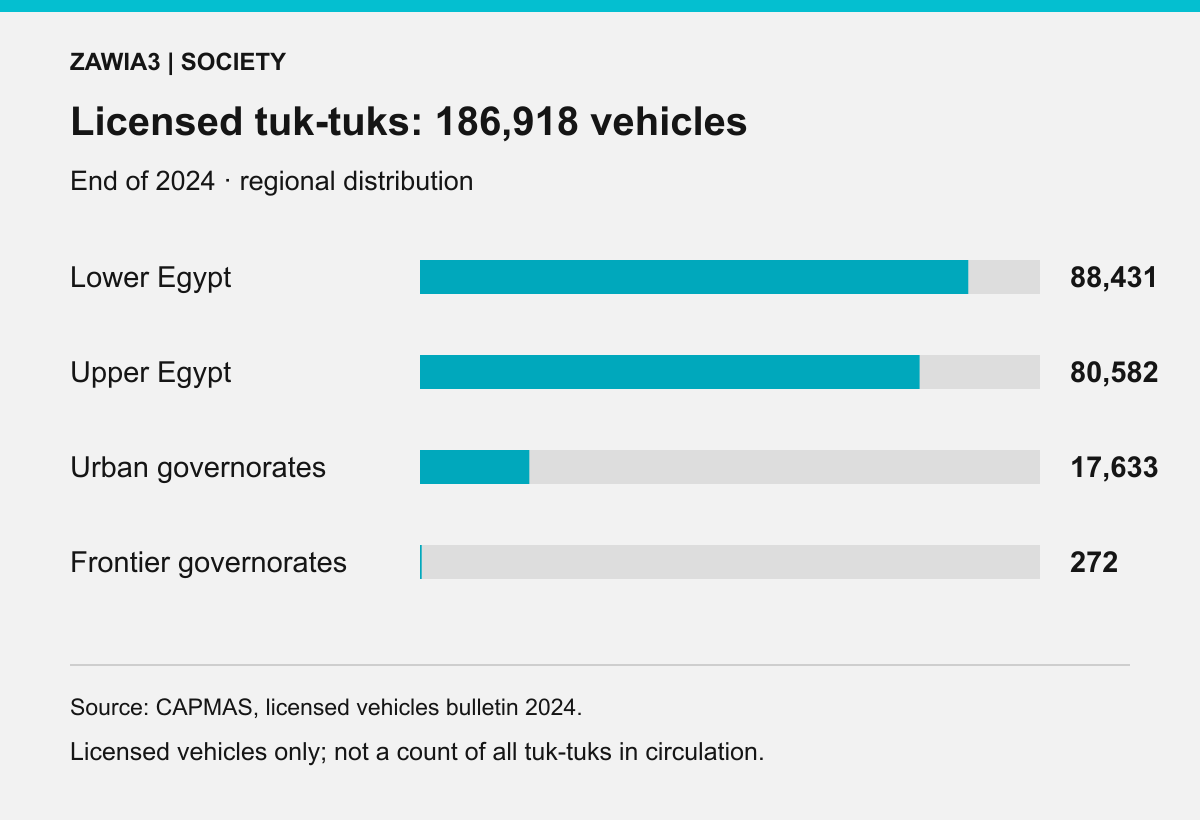
These figures count licensed vehicles only. Estimates for all tuk-tuks in circulation vary widely: reporting cited an unofficial figure of 5.4 million, while interviewees offered estimates of five to seven million. Those estimates and associated employment claims are not equivalent to an official vehicle or workforce census.
A transport need without consistent regulation
Shehab Abu Zeid, policy adviser and programme director at the Nada Foundation for Safer Egyptian Roads, says tuk-tuks spread because residents of working-class and rural areas needed transport that formal systems did not provide.
He sees their growth as a community response to local needs. In his view, weak oversight of importation, assembly and operation has made it difficult to monitor the sector and enforce safe driving.
Although many vehicles remain unlicensed, it would be inaccurate to say there is no legal provision for licensing tuk-tuks at all. Official licensed-vehicle figures and traffic rules demonstrate an existing framework; the interviewees’ concerns centre on its coverage and implementation.
Abu Zeid argues that substituting another vehicle does not automatically solve the underlying problem. Tuk-tuks became popular because they were small and their fares relatively cheap; a costlier alternative may be harder for passengers to accept.
He recommends starting with users and drivers, listening to their suggestions and designing improvements around the service they actually provide. Solutions imposed without that input, he warns, can aggravate existing problems.
Automotive and road-engineering specialist Gamal Askar, a former chair of the Engineers Syndicate’s industry committee, supports replacement in principle but questions Giza’s chosen approach. He favours light electric vehicles over another petrol- or gas-powered option.
Askar argues that emissions and their environmental and health effects should be central to the choice. He sees electric alternatives as consistent with Egypt’s expansion of renewable energy, while stressing that vehicles must also meet practical transport needs.
He raises concerns about engine durability during long daily shifts. Those concerns should not be treated as proof that natural gas inherently destroys engines. Bajaj markets Qute versions designed for different fuels, including CNG, LPG and petrol. Assessing reliability requires evidence about the particular engine, fuel system, maintenance and operating conditions.
On safety, Askar believes four wheels and an enclosed body offer advantages over a three-wheeled tuk-tuk. Nevertheless, he questions the proposed alternative’s space, comfort and suitability for intensive daily use.
He expects higher purchase, licensing, insurance, tax and maintenance expenses to affect fares. Tuk-tuks spread partly because they were easy and inexpensive to operate, he says, but the involvement of children and underage drivers represents a serious safety concern.
Askar estimates that millions of vehicles and drivers are involved in the sector and argues that a ban is impractical without an adequate replacement. His figures are estimates, not an official workforce count. He advocates gradual introduction of suitable electric vehicles, supported by clear regulation and infrastructure that protects drivers’ livelihoods.
Reports on Giza’s programme described incentives of EGP 10,000 after licensing an alternative vehicle, plus around EGP 1,000 towards licensing fees—a combined EGP 11,000. These were the incentives reported at the time, rather than a guarantee of the terms available on the date a reader consults this article.
Bajaj Auto is the original manufacturer of Qute. Reporting on the Egyptian programme described local assembly by Helwan Machinery and Equipment Company, military factory 999, in cooperation with ITAMCO.
The manufacturer describes seating for four adults, including the driver, and offers different fuel variants by market. Fuel consumption, range and specifications should be checked for the particular Egyptian version; a blanket claim of 550 kilometres on one tank is not established here for every variant.
Contemporary Egyptian reporting quoted prices of approximately EGP 200,000–215,000. These are historical reported prices, not a current quotation.
What transport regulation should achieve
Abdallah Abu Khadra, professor of road engineering at Beni-Suef University, sees Giza’s initiative as part of a wider effort to organise transport and reduce unsafe or irregular practices on urban roads.
He says comparable proposals have appeared in earlier traffic plans, especially in areas where tuk-tuks operate on main roads. He also links the governorate’s priorities to redevelopment around major sites, including the Grand Egyptian Museum.
Abu Khadra favours requiring driving licences, enforcing a minimum driving age, licensing vehicles and routes, and using local colour schemes to help organise services. In his assessment, these measures could improve accountability and road safety.
He says Giza had already worked with the local development and interior ministries on vehicle registration, identification numbers, databases of owners and drivers, and traffic campaigns before announcing replacement.
He expects the initiative to be considered in other governorates. That is his expectation, rather than an announcement in this report that a nationwide compulsory replacement programme has been adopted.
Legal specialist Adel Amer, head of the Egyptian Centre for Political, Economic and Social Studies, also describes the Giza programme as voluntary. He says formal registration and number plates make it easier to identify a vehicle and investigate an offence.
Amer discusses the uneven regulation of tuk-tuks and governorates’ role in organising them. His concern about widespread unregistered operation should be distinguished from the claim that no licensing law exists.
He associates their spread with unemployment and demand for affordable transport. Given the millions of people he estimates depend on the sector, he sees gradual, voluntary replacement as more realistic than an outright ban.
The governorate’s response
Responding directly to drivers’ concerns, Mohamed Marei, Giza’s assistant secretary-general, tells Zawia3 that the Qute replacement programme is entirely optional.
Drivers who choose to join sell their old tuk-tuks themselves, Marei says. They do not hand the vehicle over to the governorate.
He says the governorate can direct drivers towards reputable dealers to reduce the risk of exploitation, but the owner conducts the sale directly.
Alternative vehicles can be bought outright or on instalments, he explains. A driver still paying for a tuk-tuk could finish those payments before switching, arrange a sale and transfer of payments to a buyer, or carry both sets of instalments. These options depend on the applicable financing agreements and cannot be assumed to allow an automatic transfer without the parties’ consent.
Marei says drivers are not prevented from licensing and retaining their existing tuk-tuks because replacement is voluntary. He argues that the alternative offers better identification and oversight through traffic and district records.
He says traffic campaigns are ongoing enforcement measures rather than a direct consequence of the replacement scheme. They include action against unlicensed vehicles and underage driving.
On parts and servicing, Marei says the governorate was discussing an extension of the warranty from six months to a year, with coverage up to 50,000 kilometres. This was a proposed arrangement at the time of the interview, not a completed warranty undertaking established by the report. He says parts and servicing are available through the local agent.
Marei attributes higher tuk-tuk prices to import restrictions and the circulation of refurbished vehicles. The legal timeline should be stated precisely: restrictions on importing complete vehicles and chassis date to a 2014 decision, while decision 533 of 2021 addressed basic components, including the frame, chassis and engine. It is therefore inaccurate to describe a blanket ban on all tuk-tuk parts beginning in 2022.
He argues that the alternative’s fuel economy and lower purchase price could improve drivers’ returns. Drivers interviewed for this report remain concerned that those potential benefits may be outweighed by financing obligations, maintenance expenses and the realities of narrow, unpaved routes.
The debate concerns more than the appearance of a vehicle. It involves affordable local transport, safety, enforceable licensing and the livelihoods of drivers and associated trades.
Any gradual transition needs to account for those practical conditions. For drivers who have not yet paid off the vehicles they own, a voluntary choice is meaningful only if the alternative is affordable, serviceable and suitable for the roads on which they earn their living.