
Among the narrow lanes and crowded markets of Cairo’s El Gamaleya district, taxi driver Ibrahim Hussein, a father of three, awoke to a nightmare. His car, the family’s only source of income, had disappeared from outside his home. He reported the theft to police and spent weeks searching. A month later, he was told it had been found.
He hurried to the vehicle impound lot in Helwan, where police hold recovered cars while legal procedures are completed. Instead of the vehicle he remembered, he says he found a corroded metal shell, with doors and windows missing and extensive damage.
Staff told him it had arrived in that condition. Ibrahim could not reconcile the wreckage with the car he had driven daily. “It worked efficiently. Now it has become scrap that is not even worth selling for spare parts. My livelihood has been destroyed,” he says.
When he approached the responsible authorities, each pointed elsewhere. Police blamed the lot’s management, while management said thieves might have damaged it before recovery. The investigation could not establish exactly when each part was lost.
Ibrahim borrowed to support his family, but repairs would cost more than the car’s market value.
“We owners of stolen cars are robbed twice: once when our vehicles are taken, and again when they are returned as wreckage.” — Ibrahim Hussein
Similar accounts in several cities raise questions about supervision of impound facilities and the protection of property held in official custody. Zawia3 investigated what affected owners describe as another form of theft.
The theft complaints do not end at the gates
Complaints on social media, particularly Facebook, describe missing batteries, stolen stereos and cars stripped of their contents while in impound lots. Were these isolated cases, or evidence of a wider problem?
Reviewing posts in specialised Facebook groups, the investigation found allegations across different areas, with a concentration around the Helwan lot at the entrance to 15 May City. The reporter visited the site.
Large sections of the perimeter walls were dilapidated or entirely collapsed. From outside, the site appeared vulnerable to intrusion, with valuable and easily carried parts such as batteries and stereos potentially exposed.
At the main gate, a security officer said entry was restricted to people carrying an official report proving ownership of a vehicle inside. He described the site as covering about 500 feddans and being guarded by approximately 55 police personnel working in rotation. Police stations send personnel to oversee the vehicles held on their behalf, he explained.
The condition of the perimeter raised questions about whether these arrangements were sufficient to protect the cars.
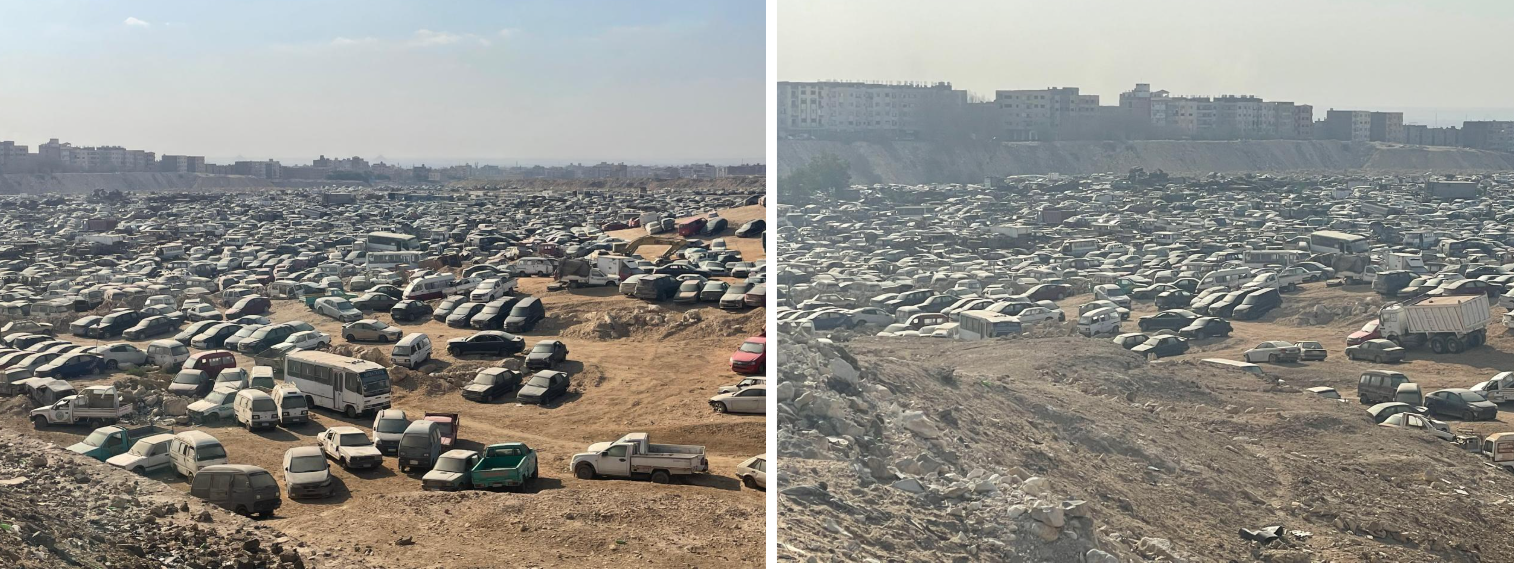
Security personnel and people visiting to recover vehicles said unclaimed cars are eventually sold at public auctions. According to their accounts, buyers with commercial registration can purchase vehicles in varying conditions, including badly damaged ones.
Owners interviewed alleged neglect, theft of contents and possible corruption. These are allegations by affected owners; they do not establish the identity of perpetrators or prove that every loss occurred after a vehicle reached official custody.
During the field visit, the reporter observed poorly secured access points and photographed vehicles left exposed. Some side entrances were open, with no security personnel intervening as photographs were taken. Guards nevertheless maintained that surveillance cameras monitored the lot around the clock.
Mahmoud Ramadan’s car was impounded in Helwan because its licence had expired. After completing the legal procedures and paying a fine, he went to collect it and says he found it neglected and stripped of possessions.
“It felt like a scrapyard,” he recalls. “The seats were filthy, as if they had been outdoors for months. My hand tools, spare tyre and small personal items had disappeared from the boot. Then I discovered the stereo I had recently installed was gone too.”
Mahmoud says staff told him they were not responsible for theft and suggested it might have happened during transport or before arrival. He recalls being told he could report it, but should not expect a result.
“I was punished three times: with a fine, with the neglect of my car, and with its theft in front of security. I could not find an authority to complain to.” — Mahmoud Ramadan
From a working car to an empty shell
Another driver, Ahmed Hassan, describes a similar experience after his vehicle was towed because its licence had expired.
“I spent two weeks running between traffic offices and vehicle stores, from El Rehab to El Basateen and then to my own traffic office, until I finally reached the impound lot,” he says. “I thought the paperwork would be the hardest part. When I reached the car, I barely recognised it. The battery, seats and even some engine parts had been taken.”
Ahmed suspects internal complicity or officials turning a blind eye. “How can all those parts be stolen inside a place that is supposed to be protected?” he asks. His suspicion is not an established finding about who carried out the thefts.
Video footage accompanying the original investigation into vehicle impound lots.
What should happen to impound space?
Alongside the theft complaints, some affected owners question why large neglected sites remain a burden instead of serving a productive purpose.
Ebtisam Raouf calls for electronic documentation so stolen and impounded cars can be traced more easily. She also wants simpler legal procedures, which she considers an additional obstacle to owners recovering their property.
Tharwat Mansour, who says he lost his car at an impound lot, proposes transparent public auctions for unclaimed vehicles. He argues that the proceeds should support public services in the surrounding areas rather than go to undisclosed recipients. He also suggests converting extensive unused sites into service projects, shopping centres or public parks.
How large is the problem? In remarks made in 2017, traffic expert Major General Yousri El Roubi described four main lots in Helwan, October, Alexandria and Qalyubia, each holding more than 5,000 vehicles, alongside smaller facilities elsewhere. He estimated the economic cost of keeping vehicles unused at EGP 20 billion. These are historical estimates, not an updated inventory for 2025.
Traffic expert Major General Ahmed Hisham says abandoned and deteriorating cars obstruct roads and pose public-security risks, including possible criminal use. He says authorities have intensified campaigns to remove them under legal procedures.
In his account, removal begins with reports from citizens or security bodies. Towing vehicles arrive and an announcement is made over loudspeakers to give the owner an opportunity to intervene. If there is no response, the car is taken to an impound lot, recorded and its owner electronically informed of the location.
For affected owners, the concern is what happens after that transfer.
Hisham rejects allegations that vehicle contents are stolen inside the lots. He says contents are recorded on arrival, and that tampering would place responsibility on the police personnel and custodians entrusted with the vehicles.
“Any violations face the appropriate legal procedures, and citizens have the right to submit a formal complaint if their cars are tampered with inside the lot,” he says.
Official custody and responsibility
Major General Medhat Qoreitem, a former assistant interior minister for specialised police, stresses the importance of dealing promptly with traffic violations, especially vehicles without number plates. He says these may be used in crimes and require checks of their identification details.
He explains that the driver is referred to a police station for a report establishing ownership through legal documents. Where documents are missing, technical checks compare the chassis and engine numbers with registered records.
For expired licences, Qoreitem describes a 30-day renewal period, after which a vehicle may be held until the legal requirements are fulfilled. He says compulsory insurance extends for 13 months, covering the renewal period.
Seized cars are taken to a police station, where a report records their condition. They are then handed over with a formal document containing the details, and the receiving body is responsible for safeguarding them. Qoreitem says holding facilities ordinarily fall under security directorates or police stations and are closely guarded.
He also describes amendments to Traffic Law No. 66 of 1973 governing abandoned and deteriorating vehicles. The relevant traffic department works with local authorities to remove them, records their descriptions and the place and date of seizure, and refers the report to the traffic prosecution. A known owner is notified within 48 hours, he says.
Under the amended provisions on unclaimed vehicles, sale may follow after 60 days from notification where the legal conditions for abandonment are met. A local disposal committee handles the process, and proceeds are deposited in the public Treasury. This is a regulated procedure, rather than an automatic entitlement to sell every recovered stolen vehicle.
CAPMAS data cited in the investigation put Egypt’s licensed vehicles at approximately 9.95 million at the end of 2023. The Interior Ministry regularly conducts campaigns against traffic violations and abandoned vehicles.
Press reporting of Interior Ministry figures cited in the article included withdrawal of 1,184 licences for failure to install an electronic sticker and removal of 49 abandoned or deteriorating cars and motorcycles during one campaign. The linked report’s headline gives a different licence-withdrawal figure; these figures describe individual campaigns, not an annual total.
A security source who requested anonymity acknowledges the cost of securing the perimeter. In the source’s account, enclosing the whole lot with protective fencing or walls would cost millions of pounds that authorities have not allocated. The source says responsibility for losses consequently falls on police personnel assigned to protect the vehicles.
Additional footage accompanying the original field investigation.
The crisis extends beyond the financial losses borne by individual owners. Conflicting accounts, insecure sites and difficult recovery procedures raise broader questions about safe, transparent public services and accountability for property in official custody.