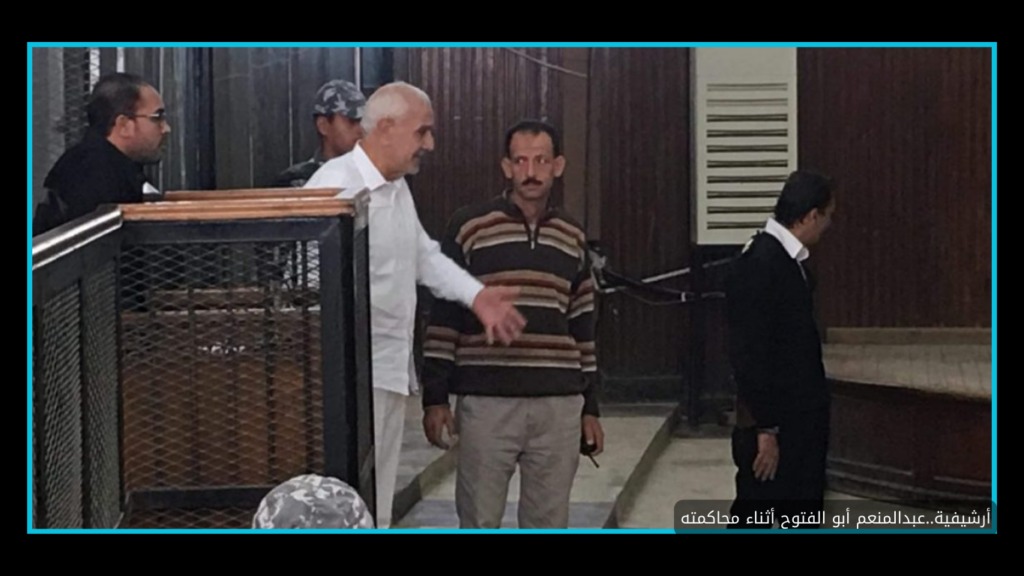
The military ruler yesterday, Sunday, 22 October, ratified the 15-year prison sentence of the head of the Strong Egypt Party and former presidential candidate Abdel Moneim Aboul Fotouh, and the 10-year sentences of the party’s deputy head, Mohamed El-Kassas, and student leader Moaz El-Sharqawy, in case 1059 of 2021.
In May 2022, the Emergency State Security Criminal Court issued the verdict against Aboul Fotouh, his deputy Mohamed El-Kassas, Al Jazeera presenter Ahmed Taha El-Qadi and 19 others, on charges of harming the country’s national interests and assuming leadership of a group established contrary to the provisions of the law, in case No. 440 of 2018 (Supreme State Security).
Although President Abdel Fattah al-Sisi announced the lifting of the state of emergency as of Tuesday, 26 October 2021, the decision did not apply to this case because it had been referred to court while the state of emergency was in force.
Aboul Fotouh: Prison Is Better for Me than Living in London’s Palaces
“Living in Abu Zaabal prison is better for me than living in one of London’s palaces.” These were the last words said by the former presidential candidate and head of the Strong Egypt Party, Dr Abdel Moneim Aboul Fotouh, during his interview with Al Jazeera in London, for which he had stipulated beforehand that the interviewer be Egyptian and a professional journalist without a political orientation, because he believes the media should not be politicised, as he told the interviewer at the time. The day after his return to Egypt he was arrested, specifically on 14 February 2018, and since then he has been held in continuous solitary confinement.
Nobel Peace Prize laureate Dr Mohamed ElBaradei says in a tweet on the social media site “X” that “according to the United Nations rules for the treatment of prisoners, solitary confinement is an exceptional punitive measure and may not exceed 15 days”.
A member of Abdel Moneim Aboul Fotouh’s defence team says: “Previously, the Mubarak regime used repression but tried to show respect for the laws, whereas the current regime does not recognise the laws at all and considers them pointless, and leaves no room for us to say that the arrest of Dr (Abdel Moneim Aboul Fotouh) is an illegal measure and that holding him in solitary confinement all these years violates the constitution, the laws and the rules of the United Nations.”
Who Is Abdel Moneim Aboul Fotouh?
Abdel Moneim Aboul Fotouh, 71, is a former presidential candidate who received 4,065,239 votes from Egyptians. He is currently held in solitary confinement at the Badr Correction and Rehabilitation Centre after being sentenced to 15 years’ maximum-security imprisonment in case 1781 of 2019 (Supreme State Security), in which he was accused of spreading false news and inciting against state institutions.
Abdel Moneim Aboul Fotouh was a prominent leading figure within the Muslim Brotherhood in Egypt, but he split from it and ran for president in 2011, and was one of the harshest critics of the Muslim Brotherhood’s policies at the time; nevertheless, many Egyptian media outlets accused him of belonging to it. He obtained a bachelor’s degree in medicine from Kasr Al Ainy Faculty of Medicine, was barred from appointment because of his political activity, was arrested in the famous arrests of September 1981, and then obtained a master’s degree in hospital management from the Faculty of Commerce at Helwan University.
Aboul Fotouh was arrested in 1981 under Egyptian President Anwar Sadat in the famous September arrests because of his opposition to the Camp David Accords; he was then arrested again, tried before military courts and imprisoned for another five years under former Egyptian President Mohamed Hosni Mubarak because of his membership of the group and his political activities. During his imprisonment he obtained a law degree from Cairo University.
On 8 February 2018, Dr Abdel Moneim Aboul Fotouh travelled to the United Kingdom and Qatar and took part in programmes on Qatar’s Al Jazeera and BBC Arabic. On 14 February 2018, Dr Abdel Moneim Aboul Fotouh’s son published a post on social media saying that security forces had arrested his father and 6 leaders of the Strong Egypt Party’s political bureau from their home in the Fifth Settlement and taken them to a security agency, before the political bureau leaders were released and Dr Abdel Moneim Aboul Fotouh was kept. On 25 February 2018, Egyptian Public Prosecutor Nabil Sadek decided to freeze the assets of Strong Egypt Party head Abdel Moneim Aboul Fotouh and 15 others on charges of carrying out “terrorist activities”.
Many consider Aboul Fotouh one of the moderate Islamists who believe in democracy; in his speeches he always stresses the importance of social justice with plans for development and security, the importance of removing the army from political life and limiting it to protecting Egypt’s borders, and that the Muslim Brotherhood should also stay away from politics and become a purely proselytising group.
Illegal Detention
Lawyer Ahmed Aboul Ela Madi, acting as attorney for the head of the “Strong Egypt” Party, submitted a request, registered as No. 49369 of 2023 (petitions of the Public Prosecutor’s Technical Office), stating that “his client Abdel Moneim Aboul Fotouh must be released immediately and mandatorily because his detention lapsed and stopped 11 months ago, specifically since 5 October 2022, in the case in which he is detained”.
He explained that “the verdict issued against him in the second case, in which he received a conviction, has not been ratified, as it is an emergency state security felony in which he was referred while free, and the verdict is not recognised or enforced until it is ratified”.
Poor Health Conditions
Ahmed Aboul Fotouh, son of Abdel Moneim Aboul Fotouh, said that his father had written his will in his last letter to the family. In his post on Facebook, Aboul Fotouh’s son accused people who “do not know the meaning of honour” of wanting to take revenge on his father and kill him in cold blood, in his words, without naming these people.
Aboul Fotouh suffers repeated heart attacks, in addition to other illnesses, and the Egyptian authorities reject the repeated demands of his family and lawyers to transfer him to hospital at his family’s expense to enable him to receive the necessary medical care that is not available in his place of detention.
Dr Abdel Moneim Aboul Fotouh suffered six angina attacks at close intervals during his detention, made worse by the lack of ventilation in his place of detention. According to a complaint filed by the Egyptian Center for Economic and Social Rights and the Adalah Center for Rights and Freedoms in 2019, “the recurrence of these attacks is a very dangerous indicator of the possibility of a heart clot and narrowing of the coronary arteries, and over time this may lead to the death of parts of the heart muscle and failure in its function, which requires urgent medical tests and admission to cardiac care, and it is also necessary to have a companion with him to give him first aid inside his place of detention”. According to the same complaint, Dr Abdel Moneim Aboul Fotouh suffers from an enlarged prostate, and surgery had been scheduled for him before his arrest in February 2018; with medical negligence, the prostate enlargement increased significantly, leading to severe congestion, negative effects on the kidneys and bladder and difficulty urinating, and he currently needs urgent surgical intervention to stop the deterioration of his condition. He also suffers from diabetes, which causes episodes of high or sudden low blood sugar, and during his detention it is difficult to maintain the ideal sugar level because healthy food is not available in prison.
Punished through His Family
After Dr Abdel Moneim Aboul Fotouh’s detention, his son was added to the same case on charges of joining a terrorist group, in addition to being placed with his father on terrorism lists in February 2018. Although that decision was appealed and cancelled in February 2020, nothing changed legally for his son: his legal status remained that of a person on those lists, so he is barred from political rights, barred from making officially documented sales and purchases, and also barred from obtaining a passport; the decision also prevents him from being appointed in the government sector, his bank balance is frozen, the assets he owns have been frozen, and his membership in unions, company boards, clubs and any entity dedicated to public benefit has been suspended, among other effects of being placed on terrorism lists. He was then placed on the terrorism lists again by a new decision on 23 January 2021.
His other son was also barred from travelling several times, so he could not return to his job abroad, which he had held since 2009, and later, in 2019, he was dismissed from his job in Egypt at a private sector company, where he was told at the time that the dismissal came “at a security request”, and whenever he applies for a job and is accepted, the hiring is reversed.
It has become a security practice in Egypt to arrest relatives as punishment for a family member’s political, human rights or journalistic activity. For example, security forces arrested 12 members of the family of former MP Ahmed Tantawy, a prominent opposition figure and prospective candidate for president in the upcoming election, and the security authorities also arrested the father of journalist Ahmed Gamal Ziada in an attempt to silence him, as Human Rights Watch said. You can read more details about the arrest of relatives in our report The Dirty War in Egypt: Silencing Dissidents Abroad by Arresting Their Families.
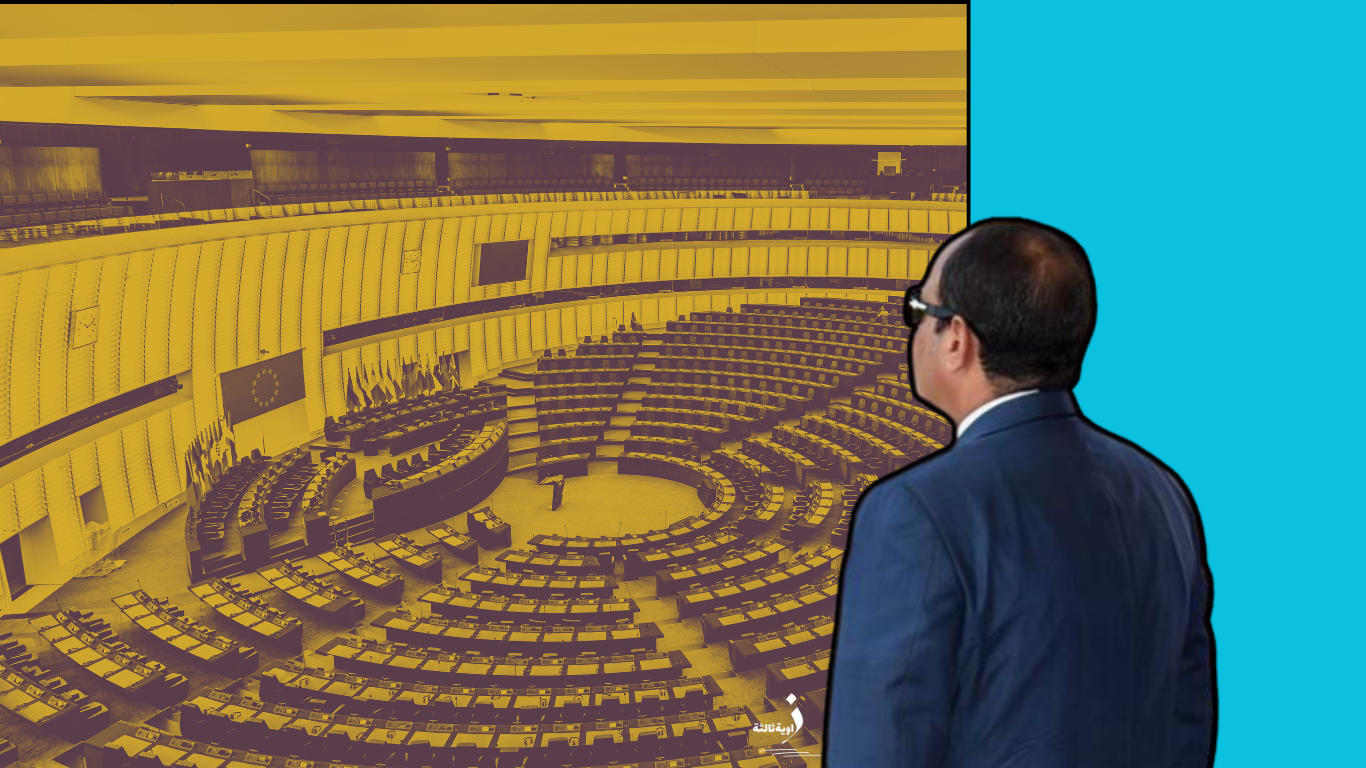
It is worth noting that Egypt launched a national political dialogue which the authorities said aims to set plans for the country’s future, including improving the human rights situation. This dialogue was announced by President Abdel Fattah al-Sisi in April 2022, and Sisi had sent a recorded message to the opening session of the National Dialogue in which he said: “I urge you to make a great effort to make the National Dialogue experience a success, and difference of opinion does not spoil the nation’s cause.”
Seven human rights organisations described “the past ten years of Egypt’s rule as the worst decade for human rights in Egypt”. The organisations stated that ten years ago, President Abdel Fattah al-Sisi, then Minister of Defence, asked Egyptian citizens in a public speech to grant him a mandate to confront potential violence and terrorism, and that this “turned into a mandate for repression that paved the way for the Rabaa massacre in August 2013, in which more than 800 protesters were killed by security forces”, and that “the mandate speech allowed the authorities to use security pretexts to strengthen their grip, silence independent media and civil society, and eliminate all forms of opposition, including peaceful opposition, Islamist or secular”.