
The crisis facing residents of Tousoun, in Alexandria’s eastern Montazah II district, has flared again as demolition and clearance begin in parts of the neighborhood while courts continue hearing challenges to a decision to expropriate hundreds of homes and properties for a new ring road.
The government says the project serves the public interest and improves the road network. Residents and their lawyers told Zawia3 that alternative engineering routes could avoid demolishing the residential area. They argue that the project ultimately serves investment and tourism developments in East Abu Qir.
Mohamed Ramadan Abu Baybars, the lawyer representing Tousoun residents, says the current crisis recalls 2008, when he challenged orders to demolish residents’ homes and obtained a judgment suspending and overturning them.
“Seventeen years later, the same scene is repeating itself,” he told Zawia3. “This time it is through expropriation decisions issued in October 2025, covering dozens of homes and plots of land, as well as four mosques and a church.”
At residents’ request, Abu Baybars filed a case before the Administrative Court challenging the expropriation decision on several grounds. Chief among them is the absence of a public-interest purpose: he argues that the planned project “serves a tourism and investment development rather than a public facility.” He also cites an existing road that already meets the traffic need and an engineering proposal for an alternative route that would avoid demolition and expropriation.
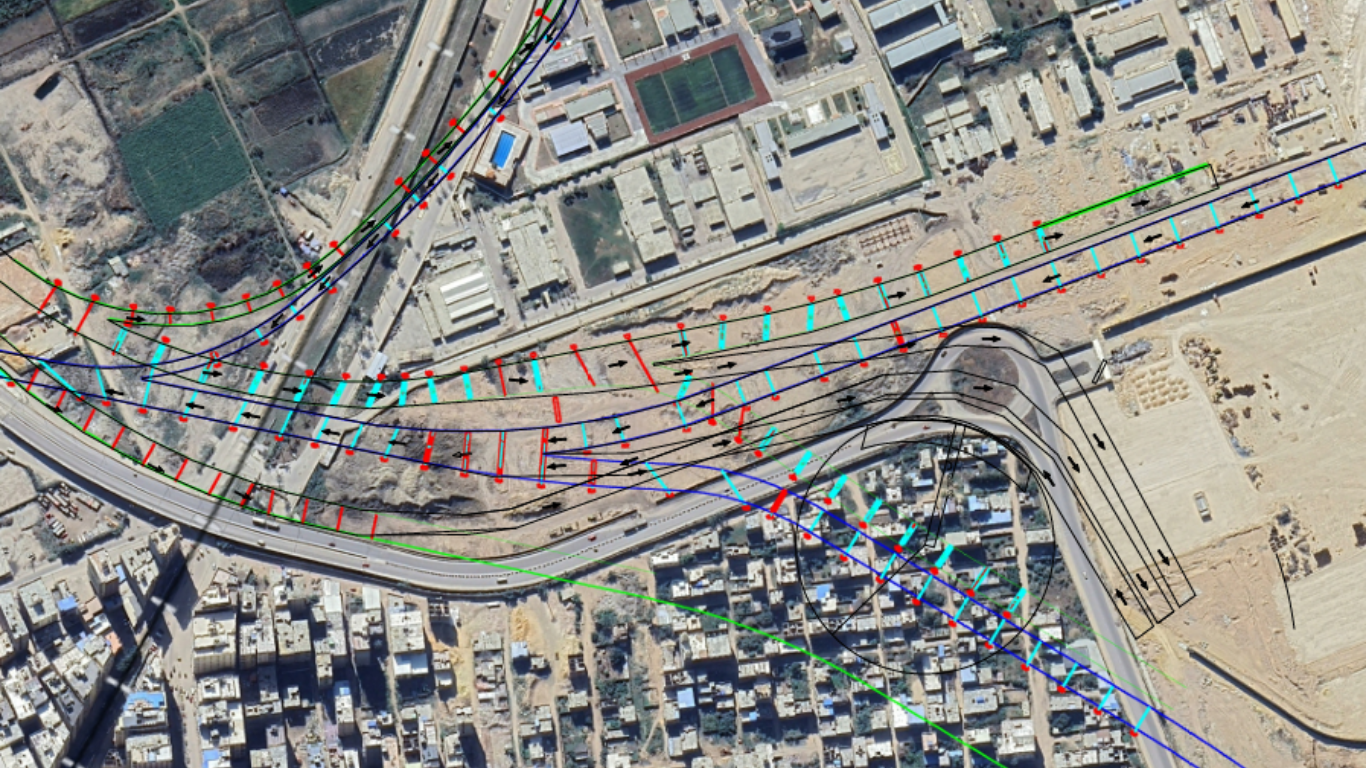
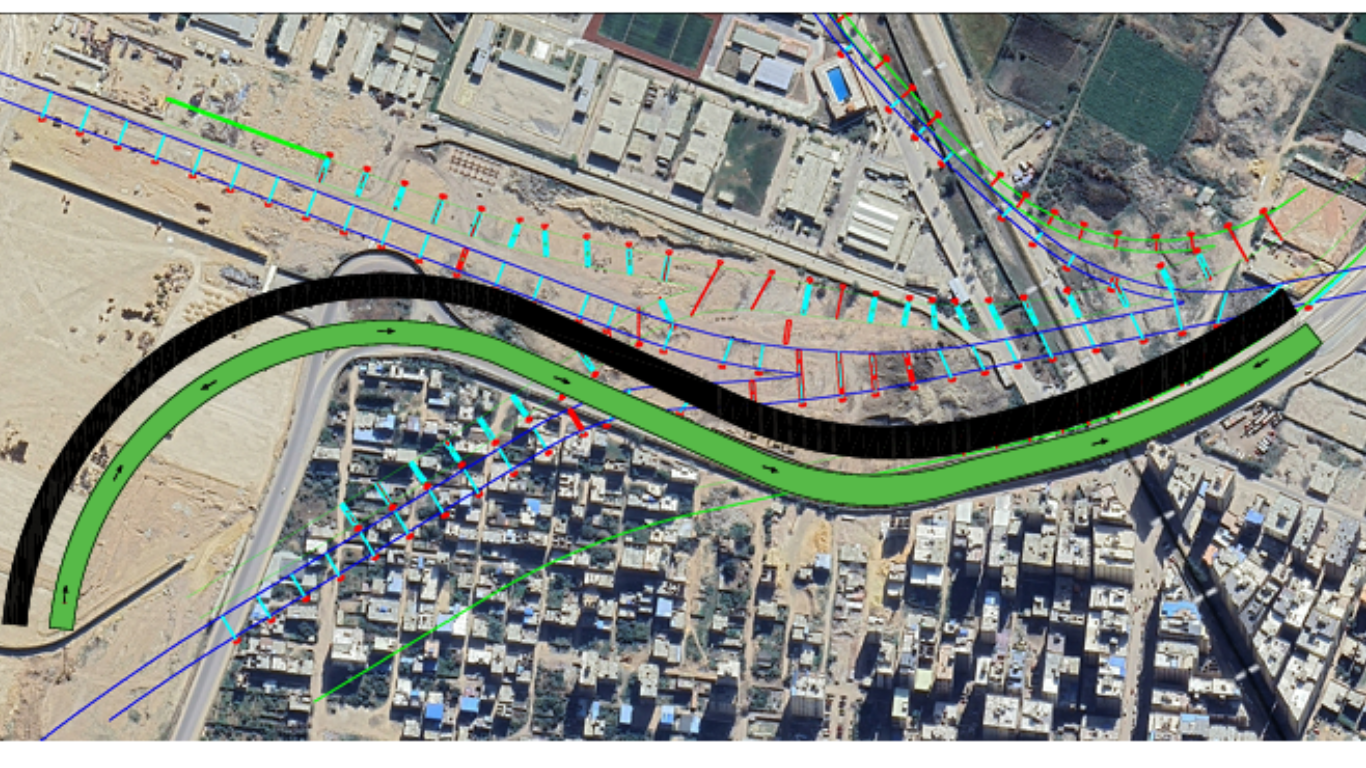
The court appointed a three-member panel of engineering experts to examine the dispute. Abu Baybars calls this a “partial victory” in a case of this kind. Residents are still waiting for the panel to begin its work. In his view, however, the most serious development concerns not just the litigation but what he describes as “pressure on the ground” against residents.
According to his account, Production Company for Integrated General Supplies, Contracting and Road Paving, which he says has established a temporary base in the area, began approaching residents to buy their homes.
Citing residents’ complaints, he says company representatives used inducements and intimidation to encourage sales, including telling residents that “sovereign authorities” were handling the matter, that refusing to sell would ultimately lead to forcible eviction, and that the company was acting for one such authority. He says these pressures prompted a limited number of residents to sell, while most refused.
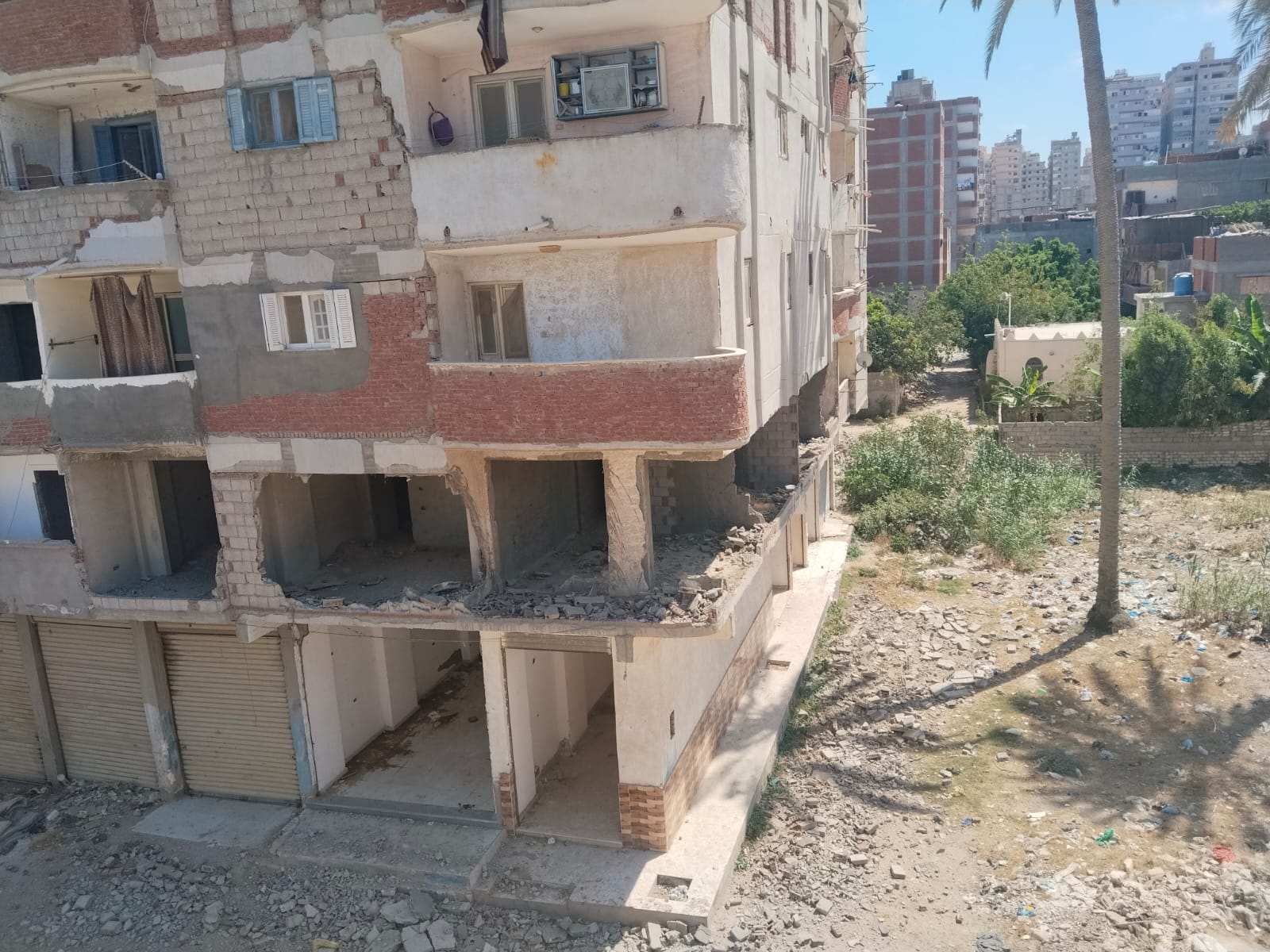
Abu Baybars says the pressure recently escalated. He cites a building containing 30 apartments, where the company bought 12 units and then began removing their walls and balconies. This caused cracks elsewhere in the building and damaged its façade, he says, increasing pressure on residents who refused to sell.
He also accuses the company of damaging sewage networks and cutting electricity to some properties. Residents tried to file police reports at Montazah II police station but were unable to do so, according to his account.
Zawia3 was unable to obtain a response from the company or the Interior Ministry to these allegations by publication time.
Abu Baybars says the legal team will pursue the court proceedings while awaiting the expert panel’s work and will file a complaint with the senior advocate general concerning the allegations against the company. He also calls for reconsideration of the decision classifying the project as a public-interest undertaking.
The challenge submitted to the Administrative Court against the president, prime minister, ministers of local development and transport, and Alexandria governor rests on four main grounds.
The first concerns violations of Law No. 10 of 1990 on expropriation for the public interest, amended by Law No. 24 of 2018. The defense argues that the decision was issued without following legally required procedures, particularly preparing a detailed project memorandum and submitting it to the competent permanent technical committee to assess its feasibility and actual need for the properties, while allowing affected parties to comment.
The second concerns the absence of a public-interest purpose. The defense points to an existing road linking the area and an alternative route that could meet traffic needs without destroying homes or agricultural land. It argues that the project actually serves a yacht marina and investment-oriented tourist area, which, in its view, disqualifies it as a public-interest undertaking.
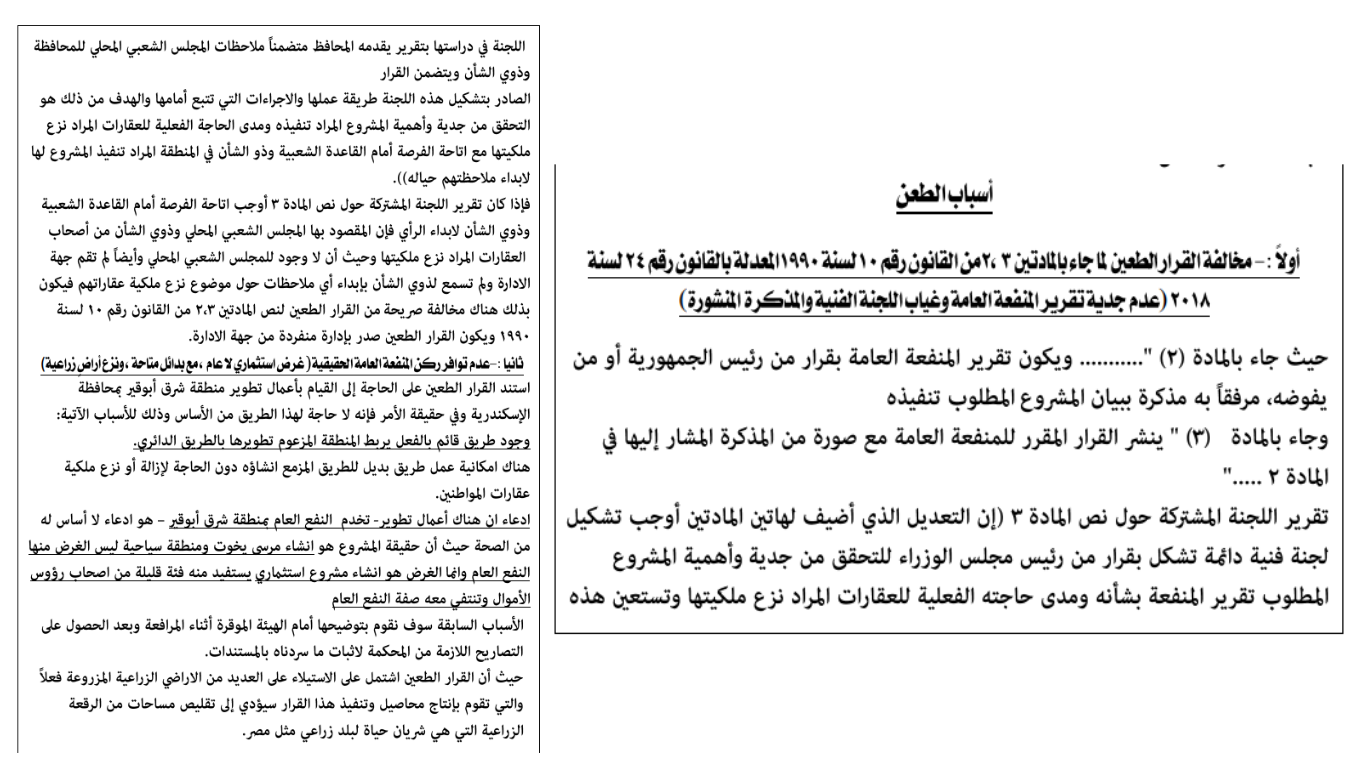
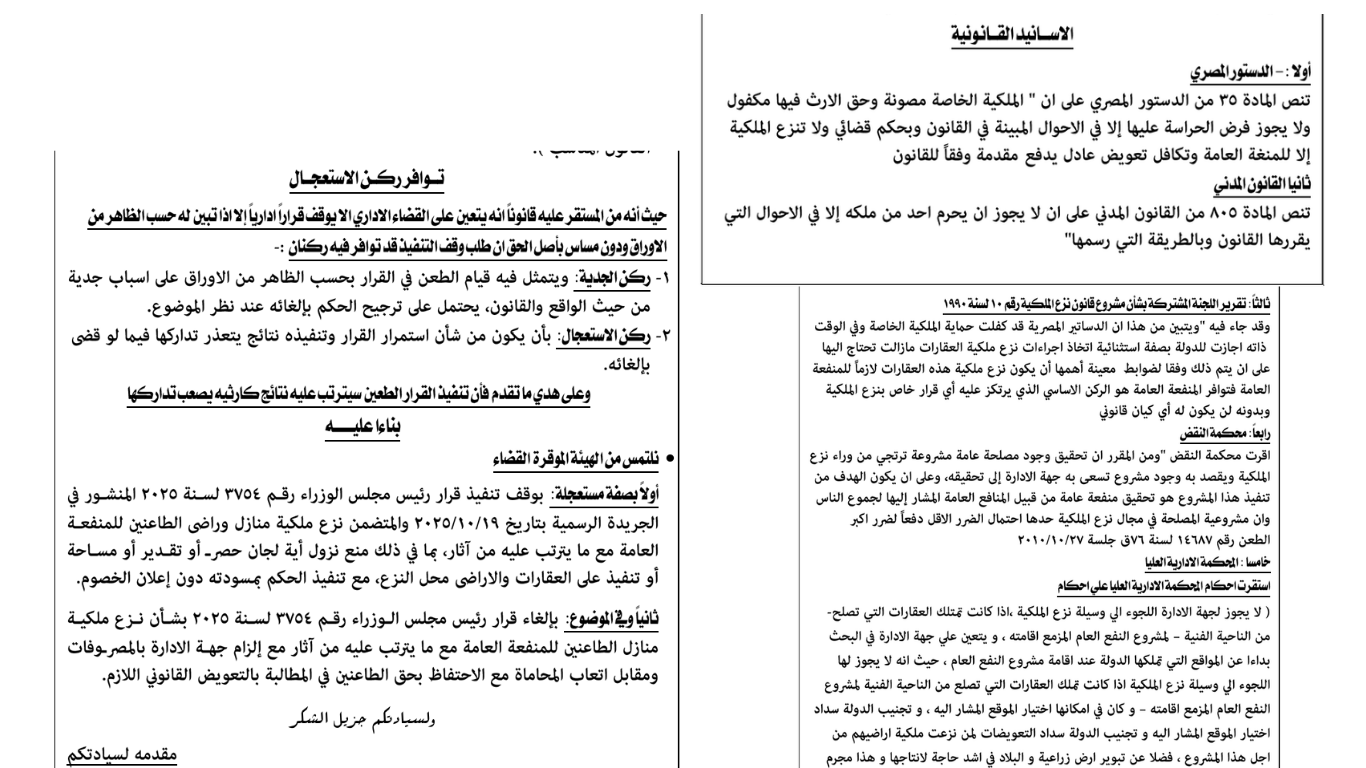
The defense also alleges abuse of power, citing a similar dispute in 2008, when the administrative judiciary overturned demolition decisions made in preparation for allocating land to Al Ittihad Alexandria Club. It further cites a Supreme Administrative Court judgment in Appeal No. 367 of Judicial Year 30, which held that expropriation for a private purpose rather than the public interest is unlawful.
The challenge warns of the social consequences of removing residents’ homes and agricultural land for a development they regard as investment-oriented. It argues that this could fuel tensions, erode confidence in justice and affect community stability. It seeks an urgent suspension followed by annulment of the expropriation decision and compensation from the administrative authority for residents’ losses.
According to residents and their lawyers, Production Company is carrying out demolition and clearance related to the project. The company had not commented on that account by the time this report was prepared.
Founded in 2022 as a limited liability company, it is headquartered in Alexandria’s Sporting district. Its activities include general contracting, demolition and clearance, excavation and backfilling, road paving and landscaping.
On its website and LinkedIn page, the company presents itself as an integrated contracting solutions provider, emphasizing demolition using specialized equipment and occupational safety systems. It says its management and workforce bring more than 30 years of accumulated experience.
According to its own information and material published on the government procurement portal, the company has participated in government transport projects in Alexandria, including demolishing buildings along the Abu Qir Metro route, and in other infrastructure tenders.
Expropriation: a law serving power
Lawyer Mohamed Fattouh says expropriation law imposes two indispensable conditions: a genuine public-interest purpose and fair compensation reflecting the actual value of the property when the decision is implemented, rather than when it is issued.
He told Zawia3: “Fair compensation does not simply mean paying a sum of money. It must enable the owner to obtain a comparable alternative at prices prevailing when the project is implemented. Compensation cannot be assessed years earlier and then paid after successive waves of inflation without reassessment.”
Fattouh cites the Alexandria tram redevelopment project. The state allocated about EGP 50 million to compensate affected shop owners when the expropriation decision was issued in 2020, he says, but implementation began years later after prices rose sharply. “The compensation should have been adjusted to prices at the time of implementation to meet the fairness and contemporaneity required by law.”
He points to another case in Alexandria’s Al Maawa area, where families were moved to Bashayer El Kheir after their homes were demolished as informal housing. The problem, he says, was not simply providing replacement units but the legal rights granted to residents. “Many families owned their homes, but the replacements were provided on a usufruct basis rather than with ownership contracts. That raises legal problems concerning secure ownership and inheritance.”
These cases were challenged before Alexandria’s Administrative Court, he says. Lawyer Hamdi Khalaf filed dozens of cases for affected residents. Fattouh sees them as a recurring pattern in the application of expropriation law.
In Tousoun, he argues, the question is not merely whether compensation exists but whether it is fair and adequate. “The administrative authority talks about compensation, but the real question is whether these amounts can buy an alternative home within Alexandria. In my assessment, they cannot.”
Although compensation is in principle subject to judicial oversight, he says scrutiny generally focuses on the legality of the expropriation decision rather than the adequacy of compensation or the soundness of implementation procedures. “The court usually examines whether the expropriation decision is lawful, while its consequences—particularly the amount and implementation of compensation—require broader judicial oversight.”
He cites the Abu Qir Metro project, where some residents were asked to leave their homes temporarily during construction in return for a monthly rent allowance of about EGP 2,000. “That is insufficient to rent suitable housing in Alexandria and leaves families facing financial burdens they cannot bear.”
For the Tousoun road, Fattouh insists that expropriation should be a last resort after all engineering alternatives have been exhausted, especially where other routes could serve the same purpose without affecting homes. “Property rights are protected by the constitution, law and international agreements ratified by Egypt. They may only be infringed within the narrowest limits and after a genuine necessity has been established.”
He argues that Law No. 10 of 1990, despite amendments, no longer reflects the urban and economic changes Egypt has undergone in recent decades, including notification procedures, compensation assessments and safeguards during implementation. “The law still relies on traditional procedures unsuited to present conditions, while property prices, urban patterns and ways of communicating with citizens have changed.”
Fattouh calls for legislation updating expropriation mechanisms, requiring authorities to reassess compensation at market values when implementation occurs, and allowing full judicial scrutiny of compensation. The central criterion, he says, should be whether residents can obtain comparable replacement housing, rather than simply receiving a payment out of step with actual prices.
What is happening now?
An Alexandria human rights activist who recently visited Tousoun, and asked not to be named, says she saw heavy equipment in the area after residents and Abu Baybars told her machinery had begun arriving at the project site.
“As soon as I entered the area, the new corridor’s route was clearly visible,” she told Zawia3. “I was standing in a tall building overlooking the site, and from there I could see the heavy equipment.”
The scale of the machinery reminded her of images of the separation wall in the West Bank. “When I first saw it, I asked myself: am I in the West Bank?”
From a distance, she observed excavators, bulldozers and heavy lifting equipment stationed near the sea and around the new bridge under construction. She could not identify the exact machinery because of her distance from the site, but described it as “huge equipment intended for construction and demolition.”
She also saw signs of clearance on some buildings: parts of façades removed and some walls demolished. She could not establish the details of what had happened inside the area.
Talk of impending eviction had circulated among residents for a long time, even before the litigation began, she says. The recent demolition nevertheless came as a surprise to them.
She did not witness direct confrontations between residents and those conducting the works during her visit. The equipment was positioned on vacant land away from the residential clusters.
She believes these locations “may be an attempt to avoid confrontation with residents in the initial phase.” This reminds her of developments on Al Warraq Island, where work began in empty areas before approaching inhabited ones.
She says approaches differ with each area’s urban and social characteristics. Al Warraq Island, for example, still sees resistance at its entrances, and implementing authorities have not penetrated its center because of its geography and residents’ close ties. Ras El Hekma is different: its scattered housing makes demolition easier.
Tousoun, she says, is different again, with a dense, continuous residential area that makes large-scale clearance more complicated. “I do not think direct demolition will be the first choice. It may be the last, after other means have been exhausted.”
She believes continued purchases of residents’ homes are more likely, describing that approach as “less costly and less likely to provoke confrontation,” referring to residents’ accounts of purchases of some apartments.
The activist says any compensation residents receive will be insufficient to obtain alternative housing in Alexandria at current property prices. “Even if someone receives EGP 300,000, it is very difficult to buy another apartment in the city, except perhaps in very distant areas. Some homes also contain more than one family, so compensation does not meet the needs of everyone living there.”
The loss extends beyond housing to livelihoods and social networks built over years, she says. Many Tousoun residents work locally or own workshops, shops and small businesses. Moving would sever those economic and social connections and add transport costs and longer journeys to work.
She describes what is happening as “forced displacement, even if accompanied by financial compensation.” The core issue, she says, is residents’ right to remain in their homes and decide whether to sell, rather than the amount of compensation. Similar experiences elsewhere, including around Arish Port, show that relocation cannot replace people’s historical and economic ties to the places where they have lived for years.
A dispute stretching back 17 years
The crisis has its roots in a conflict with state authorities that began more than 17 years ago. In 2008, the area experienced its first wave of evictions following Decision No. 957 of 2008 to expropriate agricultural land.
On May 12 that year, Alexandria’s executive authorities carried out demolition orders against several homes with Central Security forces and demolition machinery. Officials said the land belonged to the state and the buildings violated the law. Residents maintain that they had lived there for many years and that the land was their main source of income.
The disputed land covered about 42 feddans of agricultural land irrigated by the Montazah Canal. It remained productive farmland for decades. According to residents, landfilling undertaken as part of urban development projects cut off irrigation and made cultivation impossible, forcing farmers to abandon the land as its productivity declined.
A court judgment that did not end the dispute
Residents challenged the demolition orders before the administrative judiciary. In May 2009, the Administrative Court suspended their implementation, a legal victory that gave residents hope of keeping their property.
The crisis did not end there. According to litigation files and documents reviewed by residents and their lawyers, roughly 30 remaining feddans were subsequently placed under custodianship before ownership passed to Alexandria Governorate. Residents’ lawyers say this violated safeguards under Agrarian Reform Law No. 3 of 1986 concerning disposal of agricultural land and compensation. Executive authorities continued treating the land as state property.
In April 2025, Alexandria Governor Lieutenant General Ahmed Khaled issued Decision No. 88 of 2025 establishing a committee to inventory conflicts along the new ring road in the city’s east, a route about 23 kilometers long. On October 22, 2025, the Official Gazette published the prime minister’s decision to expropriate land and property in Tousoun to build the road and connect it to the Mahmoudiya Corridor.
Residents believe the project is also intended to facilitate access to a private tourism development in the area. They therefore regard the chosen route as serving investment considerations that could have been met through less socially damaging alternatives. The government has neither announced such a connection nor responded to those allegations.
Residents’ fears extend beyond losing their homes to the lack of clear guarantees of rehousing or compensation sufficient to relocate within Alexandria. The government says expropriation follows the law, serves public-interest projects and provides the prescribed compensation through the applicable legal procedures.
The arrest of residents’ representative
As the crisis escalated, residents chose Abdullah Mohamed El Sayed, 29, to represent them before authorities and the media and coordinate legal action. He was arrested in September 2025, days after meeting Lieutenant General Kamel El Wazir, deputy prime minister for industrial development and minister of transport and industry, to present residents’ demands.
Abdullah was referred to the Supreme State Security Prosecution and accused of joining and financing a terrorist group, spreading false news and misusing social media. He was subsequently released.
Last December, Alexandria’s Administrative Court referred the case brought by 62 Tousoun residents against the president, prime minister and Alexandria governor to the State Commissioners Authority for a legal opinion, while rejecting the urgent portion of the claim.
During the proceedings, the legal team, including lawyers representing the Egyptian Initiative for Personal Rights (EIPR), argued that the planned road lacked a public-interest purpose and served investment objectives instead. It submitted documents and maps that it said showed an existing road and requested official maps of the project and surrounding land. These would be presented to a panel of road engineering professors at Alexandria University to assess the project’s actual necessity and possible alternative routes avoiding demolition of the residential area.
EIPR said the rejection of the urgent claim was inconsistent with the risks facing Tousoun residents and what it described as a direct threat to their right to housing. It pledged continued legal support and defense of their rights to participation, transparency and access to information about public projects affecting their homes and property.
Hundreds of families facing demolition
According to an inventory prepared by residents’ representatives, expropriation covers about 320 homes, four mosques and a licensed church serving more than 5,000 people, mainly working families and people on middle and low incomes.
The state allocated total compensation estimated at EGP 1.262 billion across 596 plots and properties, averaging around EGP 2.1 million per property. Residents say these assessments fall short of Alexandria’s market values and cannot provide replacement housing amid sharply rising property prices.
Residents also commissioned an engineering consultancy to develop an alternative road route. According to the study, the proposal would meet the same traffic purpose without demolishing the existing residential area, while maintaining road efficiency and capacity. Residents’ representatives say they submitted it to the relevant authorities, but it was not adopted, and they received no technical response refuting the proposal or explaining its rejection.
Residents believe the disregard of this alternative reinforces their concerns that investment considerations influenced the final route. The government maintains that expropriation serves public-interest projects and improvement of the road network.
A historic neighborhood on the new road’s route
Tousoun lies in eastern Alexandria’s Montazah II district, whose population was about 575,000 according to 2023 Central Agency for Public Mobilization and Statistics data. It sits roughly in the district’s center and has about 5,000 residents, most from families settled there since the 1990s, according to Diwan Al Omran.
Named after Prince Omar Tousoun, a grandson of Mohamed Ali Pasha, the area has historical as well as social importance. Its landmarks include Prince Omar Tousoun’s palace, built during the Mohamed Ali dynasty with architecture characteristic of that period. The palace is now neglected and used as a storehouse by an educational institution. Other nearby landmarks include Kousa Pasha Fort and archaeological sites associated with Abu Qir Bay.
Dr. Abdel Rahim Reihan, a member of the Supreme Council of Culture’s History and Antiquities Committee, told Diwan Al Omran that construction around Abu Qir Bay could affect heritage sites of global importance, including submerged cities and ancient ships. He said Egypt was a party to UNESCO’s 2001 Convention on the Protection of the Underwater Cultural Heritage and therefore required specialized archaeological studies before construction to protect irreplaceable heritage.
Despite the continuing litigation, Tousoun’s crisis goes beyond disagreement over a road route or compensation. It raises a broader question about how major development projects are managed. While the government maintains that expropriation is lawful and serves the public interest, residents and their lawyers insist that such an interest must include transparency, consideration of less harmful alternatives, fair compensation ensuring family stability, and respect for the right to litigate before administrative decisions become a fait accompli.