They Paid in Full, Registered the Deeds, Won in Court. Then Mostakbal Misr Demolished Their Village
Families paid in full, registered their deeds and won in court, yet Mostakbal Misr demolished their village on Egypt’s northwest coast.
Zawia3
In the early 1990s, university professor Salwa Mohamed Rushdi was dreaming of her family owning a summer unit on the northwestern coast, with its white sandy beaches and clear turquoise waters. She chose a new residential project called “Ibn Sina 2 Village,” at Kilometer 132 on the northwestern coast of Matrouh Governorate, announced by the Community Development Association of the Hospital and Educational Institutes Authority, registered under No. 2502 of 1987, headed by Ramadan Abd El-Qader Khalil Arisha, who later became commissioner of the Ibn Sina Owners’ Union.
After reviewing the project’s official papers, she contracted to purchase a residential villa at Plot No. 12, in the front row facing the beach. Despite paying the full price and obtaining a final blue ownership contract, she waited years before construction was completed, then further years before utilities reached the village, until she and approximately 180 owners were shocked to learn that the project owner had defaulted on a loan he had taken from a bank, freezing its legal status for many years without the ownership being settled through an auction sale or transfer to another investor.
During that period, the affected parties resorted to the courts and obtained rulings ordering the delivery of their units inside “Ibn Sina 2.” Owner Salwa Mohamed Rushdi Subaih obtained, on November 5, 2024, the executive formula for the ruling issued in her favor in Case No. 18 of 2023, Partial Civil Al-Alamein, after the ruling was issued on October 28, 2024, obliging Ramadan Abd El-Qader Khalil Arisha, in his capacity as commissioner of the “Ibn Sina 2” Owners’ Union, to deliver the contracted land and enable her to take possession of it in accordance with the allocation contract dated March 11, 1993, following the submission of a certificate stating that the ruling had not been appealed.
After a wait spanning nearly three decades, the owners, including Salwa Rushdi, agreed to complete the finishing of the villas and chalets at their own expense to preserve their investments. She spent more than one million Egyptian pounds ($19,230.77) of her savings on completing her villa’s finishing work, including plumbing, plastering, paintwork, and interior finishes. But when she went to the village in October 2025 to add exterior touches to the villa’s facade, she and a group of owners were shocked to find themselves barred from entry by a member of the Armed Forces standing at the gate alongside a vehicle bearing the logo of the “Mostakbal Misr Device,” as she told Zawia3.
She recounts that an army officer told them he had instructions not to allow any person to enter the village, and that they should choose three representatives to go to the Legal Department in Nasr City to discuss their situation. But when the owners’ representatives went to the Legal Department, they were told, according to her account, that the registered contracts they held were “forged,” that the village owner had purchased the land through an informal paper, and that they should return to the project’s owner to claim their rights.
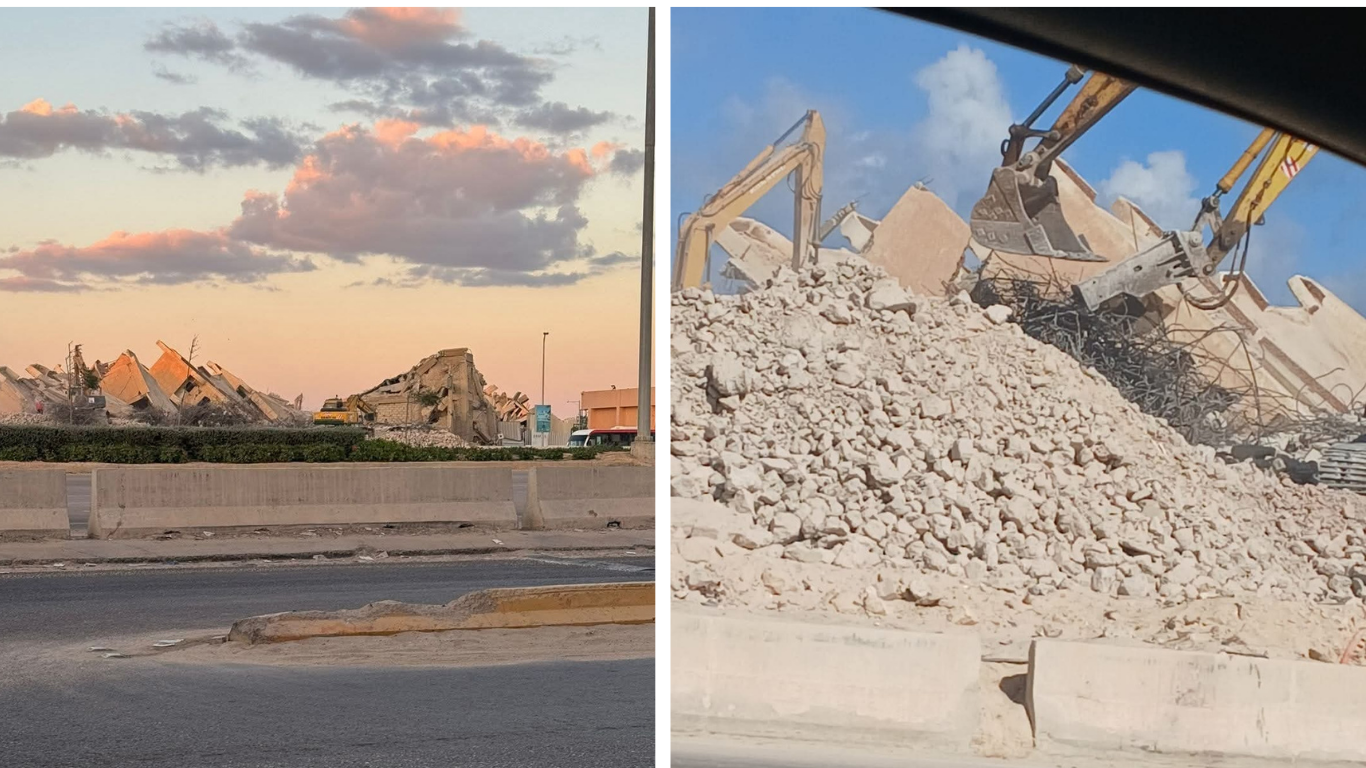
She says: “We owners then went to the New Urban Communities Authority, where we were informed that 14 stalled villages, including Ibn Sina 2, had been transferred to the Armed Forces’ jurisdiction, and we believed at the time that this would lead to the protection of our rights and the settlement of our legal situation. But when we returned to the village later, we were shocked to find heavy equipment and excavators carrying out demolition of the villas and buildings inside the project. The scene was shocking, resembling what happened in Gaza, and we were barred from entering. I then received news that my villa, on which I had spent my savings, had been demolished.”
Part of the demolition works at Ibn Sina 2 Village.
The owner affirms that she would have accepted the loss of her unit if it had been for considerations related to national security or the needs of the Armed Forces, but what happened subsequently was the conversion of the village site into an investment project. Owners were shocked after the demolitions when construction equipment and trucks belonging to three large contracting companies entered the village’s beach from the Marassi side. When they filed trespass reports against them at the police station, they received promises that the site would be vacated within four months, which eventually happened, but new construction work began shortly before summer 2026, converting the beach into a restaurant and seasonal beach resort called “Cocoon.” The information available to the owners indicates that it leases the beach or holds annual usufruct rights without purchasing the land.
Dr. Osama Rateeb recalls that his family contracted with the Association in 1993 to purchase a unit inside Ibn Sina 2 Village on the northwestern coast of Matrouh, directly adjacent to which the “Marassi Marina and Yacht Club” project of Emaar Properties, owned by Emirati businessman Mohamed Alabbar, was established in 2020. The village at that time contained a large number of villas and residential buildings, most of which had been completed, including approximately 180 plots allocated for villas. While some owners managed to register their ownership contracts with the Real Estate Publicity Office, the project remained uninhabitable due to the incomplete connection of utilities to the residential units.
He points out that the project faced a crisis when the association’s directors obtained a loan from the Arab Egyptian Real Estate Bank using 126 land plots out of the total 306 within the village as collateral, then defaulted on repayment, leading to loan restructuring and the re-mortgaging of the lands until the debt multiplied. However, the mortgaged lands were not owned by others but were still owned by the Owners’ Union, as only 180 plots had been sold while 126 plots remained in the Union’s name, which legally enabled it to mortgage them.
He adds that the bank announced auctions to sell the mortgaged units on more than one occasion, but these auctions, according to his knowledge, were never completed and never resulted in an actual sale, noting that the units subject to the mortgage represent a limited proportion compared to the total project comprising hundreds of units, while the majority of owners remained outside this dispute.
Despite their ownership rights established for more than three decades, he and other owners and their heirs were shocked in late October 2025 when demolition of the village’s buildings began in their entirety without prior notice or an official announcement clarifying the reason for demolition or its legal basis. When they went to the village site to find out what was happening, they were prevented from entering or photographing. He confirmed that he was temporarily detained inside an army vehicle and had his mobile phone confiscated to delete photographs he had taken during the demolition operations.
He told Zawia3: “The owners did not receive any official decisions regarding expropriation, land allocation, or public utility declarations. Initially we heard unconfirmed accounts linking the demolitions to the Marassi project, but they remained at the level of rumors, particularly since the land was not subsequently annexed to the project.”
He explains that owners were told to go to the Mostakbal Misr Device, which became the body they dealt with, but they received no clear explanation or official document from it clarifying the reasons for the demolition or the legal status of the village land, which was completely leveled, before being prepared and equipped during summer 2026 to host entertainment and seasonal events for a fee, under the name “Cocoon.”
He confirms that owners filed complaints after the demolition with multiple official bodies, including the Presidency of the Republic and the Secretariat General of various government bodies, but have to date received no official response or announcement regarding compensation or the legal status of the land.
Amid the relevant authorities’ refusal to announce any decisions regarding expropriation for public utility, or the withdrawal of the village lands and their allocation to Mostakbal Misr, or the transfer of their jurisdiction to the Armed Forces, and despite testimonies from a number of owners documented by Zawia3 indicating the transfer of northwestern coast village files to the army and the Device, and some being told their contracts are forged and that the village lands are state-owned encroachment, Zawia3 obtained an old document that refutes the authorities’ account and confirms the validity of the land ownership.
On May 3, 1994, the Egyptian Official Gazette published in its 99th issue Matrouh Governorate Decision No. 45 of 1994, approving the subdivision of the “Ibn Sina (2) Village” project in the Sidi Abd El-Rahman area, Al-Alamein Center, issued by the then-Governor Mohamed Zaher Abd El-Rahman on January 31, 1994, following the Al-Alamein City Council’s approval of the project submitted by the Community Development Association of the Hospital and Educational Institutes Authority, and the notarized contract No. 215 of 1993.
Under the first article of the decision, the subdivision of “Ibn Sina (2) Village” was approved at a total area of 289,397.75 square meters. The decision defined the project’s boundaries: to the north, the Mediterranean Sea setback at a width of 100 meters and a length of 300 meters; to the east, land belonging to the “Holiday” company; to the south, the Alexandria-Matrouh highway setback at a width of 50 meters; and to the west, state-owned lands with boundaries and dimensions as specified in the decision. The second article approved the building conditions specific to the project according to the approved general plan, while the third article obligated the Community Development Association to implement all public utilities for the project at its own expense, under the supervision of the Al-Alamein Center and City Local Unit, according to the approved timetable and implementation phases.
Financial Default and Legal Disputes
The allocation contracts for units in the “Ibn Sina (2) Village” project, reviewed by Zawia3, show that purchasers committed to paying the price of the units through installments. Clause Four of the contracts stated that the allocation was made in exchange for an advance payment of 25,000 Egyptian pounds ($480.77) out of the total unit price of 45,068 Egyptian pounds ($866.69).
The contract also obligated the purchaser to pay the remaining value through a set of bills of exchange due on specific dates, each worth 1,829 Egyptian pounds ($35.17), in installments beginning in September 1990 and extending to 1998, according to the payment schedule attached to the contract.
Clause Five of the contracts stipulated that if the purchaser delayed payment of any installment on its due date, the remaining unit price would become due in full, giving the contracting party the right to demand the entire remaining value according to the contract terms.
Lawyer Hassan Ibrahim, who inherited ownership of one of the Ibn Sina 2 Village chalets from his late sister, recounts that she had contracted in 1998 to purchase the chalet through the Community Development Association headed by Ramadan Arisha, paying the full value in installments, alongside additional amounts requested for connecting utilities such as electricity and water, with a promise to deliver the unit fully finished, which did not happen due to the project entering financial and legal disputes that lasted for years.
He explains that the contracts purchasers signed were installment sale contracts, with final contracts to be drawn up after full payment, but they were surprised after completing payment to find the units were not delivered nor were ownership transfer procedures completed.
This pushed the owners, including his sister, to file lawsuits demanding the delivery of the units. However, one of the delivery cases was referred to the Marsa Matrouh Court, and then its procedures were delayed after the courthouse burned during the 2011 revolution events, before they were later able to extract documentation showing that the case had been submitted and a judicial ruling had been issued affirming their right to receive the contracted chalets, as he told Zawia3.
An official document obtained by Zawia3, issued by the Nasr City Partial Court of the North Cairo Court of First Instance, dated March 29, 2015, reveals a lawsuit filed by Hanaa Ibrahim Hassan Othman against Ramadan Abd El-Qader Khalil Arisha, in his capacity as commissioner of the “Ibn Sina 2” Owners’ Union, registered on March 23, 2010, with its last session before Circuit 48 on June 30, 2011, demanding the delivery of Chalet No. 1 in Chalet Complex No. 15A in Agyal Village, Sidi Abd El-Rahman, based on an allocation contract dated July 19, 1995.
The lawyer adds: “After the Owners’ Union became involved in debts to the Arab Egyptian Real Estate Bank that led to the mortgaging of the land, the bank entered into negotiations with a number of owners and offered them at various stages the payment of additional amounts to settle their situations, beginning at approximately 7,000 Egyptian pounds ($134.62) then rising to approximately 16,000 Egyptian pounds ($307.69), but these procedures did not lead to the delivery of units or the resolution of the dispute.”
Previously, the Alexandria Economic Court set a date of November 11, 2023 for the sale of a number of residential units at Ibn Sina 2 Village at the northern coast, in the Sidi Abd El-Rahman area, located on 123 plots with various villas, some two-story and some four-story, in addition to the sale of several chalets, apartment buildings, and 3 other areas of different sizes, one of which has part of a commercial market built on it, the second designated as a clinic, and the third with a commercial services building. Most units were reinforced concrete structures without finishing, some half-finished, and some fully finished, with some in the front row facing the sea and others at the rear. The Alexandria Economic Court set the sale price at approximately 140 million Egyptian pounds ($2,692,307.69), with an auction entry guarantee of up to 5 million Egyptian pounds ($96,153.85). The sale was previously scheduled for May but received no serious offers, according to press reports.
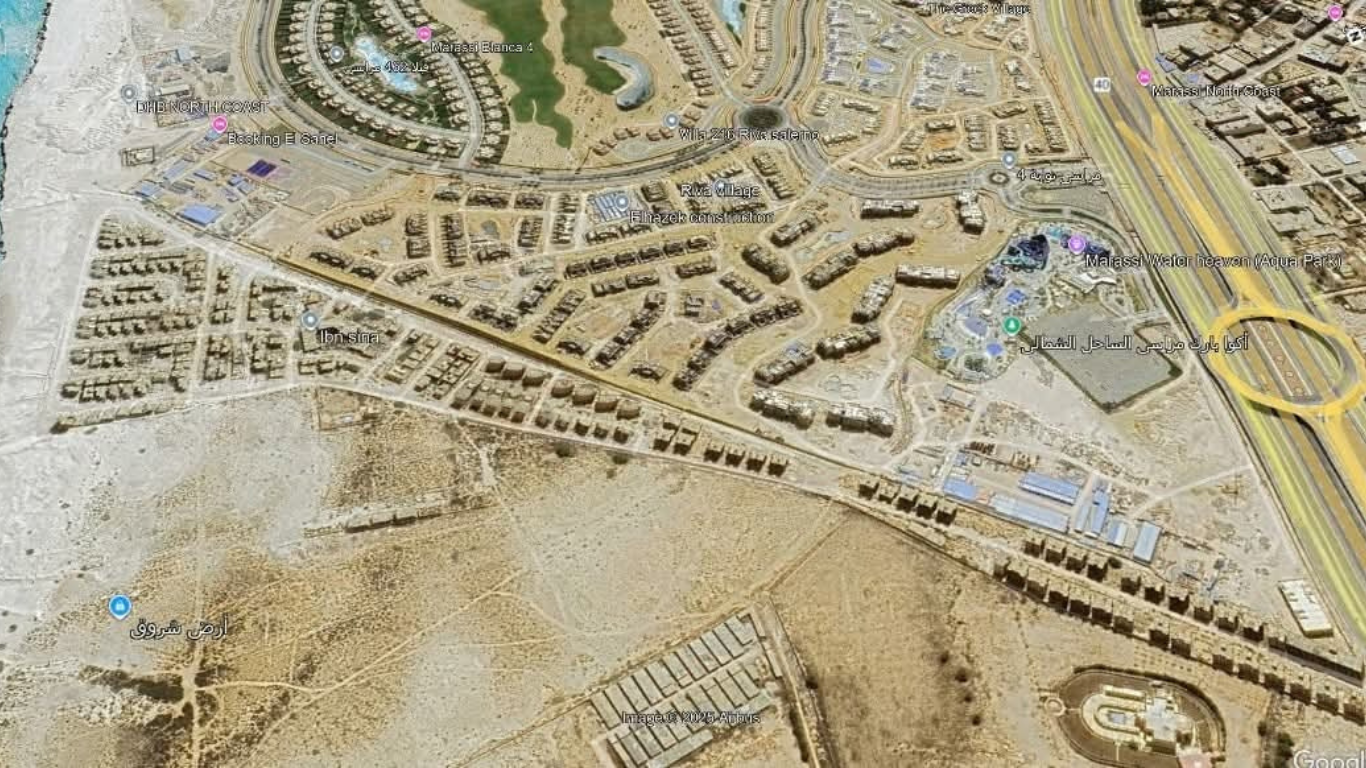
Satellite imagery showing Ibn Sina 2 Village before demolition in late October 2025, and after.
How Did the Village’s Jurisdiction Transfer to the Army?
Documents obtained by Zawia3 show that the land on which the “Ibn Sina (2) Village” project was built transferred to the Community Development Association of the Hospital and Educational Institutes Authority through a registered sale contract No. 215 of 1992, notarized on August 17, 1992, at the Real Estate Publicity Office of Matrouh Governorate.
The documents also include a model sale contract for project units dating to 1995, specifying that the Community Development Association, as the first party, sells to the second party one of the units located in “Ibn Sina (2) Village” in Sidi Abd El-Rahman, Al-Alamein Center, built on land with an area of 289,397.75 square meters, stated to be owned by the Association under notarized contract No. 215.
Although the village land, approximately 21 feddans in area, was not encroachment or usufruct but had been purchased by the Association from Marsa Matrouh Governorate in 1990 or 1991, with its full value paid and registered with the Real Estate Publicity Office, then transferred to the Owners’ Union through registered contracts as well for it to undertake construction, Amr Abd El-Moneim was one of the owners informed after the demolition of a decision that 14 northwestern coast villages, including Ibn Sina 2, had been transferred from the New Urban Communities Authority to the Armed Forces’ jurisdiction, if they had not completed their reconciliation or regularization procedures with the Authority, without this applying to lands previously disposed of by government bodies with official documents.
He told Zawia3: “The body that was conducting the demolitions on the ground was the Mostakbal Misr Device, and its elements were present at the village’s entrances during the demolition operations on November 10 and 11, and prevented owners from photographing.”
In searching open sources, Zawia3 found no official decisions issued by the Presidency of the Republic or the Council of Ministers in 2025 on this matter, but searching issues of the Official Gazette during the five years preceding the demolition, we found Presidential Decision No. 361 of 2020, issued on June 21, 2020, ordering the reallocation of approximately 707,234.50 feddans in the northwestern coastal area for the benefit of the New Urban Communities Authority, for use in establishing new urban communities, while the Armed Forces retain their properties within this area.
On October 18, 2021, the New Urban Communities Authority announced the opening of applications for negotiation from entities located within the boundaries of Presidential Decision No. 361 of 2020 on the northwestern coast. In December 2023, the Authority granted another deadline to receive negotiation applications from companies, associations, entities, and others on lands located within the boundaries of the Decision. On February 4, 2025, Housing Minister Engineer Sherif Al-Sherbini announced a final deadline to receive negotiation applications from companies, associations, and entities in the area south of the international coastal road under the jurisdiction of “Northwestern Coast development devices” from Kilometer 55 to Kilometer 212 of the Alexandria-Matrouh Coastal Road, until March 1, 2025.
The owner reveals that Ibn Sina 2 Village faced a major financial crisis after the Owners’ Union obtained a loan from the Arab Egyptian Real Estate Bank using 126 land plots out of the total 306 in the village as collateral, then defaulted on repayment, leading to loan restructuring and re-mortgaging of the lands until the debt multiplied. However, the mortgaged lands were not owned by others but were still owned by the Owners’ Union, as only 180 plots had been sold while 126 plots remained in the Union’s name, enabling it legally to mortgage them.
What further complicated matters was that the majority of purchasers owned only the units without a share in the land, as the Owners’ Union sold chalets or residential units without transferring land ownership, keeping it registered in its name, which allowed it to mortgage the land to the bank, which confirmed in the mortgage contract that the guarantee included “the land and the buildings on it.”
He adds: “Some units were sold before the mortgage, while others were sold after the mortgage, and in the latter case purchasers would discover after signing the contracts a handwritten note stating that the land was mortgaged, due to purchasers’ weak legal awareness of the need to obtain a real estate transaction certificate to confirm the land was free of mortgages.”
The owner confirms that utilities reached the village entrance but not the villas, explaining that owners were waiting for the legal dispute between the Owners’ Union and the bank to be resolved before completing the connection of utilities, as settling ownership of the mortgaged lands was a condition for completing the project.
But in the meantime, the bank resolved the legal dispute in its favor shortly before the demolition, becoming entitled to sell the mortgaged lands through public auction. However, this does not explain the demolition of the rest of the village’s non-mortgaged portions, according to Amr Abd El-Moneim, who recounts that when owners met with Mostakbal Misr officials in Al-Dabaa and asked about this, the response was that they were “an executive body” and had no explanation for what was happening.
He adds: “The real estate records still confirm the Ibn Sina 2 Owners’ Union’s ownership of the land with the mortgage for the bank’s benefit, and dozens of owners have already registered their properties with the Real Estate Publicity Office. Our dispute is with Mostakbal Misr and the New Urban Communities Authority, which inherited jurisdiction over the northwestern coast lands after Matrouh Governorate and then referred the file to the Armed Forces, without owners receiving any official expropriation decisions or any prior warnings before the demolitions were carried out.”
He reveals that owners filed lawsuits during the past months demanding the recovery of possession and the confirmation of their continued ownership of the land, which entails entitlement to compensation, after the implementing bodies told them the land had become state property, despite the land purchase contracts from Matrouh Governorate remaining valid and registered, meaning ownership is legally established and not merely encroachment.
Disregard for Litigation Procedures
On December 30, 2024, the Egyptian Official Gazette published in Issue 292 Housing Minister’s Decision No. 652 of 2024, issued on July 14 of the same year, approving the planning and subdivision of 109 feddans (undeveloped) within a plot of 121.12 feddans in the Al-Jarawela area in Matrouh Governorate on the northwestern coast, allocated to the Community Development Association of the Hospital and Educational Institutes Authority for establishing real estate facilities at 50% and other facilities according to the approved conditions for the Association. Our sources indicate that the location in question is the one allocated for “Ibn Sina 1” village and not “Ibn Sina 2,” which was subject to demolition in late 2025.
Zawia3 also learned that the former Owners’ Union president, Ramadan Abd El-Qader Arisha, died a few months ago following a health setback he suffered shortly after Mostakbal Misr demolished Ibn Sina 2 Village, which was owned by him, as his wife Salwa Masilhi recounts. She has since assumed the Ibn Sina Owners’ Union presidency following her husband’s death.
In a phone call we conducted with her, she confirmed that the Union had completed 90% of the Ibn Sina 2 Village construction, which refutes the accusation that it violated licensing conditions or was among undeveloped lands in tourist governorates, noting that she is currently engaged in a legal battle in Egyptian court corridors.
Previously, the New Urban Communities Authority withdrew five land plots on the northwestern coast in July 2025 for violating allocation conditions, alongside 10 other plots totaling 500 feddans. Press reports stated it plans to withdraw lands totaling 4,000 feddans on the northwestern coast valued at 110 billion Egyptian pounds ($2.115 billion), or impose fines on their owners, while a committee of representatives from the Ministries of Defense, Military Production, Housing, Urban Development, Tourism and Antiquities, Local Development, and representatives from various tourist governorates and other sovereign bodies is conducting an inventory of undeveloped tourist lands in various tourist governorates.
Presidential directives contained in letter No. 7768 dated June 19, 2025, required the Ministry of Housing, Utilities, and Urban Communities to halt the issuance of any ministerial or legal decisions, or the collection of financial installments from companies operating in the northwestern coastal area, pending the completion of a comprehensive review of these entities’ situations. The directives included canceling all inventory and negotiation applications submitted by 123 entities operating within the northwestern coast’s scope, resulting in a temporary halt to the issuance of ministerial decisions or the suspension of land allocation for a number of companies due to delays or violations. But in mid-September 2025, the Ministry of Housing and the New Urban Communities Authority decided to cancel those restrictions and halt decisions to regularize developers’ situations and resume work, while imposing new mechanisms and controls to collect the state’s dues.
The Legal Dimension
Rights lawyer Maha Ahmed, who specializes in the right to housing cases, argues that any demolition of a residential community must be preceded by clear legal and procedural guarantees. She explains that if the state is expropriating real estate for the achievement of a public utility, the constitution and law require a decision from the competent authority specifying the public utility project, the notification and enabling of rights holders to review the decision, the census of owners, an assessment of fair compensation to be paid in advance, and the granting of the right to affected parties to challenge the decision or the compensation amount, as well as respect for litigation procedures if there is a dispute over ownership.
She told Zawia3 that Article 35 of the Constitution stipulates that private property is inviolable and may not be expropriated except for the public good and in exchange for fair compensation paid in advance, affirming that even in cases that do not involve expropriation but rather the enforcement of court rulings or the removal of encroachments, the competent authorities remain obligated to respect litigation guarantees, notify those concerned, and refrain from arbitrary enforcement.
She says: “Contracts registered with the Real Estate Publicity Office represent the strongest form of ownership proof, while final rulings on the validity and enforceability of contracts grant their holders a strong legal position, while preliminary contracts create, in some cases, personal rights that can be invoked.” She emphasizes that the existence of these documents does not prevent the state from expropriating property when the conditions of public utility are met, but entitles their holders to receive fair compensation, to challenge expropriation procedures if they are flawed, and to claim compensation for any additional legally proven damages.
She adds that Egyptian legislation does not contain a general provision obligating the resettlement of those affected in all cases of expropriation, even though resettlement may be applied in some projects or according to state policies, while this issue enjoys clearer protection in international human rights standards, particularly for groups threatened with displacement.
Regarding good-faith purchasers, she clarifies that among established legal principles is that the purchaser alone should not bear the consequences of disputes they were not party to, if the dispute was between the association, the real estate developer, the bank, or one of the public bodies, adding that the rights of purchasers must be examined independently when they prove they bought in good faith, paid the price, and took possession of their units for years with the knowledge of administrative bodies. She notes that the extent of legal protection depends on the nature of the mortgage, whether it preceded or followed the sale, and whether it was registered and declared, as well as on the outcomes of the judicial rulings, all of which requires careful review of documents in each case.
She points out that if it is established that no official decisions, prior warnings, or compensation were issued, this raises serious legal and constitutional issues, explaining that Article 35 of the Constitution guarantees the protection of private property, while Article 63 prohibits the arbitrary forced displacement of citizens. Egypt is also a party to the International Covenant on Economic, Social and Cultural Rights, and the UN Committee on Economic, Social and Cultural Rights affirmed in General Comment No. 7 that forced eviction may only occur after the provision of a set of guarantees, including genuine consultation with residents, prior notification, access to information, the provision of effective means of challenge, the assurance that people are not left without shelter, and the provision of adequate compensation where required.
She argues that those affected can, depending on the circumstances of each case, resort to the Administrative Court to challenge administrative decisions, or file compensation lawsuits, lawsuits to establish ownership or protect possession, or to challenge compensation assessments if an expropriation decision is issued, as well as filing complaints with the National Council for Human Rights, documenting violations for use before international human rights mechanisms after exhausting local litigation avenues or in the context of international reports. She considers the most prominent challenges facing those affected to be the difficulty of obtaining official documents, the multiplicity of bodies with jurisdiction, the lengthy litigation process, the lack of clarity about the legal status of some lands, and the high cost of litigation for many of those affected.
Ibrahim Izz El-Din, Director of Policies at Diwan Al-Omran, affirms that the constitutional principle in Egypt is the protection of private property, which may not be interfered with except according to specific and clear legal procedures. He explains that the demolition of an urban community comprising hundreds of residential units cannot be based on verbal instructions or undisclosed internal directives, but requires a declared legal basis, whether an expropriation decision for the public good, a judicial ruling, or an administrative decision issued by the competent authority, while enabling rights holders to review the procedures and challenge them.
He explains that the nature of the legal process differs according to the reason for demolition: if the land is allocated for a public utility project, the constitution and Expropriation Law No. 10 of 1990 require the issuance and publication of an official decision, the census of rights holders, and the payment of fair compensation in advance. If the procedures are based on the enforcement of a mortgage for a bank’s benefit, all legal documents related to the enforcement must be shown, from the mortgage contract to the sale execution ruling and the delivery deed, affirming that the announcement of an auction alone does not establish the transfer of ownership or justify demolition.
He told Zawia3: “If the justification for demolition is the existence of construction violations, a reasoned administrative decision must be issued specifying the violating properties and the nature of the violation, with the notification of those concerned. The absence of an expropriation decision, a demolition order, or a final court ruling raises a legal basis for challenging the demolition procedures and claiming compensation, particularly if the demolition was carried out before rights holders were enabled to know the legal basis and object to it.”
Regarding the existence of mortgaged units and others owned through independent contracts within the same project, he says: “Urban administration should not treat the project as a single block, but must distinguish between the different legal positions of each plot of land or residential unit, and confine the effects of the dispute to the part connected to it, without extending them to all residents, in protection of rights holders who were not party to the dispute.”
Izz El-Din argues that government policies over the past decade have increasingly moved toward clearing lands and housing, whether through expropriation decisions or in some cases through forced eviction, considering these practices raise questions about their compatibility with international obligations relating to the right to housing and property protection.
Regarding old stalled residential projects, he argues that the correct path does not begin with demolition, but with a census of the legal status of the land and units, a review of licenses and utilities, an examination of the structural safety of each building individually, then notifying rights holders and giving them the opportunity to present their documents and file complaints or regularize their situations. He explains that Reconciliation Law No. 187 of 2023 affirms this approach, as it allows the suspension of enforcement procedures once a reconciliation application is submitted until it is decided upon, reflecting that the principle is examination and gradual escalation before demolition.
He adds: “The real estate developer’s or cooperative association’s default does not automatically extinguish purchasers’ rights, nor does it convert them into violators, particularly if they paid the unit value, took possession, and lived in them for years with the knowledge of administrative bodies. It must be verified whether any mortgage made by the association is valid, and whether it was issued with the general assembly’s approval and according to the procedures specified by the housing cooperative law, and adjudication of these matters remains within the courts’ jurisdiction.”
He affirms that urban policies must first resort to alternatives less harmful than demolition, such as completing utilities, restructuring the association’s debts, appointing temporary management, separating the disputed parts from the rest of the project, or regularizing buildings meeting safety requirements, affirming that full demolition should not be resorted to unless all other solutions prove impossible.
He continues: “Development and investment do not conflict with the protection of private property. Sustainable investment depends on the stability of legal rights, and the Ibn Sina 2 Village crisis reflects the existence of gaps in land governance due to the multiplicity of jurisdictional bodies and the overlapping of their competencies, which makes it difficult for citizens to identify the body responsible for decisions or for protecting their rights.”
He calls for institutional reforms including the establishment of a unified digital registry showing ownership status, mortgages, and administrative decisions; the unification of land management rules between different bodies; the obligation on competent bodies to publish expropriation and reallocation decisions and make them publicly available; and the establishment of an independent mechanism for reviewing public utility reports, which would achieve greater transparency and reduce disputes. He affirms that the stability of ownership and clarity of procedures represent a fundamental pillar for achieving sustainable urban development.
Between registered contracts, court rulings, officially published decisions, and conflicting accounts about the transfer of jurisdiction over the northwestern coast lands, “Ibn Sina 2” village remains a model of the complexities of managing stalled lands in Egypt. While owners affirm they hold documents proving their rights, the fundamental questions remain unanswered: what legal basis was relied upon for the demolitions? And why did they include units whose owners say are not mortgaged? Until these questions are resolved through official documents and final rulings, the fate of hundreds of owners and their legal rights remains suspended between court corridors and government bodies.