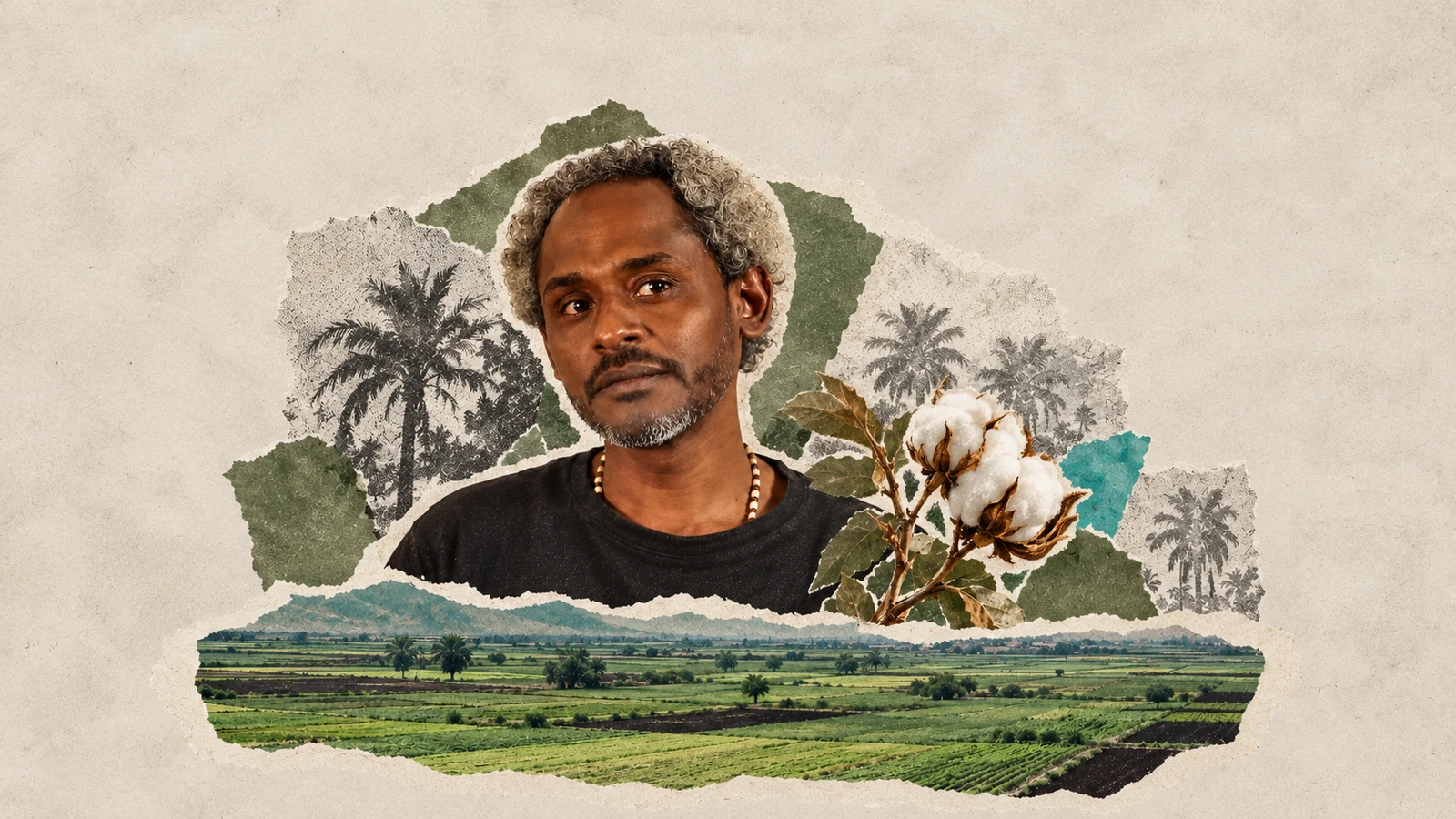


For many years, Sami Al-Toukhi cultivated cotton on his land in the village of Shabas Al-Melh in Desouk, Kafr El-Sheikh Governorate. Every year, between mid-April and the end of May, he would sow his seeds, waiting until October and November for the harvest season—when he was supposed to reap the fruits of his hard work and financial investment. But in the past two years, things have taken a grim turn for him and for other cotton farmers.
Amid rising temperatures and the effects of climate change, new pests such as the whitefly have emerged as a new enemy attacking cotton crops. The insect leaves behind a sticky layer on the leaves that quickly turns into a dark, suffocating blackness that kills production. At the same time, agricultural associations have stopped providing traps to combat it, leaving the farmer to face the infestation alone.
With deep frustration, Al-Toukhi tells Zawia3 that the problems facing cotton farmers now extend from the very moment they plant the seed until the time of harvest. The seeds distributed by agricultural associations, he explains, are of poor quality, leading to uneven growth of cotton plants across fields. The associations, once responsible for providing pesticides and field supervision, no longer perform their duties. He also accuses them of corruption and fertilizer theft.
But what weighs most heavily on the farmer’s heart, beyond weak seeds and pests, is what awaits him after harvest. Last year, he was forced to hand over his crop to the Cotton Trading System, which sold it through auctions he was not invited to attend—while prices fluctuated every few days based on supply and demand.
“How can one farmer sell a qintar (about 45 kg) for 7,000 pounds ($146), and another for 13,000 pounds ($271), when their fields are right next to each other? How can my crop be priced without me witnessing the auction?” Sami asks.
Al-Toukhi explains that “the Agricultural Bank is effectively the body responsible for receiving and marketing the crop. Farmers pay 100 pounds ($2) per sack upon delivery at the collection centers, after which the quantities are gathered and sold through auctions managed by what is known as the Cotton Trading System.”
He stresses that only three major companies control the cotton trade in Egypt. According to him, these auctions lack transparency, and their employees manipulate prices to favor large companies. As a result, one farmer sells a qintar for 6,000 pounds ($125), while another, just days later, sells for 9,000 or even 12,000 pounds ($188 or $250), leaving farmers frustrated and disillusioned.
What bothers him even more is that he did not receive his payment for months after handing over his crop to the system, which sold it at public auction. He recalls standing in long queues outside the banks, leaving his land and work behind to crowd alongside hundreds of other farmers—receiving repeated promises of payment, only to get a fraction of his dues. He accuses the Agricultural Credit Bank of withholding the funds deposited by companies that buy cotton at auction for several months to gain financial interest, causing severe hardship for farmers who struggle to cover living expenses and family needs, often resorting to borrowing at high interest rates.
He says, “Farmers are forced to hand over their crops, then wait five to six months to get paid. Even then, they receive only 70 percent of their money after long waits in overcrowded banks filled with daily arguments. Some farmers still haven’t received their remaining payments for past seasons.”
During last year’s harvest season, Al-Toukhi recalls that when the official auction price was announced at 9,000 pounds ($188) per qintar, many farmers realized it would not even cover production and harvesting costs. “A single laborer now earns 250 pounds ($5.2) a day, and one feddan requires 50 to 60 workers—not to mention pesticide spraying every ten days, which costs around 1,000 pounds ($21) each time,” he says.
“The cost of cultivating one feddan reaches 26,000 pounds ($542), while the harvest doesn’t cover it,” he adds. “Some farmers left their cotton to dry in the fields or even burned quantities inside the agricultural associations’ collection centers in protest against the low prices and delayed payments.” He notes that the cost of cultivating one feddan of cotton ranges between 25,000 and 26,000 pounds ($521–$542), while the price per qintar, ranging between 9,000 and 12,000 pounds ($188–$250), is insufficient to cover costs—especially since yields in some lands have dropped to just 4 or 5 qintars per feddan. Rising labor and pesticide costs have only worsened the crisis.
From Desouk in Kafr El-Sheikh to rural Mansoura in Dakahlia Governorate, farmer Zeidan Mohamed has, for the first time in his life, decided not to wait for cotton harvest season—after a major disappointment last year when he cultivated his 16 qirats (roughly 3 acres) with cotton.
Zeidan recalls bitterly that his land used to yield around eight qintars per season, but last year it barely produced one and a quarter. He blames agricultural pests, climate change, and counterfeit pesticides, all amid a complete absence of government support.
His shock, however, wasn’t just from the low yield but also from the chaos in pricing. “My qintar was priced at 10,000 pounds ($208), while my cousin, who delivered his crop at the same time, got 12,000 pounds ($250),” he says.
Speaking to Zawia3, he adds: “The government promised us that the price per qintar would be 12,000 pounds ($250), including 2,000 pounds ($42) in subsidies. But in the end, we were paid at different prices, and after months of waiting, we only received the rest of our money in mid-August.”
Zeidan, who still remembers his childhood memories of “white gold” that once brought life and joy to Egyptian villages, recalls a time when agricultural engineers inspected fields daily, farmers followed strict guidelines, and production was abundant—sold at prices that covered costs and ensured profit.
“Cotton cultivation in Egypt is going through one of its worst phases,” he laments, citing the lack of government oversight and declining official interest in a crop that was once known as the country’s white gold. He criticizes the absence of the agricultural associations’ role, explaining that today, “the farmer is responsible for everything, without any support or guidance.”
He adds that rising production costs and land rents, combined with low productivity and the poor quality of seeds and pesticides, mean that returns no longer even cover basic expenses. He concludes, “Egyptian cotton, once a pillar of national security, has effectively collapsed under the weight of neglect and lack of oversight.”
Last season, the government pledged to enforce a guaranteed price for cotton for the 2024–2025 agricultural season, as announced in Cabinet Session No. 277 on February 15. The decision set the guaranteed price at 10,000 pounds ($208) per qintar of medium-staple cotton in Upper Egypt and 12,000 pounds ($250) per qintar of long-staple cotton in Lower Egypt.
On April 17 of this year, the Cabinet announced that the Ministry of Finance would, within the following week, pay cotton farmers their outstanding dues—amounting to 3 billion pounds ($62.5 million).

Decline of Cotton Cultivation in Egypt
Since childhood, Mohamed Farag used to accompany his father, an agricultural engineer, through the vast cotton fields of rural Mahalla. He learned how to plant, tend, and nurture the crop like a child that requires patience and special care.
Years later, Mohamed himself became a cotton farmer and pesticide trader. Yet he still looks at the crop with the eyes of someone who knows its economic and historical worth—and its deep emotional place in the heart of the Egyptian farmer. But what he sees today, he says, is no more than a faded image of what was once Egypt’s agricultural pride.
He tells Zawia3: “More than ten years ago, the government began distributing what it calls periodic pesticides through agricultural associations. There are three types sprayed at different stages of the cotton season, and their costs are charged to the farmer whether he receives them or not. The problem is that some of these pesticides cause the cotton bolls to fall off or burn the floral buds, yet no one reviews or corrects these mistakes.”
The issue, he continues, is not only about ineffective or substandard pesticides. “In the past, agricultural engineers were present in nearly every field. Today, the farmer bears the entire responsibility alone, while a crop that requires special care is left without real supervision.”
“Cotton isn’t a crop with many pests,” Mohamed explains, “but wrong practices have multiplied its problems. Many farmers no longer plant properly. There should be one seedling in each hole, spaced half a meter apart, but now they leave five or six close together—so light and air don’t reach them, and three-quarters of the crop rots.”
While productivity continues to drop, cotton prices fluctuate unpredictably, throwing farmers into confusion. “A few years ago, the price per qintar (about 45 kg) was 3,500 pounds ($73), then it suddenly rose to 17,000 pounds ($354), before stabilizing last year at 12,000 pounds ($250),” he recalls. Mohamed believes this price is fair, “but it means nothing if farmers don’t improve their cultivation methods. If a feddan produces ten qintars, the return would be 120,000 pounds ($2,500). But today, a feddan barely produces one or two qintars, which don’t even cover the cost of picking.”
As a pesticide dealer and farmer, Mohamed says that some unscrupulous pesticide traders worsen farmers’ losses by spreading rumors that cotton must be sprayed every four or five days. “Each spraying costs 500 to 600 pounds ($10–$12) per feddan,” he explains. “If a farmer sprays that often, he’ll never make a profit. I spray every fifteen days only, and that’s enough.”
Even climate change is no longer his biggest concern, as good preparation can reduce its impact. “When I expect a heat wave, I use amino acids and calcium acetate to reduce the plant’s heat stress,” he says. “The real problem is that agricultural associations lack this awareness—they only care about selling the pesticides they have.”
Mohamed believes that what was once called white gold is now fading year after year, trapped between official negligence, poor farming knowledge, profiteering traders, and the absence of a system that protects both farmers and the crop.
The crisis of cotton in Egypt, experts agree, is the result of decades of accumulated neglect and the absence of a clear and stable agricultural and industrial policy for the crop. In recent years, with changing climate patterns, more than 60% of cotton fields have been planted late—between the end of May and June—whereas the optimal planting period ends in early May. This leaves the crop vulnerable to the length and timing of the summer season.
According to agricultural engineer Mohamed Khodr, former head of the Cotton Arbitration Authority and former government representative at the Cotton Exporters Association, “Farmers today receive no financial support—unlike in most cotton-producing countries—amid the absence of agricultural associations and extension services that were once effective.”
Speaking to Zawia3, Khodr says: “The state launched the National Campaign to Promote Cotton Cultivation and Industry in 2017, but it was never completed due to ministerial changes. The Cotton Trading System, which was supposed to be temporarily managed by the government before being handed to the private sector, has turned into a limited mechanism concerned only with trading the crop, without achieving the expected neutrality and transparency.”
The National Campaign to Promote Cotton Cultivation and Industry was a government initiative launched in 2017 by former Minister of Agriculture Abdel Moneim Al-Banna. It aimed to enhance the productivity and quality of Egyptian cotton in both Upper and Lower Egypt, revive the spinning and weaving industries, provide technical and advisory support to farmers, develop new high-yield varieties, improve ginning and spinning infrastructure, and activate marketing mechanisms to ensure fair returns for farmers and restore Egyptian cotton’s global reputation.
Khodr explains that the current system collects cotton from farmers and offers it in auctions for companies. However, these companies face significant financial burdens—chief among them high interest rates—which sometimes discourage them from buying, while farmers refuse to sell at prices that don’t cover their costs.
He adds that although the government intervened last year by announcing guaranteed prices, implementation lacked flexibility. Payments to farmers were delayed for several months, and many have still not received their full dues. As a result, the total cultivated area of cotton this year has dropped to about 195,000 feddans compared to more than 314,000 feddans last year.
“Textile factories that were supposed to operate at full capacity by the end of 2024,” Khodr notes, “are still incomplete, with only two factories in Mahalla functioning, which has limited domestic cotton consumption. Long-staple cotton represents only 3% of global production and is considered a luxury type, while the global textile industry relies mainly on short-staple cotton.”
He warns that Egypt’s domestic consumption does not exceed 400,000 qintars ($8.3 million worth at current prices), while total production may reach 2 to 2.5 million qintars ($41.6–$52 million). This makes Egypt heavily dependent on exports. He recalls that the government’s decision two seasons ago to limit exports was disastrous, leading to stockpiled inventory and a loss of confidence in Egyptian cotton on international markets, as importers turned to alternatives.
Khodr concludes that the solution lies in accelerating the development of local textile factories to increase domestic consumption and add value, while also facilitating exports—especially by reducing interest rates on crop purchase loans. He warns that continuing to burden cotton with heavy financial costs will drive farmers away from growing it altogether, pushing them toward more profitable crops such as rice—posing a serious threat to both agriculture and the national economy.
Last year, the government required cotton exporters not to export more than 40% of the local production in order to reserve more cotton for domestic factories, especially state-owned ones under the Cotton and Textile Holding Company’s restructuring plan. However, in January of this year, the government reversed course, allowing cotton exporters to ship their crops without restriction by lifting the previous export quota.
Climate Changes
In recent years, Egypt’s cotton crop has suffered successive disasters. Last year, in particular, witnessed an unprecedented crisis: some farmers left their cotton unharvested in the fields, while others used it as feed for sheep because harvesting was no longer worthwhile. The reasons included low prices, pest, fungal, and viral infestations, as well as the impact of climate change and the weakness of certain cultivated varieties, according to Dr. Tarek Abu Moussa, Professor of Agricultural Economics at the Agricultural Research Center.
He explained that the cotton crisis deepened under the current marketing mechanisms, which rely on auctions after the liberalization of crop marketing. The private sector entered the market aggressively and began competing with the state, creating confusion and harming farmers. This became especially evident during the last season, when private companies rejected the guaranteed prices set by the government — 10,000 pounds ($208) per qintar for Upper Egypt and 12,000 pounds ($250) for Lower Egypt — even though those prices were already unfair compared to actual production costs from the previous year. Consequently, the General Cotton Authority had to purchase the cotton itself.
He told Zawia3: “Farmers still have not received the remaining balance of their cotton payments. Because of this chaos and the absence of a clear agricultural policy for producing and marketing cotton, cultivated areas are shrinking year after year. In the 1980s, Egypt cultivated one million feddans of cotton; by the early 2000s, the area had declined to 500,000 feddans, and by 2024 it had fallen further to 200,000 feddans.”
Abu Moussa pointed out that Egyptian agriculture faces a severe crisis, particularly in strategic crops such as wheat, cotton, maize, and soybeans, in addition to vegetables. He explained that these crops do not yield farmers a fair profit margin that would encourage them to continue planting them, despite their vital importance to the economy and food security.
The professor added that climate change has led to the emergence and spread of new pests and fungal and viral diseases, such as the “jassid” insect, which severely damaged the cotton crop last year. He noted that the lack of sufficient oversight over the pesticide and fertilizer markets has worsened the crisis, as many farmers end up buying ineffective or counterfeit products, leading to heavy losses.
Regarding seeds, Abu Moussa explained that most vegetable seeds used in Egypt are imported, which is unacceptable given the current economic burdens. However, he said the Agricultural Research Center has begun, under directives from President Abdel Fattah El-Sisi, working to produce local varieties of vegetable seeds. He emphasized that this project will take time to narrow the gap and reduce dependence on imports.
Abu Moussa stressed that the state must intervene to regulate the agricultural market through political, economic, and financial tools that protect farmers from market volatility and the greed of certain traders. This, he said, should be achieved by providing production inputs at affordable prices and guaranteeing fair purchase prices for crops so that farmers are not left alone to face crises.
For his part, Dr. Magdy Allam, environmental expert and advisor to the Global Environment Facility, explained that climate change has indeed cast its shadow over Egyptian agriculture, though its impact is not necessarily negative for all crops. He clarified that some crops benefit from higher temperatures and that Egyptian farmers can adapt to such changes through the use of greenhouses, which allow them to control the internal environment and grow various plants under different climatic conditions.
On agricultural pests, Allam noted that rising temperatures cause an increase in the reproduction of insects of all kinds, from mosquitoes to cockroaches, and sometimes even bring about the appearance of other creatures such as snakes. Still, he stressed that ecological balance must be maintained, as every creature plays a role in curbing the overpopulation of another, thereby preserving biodiversity.
He told Zawia3: “Historically, Egypt relied on cotton and sugarcane cultivation as strategic crops that provided farmers with a steady annual income. But the agricultural production map has changed since the 1970s, following Egypt’s economic liberalization and the entry of international companies. This led to an expansion of alternative crops such as olives and export-oriented fruits, which now contribute more than $1.9 billion to agricultural export revenues.”
Regarding cotton, Allam noted that recent years have seen renewed interest in its cultivation as global prices improved. He emphasized that Egyptian cotton continues to hold its position in international markets, thanks to its natural quality, which keeps it favored in the textile industry.
Egypt’s cotton production for the 2024/2025 season amounted to 107,800 tons, equivalent to 2.15 million qintars, amid declining cultivated areas compared to previous seasons. According to the Central Agency for Public Mobilization and Statistics (CAPMAS), the total production of lint cotton reached 2.48 million metric qintars in 2024, compared to 2.47 million metric qintars in 2023.
A Multi-Purpose Crop
Dr. Khaled Fathi Salem, Professor of Biotechnology and Breeding of Strategic Field Crops at the Genetic Engineering and Biotechnology Research Institute, Sadat City University, attributes the decline in cotton cultivation in Egypt to a set of intertwined factors, foremost among them the pricing policy. He explains that farmers always seek the most profitable crop, and that the absence of fair, publicly announced indicative prices before the start of the agricultural season has led many farmers to abandon cotton cultivation—just as previously happened with wheat and sugar beet.
He told Zawia3: “There is no real support reaching farmers in terms of field services or timely provision of fertilizers and pesticides. Agricultural cooperatives no longer supply these inputs as they used to, and farmers now buy pesticides from private stores, which may not always be effective.”
Regarding agricultural pests, the biotechnology expert explained that climate change and rising temperatures have caused the spread of dangerous pests such as the fall armyworm and whitefly, doubling farmers’ losses. He revealed that one-third of cotton production costs are spent on pesticide spraying, making the crop economically unviable. He therefore calls for introducing genetically modified cotton varieties containing pest-resistant genes that enable plants to secrete natural substances lethal to insects—reducing production costs and strengthening the competitiveness of Egyptian cotton in global markets.
He added: “Egyptian cotton is a multi-purpose crop. It is not limited to producing fibers used in clothing and medical textiles; its seeds also yield high-quality edible oil and produce cottonseed cake, a protein-rich animal feed. Cotton stalks can be used to manufacture compressed wood boards for furniture and decorative panels—just as China does, exporting to Egypt finished products made from plant residues.”
Salem noted that inter-crop competition has also become a decisive factor, as rice has emerged as a major rival to cotton in the northern Delta, leading to a decline in cultivated areas. He pointed out that cotton was once a core element of the traditional three-year crop rotation system, and its absence from farmers’ land represented a significant loss, since it is both an export and industrial crop that generates hard currency for the country. However, government support waned as the textile industry declined and synthetic fibers rose.
The agricultural expert believes that reinstating the three-year crop rotation system, allocating around three million feddans annually for cotton cultivation, would restore agricultural balance, improve soil quality, and ensure the regularity of strategic crops.
Salem urges the cultivation of three million feddans of cotton to enable Egypt to achieve self-sufficiency in vegetable oils and plant fibers, secure the foreign currency needed for imports, and address the shortage in animal feed through the supply of high-protein cottonseed cake.
He concluded his remarks by emphasizing that reviving the cotton crop would help reduce Egypt’s imports of vegetable oils and fibers, revitalize the labor-intensive textile industry, and provide affordable feed for farmers—making cotton an indispensable strategic crop for the Egyptian economy.
Egypt’s cotton exports fell by 22% during the 2024–2025 season, recording 38,800 tons compared to around 50,000 tons in the previous season. The total export value of Egyptian cotton reached approximately $128.6 million.
Abolishing the Guaranteed Price
In a related context, several cotton farmers told Zawia3 that they had received news of the cancellation of the guaranteed procurement price for the current agricultural season. The announcement has sparked fears among them of a sharp drop in cotton prices that would not even cover production and harvesting costs. Some claimed that the price per qintar would be set between 6,000 and 7,000 pounds ($125–$145), although no official body has confirmed this. Others, however, expressed relief at the cancellation, arguing that they should be paid according to international market prices.
At the same time, global cotton prices have been falling. On August 29, the price dropped to $64.95 per pound, a 1.55% decrease from the previous day. During July, the price declined by 1.43%.
Zawia3 contacted Walid El-Saadany, head of the Domestic Cotton Trade Organization Committee, who confirmed that there is no longer such a thing as a “guaranteed price” for cotton procurement. He explained that cotton pricing now depends entirely on supply and demand according to international market prices, which are currently declining.
El-Saadany said: “This mechanism is similar to trading on global exchanges, like gold, where the price changes daily. It’s natural for farmers to sell at different prices — one may sell a qintar for 10,000 pounds ($208), another the next day for 11,000 ($229), or even 8,000 ($167), depending on market movement.”
Regarding farmers’ concerns that global prices might not cover production costs, El-Saadany stated that there have been calls for the government to establish practical guarantees to preserve the national strategy for reviving cotton cultivation and industry. He added that the upcoming auctions are expected to yield reasonable prices that would cover production costs and ensure farmers a profit margin.
The head of the committee clarified that price differences between regions or from week to week are due to the global cotton market’s nature, which, like the gold market, changes daily. This, he said, explains why some farmers obtain different prices for the same crop within a short time span.
As for farmers’ dues, El-Saadany said the payment system has been completely restructured: farmers now receive full payment within 20 days of sale, to avoid the financial harm they suffered in previous seasons due to delayed disbursements.
He revealed that cotton cultivation areas have decreased this year by about 35%, dropping from 311,000 feddans last season to around 195,000 feddans. He attributed the decline to the absence of a guaranteed price this season, unlike the previous one, when large expansions occurred immediately after the price announcement.
He added: “The government has fully liberalized cotton trade, both in terms of pricing and export-import quotas. This will allow an expansion of cotton exports in the new season.”
Regarding climate change, El-Saadany explained that last year witnessed severe weather fluctuations that affected productivity. However, this year partial solutions were introduced, including the provision of compounds that help plants withstand heat stress, mitigating the effects of unstable climatic conditions.
A senior official in the cotton trading system told Zawia3 that, so far, the government has not announced details of the new marketing system or the opening price for the season, denying the circulating figures that the qintar would be priced between 6,000 and 7,000 pounds ($125–$145). He confirmed that such figures are “completely baseless.” Even with the market now governed by supply, demand, and international prices, he said, it is unlikely that prices would fall to that level.
The official added that the decline in cotton cultivation areas this season stems from the problems faced last year — most notably the fixed guaranteed price, which discouraged companies from purchasing. He noted that the state had to intervene and uphold the declared prices — 12,000 pounds ($250) per qintar for Lower Egypt and 10,000 pounds ($208) for Upper Egypt — with the Ministry of Finance covering the price gap and purchasing all remaining quantities.
As for the delay in paying farmers’ dues, the government official, who requested anonymity, said it occurred because the state’s cotton collection process did not begin until May, although farmers had delivered their crops to collection centers much earlier. He stressed that despite controversy over some specifications, the state remained committed to paying the declared prices, disbursing payments gradually according to the order of receipt, with the final 30% delayed in certain areas such as Dakahlia.
Commenting on the price variations in auctions, the source explained that this depends on market mechanisms and demand. An opening price is set for each auction, and sales proceed at the highest bids. He said that price differences also stem from variations in cotton quality between regions and from fluctuations in exchange rates, since cotton is sold in U.S. dollars — a factor that directly affects its value in Egyptian pounds.
Regarding exports, the source confirmed that there are no restrictions on cotton exports for the current or previous season. He clarified that the previous year’s problem did not result from government restrictions, but from some companies’ reluctance to buy as a means to pressure prices downward. Export quota restrictions, he added, were in place before but were lifted last year, leaving the trade entirely open.
As cotton farmers struggle with weak production, lack of support, erratic pricing, and confused marketing policies, “white gold” — once a pillar of Egypt’s national economy — now teeters between volatile global markets and the effects of climate change. Farmers increasingly call for a clear strategy to restore the crop’s historic standing.
While many growers warn that current conditions could drive them to abandon cotton cultivation, experts argue that saving the crop remains possible — through real state support, fair pricing guarantees, and comprehensive development of manufacturing and marketing systems.