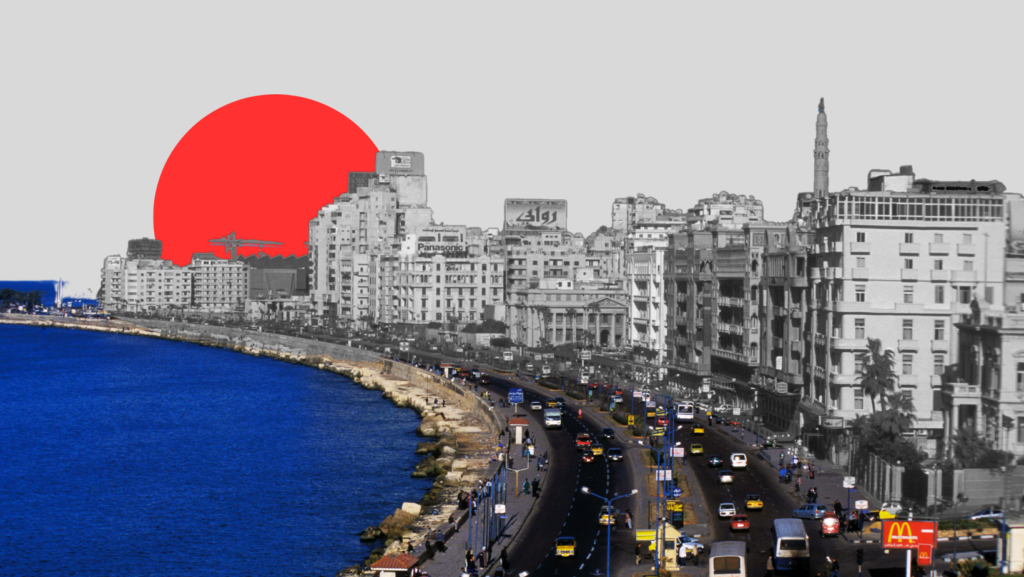

At 2 a.m. on Saturday, May 31, a violent storm struck Alexandria on Egypt’s Mediterranean coast. Coming at the end of spring, the scene was unusual: around 45 minutes of heavy thunderstorms, large hailstones and fierce winds exceeding 50 kilometres per hour spread fear among residents.
The storm injured seven people and caused extensive property damage. Ten buildings partially collapsed in the Montaza I, Montaza II, East, Central and Gomrok districts. Seven streetlight poles fell in Montaza I, East and Central, alongside eight advertising signs in East and Central. Trees, a lighting cable, an air-conditioning unit and iron pipes used in restoration work also fell, while a car caught fire. Rain and hail flooded streets and disrupted traffic on major routes.
Local authorities temporarily reduced drinking-water pressure in parts of western Alexandria and Montaza to ease pressure on networks and facilitate rainwater drainage. Sewage vehicles and equipment were deployed extensively in East and Montaza, concentrating on water accumulation points. Officials inspected major roads and removed fallen signs, trees and damaged lighting poles that obstructed traffic or drainage. The governorate put all districts and the water, sewage and electricity companies on maximum alert, coordinating with operations rooms and rapid-response teams.
The Egyptian Meteorological Authority nevertheless faced criticism for failing to give advance warning of a storm of this magnitude. Its forecast for May 31, 2025 mentioned only light to moderate rain, occasionally accompanied by thunder, over parts of the western coast and northern Nile Delta, with intermittent light rain extending into the southern Delta. It also forecast active winds that could raise dust over exposed areas of Greater Cairo, the canal cities, the Gulf of Suez, the northern Red Sea, Sinai, northern Upper Egypt and the Western Desert.

A severe supercell thunderstorm
Physics and meteorology researcher Ahmed Saeed rejects suggestions that changes in Earth’s electromagnetic field or weather-control operations caused the storm. He attributes it to a deep cold low-pressure system in the upper atmosphere, a rare occurrence at this time of year, when Egypt more commonly experiences cold troughs bringing light rain to its northern coast.
Saeed says temperatures at the 500-hectopascal atmospheric level fell to around −19°C. Combined with substantial moisture at the 850- and 700-hectopascal levels, this allowed rain-bearing clouds and strong convection to develop from energy stored in the atmosphere. These pressure levels are within the troposphere. As the low approached northwestern Egypt, thunderstorms formed over eastern Libya and reached Salloum on Friday evening. Intensifying as they entered Egypt, they produced cloud-to-ground lightning between Salloum and Marsa Matrouh, extending towards Alexandria and El Alamein, while clouds moved out over the sea.
The edges of the enormous thundercloud, centred over the Mediterranean, barely touched Alexandria and the northern Delta, Saeed explains. They brought intense thunder and lightning, unusually large hailstones and downdrafts from within the storm. He believes eastern Alexandria received more rain than the west because its coastline was more directly exposed to the prevailing winds. Strong updrafts farther west held precipitation aloft, allowing large hailstones to grow; once the updraft weakened, rain and hail fell heavily.
“The thunderstorms began in Libya and changed course around Salloum,” Saeed tells Zawia3. “The area extending to Marsa Matrouh experienced severe thunderstorms and lightning striking the ground. Between Alexandria and El Alamein, a strong updraft developed and pushed the clouds towards the Mediterranean.”
“What happened was a severe supercell thunderstorm,” Saeed says, rather than a Category 1 hurricane or a Mediterranean tropical or subtropical cyclone.
He notes that atmospheric pressure did not fall below 1,000 hectopascals. In his account, an intense, localised weather system affected Egypt’s northern coast from Alexandria to Baltim, Edku and Borg El Burullus. He links this pattern to climate change, saying similar storms have previously struck uninhabited parts of the Western Desert and could become more frequent in coming years.
Saeed calls for drainage networks capable of handling extreme rainfall and flash floods, and for advertising structures to be secured against strong winds, which he estimates reached around 100 kilometres per hour during the Alexandria storm. Although he praises the Meteorological Authority’s scientific expertise, he believes it avoids forceful warnings and does not issue frequent enough updates as conditions change rapidly. The storm, he says, exceeded weather specialists’ expectations.

Climate and environmental policy specialist Sawsan El Awady attributes Egypt’s weather to the influence of La Niña. She explains that cooling in the central and eastern equatorial Pacific can alter global air circulation and pressure patterns, with effects extending to the eastern Mediterranean, North Africa and Egypt.
El Awady says such changes can produce colder, drier Egyptian winters in some years by weakening Mediterranean lows and reducing rainfall on the northern coast and Delta. In her assessment, this affects water availability, moisture distribution and agriculture through delayed rainfall and shifts in seasonal timing, and can also affect Nile flows by changing rainfall patterns in upstream Sudan and Ethiopia.
“Egypt previously experienced the influence of El Niño, and now we are under La Niña’s influence and have entered a new climatic phase,” she tells Zawia3. She expects more thunderstorms along the Mediterranean coast in coming years and calls for a long-term national response to climate change.
For context, NOAA’s April 10, 2025 assessment reported that ENSO-neutral conditions had returned in March. El Awady’s description of an ongoing La Niña therefore differs from that contemporaneous assessment.
El Awady argues that phenomena once treated as recurring natural cycles are becoming more intense and frequent with global climate change, complicating adaptation. She calls for a shift from reacting to disasters towards anticipating them, strengthening early-warning systems and incorporating climate concerns into agricultural, water and urban planning policies.
Environmental specialist and former environment minister’s adviser Hossam Moharram says natural disasters around the world are becoming more severe. Hurricanes, earthquakes, floods and tsunamis have historically been rare or less intense in Egypt, he says, but existing buildings and infrastructure could face major challenges if disaster intensity changes.
He urges universities and research centres to study possible disaster scenarios, improve earthquake-resistant construction codes, expand rainwater and flood drainage, and incorporate these measures into new development projects. Existing buildings also need upgrading, he says, pointing to Japan’s earthquake preparedness and the United States’ experience with hurricanes as examples of reducing damage even during powerful events.
“The Mediterranean has recently seen a surge in natural disasters, including the Derna disaster, which killed thousands, and what happened in Alexandria in late May,” Moharram says. He relates these events to climate changes arising from natural variability and human activity, particularly the fossil-fuel economy since the Industrial Revolution.
Moharram also raises speculative claims circulating in unspecified circles that major powers, including the United States, Russia and China, could deliberately generate earthquakes, floods or hurricanes as a form of warfare to damage economies or pressure governments without conventional conflict. He provides no evidence establishing those claims. Other specialists interviewed for this report reject explanations involving weather manipulation or electromagnetic interference.
Solar eruptions and competing explanations
Cairo University water resources and geology professor Abbas Sharaki attributed the eastern Mediterranean’s unstable weather to solar eruptions, suggesting that radiation and particles reaching Earth’s atmosphere could produce severe weather. In media comments, he cited two strong eruptions on Friday followed by further eruptions on Saturday morning.
The International Astronomy Center’s Al Khatm Observatory reported a G3 geomagnetic storm at 07:21 UTC on Sunday, June 1. It linked the event to a coronal mass ejection launched on May 31 at 00:15 UTC, associated with an M8.1 flare from sunspot group AR4100.
Egyptian-American space scientist Essam Heggy tells Zawia3 that attributing unstable weather in the eastern Mediterranean to solar eruptions is incorrect and rests on general interpretations rather than current research. He also rejects social-media rumours that recent weather events and earthquakes resulted from a supposed collapse of the polar vortex disturbing Earth’s rotational axis, or from an object near the constellation Orion emitting electromagnetic waves through Earth’s magnetic shield.
NOAA’s Space Weather Prediction Center warned of a severe G4 geomagnetic storm beginning on Sunday, June 1, with effects potentially continuing through Tuesday, June 3, following a solar eruption on May 30. The risks it identified concerned electrical infrastructure, satellites and navigation signals, including voltage-control problems and temporary interruptions on transmission lines.
Coastal erosion and building collapse
Heggy warns that changing storm intensity and timing in Alexandria reflect climatic changes that will also put more buildings at risk. In a post on X, he said repeated scientific warnings had been dismissed by voices misleading decision-makers, whom he held responsible.
A study published in February in Earth’s Future, led by Egyptian architect Sara Fouad and involving climate, marine and space scientists including Heggy, examined Alexandria’s coastal building collapses through international collaboration among German, Dutch, American, Tunisian and Egyptian institutions. It reported more than 280 coastal building collapses over two decades and a tenfold rise in annual collapse rates, warning of growing risks along the southern Mediterranean and around 7,000 threatened buildings in Alexandria.
The study, supported by the University of California, NASA and Germany’s Humboldt Foundation, analysed satellite imagery from 1974 to 2021. It linked coastal retreat, land subsidence and building collapse, identifying disrupted sediment balances associated with urban expansion alongside sea-level rise. Its proposed mechanism is that seawater intrusion raises coastal groundwater levels, corrodes foundations and changes soil conditions, accelerating structural failure.
Heggy has cited 117 collapses between 2013 and 2015, compared with one between 2001 and 2004, concentrated in seaside districts including West Alexandria, Gomrok and Central. Alexandria’s historic coastal setting, he says, makes it an important case for understanding risks and potential protective measures in other coastal cities.
“As sea level rises, salt water enters groundwater and raises its level until it reaches building foundations, corroding them,” Heggy tells Zawia3. “Every building that collapses threatens the buildings around it.”
He says changes to soil strength can cause buildings to crack or tilt and land to subside. He puts Alexandria’s annual collapse rate at around 40 among roughly half a million buildings, with dozens of lives lost and about 7,000 buildings threatened. In his assessment, poor planning accounts for half the responsibility for these collapses.
Figures cited from CAPMAS’s 2017 building census put the number of buildings at risk of collapse nationwide at 97,535. Other reported figures refer to seven million unauthorised properties, including 2.184 million violations in recent years, while the Egyptian Center for Housing Rights estimates 1.4 million unsafe buildings. These are differently defined estimates and should not be treated as directly interchangeable counts.
Drainage and infrastructure investment
Forty-five minutes of heavy rain left 48 accumulations of rainwater across Alexandria before local authorities dealt with them. The flooded streets prompted criticism that the city’s infrastructure was ill-equipped for changing climate conditions.
In April, Investment and Foreign Trade Minister Hassan El Khatib said Egypt had invested more than $550 billion in infrastructure over the previous decade. General Authority for Investment and Free Zones chief executive Hossam Heiba repeated that figure in May.
Ain Shams University roads engineering professor Hassan Mahdy says predicting climate change’s infrastructure impacts is difficult. Egypt, like other countries, is experiencing rain and floods outside their usual seasons and must prepare through preventive measures, especially drainage and more detailed surface-water studies for every road project.
Mountain roads are particularly exposed to flash floods, he tells Zawia3, and require safe drainage to prevent roads from being severed or destroyed. Low points inherent in some road designs can collect water; mapping them and installing drains can help remove it quickly.
Mahdy also recommends electrical grounding for roadside lighting poles and buildings. Grounding connects electrical equipment to earth to provide a safe path for excess current or fault currents; it forms part of electrical and lightning safety measures.
Beni Suef University roads and transport engineering professor Abdullah Abu Khadra argues that climate change makes environmental and hydrological studies essential for road projects. Hydrological studies examine how water is distributed and moves through the environment, informing the design of roads, bridges, dams and buildings that interact with it.
He says the state has recently begun incorporating such studies and creating rainwater drains, particularly in coastal governorates, routing water towards flood channels and seeking to use it productively, especially in eastern regions. Dams have also been built in several governorates to limit flood damage.
“Alexandria’s infrastructure has improved in dealing with rainwater compared with previous periods,” Abu Khadra tells Zawia3. “Drainage networks have been installed on main and internal roads, with budgets allocated for them.” He links water reuse to agriculture and land reclamation under the five-million-feddan programme in Toshka, the New Delta, Sinai and Upper Egypt.
Abu Khadra says Egypt has allocated EGP 2 trillion to developing transport alternatives, including EGP 1.1 trillion for green public transport. He cites electric transport initiatives, cleaner loading and unloading equipment and environmental standards for ports as attempts to find lasting solutions rather than temporary fixes.
Parliamentary scrutiny and government adaptation plans
After the storm, MP Karim El Sadat submitted an urgent request for a parliamentary briefing to House Speaker Hanafy Gebaly over shortcomings in the Meteorological Authority’s warnings before Saturday’s flooding. He called for the forecasting system to be updated and its technical capabilities strengthened to keep pace with sudden changes in Egypt’s weather.
On Saturday, MP Mahmoud Essam also submitted a request for a briefing on the climate risks facing Alexandria, seeking urgent intervention by the prime minister and the environment, local development and water resources ministers.
Essam described the storm as a warning of a potentially larger disaster and cited studies suggesting that one-third of the city could be inundated by 2050. This was a projection he cited, rather than a certain outcome. He questioned how a storm of such intensity could strike a major coastal summer destination at the end of May and demanded an urgent, high-level response.
At Monday’s Senate plenary session, Environment Minister Yasmine Fouad said Egypt’s limited contribution to global greenhouse-gas emissions contrasted with its high vulnerability, particularly in the Delta and coastal areas. She said measures taken since Egypt signed the 2015 Paris Agreement had helped the country adapt and asserted that the Alexandria storm’s impacts were less severe than expected because of those measures.
Fouad said adaptation was a central objective of Egypt’s National Climate Change Strategy 2050. She cited eight years of coastal protection work by the Water Resources and Irrigation Ministry, costing EGP 8 billion and covering Alexandria, Rosetta, Marsa Matrouh, Damietta, Kafr El Sheikh and Beheira, including nature-based solutions.
She also referred to a Cabinet plan adopted in 2020 for extreme weather and an interactive climate-change map being developed with the Military Survey Department and the environment, water resources and antiquities ministries. The map is intended to use available data to anticipate future impacts across Egypt.
Alexandria’s storm raises a question extending beyond one night of rain: how prepared are Egypt’s coastal cities for extreme weather?
The accounts of experts and officials point to the need for long-term adaptation strategies, stronger urban and construction planning, better monitoring and early-warning systems, and climate considerations embedded in public policy.
For a city shaped by its history and its relationship with the sea, the warning could become an opportunity to protect lives—before the next storm reaches another unprepared city.