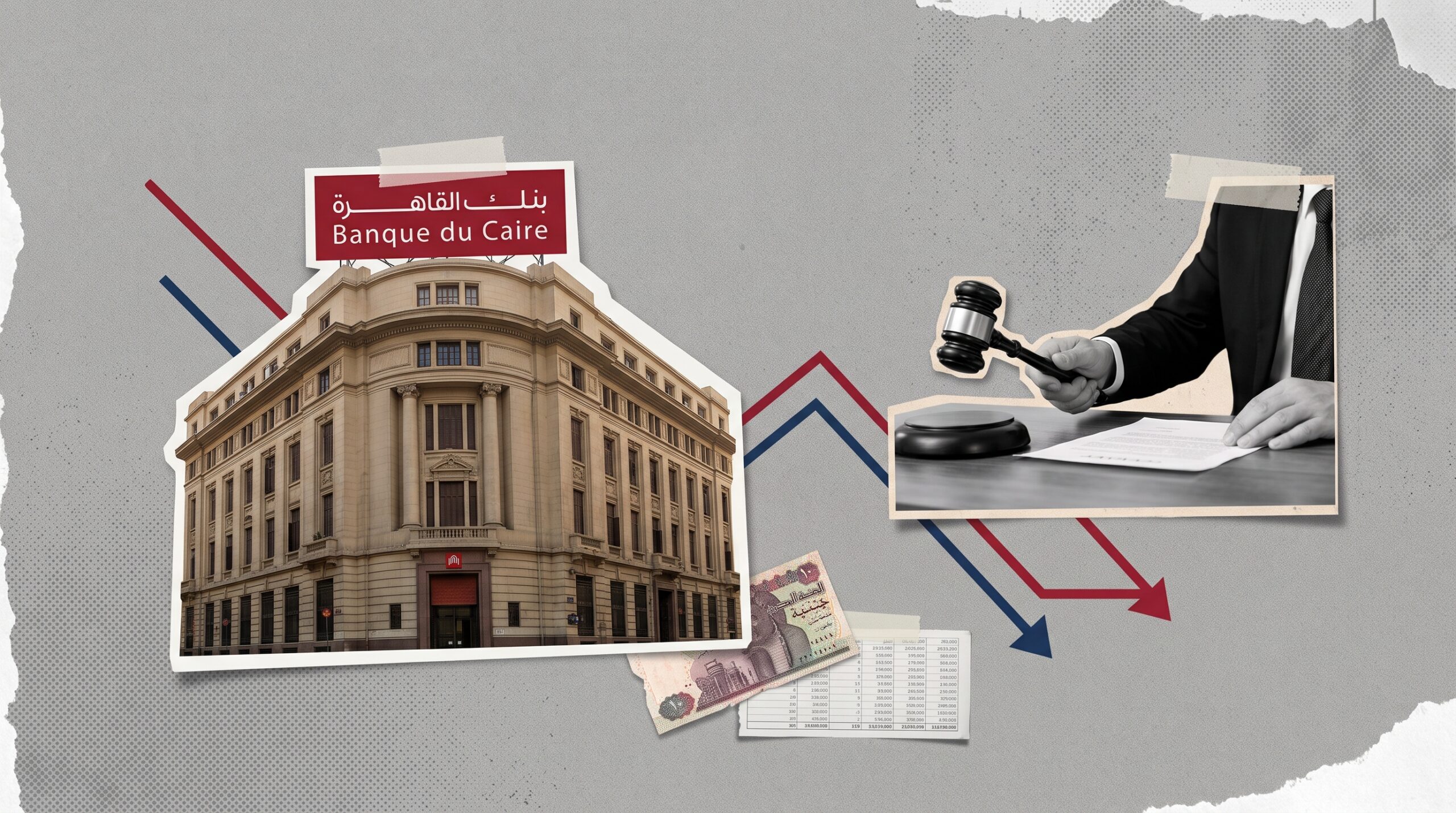

News circulating about a deal to sell Banque du Caire to the Emirati bank Emirates NBD has stirred widespread controversy over the past few days, especially since the figures circulating about the deal are estimated by experts to be far below the price of the bank, which is the third-largest state-owned bank in Egypt. The government had received offers to buy it in past years from foreign companies, worth more than double the current deal with the UAE, which would acquire 45% of the shares in exchange for between $1 billion and $1.2 billion.
In one of the urgent reactions to the deal, a number of lawyers filed an urgent lawsuit last Monday before the Administrative Court of the State Council, in which they demanded a halt to the sale procedures. Named as defendants in the lawsuit were Egyptian President Abdel Fattah El-Sisi, Prime Minister Mostafa Madbouly and the Governor of the Central Bank of Egypt, Hassan Abdalla. The lawsuit stressed the strategic importance of Banque du Caire, pointing to its long history and its pivotal role in supporting the national economy and financing development projects, which makes the decision to sell it “devastating news” for Egyptians. It warned of the potential negative repercussions of the deal on national economic security and the independence of the banking sector, demanding that transparency be guaranteed in the procedures for selling major financial institutions and that the supreme national interest be achieved.
While the government has not officially announced any details about the deal, with the prime minister merely confirming on Wednesday that the government is offering two banks within the offerings programme, namely the United Bank and Banque du Caire, which is currently being valued by a specialised consultant to determine its worth, a statement driven by the pressure the government is facing as a result of public discontent over the deal, leaks suggest that negotiations are being held with Emirates NBD to acquire the state’s stake in exchange for approximately one to two billion dollars, with this to take place within 45 days.
The same sources spoke of an alternative plan in the event the deal with the UAE is not completed, consisting of listing the bank on the stock exchange and appointing advisers for the financial supervision of the offering. This is the option preferred by observers who spoke to Zawia3 in this context. Mohamed Ramadan, an economic researcher at the Egyptian Initiative for Personal Rights, believes that listing state-owned banks on the stock exchange may be a suitable option, because banks have a broad customer base and strong loyalty, and they also maintain stable financial indicators even in times of crisis, which makes them attractive for investment. For example, a bank such as (Commercial International Bank – CIB) alone represents about 20-25% of the EGX30 index, which reflects the extent of the banking sector’s influence in the market.
Ramadan says, speaking to us, that the entry of new investors through the stock exchange may be more beneficial than direct acquisitions, which may lead to monopoly or unhealthy concentration within the Egyptian banking sector.”
Recommended reading: Transferring State-Owned Companies to the Sovereign Fund of Egypt: Privatisation Without Oversight?
Absence of transparency
Maha Abdel Nasser, a member of the House of Representatives for the Egyptian Social Democratic Party, stresses in an interview with Zawia3 that the fundamental problem in the matter of selling state-owned banks does not concern the idea of selling itself, but rather the absence of transparency and of the valuation mechanisms relied upon to take this decision. She tells Zawia3: “The issue is not whether a bank is sold or not; selling in itself is not a problem, and acquisitions of banks have taken place before without crises. But the problem lies in the method of valuation: on what basis are the assets being sold determined? And who is responsible for the valuation? These matters are not clear at all”.
She adds that there are questions about the reason for resorting to an external investor instead of offering the bank’s shares on the stock exchange as an alternative option to attract capital, asking: Why is the offering not made on the stock exchange if the aim is to achieve financial returns? Why is the acquisition only by an external party?”, demanding that the government provide comprehensive clarifications about the sale mechanisms and stressing that citizens have the right to know the details concerning the fate of public assets, saying: “The matter is simply about the necessity of respecting the citizen’s right to know”.
Days ago, Maha submitted a briefing request to the House of Representatives on the crisis, a copy of which we received, in which she demanded the disclosure of all details related to the case, pointing out that Banque du Caire achieved net profits of EGP 12.4 billion during the 2024 financial year, a growth rate of 86% compared with 2023, while its profits in the third quarter alone amounted to EGP 8.6 billion, an increase of 90% over the same period of the previous year. The bank’s operating revenues also rose by 56%, which reflects a strong financial performance that strengthens its position in the banking market. Despite these positive results, the Egyptian MP raised questions about the decision to sell the bank at a value that does not reflect its actual performance, stressing that it is capable of generating the value of the deal within a short period, which calls for reconsidering the economic feasibility of this decision.
She stressed that the experience of selling public assets to foreign investors needs careful review before any similar decision is taken, especially since we have previously witnessed cases in which these deals did not achieve the desired returns for the state, but rather led at times to negative results in the long term, insisting on the right of parliament and the Egyptian people to know the details of this deal, its reasons and its economic feasibility. In light of the above, we do not know why sale was chosen as the main option instead of increasing the bank’s capital by offering its shares on the stock exchange? How was the buyer determined, and why was the field not opened to other investors? And are there actual guarantees ensuring that the bank continues to perform its developmental and national role after its sale?
Recommended reading: A Ban on Contracting with 4 Sovereign Bodies: A Step Towards a More Transparent Economy or a Political Manoeuvre?
A shift in the privatisation system
Economic researcher Wael Gamal stresses that the sale of Banque du Caire is not the first step in the privatisation of public banks, as Egypt has previously witnessed similar attempts, such as the sale of the Bank of Alexandria in 2006 and, recently, the offering of Banque du Caire, within a trend backed by the International Monetary Fund and the World Bank to reduce state ownership in the banking sector. However, he believes that there is a decline in the level of transparency and disclosure this time compared with previous attempts, as the sale is being carried out by direct order without an auction or real competition, with only one investor, an Emirati fund, which raises questions about the valuation and pricing mechanisms.
Gamal adds that previous privatisation operations, despite the criticism that marred them, were subject to clear legal procedures, whereas the ownership of public assets is now being transferred to the sovereign fund, which means bypassing traditional governance procedures and placing decisions directly in the hands of the executive authority. He considers this approach a step backwards with regard to disclosure and oversight of the sale of public assets.
The economic researcher believes the timing of the sale is inappropriate, given the decline in the value of the pound against the dollar, which makes the value of the deal low when assessed in foreign currency. Moreover, the banking sector in Egypt is making good profits as a result of high interest rates, as banks rely heavily on investing in high-yield government debt instruments. Consequently, selling the bank at this time means granting guaranteed future returns to a foreign investor instead of the state benefiting from them.
Banque du Caire recorded a strong financial performance at the end of 2024, achieving growth in its profits of 86% compared with the previous year. The bank announced in an official statement this March that its pre-tax profits rose to EGP 17.9 billion, an increase of 64% over 2023, when they had amounted to EGP 11 billion. Net profit also rose to EGP 12.4 billion, driven by improved performance across various sectors, most notably retail banking, treasury, corporate credit, and small and medium-sized enterprises. Interest on loans and similar income grew by 40% to reach EGP 68.7 billion at the end of 2024, while the cost of deposits and similar revenues rose by 30%. This contributed to an increase in net interest income of 58%, which reflects the bank’s positive performance at various levels.
Gamal points out that the justification for privatisation in the banking sector was previously the transfer of foreign expertise and the improvement of administrative performance, but this is no longer logical now, especially since Banque du Caire underwent comprehensive restructuring in past years, which makes its sale merely a means of obtaining dollar liquidity, without achieving any real benefit for the economy. He stresses that previous experiences, such as the sale of Eastern Tobacco and the fertiliser companies, proved that these deals often have a negative impact in the long term, as profits are transferred abroad, which leads to draining foreign currency instead of strengthening it.
Ambiguity reinforces fears
Karim El-Omda, professor of political economy, tells Zawia3 that Banque du Caire has always been a subject of controversy every time it is offered for sale, as a state of ambiguity and complexity surrounds the process of selling it. He explains that in the middle of the first decade of the millennium, specifically between 2005 and 2006, the bank was suffering losses, which prompted the government to offer it for sale, with 80% of its shares valued at approximately EGP 1.5 billion.
El-Omda notes, speaking to us, that the Bank of Alexandria had been sold to the Italian bank Sanpaolo for $1.6 billion during the same period, while a number of investors submitted offers to acquire Banque du Caire, among them international banks such as Morgan Stanley, but the deal was suddenly cancelled without any explanation of the reasons. He adds: ” There is information that Field Marshal Hussein Tantawi, the former Minister of Defence, was one of the opponents of selling the bank, considering it one of the strategic assets of the Egyptian state with a large customer base, which makes giving it up a decision with uncalculated consequences.”
The professor of political economy explains that the Egyptian government is still working under the directives of the International Monetary Fund, which insists on reducing the role of the state in the economy and pushing it to exit from the ownership of public institutions, including banks. He adds: “When it is said that Banque du Caire is being sold at a price below its value, we must first determine how its price is assessed: according to profits? Or to the number of customers and deposits? Or based on the number of branches spread inside and outside Egypt?”, pointing out that the bank has 350 branches across the country, which makes it a strong banking entity.
El-Omda stresses that the price put forward for the purchase of Banque du Caire by First Abu Dhabi Bank has not yet been settled, and that the controversy raised in the Egyptian market about the sale may be deliberate, to put pressure on both parties, the Egyptian government and the Emirati bank alike, in order to reach a balanced price. He continues: “The UAE is the party most interested in the deal, and it seems to have financial liquidity ready to invest strongly in the Egyptian market, but there is no doubt that such banking deals are usually surrounded by undisclosed behind-the-scenes dealings”.
El-Omda says that “Banque du Caire suffers from overstaffing, which represents a challenge for any new investor, as no private bank can acquire it without drawing up a plan to absorb this large number of employees. He explains that any global financial institution wishes to enter the Egyptian market given the importance of the Egyptian banking sector, but he pointed out that the Central Bank of Egypt has in recent years tightened the conditions for granting licences to new banks, imposing high capital requirements and strict standards to protect depositors’ funds, especially after the banking crisis the country witnessed in 2004.
Recommended reading: Selling Egypt’s Airports: A Deal to Rescue EgyptAir or a Gain for Investors?
Questions after the deal!
Banque du Caire is the third-largest Egyptian bank, and the UAE has been seeking to acquire it since 2022, as part of a strategy to expand in the Egyptian banking market, and Banque du Caire owns a strong network of branches comprising 249 branches inside Egypt, in addition to six branches in Arab countries and two branches in COMESA countries on the African continent, which strengthens its regional importance. It has seen several attempts at sale since it was included in the privatisation plan adopted by the government of Kamal El-Ganzouri under the late President Hosni Mubarak in 1997, a plan that was halted by the economic crisis that toppled the Ganzouri government in October 1999. The government of Ahmed Nazif later put privatisation forward again as a strategic option, starting with the sale of 80% of the shares of the Bank of Alexandria to the Italian bank Sanpaolo in October 2006, then allowing the International Finance Corporation to buy 9.75% of the Italian bank’s stake, while the state retained only 20% of the bank, which was founded in 1957.
At the beginning of 2008, the government offered Banque du Caire for sale officially, but the global financial crisis soon obstructed the deal, leading to its cancellation despite its having reached its final stages with Egyptian and Arab investors, for fear of a decline in the bank’s market value. Since the first flotation of the Egyptian pound in 2016, the government has tried to sell the bank eight times, but it backed down at the last moment because of unstable economic conditions.
In this context, researcher Mohamed Ramadan explains that the bank was supposed to have been listed on the stock exchange since 2016 within the government offerings programme; indeed, the idea dates back to after 2008, specifically after the deal to sell the Bank of Alexandria and the acquisition of some financial institutions by Emirati investors. He points out that the Egyptian banking sector has witnessed waves of mergers and acquisitions, especially after the major banking crisis the market witnessed in the 1990s and the early new millennium, which reduced the number of operating banks to 38 banks currently, whereas in the 1990s there were more than 80 banks, and the number even exceeded 100 banks in the late 1970s.
In addition, Ramadan believes that the Emirati acquisitions raise many questions about the level of concentration in the banking sector, especially as Emirati banks hold a large share of deposits in the private sector. Although the state banking sector still holds the largest share of deposits, with the National Bank of Egypt alone holding about 60% of market deposits, the strong presence of the Emiratis in the sector raises questions about the future impact on the Egyptian financial market.
He adds: “The high profitability of the banking sector makes it attractive to investors, but at the same time it increases the pressure on the balance of payments, especially since profits are transferred abroad. Moreover, most of these acquisitions focus on already existing assets, and are not new investments that revive the market or expand the banking base. This reduces the expected positive impact and makes us reconsider the issue of transferring profits abroad and its impact on the Egyptian economy in the long term.”
The ambiguity surrounding the Banque du Caire sale deal remains one of the main factors reinforcing the state of controversy and concern in economic and popular circles in Egypt. While the government affirms that the sale comes within the government offerings programme with the aim of attracting investment and boosting foreign currency reserves, questions arise about the transparency of the sale procedures, the valuation mechanisms and the economic feasibility of the deal. With voices calling for more disclosure and accountability growing louder, the most important question remains: does the sale represent a well-considered step that serves the interests of the state and citizens, or is it merely a measure to boost liquidity in the short term without regard for the long-term repercussions on the banking sector and the Egyptian economy as a whole?