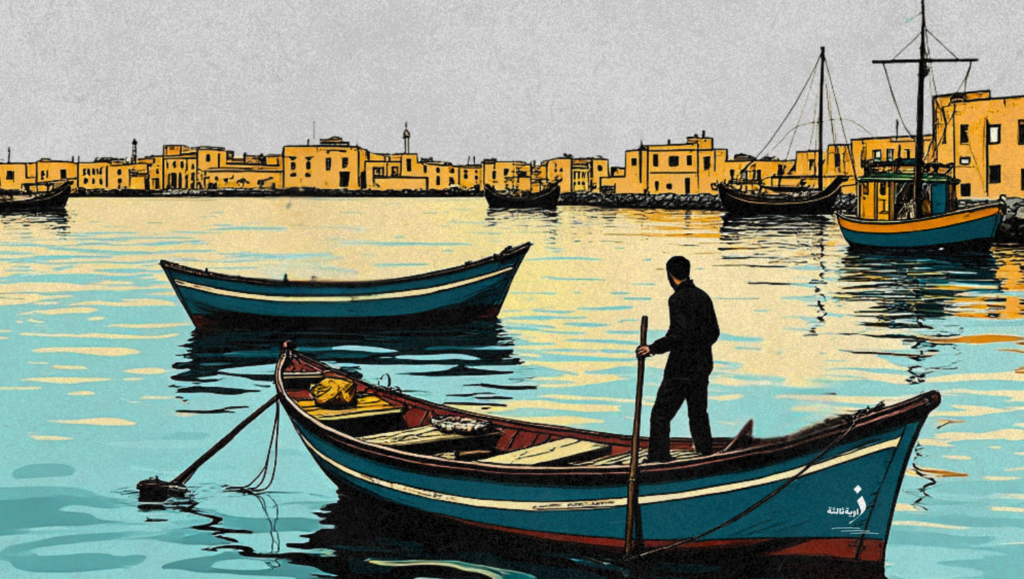
The Egyptian government’s decision to transfer jurisdiction over Bardawil Lake, Egypt’s second largest lake after Lake Manzala with an area of 165,000 feddans, to the “Mostakbal Misr for Sustainable Development” agency sparked wide controversy after unconfirmed information spread about possible Emirati investment in it. The lake has great strategic and economic importance, as it is famous for the abundance of valuable fish species, such as sea bream and mullet, making it an important source of fish for the local market. Government spokesperson Mohamed El-Homsany stated on 31 October that the decision aims to develop the lake economically, stressing that rumours about its sale or privatisation are untrue.
According to the General Authority for Fish Resources Development, Bardawil Lake is about 130 kilometres long and is one of the most important sources of fish wealth in Sinai and Egypt. The lake is distinguished by its relative shallowness, with depths between half a metre and three metres, and contains a number of islands. Its importance perhaps centres on its production of fish of high economic value, as its fish production reaches 2,500 tonnes a year, while large numbers of two birds, the little tern and the Kentish plover, live at the lake, with large concentrations of them compared with those found in the world.
Economic expert Elhamy El-Merghany explains the economic importance of Bardawil Lake, speaking to Zawia3. He says: “Its area is 650 square kilometres, and it is one of the most important Egyptian lakes and the least polluted. It contains high-quality fish species that are exported to Europe, and it has an inlet 100 metres wide on the Mediterranean Sea. It includes the Zaranik protectorate in its eastern part, located about 30 kilometres west of El-Arish, and this area represents one of the main keys to bird migration in the world, as studies have proven the importance of the area and its unique location linking the continents of Asia, Africa and Europe.”
He explains what the area represents as a crossing bridge for migratory birds between these continents, especially in autumn and spring every year. 244 bird species representing 14 families have been recorded in the protectorate, most importantly “pelicans, flamingos, ducks, herons, cattle egrets, storks, harriers, falcons, quail, kites, stone-curlews, sandpipers, gulls, terns, turtle doves, bee-eaters, crows, hoopoes, lapwings, finches, redstarts, wheatears and others.”
The Lake’s Environmental Importance
Sahar Mehanna, a fish stock assessment expert and former head of the fisheries division, reveals the lake’s environmental importance. She tells Zawia3: “It is the purest lake in Egypt and on the Mediterranean coast of North Africa, an advantage not found in Egypt’s other lakes, which have suffered from pollution. In addition, its fish are in global demand for their high quality, as well as its economic return from exporting some of its products to European markets and its output supplied to the local market. It represents one of the most important sources of food security, and it contains the Zaranik protectorate, which hosts endangered sea turtles that come to lay their eggs here, in addition to being a wintering area for migratory birds.”
According to El-Merghany, Bardawil Lake represents a distinctive environmental entity with its fish and birds, and is under the supervision of the Ministries of Agriculture and Environmental Affairs, which have the expertise and experts capable of carrying out any development of the lake and addressing any problems affecting it.
According to the latest statistics issued by the Central Agency for Public Mobilisation and Statistics, its data reveal a decline in the area of fish farms from 360,000 to 300,000 feddans in the period from 2008 to 2021, while fish production volumes rose in the same period from 1,090,000 to 2 million tonnes, in addition to an increase in the value of fish production and other marine products in the period from 2009 to 2021 from EGP 11.7 billion to EGP 66.4 billion.
The lake has faced several obstacles over the years, most notably the need to dredge the inlets, in addition to overfishing and the arrival of migratory birds on the lake’s shore, which some people hunt illegally, causing an imbalance in the ecological balance.
In this context, Sami El-Hawary, director general of the North Sinai fish resources region, speaking to Zawia3, talks about the lake’s need for the inlets connecting the sea and the lake, Inlet No. 1 and Inlet No. 2, to be cleared of sand and debris, pointing to violations committed by some fishermen on the lake’s water surface, such as fishing with lights, as they direct intense light from a spotlight at the fish, paralysing their movement so they are easy to catch, with only mullet being caught, known as mullet No. 1, distinguished by its high quality, distinctive taste and large size.
Sahar Mehanna agrees that there are obstacles facing the lake, and reveals them. She explains: “Despite its large area, its production fluctuates, averaging about three thousand tonnes a year. Some parts of the lake suffer from high salinity, making those areas unsuitable habitats for fish; therefore, the inlet-dredging projects currently being implemented are important for water flow, which helps reduce salinity.”
She adds that, in addition to suffering from overfishing, illegal nets are among its most important problems, as they destroy fish stocks and waste economic value, since small fish are not exported and sell at a lower price than their counterparts. This comes at a time when the deposition of sand in the lake’s inlets negatively affects fish migration, which in turn leads to the failure of the breeding season and a decline in fry; therefore, periodic dredging of the inlets is necessary.
The fish stock assessment expert and former head of the fisheries division points to the Fish Resources Authority issuing a decision, after 30 June 2013, to lease some areas of the lake to businessmen to set up salt pans, which resulted in water drainage works and the introduction of equipment and oil changes, considering this a source of pollution for the area, in addition to the cutting off of parts of the lake to be used as salt pans under the lease decision.
The annual bulletin of fish production statistics for 2021, issued in May 2023, revealed an increase in lakes’ fish production from 1.8 to two million tonnes in the period from 2017 to 2021, with Lake Burullus ranking first among the lakes with a production of 103,801 tonnes a year, followed by Manzala with 71,496 tonnes. Lake Nasser came third with 28,226 tonnes a year, while Lake Mariout ranked fourth with 22,273 tonnes a year, and the bulletin revealed Bardawil Lake’s production, estimated at 4,252 tonnes a year for the same period.
Transferring Jurisdiction Over the Lake
Government spokesperson Mohamed El-Homsany announced the transfer of jurisdiction over the lake to the Mostakbal Misr for Sustainable Development agency, with the aim of developing it economically and restoring it to what it was. According to him, fishing harbours will be developed to increase fish production, and transport and handling operations will be developed. This, according to the government, will help increase the income of fishermen and workers at the lake, while providing a package of social assistance to fishermen to help them until the lake regains its productive capacity of fish. He denied any intention to sell the lake to the United Arab Emirates.
Presidential Decree No. 591 of 2022 was issued establishing the Mostakbal Misr for Sustainable Development agency, headed by Colonel Bahaa El-Ghannam. The agency began its activity under the supervision of the Egyptian Air Force, with the aim of contributing to desert land reclamation projects in Egypt, and works on reclaiming new land in the Western and Eastern Deserts in northern and southern Egypt.
Economic and political researcher Elhamy El-Merghany criticises the transfer of jurisdiction over the lake to the Mostakbal Misr for Sustainable Development agency, explaining: “The agency has never worked on this type of project before. I wonder what relationship the Air Force, to which the agency belongs, has with developing lakes.”
He considers assigning the lake’s development to the agency a dangerous precedent, since it is not a specialised agency in this field, at a time when the state has specialised bodies capable of carrying out any development of the lake; therefore, “we fear any damage that could occur to the lake as a result of the agency’s weak expertise in this field”, according to El-Merghany.
He expresses further fears about future projects. He says: “Bardawil Lake is one of Egypt’s rarest resources; it is a vital resource that should be preserved as purely Egyptian, as it is a source of livelihood for more than 3,500 fishermen, in addition to hundreds of Sinai residents who benefit from work at the lake. The current fishing activity is also the best investment of the lake, and we fear that projects will be set up on the lake’s shores and become a source of pollution for the purest saltwater lake in Egypt.”
He appeals to the government to halt the project of transferring jurisdiction over it, and to form a committee from the Ministries of Agriculture and Environmental Affairs and the faculties of agriculture and science to draw up a scientific plan for developing the lake, away from random solutions that could destroy the lake and harm its distinctive environment, in his words.
Sahar Mehanna also criticised the decision to transfer jurisdiction over the lake to the Mostakbal Misr agency, justifying this by the agency’s lack of the scientific background qualifying it for such work, and criticising the requirement to catch specific sizes, because these vary according to the craft, size and location, pointing to the need to study the lake and enlist experts before issuing fishing requirements and announcing the outlines of the development plan.
For his part, Shoukry Salman, director of the Bardawil Lake administration in North Sinai, confirms to Zawia3 that he received a notice last October to vacate his office in preparation for the handover of the administration of Bardawil Lake from the Fish Resources Authority to the Mostakbal Misr agency, and that he is no longer the lake’s director and is not authorised to make any statements about the details of transferring jurisdiction over Bardawil Lake from the Fish Resources Authority to another body.
The director general of the North Sinai fish resources region comments that in the coming days jurisdiction over Bardawil Lake in North Sinai will be officially transferred to the Mostakbal Misr for Sustainable Development agency, and preparations are under way for this. The new procedures set by the agency for regulating fishing and fishing requirements, which were applied for one day on 30 October, will not be implemented; the previous system will be followed until the lake closes at the end of December, to start the fishing ban period, which lasts four months to give small fry the chance to grow, until 25 April, when the lake is opened for the new fishing season during North Sinai Governorate’s national day celebration.
Years ago, Egypt implemented a project to develop Bardawil Lake, specifically in 2017, in which four fishing harbours were upgraded and developed, obstacles totalling 3,500 tonnes were removed, the inlets were dredged and the lake’s biological rest was implemented on schedule, at a cost of EGP 120 million at the time. The state’s concerned bodies cooperated to set a vision to prevent the fishing of fry and overfishing, enforce fishing laws and care for fishermen and their living conditions. Foreign expertise from the Chinese company “Ever Green” was also enlisted to develop the fish industry, with the establishment of a sorting and export hall and obtaining an export licence to the European Union, and the authorities established a research and development centre containing specialised laboratories working on monitoring water quality, live feed for fish, fish health and diseases, and feed composition and quality.
The (Al-Tahaddi and Emirati Dredging) consortium won the project to dredge Bardawil Lake in North Sinai in August 2021. It has a track record in the Egyptian market since 2015, when it took part in implementing part of the New Suez Canal project; after that it carried out one of the phases at Sokhna Port and the development of Adabiya Port and Berenice Port on the Red Sea, and it also won the project to deepen the navigation channel of Damietta seaport.
The New Working Conditions
The consequences of transferring jurisdiction over the lake to the Mostakbal Misr agency caused a crisis among fishermen in North Sinai, as the agency set conditions that fishermen and marine science experts described as impossible, which may cause many of them to abandon the profession they inherited from their fathers and grandfathers.
Bardawil Lake in North Sinai is an important economic resource for the residents of the areas and villages of Bir al-Abd district, as thousands of residents depend on it as a main source of income, not only fishermen but a wide range of workers in sectors connected to fishing, according to a number of workers in the fishing sector from Sinai who spoke to Zawia3.
Salem El-Touny, head of the 6 October Association for Fishermen’s Services in Bir al-Abd district, says that fishing in Bardawil Lake takes place through three main sites known as harbours: “El-Tolol, Eghziwan and El-Nasr”, distributed along the lake from El-Nasr in the west to El-Tolol north-east of the city of Bir al-Abd.
Salem Dawaghra, one of the senior fishermen at Bardawil Lake, comments on the decision to transfer jurisdiction over the lake, describing it as something that will harm fishermen and confiscate their livelihoods on the lake’s open water, explaining that among the new work procedures they were informed of orally by a responsible source at the agency on 30 October was not catching fish smaller than three fish per kilogram, weighing 350 grams per fish, stressing that these sizes are not available in the lake except among breeding fish, whose number is very limited.
In addition, fishermen work with 30-inch nets costing EGP 100,000, while the new decisions force fishermen to buy 35-inch nets, costing them about EGP 100,000 more, as well as paying the cost of renting a boat licence, ranging from EGP 30,000 to 40,000, in addition to boat fuel, as a single 20-litre can costs EGP 400, as Salem Dawaghra explained.
He adds: “Although I own two boats, since the decision was applied I have only been able to catch a single fish meeting the new requirements, so I left the lake and returned home with the fishermen who work on the boats, in protest at cutting off our source of income through unfair decisions that will bring no good to fishermen”, noting that about 1,600 boats work on the lake’s water surface, each with about three fishermen, and under the new jurisdiction’s requirements the fishermen will not be able to work.
Dawaghra reveals that work at the lake’s three harbours has been stopped by fishermen, who returned to their homes until further notice and until a fair decision is reached for fishermen burdened with debts, operating expenses and the fuel that runs the boats, noting that on the same day the decision was applied, some officials collected fish from the fishermen and destroyed the catch of 1,200 boats weighing five tonnes on the pretext that the sizes were small, in his words.
Mohamed Ghonemy, a fisherman from North Sinai, says that the fish of which three weigh a kilogram are the breeding fish, which do not exceed 5% of the lake’s fish production, explaining that if this decision continues to be applied, fishermen will stop fishing because it is futile, as work has become unpaid, in addition to the increase in operating costs that now weigh heavily on them.
For his part, Mohamed Hussein, a fish trader in the city of Bir al-Abd in North Sinai, stresses that the decision to transfer jurisdiction over Bardawil Lake immediately cast its shadow on fish markets, which witnessed an unprecedented wave of price rises, preventing citizens from buying, especially those on low incomes, who find fish an alternative to goat, mutton, beef and veal.
Mohamed El-Atlawy, a senior trader and head of the fishermen’s syndicate in El-Arish, points out that news of the transfer of jurisdiction over the lake led to price increases of between 25 and 30%, stressing that this caused a marked decline in demand for fish, especially sea bream, which used to sell at prices ranging from EGP 150 for medium sizes to EGP 200 for the super size, and now sells at prices ranging between EGP 270 and 300, while prices of the mullet family rose from EGP 170 to EGP 200 per kilo, and prices of meagre and sea bass ranged from EGP 220 to EGP 300.
For his part, Bakry Abu El-Hassan, sheikh of the Suez fishermen, criticises, speaking to us, the new working conditions for fishermen, which according to him have left fishermen unable to work, calling for them to be reviewed by the relevant authorities to preserve the fishing sector, and noting that fish farming projects in Egypt produce about 70 to 75%, while the remaining percentage represents Egypt’s production from capture fisheries, which has declined.
The decision to transfer Bardawil Lake to the Mostakbal Misr for Sustainable Development agency remains the subject of great controversy among fishermen and experts, especially as it remained under the jurisdiction of the Fish Resources Authority for decades, in addition to the decision to transfer jurisdiction being issued suddenly to an agency lacking people with scientific and professional expertise in this field, and the imposition of impossible conditions on fishermen to practise their work, most notably those amounting to catching breeding fish, and making fishing impossible by requiring specific sizes, in addition to the additional costs that may mean many of them retiring from the fishing profession.