
With Egypt’s annual core inflation rising to 10.4% in April 2025 from 9.4% in March, markets and households are awaiting the Central Bank of Egypt’s Monetary Policy Committee meeting on Thursday, May 22. Will it cut interest rates again, or hold them steady while assessing the impact of its first reduction?
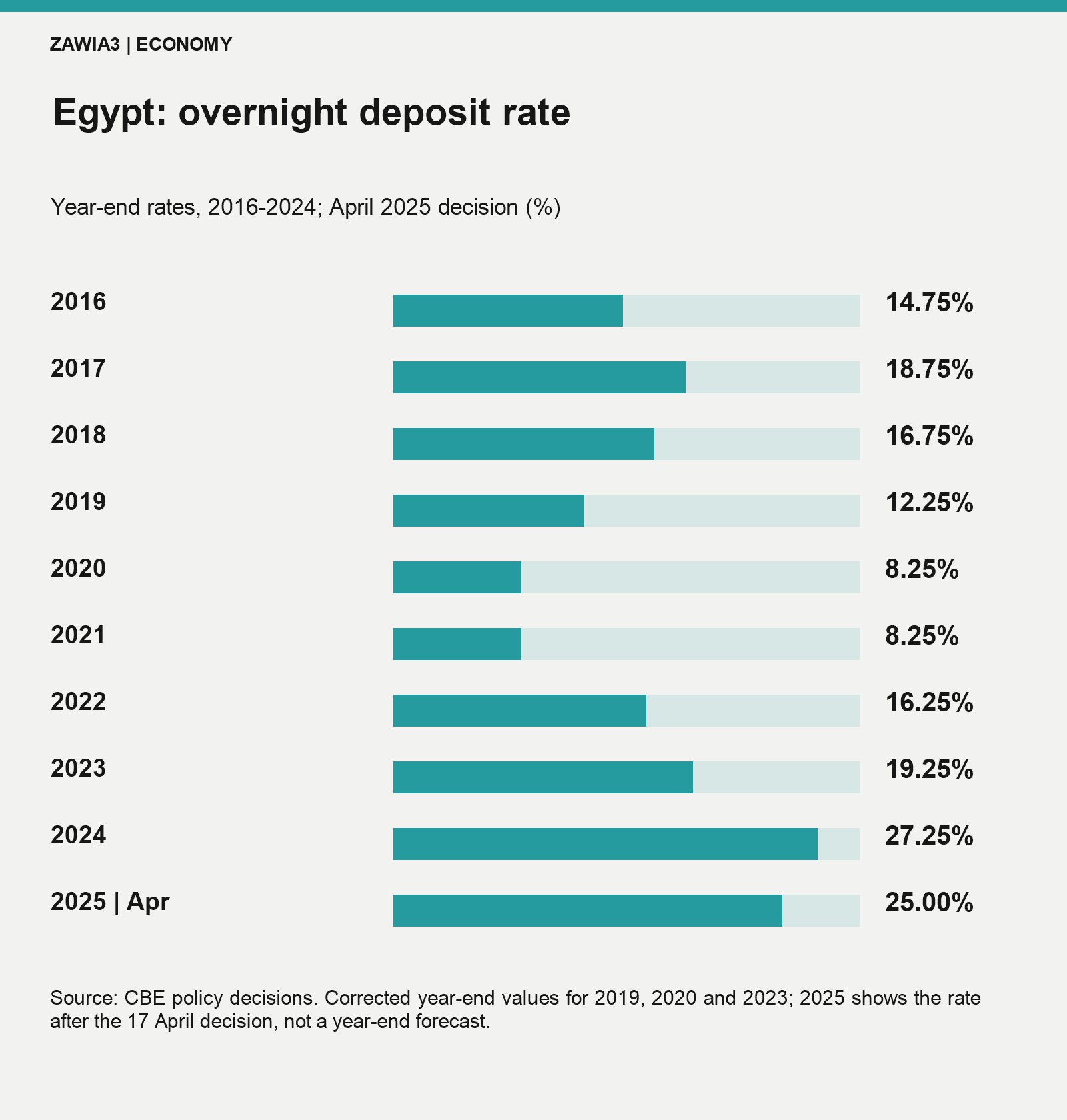
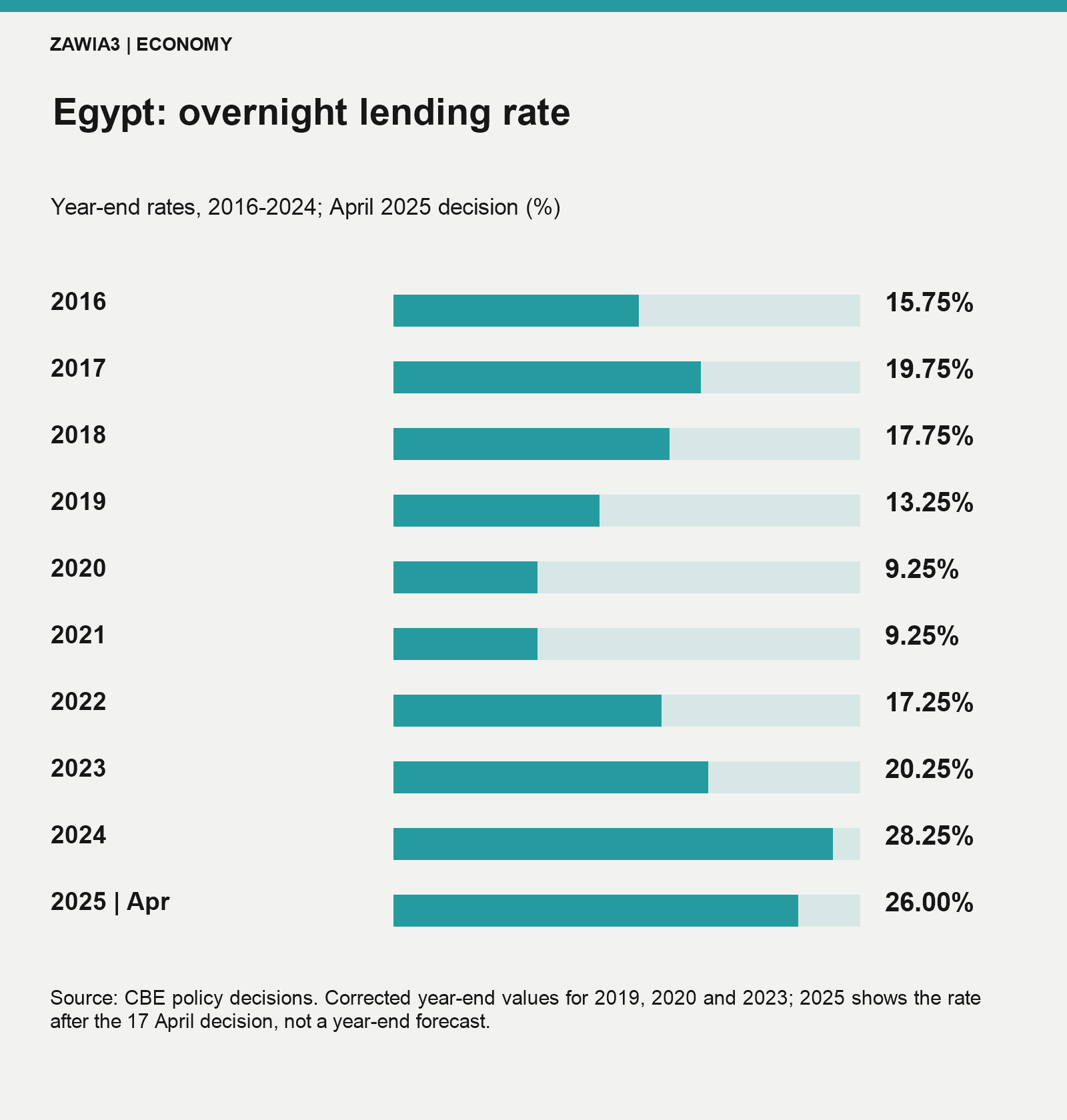
On April 17, the central bank lowered its key rates by 225 basis points, taking the overnight deposit rate to 25%, the overnight lending rate to 26%, and both the main operation and discount rates to 25.5%. It was the first cut since November 2020.
The bank pointed to easing inflation: annual headline inflation had fallen to 13.6% in March 2025, well below the 38% peak reached in September 2023. Annual non-food inflation, meanwhile, declined from 25.7% in March 2024 to 18.9% in March 2025.
Monthly price movements were moving closer to their historical pattern. Against a backdrop of improving foreign-asset and reserve positions, easing offered the prospect of supporting economic activity and reducing the burden of public debt. But April’s inflation figures also underlined why further cuts were not a foregone conclusion.
At the IMF’s April 24 briefing, regional director Jihad Azour stressed macroeconomic stability, lower inflation, exchange-rate flexibility and reforms supporting the private sector. The published transcript did not explicitly reject the April interest-rate cut.
From successive rate hikes to a possible easing cycle
Egyptian monetary policy has shifted repeatedly in response to domestic pressures and international shocks. Following the pound’s flotation in November 2016, the central bank raised interest rates to contain accelerating inflation. Overnight deposit and lending rates reached 14.75% and 15.75% that November, then 18.75% and 19.75% in July 2017—an increase of four percentage points during 2017.
An easing cycle followed. Rates fell gradually in 2019 and 2020, before remaining at 8.25% for deposits and 9.25% for lending throughout 2021. Renewed economic pressure and inflation prompted another tightening cycle from 2022. In 2024, the deposit rate reached a record 27.25% as the economy grappled with inflation above 30%.
April 2025 marked a change of direction. The 225-basis-point reduction followed March’s substantial slowdown in annual headline inflation to 13.6%. Financial institutions and analysts saw the possibility of further cuts over the rest of the year, with some forecasts putting additional easing at 400–600 basis points. These remained forecasts, dependent on inflation and wider economic conditions.
The charts below compare year-end overnight rates from 2016 to 2024 with the rates set on April 17, 2025. The final bars are not full-year figures.
Economics professor Karim El-Omda expects a further cut of one to two percentage points at the next meeting. Speaking to Zawia3, he says total reductions in 2025 could reach six to eight percentage points if inflation continues its downward trend.
One reason for that expectation, he explains, is the large gap between nominal interest rates and inflation. Subtracting inflation from the nominal rate gives an approximate measure of the real interest rate, an important influence on decisions to save, spend or invest.
El-Omda argues that high real rates restrain both consumption and production. At current levels, borrowing costs burden economic activity and encourage saving at the expense of investment and spending. In his view, this creates a case for further reductions in the coming months.
He identifies three areas particularly sensitive to interest rates: domestic debt, investment and financial markets. Higher rates increase debt-servicing costs and discourage investment; lower rates can relieve those pressures and support growth. After years of expensive borrowing, he expects further easing to help an economy struggling with weak activity.
Interest rates matter to foreign investors, especially those making short-term portfolio investments often described as “hot money.” But El-Omda stresses that they are only one factor. A better investment climate also requires structural reform, a wider state withdrawal from commercial activities, and fairer competition for private businesses.
The pound, inflation and the cost of borrowing
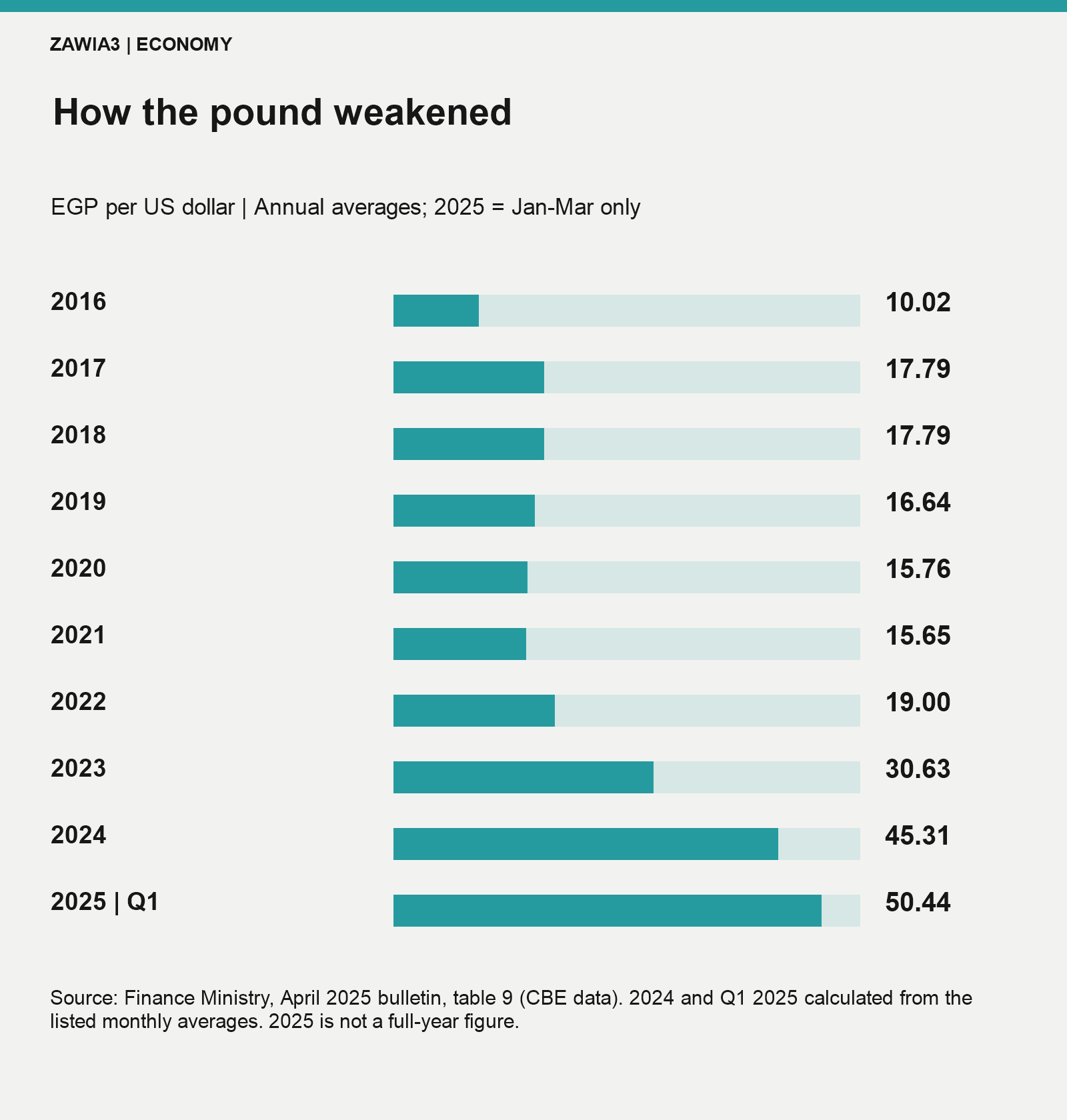
The pound’s depreciation since its November 2016 flotation has had consequences across the economy. The exchange rate moved from roughly EGP 8.8 to the dollar before flotation to around EGP 18 in the period that followed, increasing the cost of imports and eroding purchasing power.
The path was not a continuous decline. The pound strengthened somewhat in 2019 and 2020 before depreciating again in 2022 and 2023. The official rate stood near EGP 30.84 to the dollar at the beginning of 2024, before the move to a flexible exchange rate in March. Monthly averages subsequently reached about EGP 50.51 in December 2024 and EGP 50.56 in March 2025, according to the exchange-rate table in the Finance Ministry’s April 2025 bulletin.
Those monthly readings should not be confused with annual averages. The following chart uses calendar-year averages for 2016–2024 and a first-quarter average for 2025, drawing on the ministry’s published exchange-rate data.
After the 2016 flotation, higher import and energy costs helped push annual urban inflation to 23.3% by December. It reached about 33% in July 2017, amid measures associated with the economic reform programme, including fuel-subsidy reductions and tax increases.
Inflation then fell to around 11.4% in May 2018 before rising to 15.7% that November. By November 2019 it was approximately 3.6%. It stood near 5.7% in November 2020, during the coronavirus pandemic, and 5.6% in November 2021. A renewed acceleration took the rate to about 21.3% by the end of 2022.
In September 2023, inflation reached a record 38%, before easing to 33.7% at year-end. It slowed to 24.1% in December 2024. The latest April 2025 figures show annual urban headline inflation edging up to 13.9%, from 13.6% in March, alongside the rise in core inflation.
Slower inflation does not mean that earlier price increases have been reversed. Prices remain substantially above their pre-2016 levels, leaving households under continuing pressure.
Mohamed Ramadan, an economic researcher at the Egyptian Initiative for Personal Rights, recalls the rate cuts of 2020 as an attempt to support growth and reduce the risk of recession when the pandemic disrupted production and trade. No further cuts followed between November 2020 and April 2025; instead, renewed inflationary pressure eventually brought another tightening cycle.
Speaking to Zawia3, Ramadan points to the substantial gap between nominal overnight rates of 25–26% following April’s reduction and annual inflation. That gap helps explain the appeal of Egyptian government debt to domestic and foreign investors seeking high returns.
The risks of relying on “hot money”
Ramadan partly attributes the prolonged period of high interest rates to the desire to attract short-term foreign capital. He argues that this comes at a cost to the domestic economy: productive investment is discouraged and borrowing becomes more expensive.
He sees room for another cut at the next meeting because real interest rates remain high. Yet the decision will also depend on the government’s and central bank’s dollar requirements and external developments, including global economic uncertainty, US–China trade tensions and the Federal Reserve’s interest-rate decisions.
For companies, expensive credit raises the cost of working capital. According to Ramadan, this is why businesspeople are pressing for lower rates to ease financing burdens and expand production.
Property provides one example of how financing costs feed into prices. Interest rates are an important component of developers’ pricing models, particularly for homes sold on instalments. Higher financing costs can be passed on to buyers through the final purchase price, contributing to the repeated increases seen at major formal-sector developers.
Ramadan expects further cuts to influence asset valuations gradually, including in property, and believes cheaper financing could ease some price pressures over time. This is not an automatic relationship: lower interest rates can also stimulate demand for property and other assets, so a cut does not by itself guarantee lower prices.
He also stresses the limits of domestic policymakers’ freedom. Decisions by major central banks, particularly the US Federal Reserve and the European Central Bank, affect the financial conditions facing Egypt and other developing countries and help shape the scope for monetary easing.
Attracting short-term capital can bring foreign currency into the economy. Its ability to leave quickly, however, makes it a fragile basis for lasting stability.
“Hot money” generally refers to short-term investment in instruments such as treasury bills, bonds and shares, seeking returns from interest-rate differences or exchange-rate movements rather than a lasting productive commitment. Egypt attracted substantial inflows after the 2016 flotation as interest rates rose.
During shocks such as the pandemic and Russia’s invasion of Ukraine, rapid outflows placed pressure on the pound and foreign-currency reserves. Credit-risk concerns can further undermine investor confidence. Economists have therefore warned against treating these flows as a substitute for more durable sources of foreign currency and long-term investment.
Despite the broader decline in inflation, Egypt’s economic difficulties remain substantial. The choice between another cut and a pause is a test of policymakers’ ability to balance price stability with growth. Whichever course they take, its effectiveness will depend on wider reforms that strengthen domestic production, improve the investment environment and relieve the mounting pressure on people’s living standards.