

April continued the paradox that has come to define Egypt’s human rights landscape: limited measures suggesting a partial easing, alongside the continued expansion of administrative and judicial repression and growing social crises involving justice, discrimination and protection. While several people held in pretrial detention were released after years in custody, other political figures and rights defenders returned to prosecution and imprisonment. Rights reports continued documenting violations in detention facilities, and decisions restricting press freedom and expression recurred.
Other prominent issues concerned women’s and children’s rights, maintenance and personal status disputes, rising domestic violence, workers’ conditions and pensions, and violations against Sudanese refugees.
 Limited Releases, but the Doors of Detention Remain Open
The Public Prosecution released several people held in politically motivated cases, including Nermin Hussein after six years in pretrial detention, Sherif El-Rouby, former spokesperson for the April 6 Movement, and Ahmed Oraby, who was injured in the January Revolution. Others detained over political posts or solidarity with Palestine were also released.
But this did not last long. The Cairo Criminal Court’s Second Terrorism Circuit renewed the detention of labour leader Shady Mohamed and five others for 45 days in the case known in the media as the “Palestine solidarity banner” case. This reflected the continuing pattern of selective releases without a genuine resolution of prolonged pretrial detention.
The Committee for the Defence of Prisoners of Conscience submitted an official memorandum to the public prosecutor calling for the immediate, comprehensive release of everyone detained in political cases and an end to what it described as the use of pretrial detention as an extended punishment outside the law.
The Egyptian Initiative for Personal Rights also renewed its demand that the public prosecutor’s instructions to review the circumstances of pretrial detainees be implemented. It said any serious assessment of recent releases remains incomplete without safeguards preventing released detainees from being imprisoned again in new cases.
A Seventh Case Returns Ahmed Douma to Pretrial Detention
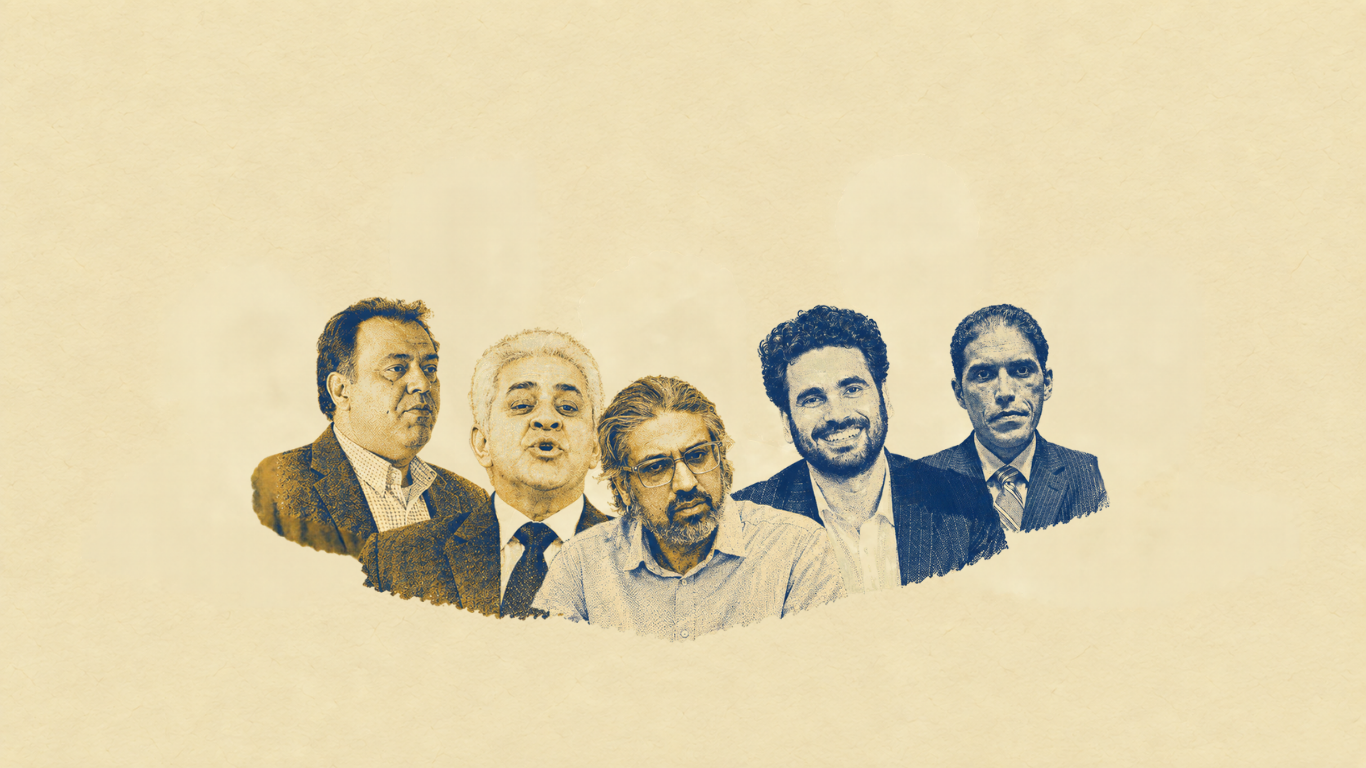
Writer and politician Ahmed Douma returned to the forefront as the Supreme State Security Prosecution in Cairo referred him to the New Cairo Misdemeanour Court on Monday. He was accused of spreading false news, statements and rumours inside and outside the country over a post and an article published on Al-Araby Al-Jadeed, according to human rights lawyer Khaled Ali, a member of his defence team.
Defence lawyer Mahienour El-Masry tells Zawia3 that Douma’s referral to trial came quickly in a publication-related case based on complaints submitted by citizens. She sees it as another link in a chain of similar cases, including that of Dr Abdel Khalek Farouk, who was sentenced to five years in prison at first instance and on appeal.
She believes this conveys the continuing message that freedom of opinion does not exist and that no one will be allowed to criticise performance, whether the state’s economic policies, as in Farouk’s case, or security practices, as in Douma’s.
El-Masry says the defence is awaiting the first trial hearing, scheduled for Wednesday, to examine the case in detail. It has not yet seen the substance of the complaints that led to Douma being summoned, questioned and arrested. Despite the referral, she says, the investigation has not been fully completed.
Douma was questioned under Articles 80(d) and 102 bis of the Penal Code, concerning the publication of false news, statements or rumours that could harm the public interest or disturb public security.
At the beginning of April, the Supreme State Security Prosecution ordered his detention for four days in Case No. 2449 of 2026 after six hours of questioning, accusing him of spreading false news and statements.
This is the seventh case in which Douma has been investigated since a presidential pardon in August 2023, following ten years in prison.
Sayed Moshagheb: Six Hours of Freedom
In another incident illustrating the fragile boundary between release and detention, security forces rearrested Sayed Moshagheb, a founder of Zamalek’s White Knights supporters’ group, around six hours after he reached home following his release. He had spent nearly eleven years detained in various cases.
The Interior Ministry said it had identified videos showing people gathering in Bulaq El-Dakrour and lighting fireworks to celebrate his release.
His lawyer, Osama El-Gohary, said the gathering was spontaneous and peaceful, within his residential area. He said the arrest report presented an account contrary to what occurred and called for an investigation into the circumstances of the rearrest.
Recommended reading: Sayed Moshagheb Detained Again Six Hours after Release
589 Violations in Three Months
Alongside these developments, the El Nadeem Center for Rehabilitation of Victims of Violence and Torture published its periodic report, “Archive of Oppression”, for the first quarter of 2026, documenting 589 cases involving various violations.
Individual harassment topped the list with 178 cases, followed by 79 enforced disappearances, 69 appearances after disappearance, 68 cases of violence attributed to state bodies, 55 cases of recycling detainees into new cases, and 51 cases of medical neglect.
The report also recorded 46 cases of collective harassment, 22 of individual torture, 18 deaths in detention and three killings.
It described physical and psychological violations including electric shocks, severe beatings, dragging, continuous shackling, threats of rape, forcing detainees to watch others being tortured and confinement in inhumane conditions.
Regarding women, testimonies described detained women being stripped and left to sleep directly on the floor without blankets in extreme cold, with all personal belongings confiscated.
The report also documented the use of criminal prisoners, allegedly with prison administrations’ consent or acquiescence, to assault other detainees. Extreme verbal humiliation and confinement in inhumane places were recurring features of what it described as “daily harassment”, worsening detainees’ physical and psychological health.
According to the report, these incidents represent a continuing pattern of absent oversight and accountability in detention facilities, rather than isolated abuses.
Freedom of Belief: Baha’i Marriages Denied Legal Recognition
The Court of Cassation refused to recognise marriages between followers of the Baha’i faith, overturning an earlier ruling that had acknowledged a Baha’i couple’s marital relationship. The judgment revived a longstanding crisis over the denial of legal recognition to Baha’i families.
Marina Samir, a researcher on freedom of religion and belief at the Egyptian Initiative for Personal Rights, explains that the latest judgment is part of a long series of legal and administrative difficulties faced by Baha’is in Egypt, particularly in proving marriage and securing the resulting family and civil rights.
She tells Zawia3 that this trajectory dates back to the 2009 ruling allowing a dash in the religion field on identity cards. It opened the way to subsequent problems with marriage documentation and proof of family relationships, in the absence of a legal framework recognising these marriages and their legal consequences.
The current dispute began when a Baha’i couple brought a case seeking recognition of their existing marital relationship. The interior and justice ministries and the head of the Civil Status Authority appealed the ruling, before the Court of Cassation overturned it on public-order grounds.
Samir says the continued refusal to legally recognise Baha’i marriages has daily repercussions involving inheritance, pensions, insurance, children’s school registration and dealings with banks, as well as restrictions related to residence and nationality.
These conditions affect far more than the right to form a family, extending across social life in the absence of a clear regulatory mechanism. Proposals such as appointing a delegated registrar to document marriages have received no response so far.
She believes this continuing legislative and administrative vacuum creates daily suffering and leads some Baha’is to consider leaving the country. Guaranteeing their fundamental rights as citizens remains a state obligation, foremost among them recognition and legal regulation of families to protect spouses’ and children’s rights.
نصوص تَعِد بالحرية وممارسات تُقيدها: الوجه المزدوج لحرية المعتقد في مصر
Investigation Shelved over El-Baz’s Statements about Mostafa El-Naggar
The “Stop Enforced Disappearance” campaign expressed dismay at the shelving of a complaint by the family of former MP Mostafa El-Naggar concerning statements attributed to journalist Mohamed El-Baz about his “death” on the Egyptian-Sudanese border. It described the decision as “a squandering of justice”.
The campaign said El-Naggar’s family submitted the complaint to the Aswan prosecution on 28 January 2026 to investigate public statements in which the journalist claimed to have information about his death. The complaint was shelved on 11 February, around two weeks later, without summoning the complainants or undertaking substantive investigative steps, according to the campaign’s statement.
El-Naggar’s case dates to 28 September 2018, when contact with him was lost while he was in Aswan. Information about his fate remains conflicting. His family and lawyers say they have submitted numerous complaints and pursued legal proceedings, including obtaining a court ruling requiring the relevant authorities to disclose his place of detention, which has not been implemented.
Doctors and Union Members: From Professional Disputes to State Security
April saw a marked escalation in the crisis involving doctors detained over their objection to reductions in mandatory government placements for medical graduates. Public figures, parties and rights organisations called for the release of three doctors and pharmacists held in Case No. 945 of 2026.
The case gained further momentum after detained doctor Mohamed Osama received thousands of votes in the Dental Syndicate’s midterm elections. The vote was seen as an expression of solidarity from colleagues and rejection of his continuing detention.
At a hearing on Sunday, 19 April, the prosecution renewed the detention of three defendants: Dr Mohamed Osama El-Sayed from Mansoura; Dr Mostafa Mahmoud Oraby from Damietta, the class of 2023 representative at the General Dental Syndicate; and Ihab Sameh Abdel Malek, a pharmacist from Zagazig. Observers see turning professional and union disputes into State Security cases as a recurring feature in the management of social conflicts.
The Press under Blocking and Digital Prosecution
An Access Now report, “Espionage for Repression”, revealed a hacking campaign targeting journalists and critics of the Egyptian government, including journalist Mostafa El-Aasar and politician Ahmed El-Tantawy.
The report said attacks were carried out through phishing messages appearing to come from trusted sources, aimed at stealing personal and financial information between 2023 and 2024.
An earlier Zawia3 investigation revealed the expanding use of companies and sophisticated digital surveillance technology to track journalists and opponents inside and outside Egypt. These included software capable of infiltrating phones and spying on communications and sensitive data without users’ knowledge.
The investigation showed that this system extends beyond foreign tools such as Israeli and European hacking software. It encompasses a broader surveillance infrastructure involving government contracts and official projects enabling analysis of user data and monitoring of digital content under the cover of “securing networks” and “developing technological infrastructure”.
It highlighted the use of these tools to target media and human rights voices, raising growing concerns over expanding digital surveillance and diminishing protections for privacy and freedom of expression online.
حين يحذرك من اشتراه: الاتصالات تنبه من برمجيات إسرائيلية دفعت مصر ملايين الدولارات لاستخدامها
Domestically, the Supreme Council for Media Regulation continued its blocking policy, ordering the blocking of the Egyptke website on grounds of failing to meet licensing requirements and publishing news that could destabilise markets.
The Egyptian Observatory for Journalism and Media said the decision raises legal and professional questions because it does not identify the articles or incidents constituting violations, preventing independent verification or objective review.
The month also brought a judicial victory for Al-Bawaba News journalists. The Qasr El-Nil Misdemeanour Court acquitted nine journalists from the organisation, along with Journalists Syndicate board members Eman Auf and Mahmoud Kamel, of insult and defamation charges arising from labour protests.
A labour court also ordered a fine of EGP 3.341 million against the organisation’s board chair in favour of 257 journalists over failure to implement the minimum wage.
Journalist Afaf Hamdy tells Zawia3 that the crisis began on 17 November last year, when journalists started an open-ended sit-in at the organisation’s premises to protest their conditions. Management refused to negotiate or respond to the syndicate’s proposals for a satisfactory solution, citing “financial difficulties” and raising the possibility of liquidating the organisation.
She says the crisis escalated in January when management used private security personnel to forcibly break up the sit-in, prompting journalists to move their protests to the Journalists Syndicate headquarters.
The Personal Status Law: A Postponed Battle
A bill proposed by the Justice Party sparked anger over a provision ending custody when a boy or girl reaches nine years of age.
The proposal gives fathers a higher place in the custody order and grants the non-custodial parent 24 hours of hosting per week.
Feminist organisations saw the proposal as a reversal of previous legal gains, favouring adult disputes at the expense of the child’s best interests.
The Free Egyptians Party announced that it was opening its draft bill on protecting children’s rights and ensuring family stability to public dialogue, seeking proposals before the final text is prepared.
The bill aims to integrate data on custody, visitation, maintenance, education and travel and link these to income and salaries, ensuring transparency, accelerating litigation and enforcement and reducing manipulation.
The draft introduces a unified digital “family register” connecting family and child data, including judicial rulings, enforcement proceedings and financial obligations. Each family would receive a family number beginning with the marriage contract and continuing across different stages of life.
This came days after President Abdel Fattah El-Sisi directed the government to swiftly submit bills relating to Egyptian families and refer them to parliament.
A New Woman Foundation report, “The Draft Personal Status Law: Where Is It Heading?”, criticised insufficient transparency and the continued handling of the issue without effective public dialogue involving all parties, despite the law’s sensitivity and direct impact on family life. Reform, it said, must take a comprehensive approach grounded in justice, equality and genuine public discussion, instead of formal procedures that do not address the roots of the crisis.
Neveen Ebeid, executive director of the New Woman Foundation, connects proposals to lower children’s custody age with the broader economic and social context. She believes the severe economic crisis plays a central role in reshaping power within families, intensifying disputes over custody, maintenance and housing.
She tells Zawia3: “Living pressures, rising impoverishment and shrinking social protection have led some fathers to demand a lower custody age as a way to recover the custody home and reduce financial burdens. These motives concern economic conflicts within the family, rather than the child’s interests.”
She believes the absence of comprehensive reform and reliance on partial amendments have worsened the crisis and opened space for a conservative discourse undermining women’s and families’ gains.
Ebeid criticises the state’s hesitation to present a comprehensive personal status law for broad public dialogue. The lack of transparency increases social polarisation, she says. Although the child’s best interests have been discussed for years, the principle has not been translated into clear policies on maintenance, easier guardianship procedures or better conditions for custodial parents.
Workers: Delayed Pensions and Increasing Accidents
A severe crisis at Port Said’s social insurance office disrupted payments due to some retirees, which have been stalled since December 2025, affecting thousands of families. Shutting down the SAIO system before its replacement was ready prevented pension registration, payments and document issuance, harming groups such as drivers and fishers. This occurred despite approximately EGP 1.3 billion spent on upgrading the system and contracting for a CRM programme, according to a parliamentary request for clarification submitted by MP Ahmed Farghaly, a member of parliament’s Economic Committee.
On occupational safety, the Center for Trade Union and Workers Services reported a marked increase in accidents. In the first quarter of 2025, it recorded 49 incidents involving 356 casualties, including 43 adult deaths and one child death, alongside 298 injured people, including 14 children. In the same period of 2026, accidents rose to 70, with 358 casualties: 44 adult deaths and three child deaths, and 294 injured people, including 17 children. It questioned the effectiveness of safety measures and stressed the need for urgent action to prevent further incidents.
Sudanese Refugees: Detention, Deportation and a Fifth Death
Sudanese refugees remained a prominent issue after Refugees Platform in Egypt announced the death of Sudanese asylum seeker Rashed Mohamed Abbas following detention. This came amid a broad security campaign against refugees, asylum seekers and migrants in Egypt over recent months, with a marked escalation since the beginning of this year.
The platform said this was the fifth death of its kind in recent months. It expressed concern over deteriorating protection for refugees and asylum seekers and detention conditions, calling for a serious investigation into the circumstances and safeguards against recurrence.
Rights organisations also documented the forcible deportation of Sudanese writer and novelist Idris Ali Babiker to Sudan, despite his asylum documents, after around 50 days in harsh detention conditions.
In their statement, the organisations said his testimony reveals harsh and inhumane conditions, including deliberate starvation, financial extortion and forced payment for accommodation inside the detention facility. His health deteriorated amid infestations of lice, cockroaches and mosquitoes in an environment lacking basic hygiene and healthcare.
The platform meanwhile welcomed the Egyptian authorities’ facilitation of Sudanese secondary certificate examinations in Egypt, while demanding an end to arrest campaigns and the release of detained students.
Recommended reading: From Deportation to Hate Speech: How Did Refugees Become Targets of Digital Campaigns in Egypt?
Alexandria: Development Consumes the City’s Memory
The demolition of the more than 160-year-old Bulkeley tram station as part of Alexandria’s Raml tram development drew widespread criticism. A Zawia3 report, “In Alexandria: The Tram Replacement Faces Financial Difficulties, and Drivers Have Awaited Their Payments for Two Months”, revealed problems operating the alternative transport system and delays in payments to workers and vehicle owners, amid fears of complete traffic paralysis.
MP Dr Ahmed Alaa Fayed of the Egyptian Social Democratic Party submitted a parliamentary request for clarification to the prime minister, transport minister and local development minister concerning the difficulties facing the Raml tram replacement system, suspected waste of public funds and the risk of traffic paralysis from stopping the tram before alternatives were ready.
He called on the government to clarify the replacement system’s status and actual ability to meet residents’ needs after tram services were reduced. He demanded urgent payment of all overdue sums to drivers, vehicle owners and workers, a halt to further demolition of historic tram stations pending a full legal review, and a comprehensive investigation into reported scrapping and sales to ensure protection of public funds.
The Egyptian Commission for Rights and Freedoms condemned the cutting of trees around Alexandria’s historic tram stations as part of a broader reduction in green space. A petition it launched warned that removing the tram and replacing it with more polluting transport while cutting trees would worsen pollution in a city already threatened by climate change. It described this as a breach of constitutional obligations to protect the environment.
Women between Paternalism and Violence
April also saw measures and debates that returned women’s rights to the forefront. The Labour Ministry issued binding decisions for recruitment companies prohibiting Egyptian women from travelling and working abroad in several occupations, including domestic work, cooking and home nursing.
Rights groups saw the decision as imposing paternalistic control in the name of protection and restricting women’s rights to work and travel, instead of creating effective mechanisms against exploitation.
The Supreme Constitutional Court meanwhile ruled unconstitutional an earlier decision granting female workers only half the share allocated to men in ownership of reclaimed land, finding it discriminatory and contrary to the Constitution.
A report by Barah Aman documented 5,338 crimes of violence against women in the private sphere between 2018 and 2024, including 1,823 physical violence crimes, 256 cases of economic violence and 170 crimes of a sexual or reproductive nature.
The report noted increasing killings motivated by rejection, divorce or separation and rising economic and psychological control within families.
Debate also intensified over rape survivors’ right to safe abortion after two underage sisters in Menoufia were repeatedly assaulted by their uncle, resulting in pregnancy. This prompted discussion of the criminalisation of abortion even in rape cases.
Feminist activists and civil society organisations defending women’s rights launched the hashtag “Safe Abortion for Girls in Rape Crimes”. The Cairo Foundation for Development and Law said forcing a child to continue a pregnancy resulting from rape compounds the violation of her rights, calling for access to safe abortion as a right linked to life, health and dignity.
A Mother’s Suicide
The suicide of a young mother in Alexandria highlighted Egypt’s maintenance crisis. Rights organisations linked the incident to complex enforcement procedures and weak economic and social protection for women supporting families.
The Egyptian Center for Economic and Social Rights noted that the maximum maintenance payment through Nasser Bank remains EGP 500, unchanged since 2004, a sum that has lost almost all its value through successive waves of inflation.
Feminist organisations called for urgent reform, including swift enforcement of judgments, higher minimum maintenance and sustained psychological and social support for women in family disputes.
The Cairo Foundation for Development and Law warned of the compounded pressures facing women who support their families. Economic burdens, legal complexities and weak social protection can drive some to breakdown, it said, pointing to a gap between maintenance judgments and their actual enforcement.
The Center for Egyptian Women’s Legal Assistance stressed that the young mother’s suicide reveals a structural failure in the personal status system rather than an isolated incident. It cited accumulated economic, legal and social pressures, particularly obstructed maintenance enforcement and absent effective protection in custody and housing cases.
In April, the Public Prosecution placed people refusing to pay maintenance on travel-ban and arrival-watch lists. The Cairo Foundation for Development and Law called for effective and prompt rights to challenge and appeal, accurate listing procedures with periodic review, and consideration of humanitarian cases and exceptional economic circumstances.
Recommended reading: Maintenance in Exchange for Services: Is the State Encouraging Fathers to Pay or Pushing Them out of the Labour Market?
Children between Violence and Punishment
Malath Foundation published its quarterly report, documenting 47 cases of violence against children in the first three months of 2026, including physical assaults, sexual violations, exploitation and killings. Another report by Bint El-Nile Foundation recorded 662 crimes of domestic violence against minors between 2022 and 2025.
A parliamentary bill sparked extensive debate by proposing to lower children’s age of criminal responsibility to ten and raise the maximum aggravated prison sentence to twenty years for certain offences.
Lawyer Ahmed Moselhy, head of the Child Defence Network, tells Zawia3 this conflicts with the philosophy of Egypt’s Child Law and the principles of the international Convention on the Rights of the Child. The existing framework sets criminal responsibility at twelve, with graduated treatment reflecting age differences and a focus on rehabilitation.
He warns that severe penalties, such as imprisonment for up to twenty years, could produce criminals rather than reintegrate children into society, especially given their incomplete psychological and mental development. He also points to a conflict with civil-law principles treating those below adulthood as lacking full discernment, raising legal problems with holding them criminally responsible in this way.
Prison and a Fine for a Port Said Hotel Manager Who Discriminated against a Journalist Staying Alone
On 27 April, the East Misdemeanour Appeals Court sentenced the manager of Utopia El-Safwa Hotel in Port Said, in absentia, to one year in prison and a fine of EGP 50,000 for discriminating against Alaa Saad and preventing her from staying in a single room for women. It overturned the first-instance ruling issued on 3 March.
The case began in January, when journalist Alaa Saad was refused a hotel room because she was a woman travelling alone. This is a form of discrimination imposing social and moral control and diminishing women’s right to full legal capacity and autonomy.