
The military confrontation between Iran and Israel has immediately disrupted Egypt’s natural gas supplies. Israel’s strikes on Iranian nuclear and military sites early on Friday, 13 June, killed military commanders and prompted Iranian missile attacks that caused deaths, injuries and damage in Israel.
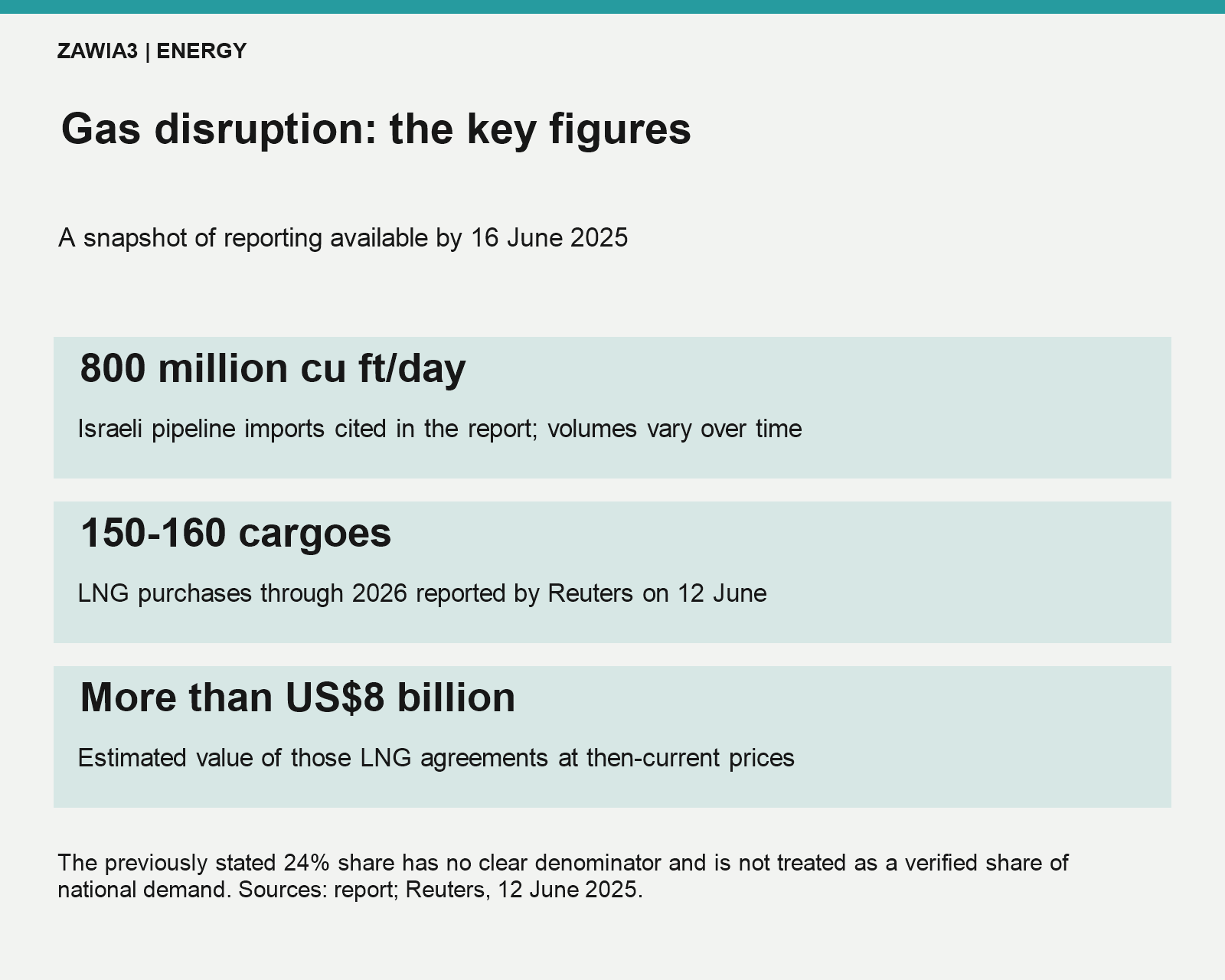
Egypt began importing Israeli gas in 2020. The supply estimate cited in this report is approximately 800 million cubic feet a day before the disruption; this is a variable volume, not a constant level maintained since imports began. Israeli suppliers notified Egypt on Friday that deliveries would be reduced following the shutdown of the offshore Leviathan field.
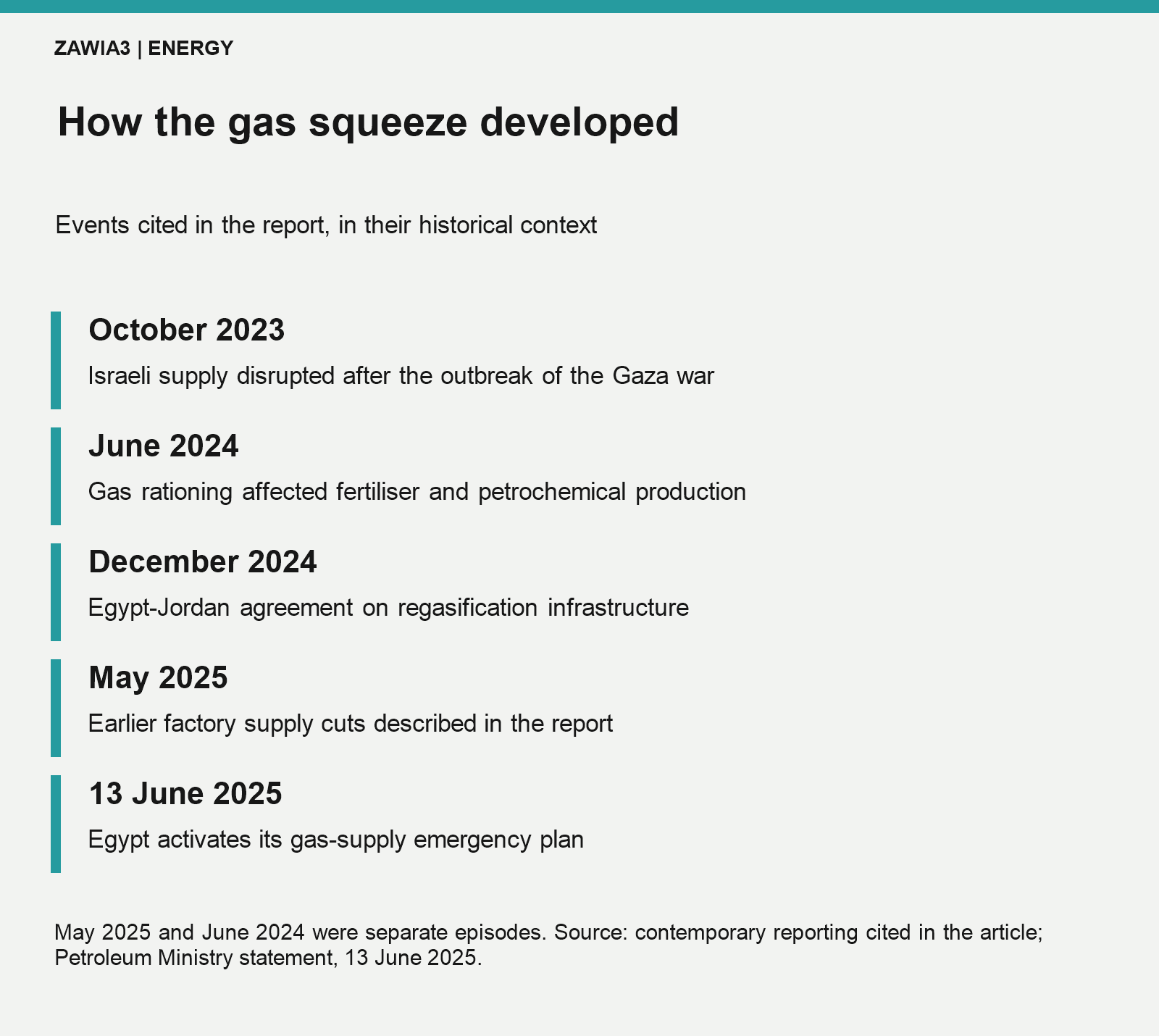
The Petroleum Ministry activated its prearranged emergency plan, stopping gas supplies to some industrial activities, maximising fuel-oil use at power stations and running some plants on diesel. The aim was to stabilise the gas network and avoid electricity rationing.
In its 13 June statement, the ministry said three floating regasification vessels had arrived. One was feeding the national grid; the other two were still being prepared and connected. It said the gas network and fuel-oil reserves were secure, with an operations room monitoring conditions around the clock.
Asharq Business reported that Egypt also halted fuel-oil and diesel deliveries to factories on Saturday for 14 days, affecting industries including food and cement. The purpose was to reserve approximately 8,000 tonnes of fuel oil a day for electricity generation until imported cargoes arrived.
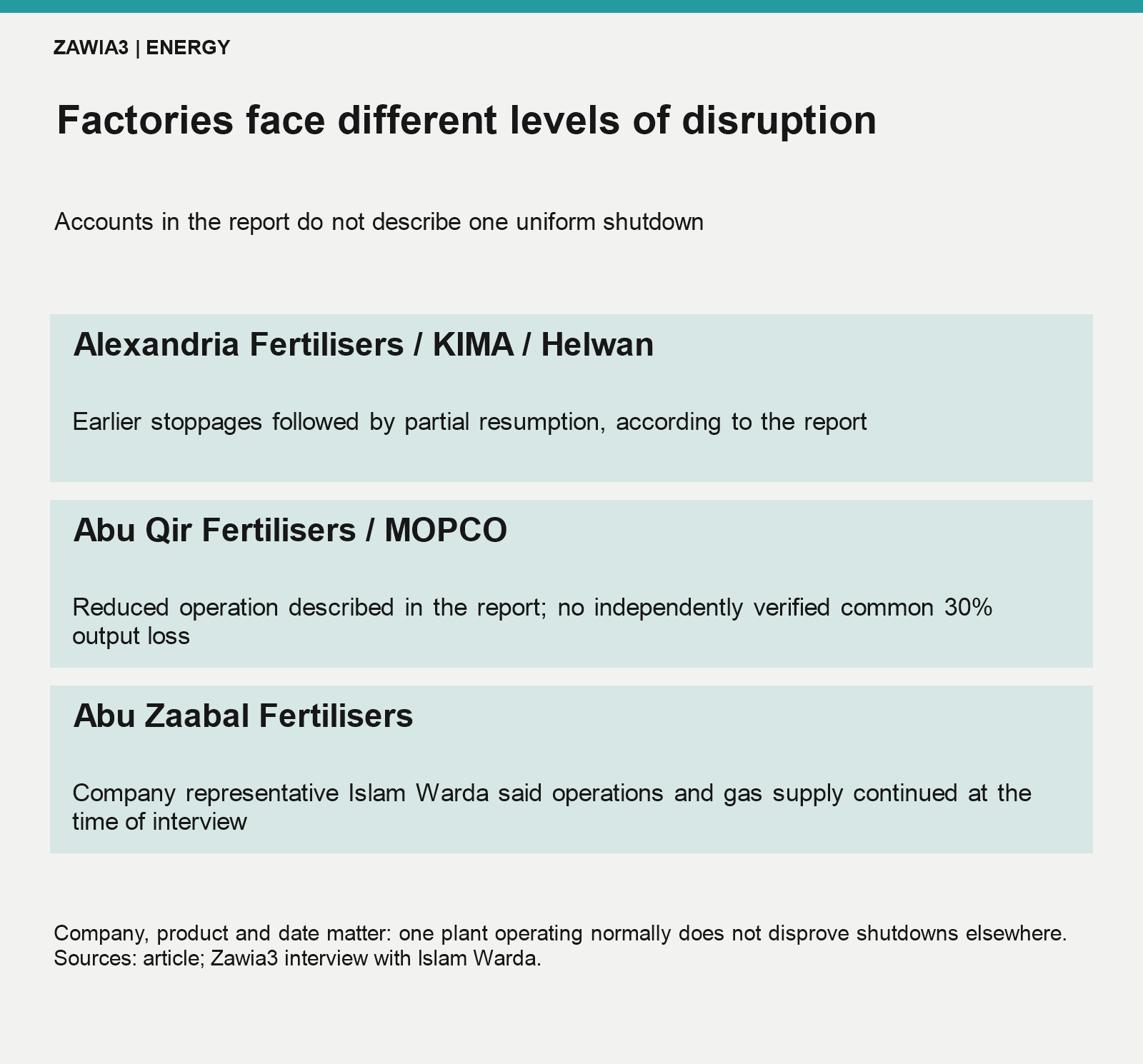
This followed the gradual resumption of activity at fertiliser and petrochemical plants after an earlier round of gas shortages. The report describes stoppages at Alexandria Fertilizers, KIMA in Aswan and Helwan Fertilizers in May, alongside reduced operations at Abu Qir Fertilizers and MOPCO. Partial restoration of supplies, reportedly at 60–70% of normal volumes, allowed production to resume. The reductions did not establish a single uniform percentage loss of output across those companies.
Despite its own shortage, Egypt began supplying Jordan with a reported 100 million cubic feet of gas a day for electricity generation after Israeli deliveries were interrupted.
The arrangement followed a December 2024 agreement enabling Jordan to use Egypt’s floating storage and regasification infrastructure to secure LNG supplies over the following two years.
Expectations of higher gas prices
Hassan Nasr, head of the petroleum products division at the Federation of Egyptian Chambers of Commerce, says higher industrial gas prices had been anticipated before this escalation because wars were already affecting global energy markets.
He argues that earlier Israeli supply suspensions, described as maintenance lasting 20–30 days, had also put pressure on Egypt in price negotiations. This is his interpretation of the suppliers’ motives. Egypt buys Israeli gas because the existing pipelines and short transport distance make it cheaper than overseas LNG cargoes, he explains.
Nasr tells Zawia3 that rising gas prices will eventually reach consumers through the cost of other goods. He says Egyptian delegations had discussed imports with Qatar but, according to his information at the time of the interview, the discussions had not yet produced deliveries.
He also warns about attacks on regional gas infrastructure. For clarity, the reported 14 June strike hit a gas-processing facility on the Iranian side of the South Pars field. It does not establish that Qatar’s North Field facilities were struck, although the two countries share the underlying reservoir.
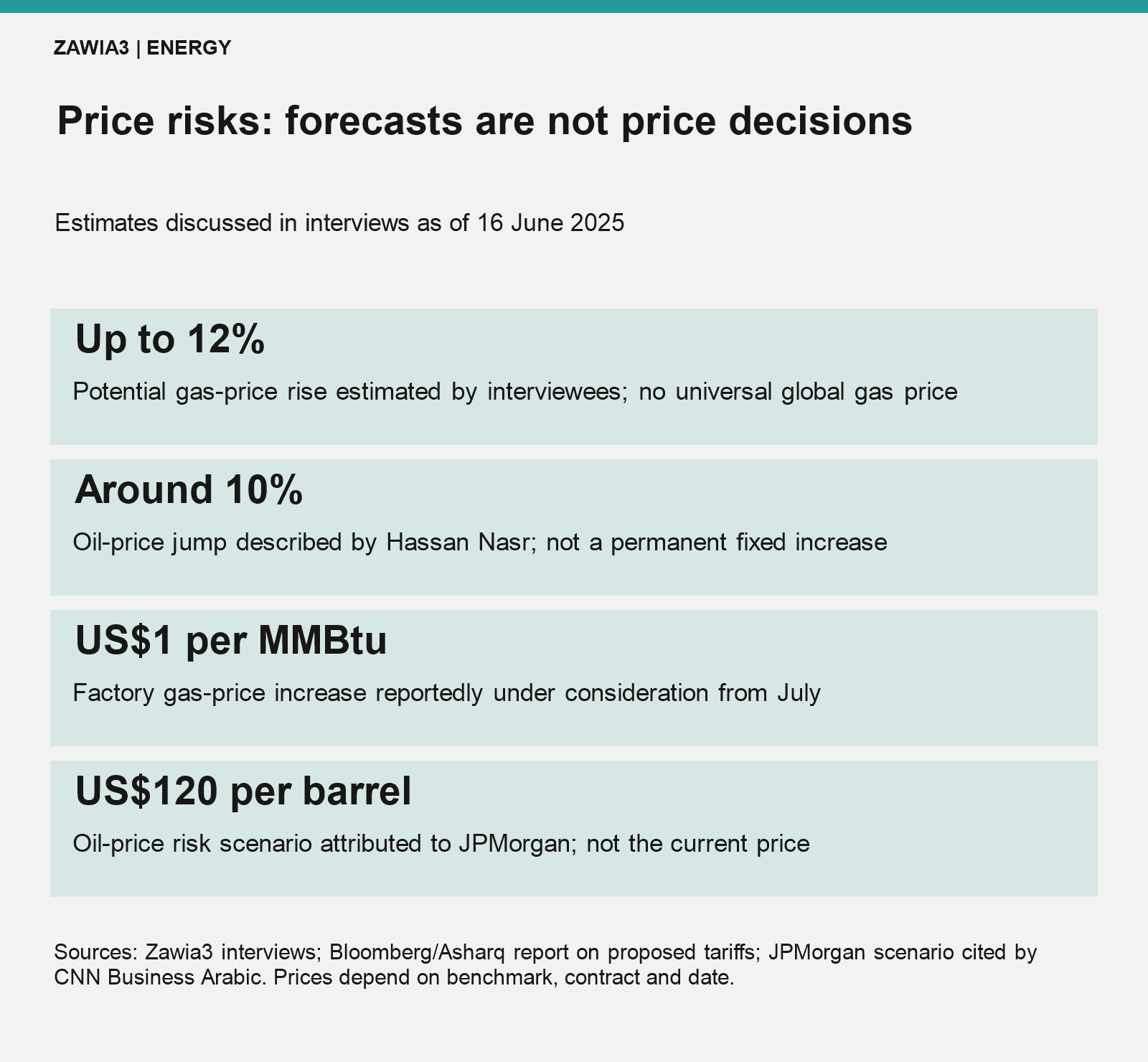
Nasr estimates that oil prices rose by around 10% and that gas increases could reach 12%. These are interview estimates, not fixed market quotations or announced Egyptian tariff changes. He links summer electricity demand to increased gas consumption, dollar requirements and potential exchange-rate pressure. His expectation of a new gas price in October is a forecast, not a government announcement.
He says the Leviathan shutdown has had a substantial impact on Egypt and led to cuts for factories. He estimates that approximately $6 billion had been allocated to gas and power-generation fuel, and that buying before the price surge could save around $500 million. Those figures were not independently verified as completed payments or realised savings.
Nasr believes advance purchases provide a buffer against summer shortages. Contracted cargoes, however, should not be confused with cargoes already received or with self-sufficiency from domestic production.
On Friday, Dutch July gas futures, the European benchmark, rose 2.85% to €37.20 ($42.93) per megawatt-hour. A JPMorgan scenario put oil at as much as $120 a barrel if the conflict severely disrupted supplies; that was a risk scenario, not the prevailing oil price.
A week earlier, Bloomberg reported that Egypt was considering an industrial gas increase of approximately $1 per million British thermal units from July. Al Arabiya also reported consideration of a three-year phase-out of industrial gas subsidies. Both were proposals under discussion.
Industrial tariffs vary by activity. The reported minimum for nitrogen fertilisers is $4.50 per million British thermal units, compared with $5.75 for non-nitrogen fertilisers and iron and steel, $12 for cement and $4.75 for other industrial uses. Power stations pay $4 per million British thermal units. These sectoral prices cannot be treated as a single tariff applying to every factory.
Could electricity rationing return?
Hossam Arafat, a petroleum engineering professor and former head of the petroleum products division, links the confrontation to geopolitical risks across Iran, Qatar and the Gulf. He estimates that global gas prices could rise by 12% and predicts a possible return to electricity rationing. The emergency plan, however, is intended to avoid that outcome; his prediction is not an announced rationing schedule.
He says preparing regasification vessels and signing supply contracts cannot eliminate uncertainty over deliveries. He refers to around 60 summer cargoes, potentially supplemented by another 30, and argues that Egypt is working simultaneously on infrastructure and current and future purchases.
The larger procurement figure needs a separate timeframe: Reuters reported on 12 June that Egypt had agreed to buy 150–160 LNG cargoes through the end of 2026, not over three years. Summer purchases and longer programmes may overlap and should not automatically be added together.
Arafat warns that a wider war could disrupt pipeline gas and other internationally traded cargoes. He cites roughly 800 million cubic feet a day of Israeli supplies and recalls disruptions in October 2023. A percentage of total Egyptian needs is not assigned here because the basis for the 24% estimate in the interview was unclear.
“These vessels need liquefied gas to convert—where is the gas in the first place?” Arafat asks.
His point is that floating regasification capacity alone cannot replace missing fuel. Israeli gas enters through pipelines, whereas LNG arriving by ship must first be converted back into gas. The ministry’s contemporary statement said only one of the three vessels had begun pumping, with two still being prepared.
Once domestic or imported gas reaches the national network, Arafat explains, household use, vehicle fuel and electricity receive priority. Some power stations can switch between gas and fuel oil, giving them alternatives unavailable to plants that need gas as a raw material.
Fertiliser production is especially exposed, followed by energy-intensive industries such as steel, cement and ceramics. Reduced supplies may force factories operating three shifts to reduce their schedules to two or one.
Arafat sees the ministry’s announcement as a warning of possible price rises as summer demand intensifies. He estimates that fertiliser and petrochemical gas supplies could fall by 30–40% if household and electricity needs take priority. This is a forecast, not a measured reduction across the sector. Greater fuel-oil use at power stations could ease pressure, he says, although both fuels require foreign currency.
Households had already faced a gas tariff increase from the June 2025 bill: the first consumption band, up to 30 cubic metres, rose from EGP 3 to EGP 4 per cubic metre, or 33.3%; the 31–60 band rose from EGP 4 to EGP 5, or 25%; and consumption above 60 cubic metres rose from EGP 5 to EGP 7, or 40%. This followed increases in motor fuel and cooking-gas cylinder prices in April.
Temporary and precautionary—or a deeper disruption?
Reuters reported, citing unnamed sources, that Egyptian fertiliser companies halted operations on 13 June following the decline in Israeli gas imports. But conditions were not identical at every plant.
Islam Warda, an official at Abu Zaabal Fertilizers, tells Zawia3 that his plant was operating normally when interviewed. Its gas had not been cut, and management had not received official instructions concerning the ministry’s emergency plan.
He says the reduction in June 2024 had not adversely affected Abu Zaabal’s output because it coincided with a period when the plant was already producing less. He identifies September to January as its peak period, linked to the agricultural season, and says the plant did not experience a complete 24-hour gas shutdown.
In June 2024, the ministry reduced fertiliser companies’ gas supplies by 20–30%. Some plants stopped while replacement volumes were arranged. Press reports had also described an 11-day interruption to petrochemical supplies. The ministry announced gradual restoration to fertiliser plants from 6 June 2024; Abu Qir, Sidi Kerir and KIMA had reported stoppages linked to unstable regional gas pressure.
Khaled Abul Makarem, chair of Egypt’s Chemical and Fertilizers Export Council and head of Makarem Tex, says the regional and international changes expose industry and exports in many countries to disruption. He calls for state institutions to reorder priorities and find more efficient alternatives.
“The relevant government bodies are making clear efforts to keep vital sectors operating steadily and reduce the possibility of disruption,” he tells Zawia3. He expresses confidence in the sector’s adaptability and says coordination with the authorities is intended to maintain regular supplies and exports.
Abul Makarem describes the ministry’s cuts as temporary precautions affecting activities that are less strategic or can use substitute fuels. In his assessment at the time of the interview, chemical and fertiliser exports had not yet suffered a substantial impact. He says the council is working with manufacturers to sustain production.
He also emphasises stronger commercial ties and the expansion of export markets, arguing that Egypt’s institutions can manage the crisis while preserving economic and security stability.
The reported programme of 150–160 LNG cargoes through 2026 was valued at more than $8 billion. That is a contract-value estimate, not proof that the entire amount had already been paid.
The procurement illustrates the scale of Egypt’s renewed import needs after its return to being a net gas importer in 2024, as described in the report cited by the Arabic article.
“The market cannot bear more increases”
Economist Khaled El Shafy, head of the Al Asema Centre for Economic Studies and Research, says the immediate problem is replacing the volume no longer arriving from the closed Israeli field.
Egypt must either find other suppliers for fertiliser, petrochemical and steel plants, even at higher prices, or accept reduced factory output, he argues. His estimate that 70–80% of production is export-oriented concerns the activities he is discussing; it is not a verified share for all Egyptian industry.
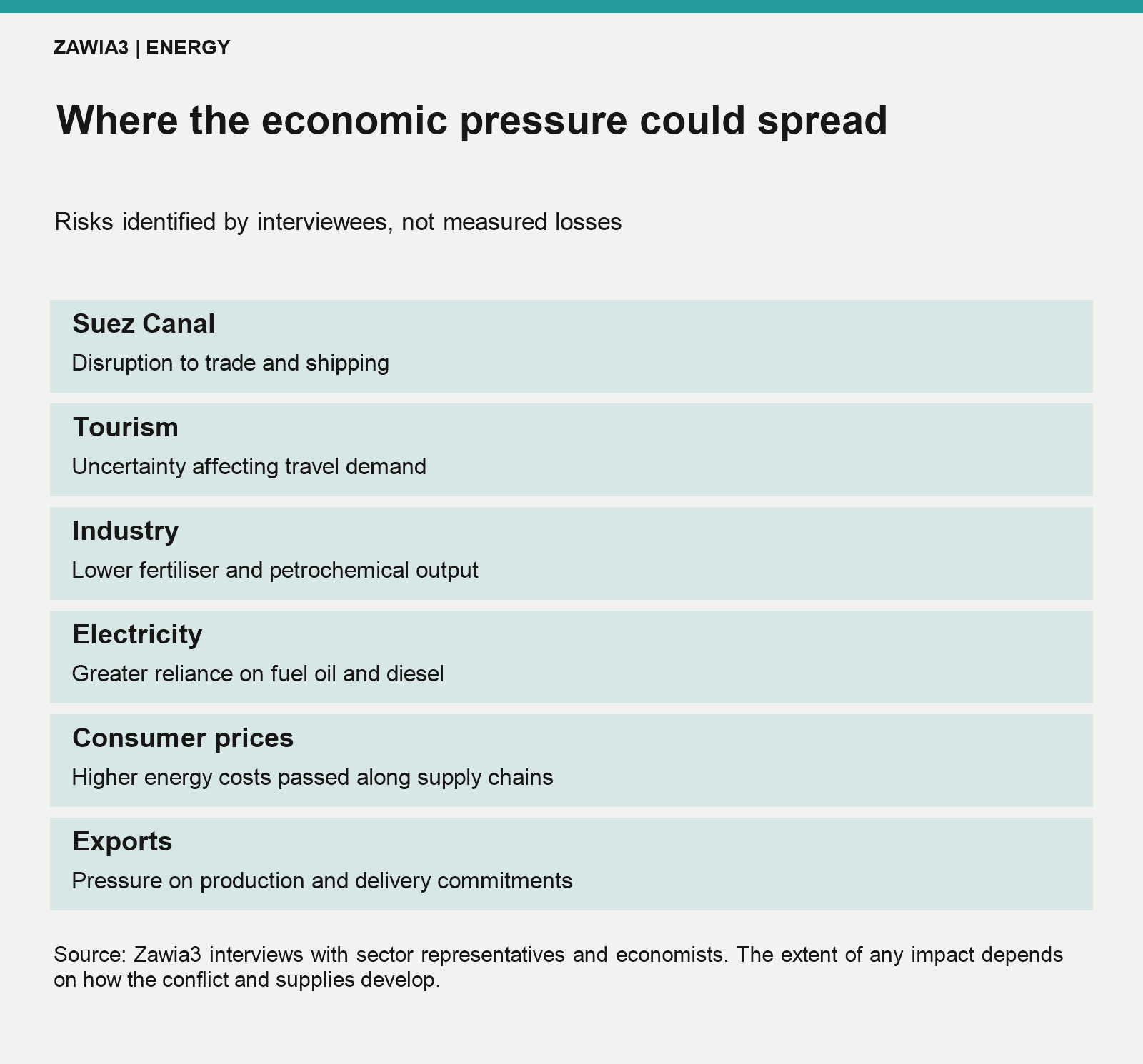
El Shafy warns of effects extending beyond gas: Suez Canal shipping, global trade, supply chains and Egyptian tourism could all face pressure. Higher energy costs could raise the prices of both locally consumed goods and exports, leaving economic conditions unsettled until the confrontation stabilises.
He believes the petroleum and finance ministries had taken precautions before the war to meet summer needs. He nevertheless expects industrial gas prices to rise with international prices.
For households, he expects no further increase before October. That is his assessment, not a binding government promise. His argument is that an immediate additional rise would feed through to other prices and inflation.
“The market cannot bear more increases at the moment,” El Shafy says.
The confrontation exposes the vulnerability of Egypt’s energy system to geopolitical shocks. Reliance on Israeli imports means military escalation can rapidly become a domestic supply problem. Emergency fuel switching and additional cargoes may relieve immediate pressure, but the consequences extend to export industries and consumer prices.
With summer demand rising, the need for more stable, diversified long-term energy partnerships is clear if Egypt is to avoid repeated industrial stoppages and electricity shortages.