
The State Council’s latest round of promotions has stirred debate across Egypt’s judiciary over the widening gap in career progression between its members and their counterparts in other judicial institutions.
The council’s Special Council for Administrative Affairs, chaired by Ahmed Abboud, approved the measures at its meeting on 17 February. Described by the council as its largest promotion round, the package prompted demands for more equal opportunities across the judiciary.
Critics called on the president, who chairs the Supreme Council for Judicial Bodies and Authorities, to address the disparities. Some cited Article 8 of a bill published in 2019, which proposed reducing differences in promotion times within ten years. That published draft, however, does not by itself establish that the provision became binding law.
The controversy has also revived proposals to bring Egypt’s separate judicial institutions under a more unified structure, with common standards for appointments and promotions.
The State Council’s general assembly approved the senior promotions on 26 February, but debate continued over their implications for the balance between judicial institutions.
Opponents argue that the promotions have widened, rather than narrowed, the gap between judges who graduated or entered service in the same year.
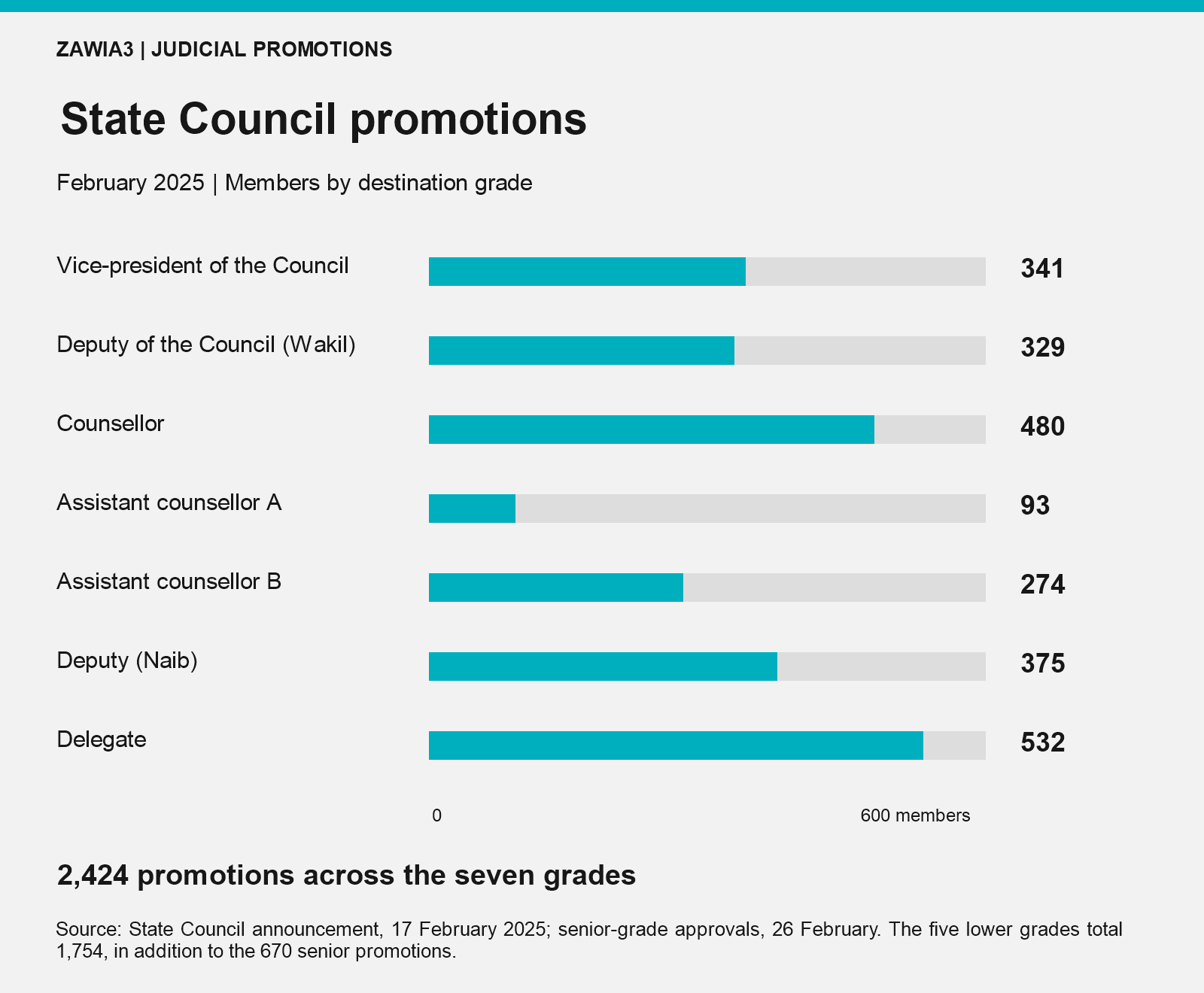
The council’s announcement covered 341 promotions to vice-president and 329 to deputy of the State Council. A further 1,754 members were promoted to five other grades: 480 counsellors, 93 assistant counsellors A, 274 assistant counsellors B, 375 deputies and 532 delegates. Together, the seven categories total 2,424 promotions.
Supporters see the move as strengthening the council’s capacity. Critics want promotion policies adjusted to achieve a better balance across the judiciary.
Different routes to the same seniority
An analysis supplied exclusively to Zawia3 by judges and counsellors from several judicial institutions identifies substantial differences in promotion speed and grade progression. Its authors say State Council members advance faster and more regularly than colleagues in the ordinary judiciary, Public Prosecution, Administrative Prosecution Authority and State Lawsuits Authority.
The estimates suggest gaps exceeding a decade at senior grades, with consequences for pay and professional benefits. They are an approximate comparison supplied by sources, not statutory ages for promotion or a census of every judge’s career.
The sources describe State Council members reaching vice-president in their late thirties, while counterparts elsewhere may reach comparable senior grades, such as appeal court president, Court of Cassation vice-president or deputy head of a judicial authority, at around 47 or 48.
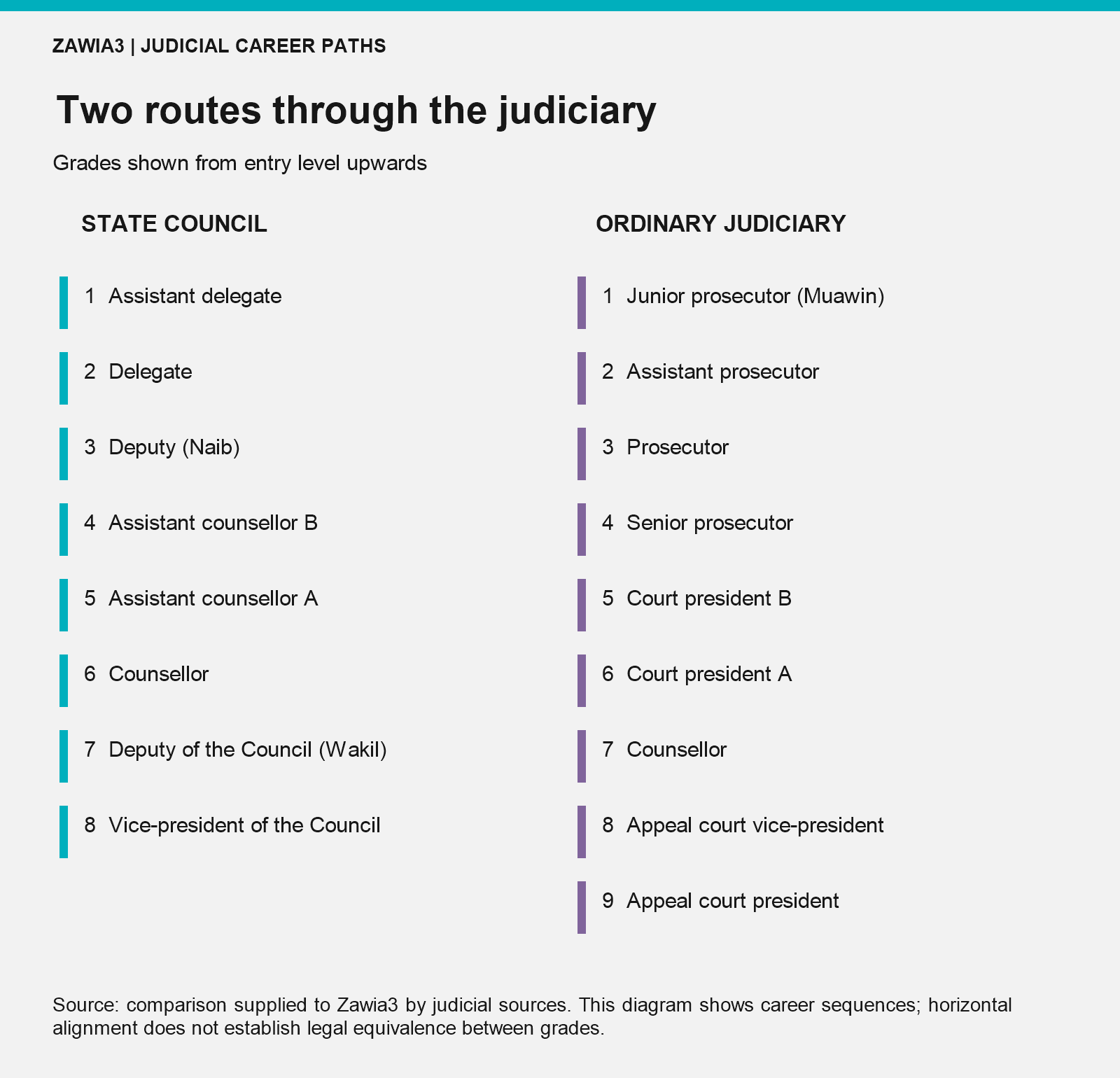
The State Council’s career sequence runs from assistant delegate to delegate, deputy, assistant counsellor B, assistant counsellor A, counsellor, deputy of the council and vice-president. The ordinary judiciary and prosecution service follow a different sequence, beginning with junior prosecutor, assistant prosecutor, prosecutor and senior prosecutor, then court president B, court president A, counsellor, appeal court vice-president and appeal court president.
According to the sources, the additional stages and slower progression in the ordinary judiciary contribute to the delay. They also point to differences at senior levels, where State Council members can reach a grade they consider comparable at a much younger age.
Their age comparison starts with an assistant delegate at the State Council and an assistant prosecutor at about 25. At 26, it pairs a council delegate with a prosecutor; at 28, a council deputy with a senior prosecutor.
The gap begins to open at assistant counsellor B, reached at about 30 in the council, compared with roughly 33 for court president B. Assistant counsellor A is reached at about 32, while court president A is reached at around 35.
At counsellor level, the comparison puts a State Council member at about 33 and an appeal court counsellor or advocate general at about 43. It places a deputy of the council at 34–35, against about 45 for an appeal court vice-president. At the top of the illustrated sequence, it gives 36–37 for a State Council vice-president, compared with 47–48 for an appeal court president or Court of Cassation vice-president.
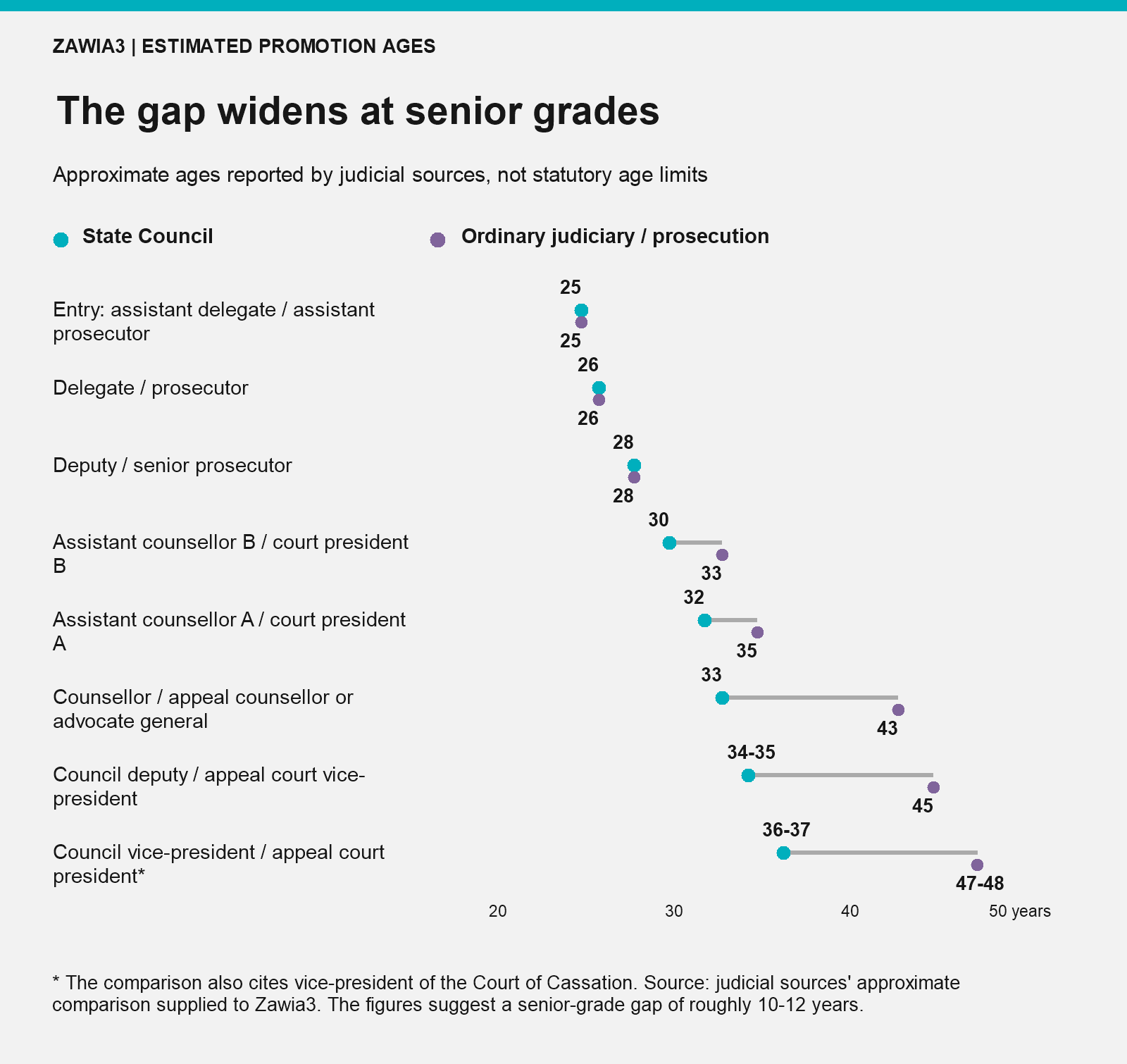
The figures in the chart therefore suggest a senior-grade gap of roughly 10–12 years. The original report’s broader reference to a 20-year gap was not supported by this comparison.
“I felt wronged and considered resigning”
“I never imagined the gap would be this large,” a judge holding the grade of court president A told Zawia3, asking not to be named.
He graduated near the top of his law-school class in 2011 with an excellent grade and was accepted into the State Council in 2012. At his father’s urging, however, he moved to the Public Prosecution in 2013, expecting only modest differences in career progression.
After 12 years of service, he says, he is still a court president A, working in a court two hours from home under relentless pressure. Former colleagues who remained at the council have reached its deputy grade, which he describes as comparable to a Court of Cassation counsellor or appeal court vice-president.
“It is not just about the job title,” he says. “It goes beyond that to salaries, workload and working hours.”
He describes his own work as unremitting, while saying his former colleagues have lighter schedules and workplaces closer to home. These are his comparisons of working conditions, rather than a measure covering all judges.
“I always had a sense that promotions at the State Council moved faster. But when I met a former colleague and discovered he had become a deputy of the council while I was still in my current grade, I felt as though I had lost years of my professional life,” he says.
The difference, in his account, extends to income, financial benefits and standing within the judiciary. He invokes the constitutional principle that judges are equal in rights and duties, contained in Article 186, but describes such guarantees as provisions that are not being put into effect.
He argues that the State Council has become a separate entity within the judiciary with greater advantages than ordinary-court judges, even though the latter exercise general jurisdiction.
The judge also raises secondments and their financial rewards. “My colleagues there are seconded to outside bodies that pay them the equivalent of 100% of their total salaries,” he says, describing earnings twice those available to him and his colleagues in the ordinary judiciary.
He questions how an administrative judge could hear a dispute involving a body to which that judge was also seconded, and whether such an arrangement would compromise impartiality. His concern highlights the potential for a conflict of interest; it does not establish that a particular judge adjudicated a case involving their own secondment.
He also argues that accelerated promotions run against efforts to narrow the gap between institutions. In his account, a ten-year legal timetable beginning in 2021 should have achieved parity by 2031.
Editorial clarification: the article’s linked source contains the text of a 2019 bill. It does not substantiate the assertion that this provision was enacted in 2021 or that 2031 is a binding deadline. That assertion is retained here as the source’s understanding, not an established legal conclusion.
The judge describes the disparities as a fundamental failure of fairness within the judiciary and accuses the State Council of prioritising its own members without considering other institutions.
He says he is seriously considering resignation. Although he continues to work, the thought has become more persistent. He and colleagues who share his concerns view the differences as systematic discrimination within an institution expected to uphold justice.
Would a unified judiciary solve the problem?
Mohamed Nagi Derbala, a former vice-president of the Court of Cassation, tells Zawia3 that differences in promotion and financial benefits have accumulated over many years and should have been addressed much earlier.
He recalls proposals for independently resourced budgets for the Supreme Judicial Council, the State Council’s Special Council and the Supreme Constitutional Court’s general assembly, approved by parliament as a single budget figure. He says this approach was realised for the Constitutional Court but argues that practical financial autonomy has not been achieved on the same basis elsewhere.
The constitutional position is distinct from that criticism of implementation: Article 185 expressly provides each judicial body or authority with an independent budget. Article 191 separately sets out the Constitutional Court’s budget arrangements.
Derbala sees an immediate remedy in state funding for the posts needed to support promotions across institutions. He argues that decisions should take account of recruitment cohorts and the number of judges in each body, with the state supplying the resources and funded positions through the public budget.
Derbala’s broader proposal is a unified judicial structure with common rules for promotion and financial benefits, while preserving the work’s different specialisms.
He says he supported such a proposal while serving in the constituent assembly that drafted the 2012 constitution. In his account, it faced strong opposition from representatives of the State Council and Supreme Constitutional Court, who feared losing particular benefits.
He warns that leaving the present system unchanged will widen the disparities year after year. In his view, multiple judicial centres of power do not strengthen independence or serve justice.
Former State Council judge Essam Mohamed Refaat similarly says the latest promotions caused anger over unequal treatment. He traces the problem to the discretion available to decision-makers and the variation in promotion standards between institutions.
He argues that the rules governing public functions such as judging should establish fair, common criteria rather than allow personal considerations or institutional pressures to deepen divisions.
Refaat proposes one umbrella institution for the Egyptian judiciary, encompassing prosecution, criminal, administrative, personal-status, economic and civil adjudication, a supreme court for cassation and appeals, and legal advisory and legislative functions. He believes this would improve oversight of the system and standardise career benefits.
He links his proposal to separation of powers, judicial independence and equality before the law. In his view, a coherent structure could protect judges from executive and legislative interference, particularly when hearing administrative disputes.
Comparative clarification: a common system for managing judges’ careers is not the same as a single court structure, and neither necessarily means adopting Anglo-American common law. Refaat’s original examples included Algeria, but the country’s State Council explains that Algeria adopted a dual judicial system under its 1996 constitutional amendment. Judicial arrangements in the countries cited by the sources differ substantially.
Constitutional questions
International-law specialist Mohamed Mahmoud Mahran, a member of the American and European societies of international law, tells Zawia3 that wide differences in promotion and pay raise questions about consistency with constitutional principles and international standards.
He stresses that not every difference in benefits or grade amounts to prohibited discrimination. But, he argues, substantial differences between the career paths of judges from the same cohort may conflict with equality before the law.
Article 94 of the Egyptian Constitution treats judicial independence and judges’ immunity as safeguards for rights and freedoms. The general equality guarantee is in Article 53, while Article 186 addresses judges’ equal rights and duties. These provisions provide the constitutional context for the dispute; they do not by themselves determine that every difference in promotion timing is unlawful.
Mahran calls for a review of the promotion system and fair financial safeguards that protect judicial independence. He invokes international civil-rights and judicial-independence standards in support of that argument.
He points to reforms involving judicial councils in Morocco, Tunisia and Jordan as possible reference points, while acknowledging that Arab countries retain differing court structures and career paths. Such comparisons concern aspects of governance, rather than proof that these countries all operate an identical unified judiciary.
A common organisational framework need not abolish judicial specialisation, Mahran argues. Its purpose would be fairer promotion rules and salaries while respecting each institution’s functions.
His preferred solution is a system that takes account of the nature of each body’s work while narrowing differences in living standards and ensuring pay consistent with judicial dignity and independence.
Why promotions move faster
A senior State Council judicial source offers a different explanation for the pace of promotions: the council recruits fewer people each year than the other institutions.
Speaking anonymously, the source gives an illustrative comparison. If the Public Prosecution recruits around 1,000 new members, the council might appoint only 100–150, making it easier to fund enough positions for all eligible members to advance. These figures are the source’s example, not verified annual recruitment totals.
In the ordinary judiciary, the source says, a cohort of 1,000 members may become eligible for senior promotion when funding covers only 100–200 posts. The remainder must wait for later rounds. At the State Council, the number eligible is closer to the number of funded positions available, reducing delays.
The source argues that postponed promotions accumulate over successive years, turning differences in recruitment and funding into a much wider disparity in grade and benefits between institutions.
Amid the growing dispute, a senior council source says the promotion file was sent to the presidency on Thursday, 27 February, in preparation for a presidential decree. At the time of publication, the issue remained whether the president, as chair of the Supreme Council for Judicial Bodies and Authorities, would intervene to address the differences and pursue greater balance across the judiciary.