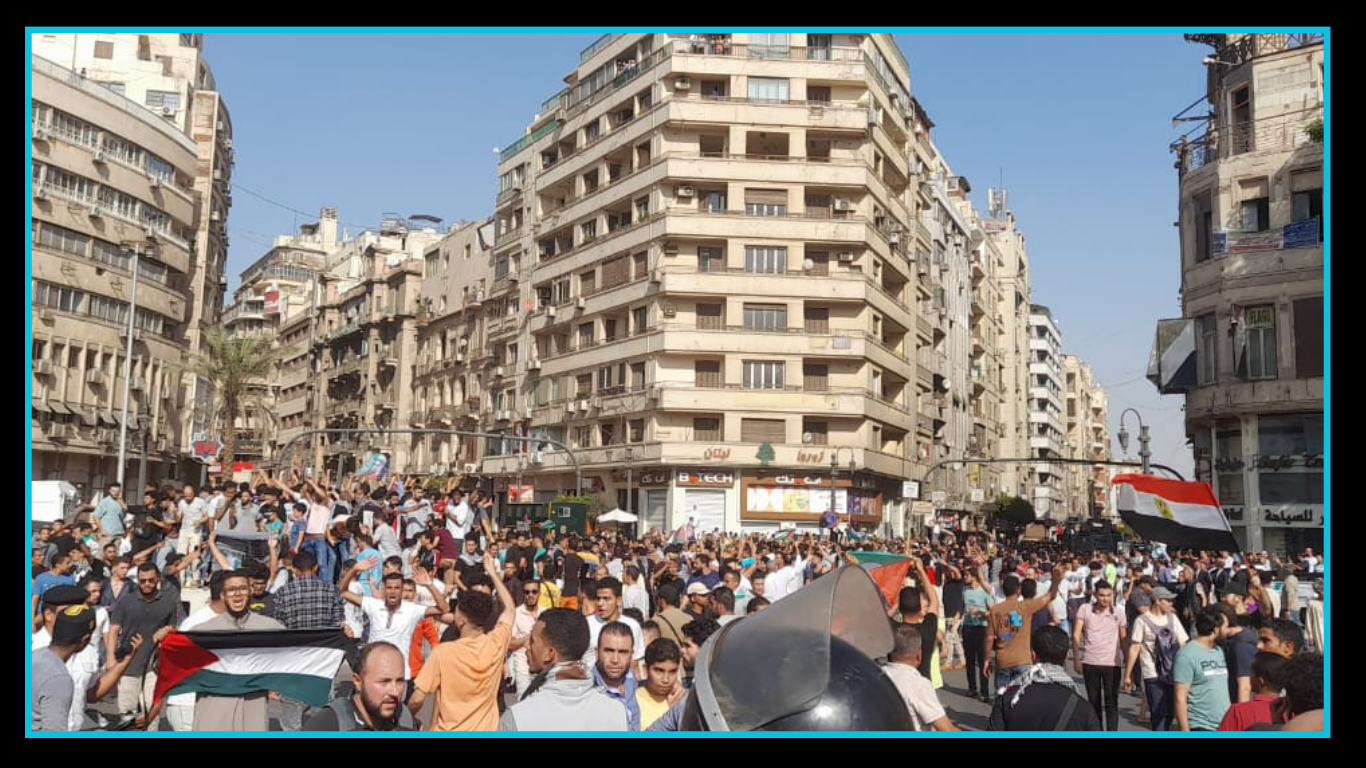
“It never crossed our minds that this cursed war would last a whole year, the worst of our lives by far. I have lost count of how many times I escaped certain death; there has been no safe place in Gaza since 7 October 2023.” These are the words of Sondos (a pseudonym), a woman in her twenties displaced from the north of Gaza to the south.
She says: “I lived with my family in the Jabalia area in the north of the Gaza Strip, and as soon as the Israeli occupation forces began their attack on the Strip, the north became the first line of fire. We lost our home as a result, which forced us to flee to the south, especially with the occupation forces’ warnings to evacuate the area.” She noted that she and her family were displaced more than three times during the year, from the north to Khan Younis, then to Rafah, then Deir El-Balah, and back again to Rafah, each time witnessing escalating horrors, in addition to the spread of many different diseases.
A year has passed since Israeli military operations began in the Gaza Strip, during which the occupation forces used a wide range of weapons, killing about 42,000 people, most of them children and women, and injuring about 97,000 others, according to statistics from the Palestinian Ministry of Health and the Palestine Martyrs Observatory. The health and education systems, as well as homes, facilities and infrastructure, suffered severe damage, with widespread destruction affecting the Strip’s vital sectors.
According to a report by the UN Office for the Coordination of Humanitarian Affairs in the occupied Palestinian territory, more than 70,000 housing units in Gaza have been destroyed, while the number of forcibly displaced people has reached 1.9 million.
In the same context, United Nations experts announced that the grave violations committed by Tel Aviv against Palestinians, especially in Gaza, indicate that genocide is taking place. They presented evidence of escalating incitement to genocide, the public intention “to definitively eliminate the occupied Palestinian people”, blatant calls for a “second Nakba” in Gaza and the rest of the occupied Palestinian territory, and the use of powerful weapons with indiscriminate effects that caused heavy loss of life and destroyed the Strip’s infrastructure.
The health security of Gaza’s population is under increasing pressure as a result of the collapse of health care infrastructure and basic services. According to a World Bank report, the average number of hospital beds available in the Gaza Strip before the latest conflict was 1.4 per thousand people, far below the global average of 2.9. The number of hospitals also fell markedly from 36 before the war to 15, increasing pressure on available health resources. In addition, the Strip suffers from a shortage of doctors, with an average of 2.2 doctors per thousand people, compared with a global average of 3.5. Referring urgent medical cases has become an additional challenge, as it can take weeks or months. Even before the current conflict, requests to refer patients for treatment outside the Strip faced difficulties, with the World Health Organization recording that 33% of those requests were either delayed or rejected.
Attacks on health facilities continued before and after 7 October, further complicating the challenges the population faces in obtaining medical care. According to documentation by the World Health Organization, 410 attacks on health care services in Gaza were recorded between October 2023 and 23 April 2024, killing 723 people and affecting 101 health facilities, 84 of which stopped working entirely.
Sondos, who lost her normal life when the war broke out, now suffers from life in tents, which make summer a torment and winter unbearable. She had hoped that life would return to normal this year so she could resume her studies. Her suffering is compounded by her family’s dispersal; she had to leave her sister and her sister’s children in the north after her sister’s husband was completely paralysed, and she has lost many members of her family, including her paternal uncles, her maternal aunt and her aunt’s children.
Between Crossing and Suffering
Although Mohamed Abu Adnan (a pseudonym) managed to leave Gaza for Egypt with his family a few days before the war broke out, the challenges they face in Egypt have become a heavy burden. Like other displaced people, Mohamed finds it difficult to obtain legal residence, as he has only his passport and crossing permit, which hinders his access to basic rights such as education and work. Although he managed to enrol his children in a private school, the high cost is beyond his means, especially after losing the job he found four months ago and exhausting his savings.
Mohamed rents a small apartment in a working-class area of Giza Governorate to escape high rents, but he lives with his family without basic furniture, as circumstances have not allowed him to provide for their basic needs.
Egypt has received more than 19,000 buses from the Gaza Strip through the Rafah land crossing, carrying more than 89,000 people, including more than 21,000 children who received the necessary vaccinations, such as polio, rubella and mumps vaccines.
Speaking to Zawia3, Essam Abdel Rahman, director of the media centre of the Sonaa El-Kheir Foundation for Development and a member of the National Alliance for Civil Development Work, explained that a special operations room had been formed to coordinate humanitarian support for Gaza in cooperation with Egyptian executive bodies. This support includes medical aid, such as blood donations, medicines and medical equipment, as well as food and other aid.
Essam stressed that the National Alliance launched a series of aid convoys under the slogan “Masafet El-Sekka” (Just a Drive Away), noting that Egyptian aid makes up more than 80% of all aid sent to Gaza worldwide. Nevertheless, the Israeli occupation forces’ obstinacy in allowing trucks into Gaza is the biggest obstacle to that aid arriving effectively.
Severe Injuries and Total Collapse
“I have never faced injuries like these in my life. The occupation forces are using weapons that cause severe and multiple injuries; even when medicines are available, their benefit has become limited,” Nael Abdullah (a pseudonym) tells Zawia3.
Nael, an orthopaedic surgeon in the Jabalia area of northern Gaza, explains that most of the injuries he sees are amputations and loss of limbs. According to him, five out of every ten injured people in Gaza lose a limb as a result of severe injuries.
Nael describes the health situation in Gaza as near collapse, noting that the deterioration is not limited to the health sector but extends to food and education as well. He adds that the situation in Gaza remains extremely dangerous, as Israeli attacks on the city and its residents have continued throughout the year, making the area one of the bloodiest places in the world.
According to Ministry of Health data up to 6 October, the total number of people killed exceeded 41,000, while the number of missing is estimated at about ten thousand, in addition to more than 97,000 injured, many of whom have serious, life-threatening injuries. The ministry explained that only 15 of Gaza’s 36 hospitals are operating, all of them partially, amid a severe shortage of medical supplies, while 32 hospitals have been completely destroyed by Israeli attacks.
The Ministry of Health reported that about 986 health workers have been killed, in addition to 310 others detained and hundreds injured, further complicating the provision of medical services. 130 ambulances have also been destroyed, depriving civilians of access to basic health care. The ministry pointed out that the occupation forces have carried out more than 340 attacks targeting health care facilities and their workers.
Despite the urgent need for humanitarian aid as the crisis worsens, delivering this aid faces multiple difficulties. UNRWA stated that “families in Gaza are suffering from forced displacement and hunger, and cannot find what they need to survive in difficult conditions and high temperatures.”
In a joint report by the World Bank and the United Nations, with financial support from the European Union, damage to infrastructure and buildings in the Gaza Strip was estimated at about USD 18.5 billion, equivalent to 97% of the combined GDP of the West Bank and Gaza in 2022. The report also indicated that 84% of hospitals and health facilities had been damaged or destroyed, severely limiting access to necessary health care amid a lack of electricity and water to run what remains of them.
397 Schools and Universities Destroyed in Gaza
The education sector in Gaza suffered severe damage from the war, as the Institute for Palestine Studies reported that 124 public schools were severely damaged, while 62 public schools were completely destroyed. Another 126 schools were partially damaged, in addition to the bombing and destruction of 65 schools belonging to UNRWA. In higher education, 20 educational institutions were damaged, and 35 university buildings were completely destroyed and 57 others partially destroyed.
Since the start of the war on the Gaza Strip, 416 education staff have been killed and more than 2,463 teachers in schools and universities injured.
In addition, the war has deprived 39,000 male and female students of sitting the “Tawjihi” exams, either because they were killed or because their education was cut off by the comprehensive destruction of the educational process.
About 630,000 male and female students in Gaza, in government schools, UNRWA schools and private schools, have been deprived of their right to education since 7 October 2023. This deprivation also includes 88,000 university students and 80,000 children who have reached kindergarten age.
According to the study “The War on Gaza and Its Health Security Implications” prepared by the Arab Center for Research and Policy Studies, the conflict in the Gaza Strip is one of the most prominent examples of human suffering resulting from ongoing geopolitical conflicts in the region. Since October 2023, this conflict has caused massive displacement and loss of life, profoundly affecting the civilian population and further complicating their daily lives.
For her part, Nagwa Qatfan, media officer of the Palestinian Women’s Union in Cairo, points out that those displaced from Gaza face major challenges in Egypt, most importantly the difficulty of obtaining the residence permit needed to regularise their legal status. High rents and challenges in education and health care add to their suffering, as displaced Palestinians in Egypt do not enjoy the support provided by international institutions such as the UN refugee agency or UNRWA.
Nagwa explains that displaced Palestinians come to Egypt with whatever money they have left, which may only last for short periods, making it even harder to meet basic needs such as food, shelter and health care. She adds that families with children face additional challenges in providing education, especially in the absence of official papers that would allow children to enrol in public schools, while joining private schools and universities requires large sums of money, making it impossible for many families.
Nagwa stresses the importance of facilitating residence procedures for Palestinians in Egypt, to ensure they have access to work and can meet their basic needs. She also calls for reducing tuition fees to make it easier for students to enrol in schools and universities under these difficult circumstances, until the war ends and they return to their homes in Gaza.