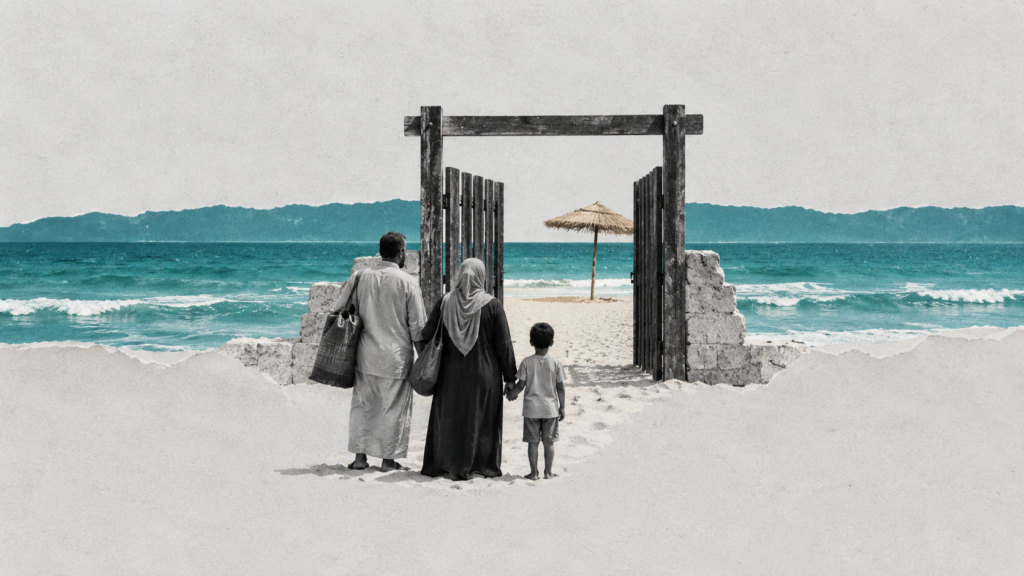
At the start of summer 2026, residents of Egypt’s Matrouh governorate began posting complaints about being denied access to beaches they had previously used, after their management or operation was assigned to investors. They said restrictions on reaching the sea created a sense of exclusion, marginalisation and anger. MPs representing the governorate, however, denied that public beaches had been closed entirely. This report examines testimony and documents from that summer season. One of the gate concessions it discusses expired on 30 September; the prices quoted here should not be read as tariffs currently in force in October.
Beach admission and equipment hire: Different bills
Local sources describing summer 2026 prices said admission to Blue Beach in the Al-Obayed area cost EGP 50 per person, while an umbrella and four chairs cost EGP 250 to hire. At the Armed Forces beach in Al-Obayed, they quoted EGP 175 per person, including an umbrella and chairs. For Al-Gharam beach, sources gave a price of EGP 120 per person including facilities, but EGP 260 for the minimum booking of two people. That is EGP 20 more than twice the individual price. The sources did not explain the difference, so the figures cannot be treated as a consistent tariff or as proof of a particular additional charge.
In the Cleopatra area, sources reported prices of around EGP 180 without specifying whether this covered individual admission or equipment hire. They put admission to Bosphorus beach at EGP 100 per person, and admission to the Armed Forces Lagoon beach at the same amount. At the Armed Forces Rommel Lagoon beach, they described several prices for an umbrella and four chairs: EGP 150 in the rear area overlooking the sea, EGP 200 at the front, and EGP 250 in the “turquoise sea” area. According to the same accounts, umbrella and chair hire at Rommel public beach and Rommel Lagoon public beach cost around EGP 180.
Riviera Bousset beach charged EGP 250 per person, including an umbrella and chairs, according to the local accounts. Admission to Umm al-Rakham beach was EGP 10 per person, with an umbrella and three chairs costing EGP 180. At most beaches along the new corniche in Al-Obayed, sources quoted admission of EGP 10 per person and umbrella and chair hire ranging from EGP 150 to EGP 180.
Sources put admission to Agiba beach at EGP 15 per person, with an umbrella and chairs costing about EGP 350, sometimes negotiable down to EGP 300 or EGP 250. At Marasina beach, admission was EGP 10 and an umbrella with four chairs cost EGP 400. They quoted EGP 15 to enter the Cleopatra attraction, about EGP 180 for umbrella and chair hire at Al-Awam beach, and admission of EGP 20 per person at Al-Obayed Lagoon, with a further EGP 350 for equipment hire. These are prices reported by local sources during the season, involving different services and charging units. They are not a single official price list covering every beach in the governorate.
Six gates under an EGP 3.61 million summer concession
The complaints were not confined to beach admission and equipment. They also concerned passage through gates on the new corniche in the Al-Obayed beach area. Resident Alaa al-Beltagy complained that he had been charged EGP 15 for his car and EGP 15 for each passenger while driving along the corniche, although, he said, he had neither entered a beach nor used its facilities. When he asked for the legal basis for the charge, he said he was shown a letter awarding a concession to operate the Al-Obayed beach gates. His description of the payment remains his own account; the letter reproduced below establishes the listed fees and contractual period, rather than every circumstance of that encounter.
Al-Beltagy called on Matrouh’s governor to disclose the law or administrative decision authorising the fees and clarify whether the new corniche was a public road or part of a beach area subject to admission charges. He also asked for action if charging people who were merely passing through, without using the beaches or their services, proved unlawful.
A letter issued by the contracts department of the Marsa Matrouh city administration on 30 June 2026 records the award of a restricted auction for operation of the Al-Obayed beach gates during the summer season. It covers six gates: the new corniche entrance, Al-Marwa, Al-Aseel, Arous al-Obayed, Zomorodat al-Obayed and Loaloat al-Obayed.
Signed by Major General Mohamed Abdallah Ragab, head of the Marsa Matrouh city administration, the letter states that the auction held on 29 June 2026 was awarded to Hamza Saleh Yaacoub for EGP 3.61 million. The concession ran from 30 June to 30 September 2026, subject to the auction’s specifications and conditions. The award amount is the contractual consideration stated for operating the gates during that period. It does not establish that the same sum was actually collected from visitors.
The letter lists admission charges of EGP 15 per person, EGP 15 per private car, EGP 25 per microbus and EGP 30 per bus.
It also instructs the successful bidder, Hamza Saleh Yaacoub, to attend the contracts department to complete the final contracting procedures.
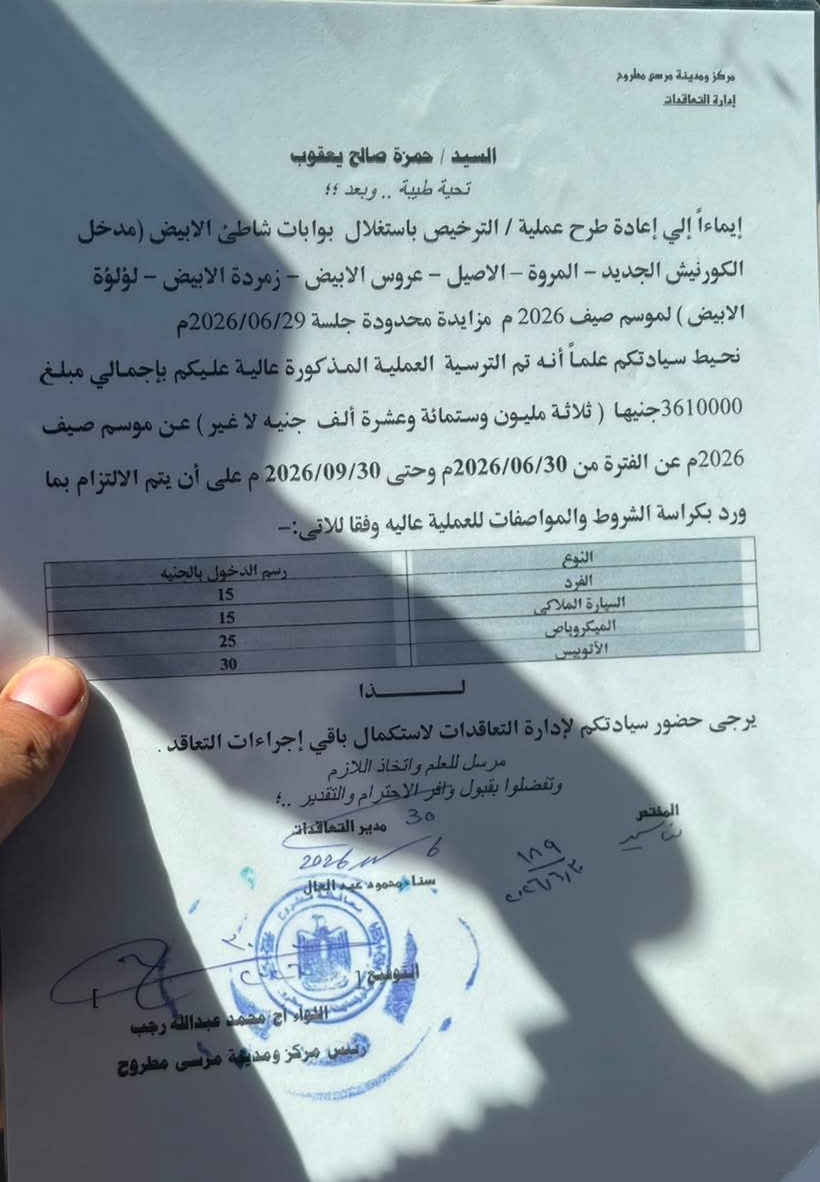
Al-Obayed gate concession award letter, dated 30 June 2026, covering 30 June to 30 September 2026. The Arabic document lists EGP 15 per person, EGP 15 per private car, EGP 25 per microbus and EGP 30 per bus, and an award value of EGP 3.61 million. Source: document reviewed by Zawia3.
Living by the coast without seeing the sea
Residents’ complaints form part of a wider debate over the allocation of beaches and concessions granting investors the right to use them. Investment along Egypt’s northwestern Mediterranean coast has turned sections of the seafront into resorts, hotels and luxury residential developments. These projects form part of the government’s effort to attract tourism investment, while restrictions on access have raised concerns about the space remaining available to the public. Assigning management does not necessarily transfer ownership: legal title, operating rights and the conditions people encounter at an entrance are distinct matters.
Under a usufruct arrangement, an investor receives the right to use land or a beach for a season or a specified number of years in return for a fee, without acquiring ownership. Such arrangements allow the provision of recreational or tourism services. Some public beaches on the northwestern coast have been offered on this basis by the New Urban Communities Authority and the coastal development administration.
Matrouh resident Mohamed Ibrahim said fees on some roads and beaches had caused resentment among both residents and holidaymakers. The governorate, he explained, had historically been an affordable summer destination for broad sections of Egyptian society, including middle-class families, workers and employees from Alexandria, Beheira and Cairo, as well as visitors from Upper Egypt. Its relatively low costs had distinguished it from other tourism destinations.
“The rising cost of a holiday in Matrouh, which can reach about EGP 25,000 a week for a small family, together with the many charges, makes a visitor feel as though they are entering another country,” he told Zawia3. In his account, a visitor begins by paying to enter the governorate, then encounters another charge on the corniche, alongside expensive goods and services. He argued that the standard of those services did not justify the cost.
Ibrahim said much of the accommodation still consisted of furnished apartments with ageing equipment, while water and electricity outages remained recurring problems. Restaurants and cafés, he added, charged tourist prices for what he regarded as ordinary service. He called for a balance between tourism investment and the public’s ability to reach the beaches.
He proposed areas and services suited to different incomes: higher-end facilities for those who could afford them, alongside free or low-cost beaches and parks for middle- and lower-income households. For many Egyptian families, he said, such places were their main opportunity for recreation.
In his view, the extension of paid areas along the coast reduces opportunities to reach the sea without paying, including for people using their own cars. He warned that this could deepen a sense of injustice and resentment. Public beaches and parks, he argued, fulfil social and psychological needs by offering relief from everyday pressures.
Nidal al-Qadi, another Matrouh resident, questioned the growing reliance on investors to manage beaches in a governorate that had long lacked basic services such as street lighting and drinking water. At the same time, he recalled it as a place known for its clean environment. Investment, he argued, should create direct benefits for residents instead of competing with their traditional sources of income. He believed such competition increased unemployment and discontent. That is his assessment of the effects of investment, rather than a statistical measurement of unemployment or its causes.
Al-Qadi told Zawia3 that Matrouh offered opportunities for productive businesses, industrial projects and land reclamation that could create new jobs. He called for simpler investment procedures and the extension of utilities to these projects, instead of concentrating on the commercial exploitation of resources already supporting local livelihoods.
Resident Sayed Noureldin did not oppose tourism investment. Tourist villages had created jobs for Matrouh residents and workers from other governorates, he said. His concern was how to preserve those benefits while maintaining public access to the shoreline.
“The state should set aside public beaches between tourist villages so residents of coastal towns and villages can use the sea without restrictions,” he told Zawia3. “The spread of tourist villages along the coast has deprived many residents, especially those living south of the international coastal road, of access to the beach or even a view of it.”
Noureldin acknowledged that regulating entrance procedures and fees fell within the governorate’s role in improving services. But he urged it to consider local residents’ circumstances. He described the frustration of people who felt they were being treated as strangers in their own governorate despite having a particular stake in its natural resources.
“The state should set aside public beaches between tourist villages so residents of coastal towns and villages can use the sea without restrictions.”
Sayed Noureldin, Matrouh resident
A study published by the American University in Cairo’s public policy centre in August 2024, citing the Central Agency for Public Mobilization and Statistics (CAPMAS), reported 271 private beaches extending over 617,504 metres and 97 public beaches extending over 497,247 metres in 2022. The combined count is 368. The figure of 304 beaches, with a combined length of about 689.15 kilometres, instead belongs to 2021, when 229 private and 75 public beaches were recorded. The study also illustrated access by comparing a population of 106 million with the length of public beaches: roughly one metre per 210 people, or about 213 using the stated figures directly. This was an illustrative ratio in a study published in 2024, not Egypt’s 2022 population count or a measurement of actual beach crowding.
A separate ARIJ analysis published in October 2025, using 2024 data, put private beaches at about 88% of the total, compared with 14% in 2013. It recorded 478 additional seaside tourist villages between 2019 and 2024, bringing the number to 562. These percentages refer to a different series and data scope from the 2021 and 2022 figures above. They should not be merged into a single total or presented as a measurement confined to Matrouh’s beaches.
The loss of seasonal livelihoods
Lawyer Mamdouh Ragheb al-Darbaly, a former head of the Matrouh Bar Association, said young people’s seasonal earning opportunities had sharply deteriorated. For decades, he explained, they had hired out beach chairs and umbrellas and prepared and sold food and drinks to holidaymakers. He said some had lost these livelihoods in the five years preceding his testimony as coastal land allocations and auctions of beach operating rights expanded. He described unemployment as “unprecedented” and said finding an accessible public beach had become rare. These are his descriptions and assessments; MPs quoted below dispute the claim that all public beaches have been closed.
Al-Darbaly believed the loss of work could push some young people into illegal activities, including smuggling across the Libyan border or the drug trade. He warned of feelings of marginalisation and diminished citizenship. The material available for this report does not establish a causal link between beach concessions and those activities, and his opinion cannot be generalised to the governorate’s young people. It reflects his concern about the consequences of lost income.
Matrouh governorate covers approximately 166,563 square kilometres and has eight principal administrative districts. Marsa Matrouh is its capital and one of its main population centres. A population list published by Al-Mashhad gives a governorate total of 554,581, around 0.5% of Egypt’s population, but does not identify a separate reference date for that figure despite subsequent updates to the page. By contrast, a Ministry of Planning document issued in December 2020 explicitly records 481,718 residents on 1 January 2020. These numbers should therefore be read as dated or attributed figures, rather than a live count for summer 2026. The figure of 255,401 circulated for Marsa Matrouh city likewise lacks a clear reference date in the available sources and cannot reliably be compared with the governorate total or used as a current estimate.
Saeed al-Hefian, an engineer and former head of Matrouh’s local council, argued that the expansion of beach leases following development work had reduced the areas available free of charge. Some investors, he said, charged for entry. He described public beaches as “an established right that must not be infringed”.
Al-Hefian said efforts to increase governorates’ revenue should not come at the expense of basic rights. He called “blocking people from the sea” a serious mistake and urged the state to preserve free areas along the coast, while allowing moderate fees elsewhere. He described excluding people unable to pay as “a fully constituted crime”. This is the source’s language of protest, not a court ruling or proof that the elements of a particular offence have been established.
“Matrouh suffers from accumulated service problems, including drinking-water cuts, rising prices and declining services,” he told Zawia3. “Local administration should focus on planning projects and improving services, not searching for revenue by imposing new charges.” He called on the governor to visit beaches and hear residents’ complaints directly instead of relying only on office reports.
Al-Hefian stressed that he supported investment and job creation, provided that the public’s rights were protected. He proposed making wider use of coastal land held by state bodies and camps through usufruct arrangements for major tourism and development projects. In his view, this could generate revenue and employment without restricting public beaches.
Matrouh MP Heiba Idris Heiba offered a different account. He told Zawia3 that the governorate offered some beaches for investment and that a large proportion of the operators receiving usage rights were local residents participating in that system.
He described claims that every beach had become subject to a charge as inaccurate. Not all beaches were covered by those arrangements, he said, and many public beaches remained open.
Land allocations: Ownership and operating rights
Recent years have seen presidential decrees reallocating substantial areas of land between state bodies in Matrouh for development and strategic projects on the northwestern coast. Presidential Decree No. 278 of 2025, issued in May, allocated two large plots to Matrouh governorate for development after transferring them from land previously assigned to the Armed Forces under Decree No. 226 of 2023. The plots cover approximately 6,945.36 feddans, or 29.18 million square metres, and 8,624.22 feddans, or 36.23 million square metres. A third plot of about 8.47 feddans, equivalent to 35,570 square metres, was allocated to the Ministry of Transport for a diesel railway route. The decree preserves Armed Forces control over strategically significant areas within those boundaries.
This followed Presidential Decree No. 55 of 2024, issued in February 2024, which allocated approximately 170.8 million square metres in Ras al-Hekma to the New Urban Communities Authority for the development of the new city, transferring the land from the Armed Forces.
Presidential Decree No. 9 of 2023 had allocated roughly 466.64 feddans, about 1.96 million square metres, of state land in Matrouh to the Armed Forces. Earlier decisions included Decree No. 299 of 2017, reallocating approximately 360.5 feddans of tourism land in Matrouh to the military, and Decree No. 465 of 2020, allocating around 47 feddans for administrative and service purposes, including military-affiliated wastewater projects.
Gate fees: What is their legal basis?
At the beginning of summer 2026, charges collected at the Kilometre 8 gate, the main entrance to Marsa Matrouh, and other gates generated debate on social media. Some residents likened them to an “entry visa” for an Egyptian governorate. Videos, complaints and price lists circulated concerning tourist buses, microbuses and goods vehicles carrying marble, salt and building materials. These charges are distinct from the Al-Obayed beach-gate concession and from umbrella and chair hire, even though residents cited them together when describing the cumulative burden.
The fee-list image supplied with the report sets out EGP 200 for a tourist bus, EGP 150 for a minibus and EGP 100 for a 14-seat microbus. Cargo charges use different units: the marble and salt entries list EGP 1,500 per vehicle, while other entries are calculated by the tonne, including EGP 1,500 for olives, EGP 2,000 for olive oil, EGP 1,500 for raw salt and EGP 750 for processed salt. A per-vehicle charge cannot therefore be compared directly with a charge per tonne. No clear issue date appears on the image, so it cannot by itself establish that all its entries remained applicable after announced exemptions.
In a statement reported by Al-Ahram on 14 June 2026, the governorate said entrance fees did not apply to locally registered taxis operating on their designated routes, and that the charges concerned excursion vehicles and tourist buses arriving from outside Matrouh. On 1 July, Al-Ahram reported the Chamber of Commerce’s announcement that vehicles carrying bottled water and food were exempt following a meeting with the governor. These statements concern governorate entrance charges. They do not, on their own, resolve the complaint about driving along the Al-Obayed corniche or every form of charging described by residents.
The 1 July 2026 report details the exemption for food and bottled-water vehicles. The announced exemption, the collection practices described by complainants, and whether the exemption applies to a specific gate or service need to be considered separately.
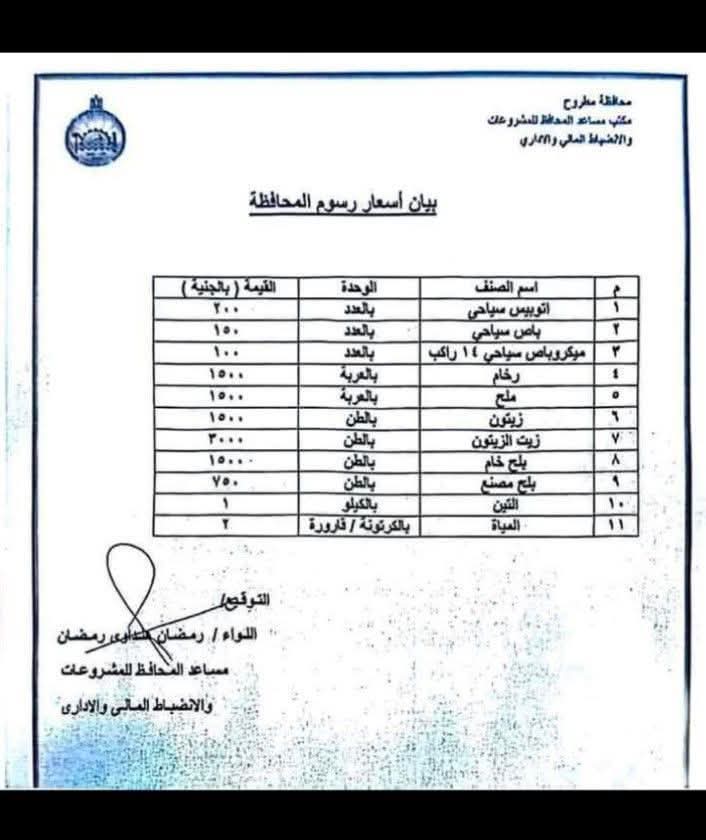
Fee list signed in the name of Major General Ramadan Hendawy Ramadan, the governor’s assistant for projects and financial and administrative discipline. The Arabic document lists EGP 200 for a tourist bus, EGP 150 for a minibus and EGP 100 for a 14-seat microbus. Cargo entries use both per-vehicle and per-tonne charges. No clear issue date is visible. Source: document reviewed by Zawia3.
Al-Hefian criticised additional road charges introduced through administrative decisions and questioned their legal basis. He argued that extra costs for visitors and residents, combined with higher service prices and deteriorating infrastructure, harmed tourism and the local economy. Matrouh’s tourism potential, he said, required a stronger development strategy and more active management on the ground rather than new fees. His objection alone does not establish that a particular charge is invalid; that would require examining the relevant decision, its legal basis and its application.
He also pointed to the governorate’s recurring summer drinking-water crisis. The problem, he said, extended beyond inadequate supply through the network to the higher cost of water in Matrouh compared with other governorates because of its reliance on desalination. Residents had contracted with the state to receive a service, he argued, making the responsible authorities accountable for providing it.
Matrouh MP Abdel Nasser Taher Abu Shaafa denied that public beaches had been closed or placed entirely under investors’ control. Public beaches remained available, he said, and the governorate was leasing designated spaces for umbrellas, an arrangement repeated annually rather than a new measure. He said he was unaware of charges on cars or individuals at the new corniche gates in Al-Obayed.
Asked about fees previously imposed on certain groups, Abu Shaafa told Zawia3 that the local levy known as the “karta”, which had prompted earlier complaints, had been abolished for Matrouh residents and their products. Ordinary vehicle passage charges of the kind imposed in other areas remained in place, he said.
Abu Shaafa acknowledged continued summer water cuts but pointed to government action, including a visit by the housing minister and work on the new Rumeila desalination plant. He hoped expanded desalination capacity would ease the crisis and improve supplies. The official statement distinguishes inspection from commissioning: it does not describe the 21 July visit as an inauguration.
On 21 July 2026, Housing Minister Randa al-Minshawi and Matrouh Governor Mohamed al-Zamallout inspected Rumeila’s desalination facilities, according to a statement by the Holding Company for Water and Wastewater. The cited capacity was 65,000 cubic metres per day for Rumeila 4 and 48,000 for Rumeila 1 and 2, totalling 113,000 for those facilities. The statement establishes an inspection visit, not a formal opening on that date. Design capacity also does not necessarily mean that the same volume reaches households or that interruptions have ended.
Between residents’ accounts and MPs’ denials, the questions remain: How much shoreline is actually accessible, at what cost, and under what authority are charges collected?
Residents’ complaints about shrinking access to public beaches and the growing burden of fees bring the relationship between public rights and commercial returns into focus.
While official representatives insist that public beaches remain open, residents and local sources argue that the spread of paid areas and multiple charges limits practical access to the sea, particularly amid rising living costs and persistent shortcomings in basic services.
As the state pursues development and investment along the northwestern coast, the central test is whether those plans can advance without depriving Matrouh’s residents and visitors of the shoreline. That requires a workable balance between investment and social justice.