
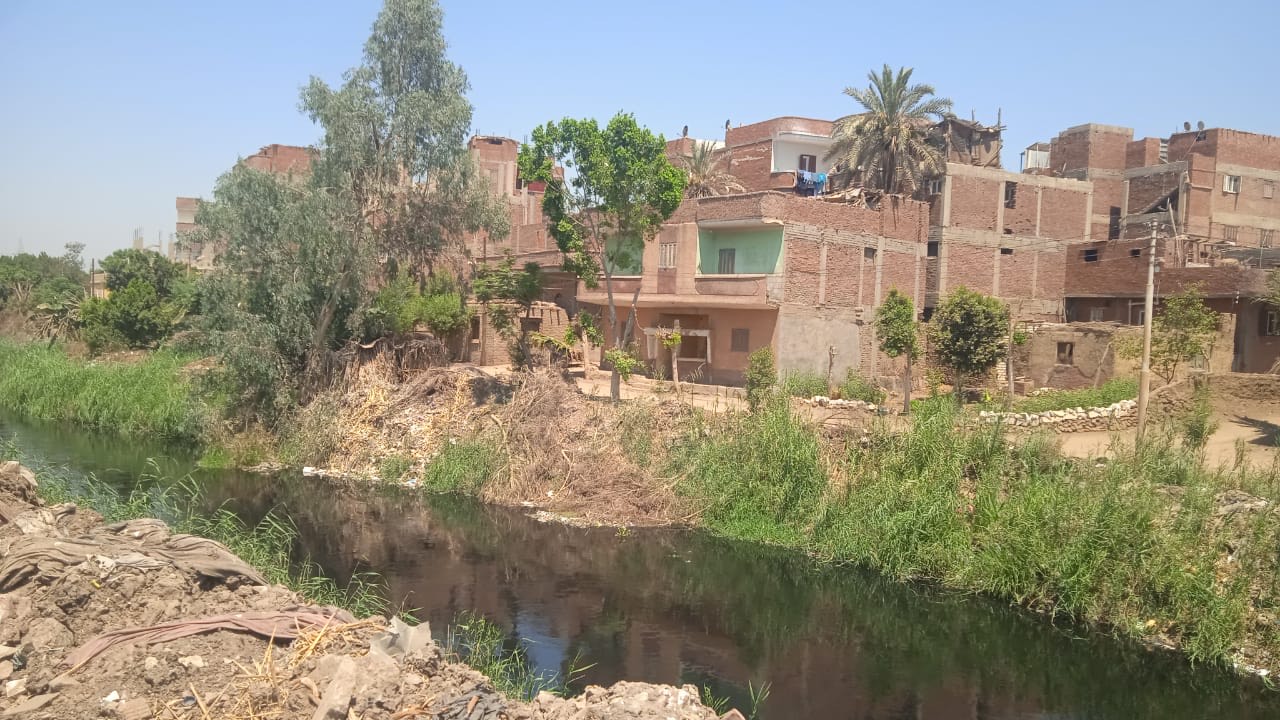
In the village of Kafr Mweis, one of the villages of Benha district in Qalyubia Governorate (north of Cairo, 58 kilometres from the capital), Ahmed Eid, a 33-year-old farmer, lives a life full of challenges, as he relies entirely on farming as a source of livelihood for himself and his family of his wife and three children. With no other job, their lives hang by a thread because of the harsh conditions he faces every day.
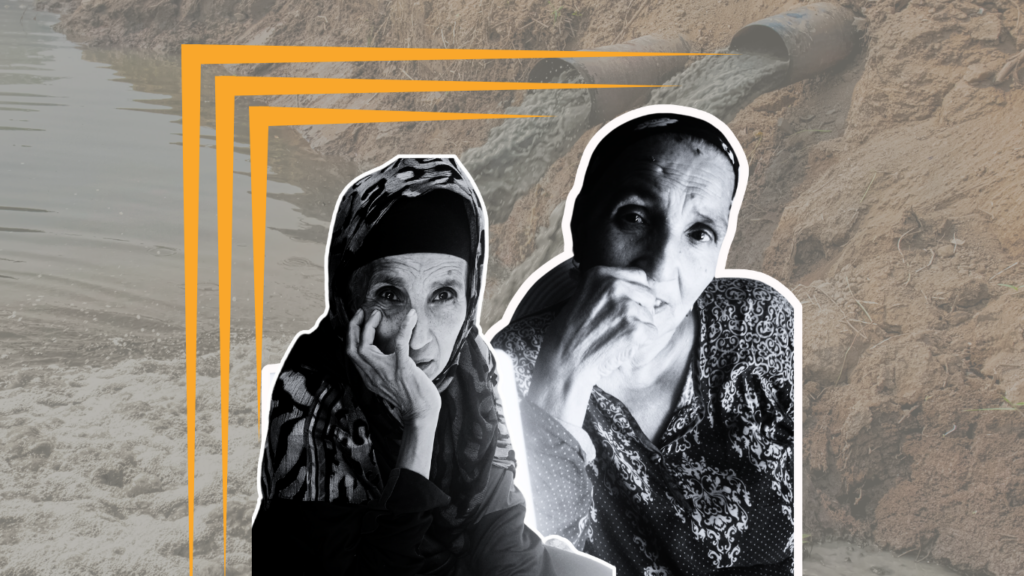
Because of the scarcity of clean irrigation water, Eid finds himself forced to use sewage water from a drain to irrigate his rented one-feddan plot. He says: “Nile water does not reach us regularly, which forces me to irrigate from the drain running through our village. Irrigation with well water is very expensive, as an hour costs EGP 100 and a feddan needs eight hours, equivalent to EGP 800 for each irrigation, and I have to irrigate the crop three times a month, which means I need EGP 2,400 at the end of each month so my land does not die of thirst.”
Eid adds: “The accumulation of financial costs adds to my suffering, as I find myself unable to bear the burden of irrigation along with the high rent. Farmers grow rice, so the state cuts off water from us, and water does not always reach us.”

The suffering of Eid and the people of his village is not limited to financial matters but extends to health consequences they described as catastrophic. Using sewage water for irrigation has led to the spread of diseases such as kidney failure in the village. He says: “The village has become full of diseases because of bilharzia and kidney failure.”
According to World Bank estimates in 2020, 30% of the workforce works in rural areas, and 55% of the population depends on agriculture as a source of income, while estimates by the Central Agency for Public Mobilization and Statistics in its report (Egypt in Figures) in 2023 indicate that the number of workers in agriculture and fishing amounted to 18.9% of the total population in 2021.
Based on field visits Zawia3 conducted to a number of villages in Qalyubia Governorate, specifically in Benha district, covering more than five villages including “Kafr Mweis, Shiblanga, Kafr El-Arab, Kafr Sandanhour and Kafr Atallah”, this report documents farmers’ use of untreated wastewater from drains to irrigate crops. This has led to residents contracting liver diseases and kidney failure, in addition to chest diseases.
Mostafa Madbouly pointed out that during the 2022/2023 agricultural season, the cultivated area reached 9.8 million feddans, including 6.1 million feddans of old land and 3.7 million feddans of new land, explaining that the cropping intensity reached 180% (growing more than one crop on the same land). The total number of treated sewage plants reached 508 in 2022/2023, compared with 484 in 2021/2022, an increase of 5%. The total amount of treated wastewater reached 5.4 billion cubic metres in 2022/2023, compared with 5.23 billion cubic metres in 2021/2022, an increase of 3.3%.
Diseases
In the village of Sandanhour, one of the villages of the city of Benha in Qalyubia Governorate, Mohamed Mosleh Abdel Galil, a 38-year-old accountant, decided weeks ago to submit a complaint to the Governor of Qalyubia demanding a solution to the sewage problem that has come to threaten the lives of his village’s residents. Abdel Galil says: “The village’s people suffer from a number of diseases because there is no sewage system. The current situation forces us to pump out sewage using suction trucks and dump it in the Rashah drain near our homes.”
He adds: “This situation has caused foul smells to spread and increases residents’ suffering because of the large spread of mosquitoes and flies,” and that “the diseases the village’s residents suffer from are not limited to skin and respiratory problems, but extend to infectious diseases resulting from pollution of the surrounding environment”, according to his statement.
Sandanhour residents’ calls on officials to intervene urgently to find a solution to the sewage problem are growing, as Abdel Galil and a number of his village’s residents whom Zawia3 met demand the complete closure of the Rashah drain and the establishment of a sewage system that serves the village’s residents and protects them from the widespread diseases.
Aziza Fathy, a 52-year-old housewife from the village of Kafr El-Arab in the city of Benha, describes her daily suffering from the deteriorating quality of the vegetables she buys at the market. She says some vegetables spoil in the fridge after only two days, adding: “The onions I stored to last me the whole year did not stay good for more than a month before they spoiled.”
Aziza explains that her family knows the sources of irrigation for farmland in their village and can distinguish vegetables irrigated with drain water by their appearance and smell. She adds: “We are tired of this situation; the pollution has caused us kidney diseases and stones, and even our drinking water is not clean.”
Aziza’s words reflect a bitter reality lived by many village residents who face health risks as a result of polluted irrigation and drinking water, highlighting the urgent need to address this environmental and health problem.
Rania Abou Neama, an environmental protection consultant and secretary-general of the Ain El-Bee’a Association, stresses that recycling waste is an essential part of their initiative. She explained to Zawia3 that sewage water falls into two parts: the first includes areas where the state is responsible for treatment, as the number of treatment plants has increased since March 2015 under the Egyptian government’s sustainable development strategy “Vision 2030”, and these areas have an effective sewage network. The second includes areas without a sewage network, such as villages and some governorates, where residents rely on the “suction” system, which means transporting sewage to drains or canals using suction trucks.
Abou Neama adds that disposing of sewage in drains and canals and its use for irrigation by farmers is a major environmental and health disaster. She said: “Although farmers know the risks of using polluted water, they prefer the cheaper and easier solutions, which is a deliberate crime.”
She stresses that the association’s role focuses only on recycling grey water, not sewage, because treating sewage requires a huge budget. She explained that grey water, resulting from face washing or soapy water, can easily be treated using dual treatment technology, giving good results for reuse in irrigating trees or farmland.
Abou Neama points out that treating sewage is very difficult and expensive, and after treatment it cannot be used to irrigate farmland because of its severe pollution, but it can be used only to irrigate ornamental trees. So the association constantly raises community awareness of the importance of recycling and making use of available resources in a safe and effective way.
The Irrigation Law No. 12 of 1984 prohibits the use of drainage water for irrigation, stipulating that agricultural drainage water may not be used for irrigation purposes except with a licence from the Ministry of Irrigation. The licence application must be accompanied by a copy of all studies and analyses, including the soil type, analysis of the drainage water, the types of crops in detail and the degree of salinity resistance of each, how the drainage water will be used for irrigation directly or after mixing with fresh water, and the name of the freshwater channel to be mixed with and the mixing ratio. Likewise, Prime Ministerial Decree 603 of 2002 prohibits the use of sewage water to irrigate field crops such as vegetables and fruit, limiting its use to growing timber trees only, and Minister of Agriculture Decree 1083 of 2009 prohibits the use of treated or untreated sewage water in growing food crops, punishing violators by removing the crops at their expense.

Wafaa Amer, professor of botany at Cairo University’s Faculty of Science, stresses to us the major health risks resulting from irrigating crops with untreated sewage water, pointing out that there are several serious aspects to this practice.
She notes that the accumulation of pesticides and chemicals in food crops leads to crop poisoning and poor product quality, pointing out that these residues remain in plant tissues in a way that makes them impossible to remove even after cooking or processing, which makes crops and products irrigated with untreated wastewater unfit for human consumption.
She adds that wastewater contains parasites such as bilharzia and tapeworms that may be transmitted through crops. Untreated wastewater may also contain pathogenic bacteria and viruses that cause serious diseases such as typhoid, cholera and viral hepatitis.
The botany professor points out that irrigating food crops with untreated wastewater leads to the accumulation of chemicals in human bodies, causing serious health problems such as cancer and diseases of the liver, kidneys and nervous system. She warns of the health risks of fertiliser residues, especially ammonium nitrate, which may cause blood poisoning when converted in the body, inhibiting the blood’s ability to carry oxygen and causing serious effects, especially in infants, such as pallor, irritability and convulsions, explaining that some studies have linked chronic exposure to ammonium nitrate residues to an increased risk of some types of cancer, such as bladder and stomach cancer.
Regarding the risks of contamination with lead compounds, Wafaa stresses that these compounds are among the most widespread toxic metals in air and wastewater. She explains that lead residues in untreated wastewater have negative effects on children’s growth, maturity and mental health, as lead enters the human body and causes blood and heart diseases, affects the immune system and causes cancer.
The Cairo University botany professor warns of pollution of the environment and ecosystem as a result of these pollutants leaking into the soil, groundwater, rivers and lakes, which pollutes the environment and harms the ecosystem as a whole. She explained that these chemicals may move through the food chain and affect wildlife and the ecosystem, and stressed that using polluted untreated wastewater for irrigation may lead to the accumulation of pollutants in the soil and affect farmland productivity in the long term. She says: “It is therefore necessary to limit the use of fertilisers containing ammonium nitrate and dispose of their waste safely, to protect human health and the environment, not to irrigate food crops with untreated wastewater, and for farmers to commit to irrigating with good water that does not affect human health and the environment.”
She recommends conducting field survey studies of the rates of cancer, kidney failure and liver failure among a large segment of Egyptian society and their prevalence in rural Egypt, to clarify the extent of the link (if any) between irrigation water quality and cancer, kidney failure and liver failure, so that the state can set policies and strategies that work to reduce these diseases and help the well-being of the Egyptian people.
According to the book “Toxicity of Pesticides and Metals” by Alaa El-Din Bayoumi, a professor at Ain Shams University, lead is toxic at any dose level and is a carcinogen, especially for kidney cancer, and also causes anaemia. It is absorbed by plants whose leaves are eaten, and much less in tomatoes and carrots. The amount of lead an adult is allowed to ingest daily through food is 0.01 milligrams per kilogram.
Untreated Sewage
Hossam Moharam, former adviser to the Minister of Environment and an expert in environment, quality and industry, comments on irrigating crops and green spaces with untreated sewage water. He says: “Wastewater used to irrigate crops should meet certain requirements, depending on the type of crops or the type of green spaces that this water irrigates.”
According to experts we spoke with, facilities located in areas without public sewage network utilities often dispose of sewage or industrial wastewater by dumping it into a waterway near the facility or urban community, directly or indirectly, or discharging it onto the ground or soil directly or indirectly, as happens with unlined underground tanks that pollute groundwater reservoirs or waterways in one way or another, or transporting it to the nearest manhole of the sewage network, which is the most environmentally safe of all the options mentioned.
Moharam stresses to us that the radical solution to this problem lies in pumping sufficient investment to complete the sewage infrastructure by completing sewage utilities nationwide, including treatment plants, networks and drainage lines, as soon as possible, giving priority to areas generating high pollution loads of industrial liquid waste, areas dumping industrial waste into sensitive or environmentally degraded media, areas dumping liquid waste that causes serious pollution of the Nile or its branches, groundwater or any freshwater bodies, or areas dumping this liquid waste into the coastal or marine environment.
He points out that low public and private investment in infrastructure sectors for decades has led to the accumulation of problems resulting from weak infrastructure in Egypt, adding that the obstacle preventing this radical solution from being applied is the need for very large investments that can only be provided over a very long period given the current pace of public investment in infrastructure, so other options must be used, such as public-private partnerships or granting investors concessions to build and manage projects, in order to shorten the time needed to complete the infrastructure.
In the same context, Mohamed El-Sherbiny, professor of fertilisers, fertilisation and soil fertility at Cairo University’s Faculty of Agriculture, warns of the health and environmental risks of irrigating crops with sewage water, explaining that this water contains heavy elements such as cadmium and lead, in addition to harmful organisms that contaminate the crops irrigated with it.
He explains that these heavy elements accumulate in plants that animals feed on, leading to their accumulation in animals’ meat and milk. This contamination passes to humans through the consumption of these products, causing serious diseases that appear after years of continuous exposure.
He adds that leafy crops such as lettuce and spinach irrigated with sewage water absorb these heavy elements, which accumulate in the human body over time. These elements appear in the human body after a period of five to ten years, causing various disease symptoms.
El-Sherbiny points out that milk is the most dangerous source for transmitting these toxins to humans, as heavy elements concentrate in the milk of animals fed on fodder irrigated with sewage water. This contamination reaches children through breast milk, directly threatening their health, stressing that irrigating ornamental crops and trees with sewage water can be safe, because their use is limited to timber and they do not enter the human food chain.
He stresses that using sewage water to irrigate crops harms not only the farmers but also consumers, especially children and the elderly, and calls on farmers to think about the serious damage these practices can cause to future generations, instead of seeking short-term gains at the expense of society’s health.