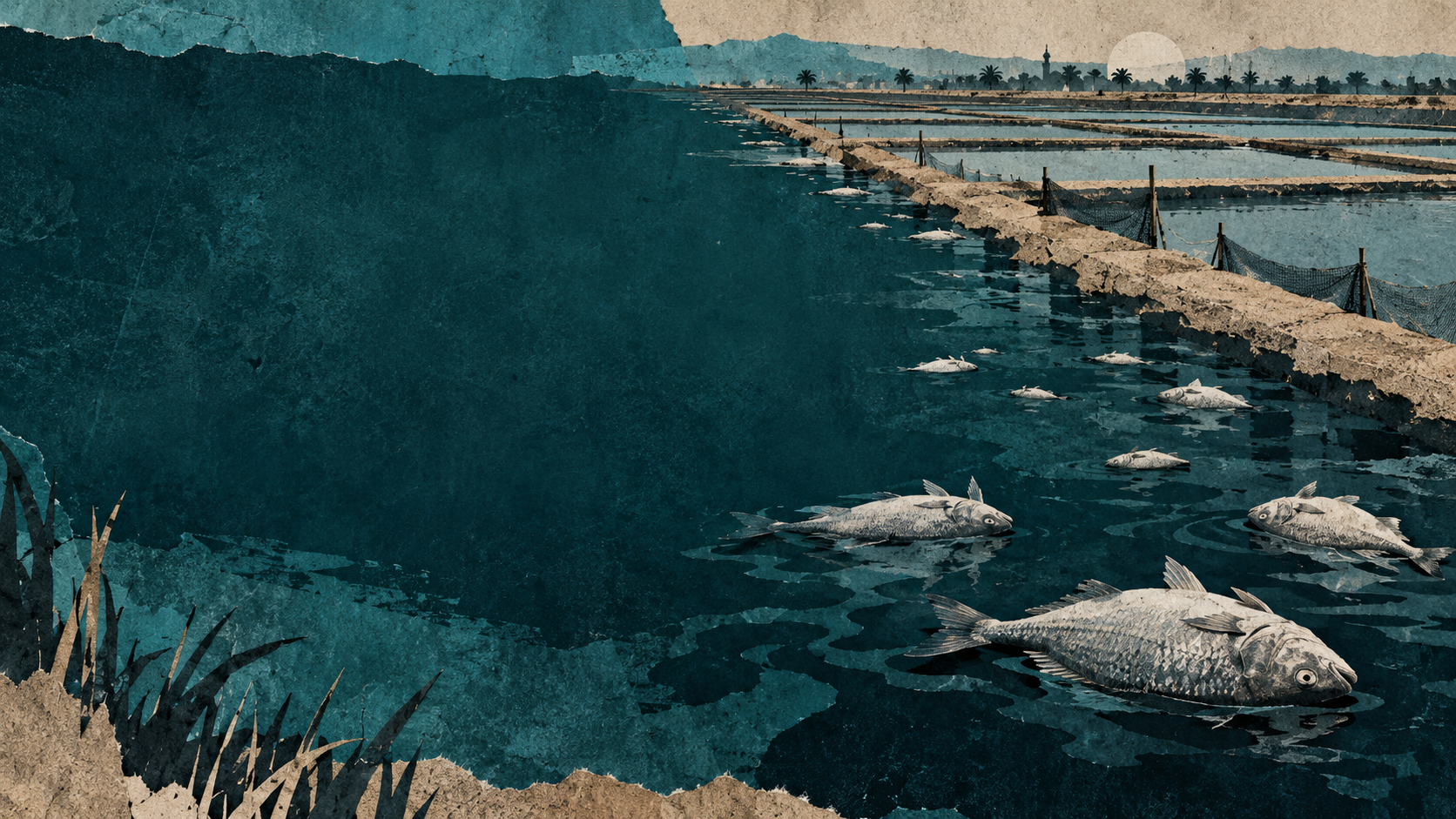
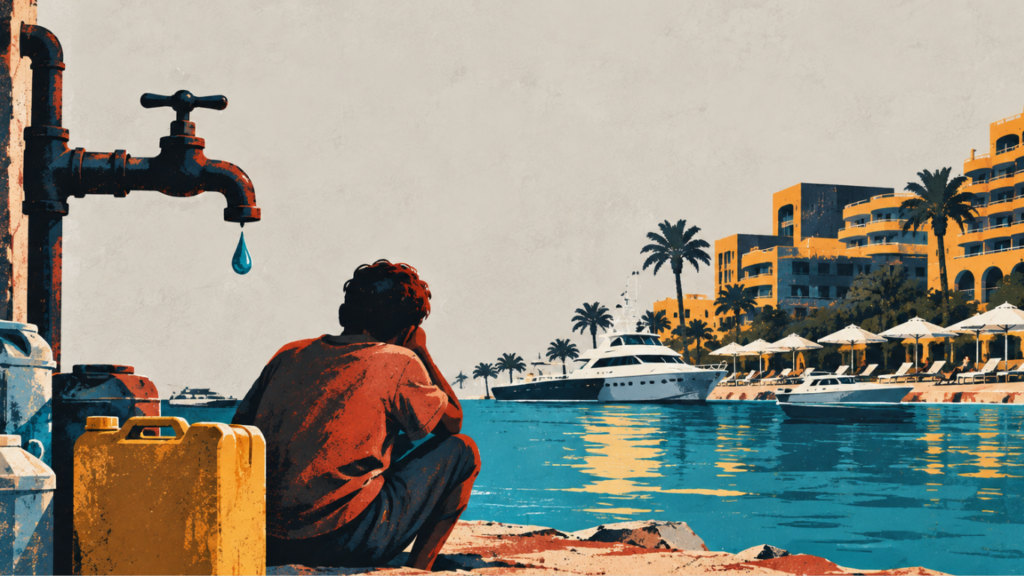

On the seventh day without water, Ahmed Adel, 44, and his wife watch a WhatsApp group in Hurghada’s al-Dahar neighbourhood. The Red Sea water company created the group to tell residents when pumping will resume after eight consecutive days of interruption, allowing them to refill the tanks on their roof for another week.
They stay alert throughout the day. An announcement can arrive at any hour; missing it means failing to fill a tank that barely covers drinking, cooking and personal hygiene until the next supply.
This is the rhythm of life in Hurghada this summer: tanks refilled every eight days and a black market charging as much as EGP 500 per cubic metre, or about $10. The former governor estimated the city’s daily shortfall at 45,000 cubic metres in summer 2025; the current governor puts the entire governorate’s shortfall at 100,000 cubic metres a day. Meanwhile, the city welcomes millions of tourists and adds hotel rooms year after year.
This report concerns Hurghada, the Red Sea governorate’s capital, largest city and biggest hotel centre. However, most official production, deficit and hotel-room figures are released only for the governorate as a whole. Each figure therefore identifies whether it concerns the city, governorate or country. Between residents paying for shortages and hotels denying responsibility, Zawia3 follows the strands of the crisis.
Residents monitor neighbourhood WhatsApp groups and the company’s Facebook page to fill their tanks before the next interruption. Those who miss the pumping window must obtain a company tanker at EGP 140 per cubic metre, about $2.90, or hire privately operated vehicles until the water returns the following week.
A tank for every home
“Filling tanks is an old habit in Hurghada. We do not have continuous supply, so everyone needs a tank to fill when the water is pumped, to last through the days it is cut off,” Ahmed tells Zawia3.
Before the current crisis, water arrived twice a week, on Mondays and Thursdays. His four-cubic-metre tank more or less covered his family’s needs. Now the gap is eight days, and he gets up at any hour—“two in the morning or four at dawn”—to refill it. Older buildings sometimes have large underground tanks holding 25 cubic metres, providing a buffer that his household lacks.
What Ahmed describes as the absence of continuous supply is the company’s “rotation system.” In a May response to an article by Mohamed Sheta, the Holding Company for Water and Wastewater acknowledged that some areas depend on rotations because production is limited, while neighbourhoods with upgraded networks receive water around the clock.
On 15 July, Bahaa Abdel Moneim Sayed al-Ahl, chairman of the Red Sea Drinking Water and Wastewater Company, inspected network rehabilitation in Mubarak 11, Star City and Mubarak 5 in preparation for continuous 24-hour pumping and the end of rotations. Uninterrupted supply remains an objective being pursued neighbourhood by neighbourhood.
The crisis is longstanding. Residents interviewed by Zawia3 say it has worsened over the past four years: water once arrived every three days, but now comes every eight.
The Kureimat line and al-Yusr plant: a recurring summer crisis
Complaints intensified in early May 2025 as shortages returned for another year. Officials repeatedly attributed interruptions to breaks in the Kureimat pipeline supplying Hurghada and said repairs were under way.
That year, then-governor Amr Hanafy commissioned a parallel section of the line extending 27 kilometres between Ras Ghareb and Hurghada. Costing EGP 950 million, about $19.7 million, it was intended to secure approximately 30,000 cubic metres a day for residents and reduce repeated failures. The crisis nevertheless continued.
The shutdown of Hurghada’s al-Yusr desalination plant, the governorate’s largest, exacerbated the shortage in 2025. Hanafy said expired filters were being replaced with imported ones, and promised to increase output from 40,000 to 60,000 cubic metres a day within 15 days.
Emergency measures included water tankers, which redistribute water rather than create new supplies. The governorate is also seeking new desalination capacity alongside 11 existing plants.
On 2 August 2026 it contracted for a 10,000-cubic-metre-a-day plant in al-Ahyaa, northern Hurghada. On 29 August, Governor Walid al-Barqi announced four new plants in Safaga, Quseir, Marsa Alam and Ras Ghareb, with total capacity of about 85,000 cubic metres a day. None of those four is in Hurghada.
The city’s announced additions are therefore the al-Ahyaa plant and two other plants that al-Barqi said on 10 August would enter service in November and December; he did not specify their capacity.
A city deficit and a governorate deficit are different figures
Speaking on Ala Mas’oulity on 19 May 2025, Hanafy identified three sources for Hurghada: al-Yusr, with design capacity of 80,000 cubic metres a day; the Kureimat line, supplying about 30,000; and the Qena line.
He said there was “no real water crisis in Hurghada, but some challenges,” while estimating the city’s deficit at 45,000 cubic metres a day. He attributed it to tourist and resident demand, encroachments reducing flow through the Kureimat line, and filter problems that had cut al-Yusr’s production to 40,000.
Before al-Yusr began operating, Hurghada relied entirely on Nile water conveyed through the Qena and Kureimat pipelines, respectively 220 and 500 kilometres long, according to Akhbar al-Youm.
In mid-August 2026, al-Barqi estimated the whole governorate’s severe drinking-water deficit at around 100,000 cubic metres a day. He put governorate-wide production from desalination and the two external pipelines at no more than 162,000 cubic metres daily—well below residents’ needs, with Hurghada particularly affected.
A few days earlier, he told Ala Mas’oulity that the challenge had emerged three years ago, described dependence on the Kureimat and Qena supplies, and linked the deficit to the Kureimat duplication project.
The two shortfall figures cannot be compared directly: 45,000 cubic metres concerns Hurghada in summer 2025; 100,000 concerns the entire Red Sea governorate in summer 2026. The city’s share of the latter has not been published.
Al-Barqi linked the shortage to urban and population growth, tourism establishments, limited natural water sources and dependence on external pipelines. Rising tourist and tourism-worker numbers, he said, had put unprecedented pressure on production, transport and distribution across the governorate’s cities.
He said foreign visitors had previously numbered no more than 5.5 million and reached seven million the preceding year, adding that every tourist requires three tourism workers. Hanafy had similarly described Hurghada as facing particularly heavy pressure from domestic and international tourism.
In its May response, the holding company said approximately 50% of al-Yusr’s membranes had been replaced in March and April 2025 at a cost of about EGP 100 million, or $2.1 million. Its plans included four desalination plants totalling 85,000 cubic metres a day and additional projects providing 110,000, within a strategy running to 2050.
Sheta replied that describing these efforts did not answer the central questions: can the existing system continuously supply every Hurghada neighbourhood, and where do water traders obtain uninterrupted quantities when official networks are interrupted?
Hurghada leads the governorate in hotel numbers
A statistical report cited by Al-Masry Al-Youm said Hurghada welcomed around two million tourists of different nationalities in the first half of 2026, with occupancy at many hotels and resorts reaching 90–100%.
In mid-August, al-Barqi announced that 11,000 hotel rooms had been added across the governorate’s cities between January and July. Hurghada was the largest tourism centre, but its share of the new rooms was not specified.
The Tourism and Antiquities Ministry’s directory of fixed hotel establishments lists Hurghada first in the governorate with 159 hotels, followed by Marsa Alam with 64, Safaga with 28, El Gouna with 20 and Quseir with 16.
Nationally, Egypt had 1,284 hotel establishments and 228,146 rooms in 2024. Mohamed Amer, head of the ministry’s central administration for hotel establishments, said in 2025 that more than 5,000 rooms added since the beginning of that year had taken the total to about 234,000. The national target is 500,000 rooms by 2031 to welcome 30 million tourists annually.
The Red Sea is the governorate with the most hotels, according to ministry figures. It also leads tourism areas in luxury-hotel numbers: 26, followed by Greater Cairo with 23, South Sinai with 17, the North Coast with eight and Luxor with seven.
Luxury hotels in selected tourism areas
| Area | Hotels |
|---|---|
| Red Sea | 26 |
| Greater Cairo | 23 |
| South Sinai | 17 |
| North Coast | 8 |
| Luxor | 7 |
View the hotel-establishment data from the original map
Hotel establishments: data in the original map
| Area as labelled in source | Establishments |
|---|---|
| North Sinai | 6 |
| Luxor and Aswan (combined label in source) | 50 |
| Red Sea | 290 |
| Matrouh | 1 |
| New Valley | 16 |
| Suez | 33 |
| South Sinai | 241 |
| Port Said | 14 |
| Dakahlia | 1 |
| Sharqia | 3 |
| Ismailia | No value provided |
| Damietta | 20 |
| Kafr el-Sheikh | No value provided |
| Beheira | 1 |
| Alexandria | 43 |
| Cairo | 97 |
| Giza | 72 |
| Minya | 7 |
| Fayoum | 9 |
| Beni Suef | 1 |
| Menoufia | 1 |
| Qalyubia | 1 |
| Gharbia | 3 |
| Sohag | 3 |
| Qena | 2 |
| Assiut | 6 |
| Luxor | 28 |
Sayed al-Gabri, head of the Red Sea chamber of tourism companies, said room growth tracks rising tourism activity. Mohamed Shamroukh, managing director of a hotel group, said each room is associated with three to four direct and indirect jobs. Hotel expansion brings investment and employment, but the governor sees added pressure on water demand.
“We are no longer a burden on the government”
Rami Fayez, a board member of the Chamber of Hotel Establishments and head of the Marsa Alam marketing committee, rejects the claim that tourism expansion causes the shortfall. He tells Zawia3 that many of the approximately 290 hotels he estimates across the governorate rely on private desalination.
He puts recent hotel growth in Hurghada at 7–10% over two years—about 15–20 hotels still under construction—and argues they cannot be responsible for the current crisis.
Existing Hurghada hotels, however, have freshwater connections like other commercial premises, according to Fayez. Private desalination plants and wells are particularly common in Marsa Alam and Quseir. His desalination argument therefore mainly concerns those cities, while existing Hurghada hotels draw on the network also serving residents.
“We are no longer a burden on electricity networks or even water networks,” Fayez says, pointing to infrastructure that investors install before building hotels and that can sometimes cost more than the buildings themselves.
The governorate nevertheless required hotels and resorts to rely on seawater desalination during the intensifying Hurghada crisis, to free water for residents. Establishments were asked to set deadlines for developing their desalination and treatment facilities.
Fayez criticises the financial burden on existing hotels connected to public networks. He estimates a desalination plant at EGP 15–20 million, about $311,000–414,000, paid by the hotel, and calls for more consultation with the sector.
Ali Saeed al-Dabi, chairman of the Golden Beach Hotel in Hurghada’s al-Ahyaa area, gives the same estimate for a private plant producing 1,000 cubic metres a day; doubling output to 2,000 would double the cost.
His hotel installed a plant around 20 years ago, but it stopped operating ten years ago. Extensive and increasingly costly maintenance, along with disputes with the intended maintenance contractor, led him to abandon the work.
Since then, the hotel has depended entirely on government pipelines. Al-Dabi says shortages affecting hotels, resorts and households began worsening about seven years ago and gradually reached today’s level.
Golden Beach has 450 rooms and capacity for roughly 1,200 guests. Daily water use is 500–700 cubic metres, billed at what al-Dabi calls a tourism tariff of EGP 150 per cubic metre, around $3.10.
Zawia3 calculates that, at full occupancy, this amounts to about 420–580 litres per guest per day—roughly three to four times the water-company chairman’s estimate of 150 litres per citizen. The hotel figure includes the establishment’s total consumption, rather than only water used personally by guests.
Licensing is another obstacle. In 2023, owners and investors called for easier approvals for private desalination plants during peak tourism demand, repeated pipeline breaks and al-Yusr’s decline from 80,000 to 35,000 cubic metres a day.
Al-Dabi explains that approvals begin with the governorate and environmental authorities for a seawater intake. High groundwater salinity makes seawater the more common option, but securing an intake can take considerable time.
An Egyptian Environmental Affairs Agency source said seawater plants first require environmental studies, Shore Protection Authority approval, approval from the Irrigation Ministry’s higher licensing committee, and compliance with conditions protecting marine environments and groundwater.
Tourism expert Mohamed Karam says many hotels lack private desalination because of its cost and consequently rely on government supplies.
A black market and an EGP 100,000 fine
Bishoy, a pseudonym for a 50-year-old resident of Hurghada’s Magawish district, now sets aside a substantial part of his salary to buy water for his 15-cubic-metre tank. Keeping the family supplied through the week comes at the expense of other household needs.
He tells Zawia3 that private drivers charge EGP 400–500 per cubic metre, around $8–10, refusing the governorate’s EGP 140 rate.
“We have to accept the price, otherwise we will not find water,” Bishoy says.
During a 40-day interruption the previous year, he paid EGP 700 per cubic metre, about $14.50, and complained to the cabinet.
Bishoy describes the official network tariff as EGP 7 per cubic metre, approximately 14 US cents. The holding company’s response instead cites EGP 25 per tonne, around 52 cents, and attributes higher circulating prices to individual dealings outside its official arrangements. These are separately attributed figures, rather than a single confirmed tariff.
He asks why residents must pay EGP 140 to arrange private transport when they have contracted with the company to deliver water. In his view, tankers have created further problems: spillage can reduce deliveries by about half a cubic metre; vehicles consume diesel, are old and poorly equipped, and crowd narrow streets.
Company chairman Bahaa Abdel Moneim Sayed al-Ahl denies any brokerage in water deliveries. He tells Zawia3 that residents requesting a tanker receive water for EGP 140 per cubic metre, while the company bears delivery costs to areas without pumping. Bishoy’s complaint, however, concerns private drivers rather than company vehicles.
On 10 August, al-Barqi announced a maximum price of EGP 140 per cubic metre. Anyone charging more, he said, would face a fine of EGP 100,000, about $2,070, and seizure of their tanker. Vehicles would display reporting numbers, with enforcement coordinated with the Interior Ministry. The governorate was bringing tankers from neighbouring governorates; he described selling water as an uncomfortable arrangement.
The water-company chairman attributes the shortage to population growth outstripping supply and to tourist resorts and hotels lacking desalination. Summer visitors from elsewhere in Egypt and from Arab and Gulf countries add pressure.
He estimates citizens’ needs at 150 litres without specifying a time period. Assuming this means daily use, the following calculation shows weekly costs for individuals and households at tanker prices.
Weekly tanker-water costs at 150 litres per person per day
| Household members | Daily litres | Weekly litres | At EGP 140/m³ | At EGP 400/m³ | At EGP 500/m³ |
|---|---|---|---|---|---|
| 1 | 150 | 1,050 | EGP 147 | EGP 420 | EGP 525 |
| 2 | 300 | 2,100 | EGP 294 | EGP 840 | EGP 1050 |
| 3 | 450 | 3,150 | EGP 441 | EGP 1260 | EGP 1575 |
| 4 | 600 | 4,200 | EGP 588 | EGP 1680 | EGP 2100 |
| 5 | 750 | 5,250 | EGP 735 | EGP 2100 | EGP 2625 |
| 6 | 900 | 6,300 | EGP 882 | EGP 2520 | EGP 3150 |
Planning in reverse
Urban-planning professor Seif Farrag attributes recurring Red Sea water crises to haphazard planning. He tells Zawia3 that planning should begin with urban-economic studies establishing how much construction an area can support and which income groups it serves.
Those studies should examine population composition, ages, children, household sizes and employment needs. Water, electricity, wastewater capacity and discharge points, land uses, building density and heights, schools, hospitals and administrative facilities should then follow from that information.
Infrastructure needs should have been assessed before urban and tourism expansion, Farrag says. Instead, construction preceded the identification of needs: planning happened “in reverse.”
Without detailed studies and adequate information, development left a gap between demand and actual capacity. Correcting it after construction costs substantially more money and time than planning infrastructure in advance.
Farrag recommends a comprehensive assessment of current conditions, an inventory of deficiencies and revised plans based on present data, so future expansion matches the capacity of public utilities.
Karam makes a similar argument: rising tourist numbers have strained Hurghada’s resources. Hotels must provide for all arrivals even when not fully occupied, and the city’s capacity does not fully match growth, affecting basic services including water.
He notes that infrastructure pressures also affect other tourism cities and projects still under construction, including Marsa Alam developments and roads connecting destinations. Such state projects take time. Achieving the targets of 30 million tourists and 500,000 rooms requires infrastructure capable of supporting them.
While they wait for new plants, Ahmed Adel’s family strictly ration their stored water: taps are closed carefully and showers are staggered to preserve enough for drinking and cooking.
Bishoy’s family follows a similar routine. They fill the tank when pumping resumes and wait another week: “We have to conserve. We shower less and wash clothes while the water is running.”
Until the company’s neighbourhood-by-neighbourhood programme of continuous supply reaches al-Dahar and Magawish, Ahmed will keep waking at two in the morning to fill a tank that must last a week.