


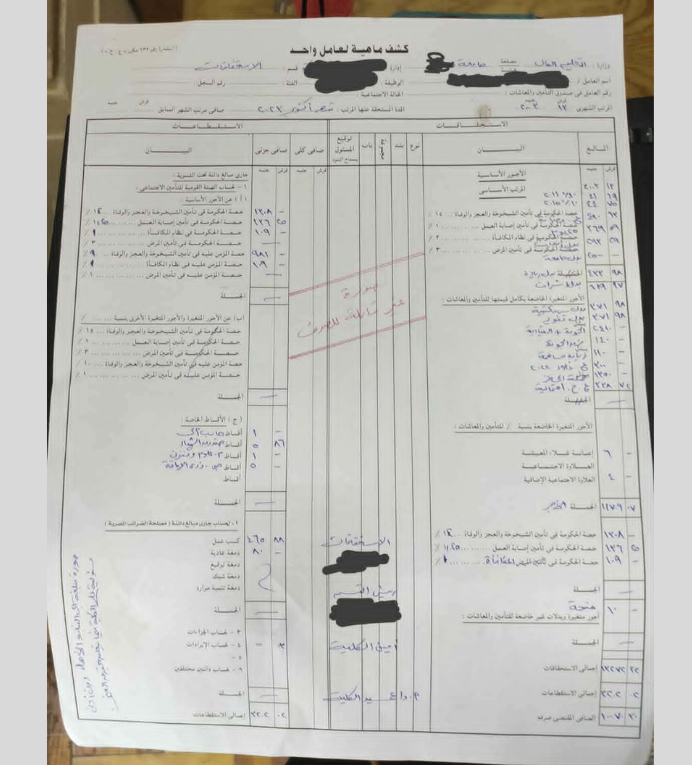
In 1972, an Egyptian pound was worth about $2.3 and a gram of 21-carat gold cost no more than 170 piastres, according to the historical comparison used in this report. That year, Universities Organisation Law No. 49 introduced faculty salary scales: the professor grade ranged from EGP 1,400 to 1,800 annually, plus a EGP 420 university allowance and EGP 75 annual increment. The report estimates an average monthly figure of EGP 174.5, equivalent to about $405.8 or 102.6 grams of gold, without adjusting for inflation. These are the Arabic report’s approximate historical calculations, rather than an independently reconstructed payslip.
More than half a century later, a professor near the end of service earns around EGP 15,000–17,000 a month, the report says—roughly $300–340 or 2.5–2.9 grams of gold at the rates used in its comparison. Pay that once represented more than 100 grams of gold now buys fewer than three, while parts of the law written when a pound exceeded two dollars remain in operation.
“We still receive salaries counted in pounds and piastres after a long journey of work, research and prestigious academic qualifications,” Wael Kamel, professor at Capital University’s Faculty of Music Education, tells Zawia3. “The result is a faculty member running on a treadmill to bring in money, students not receiving their full right to education, research dominated by quantity over quality—and society ultimately losing.”
The debate has reached parliament. In the intervening decades, the salary schedule was amended in 1983; a 2012 amendment increased only the university allowance. A 2015 budget measure then fixed incentives, allowances and bonuses as amounts based on the 2015 basic salary rather than percentages of the annually changing basic wage, while deductions follow current-year salaries. Academics say that arrangement, compounded by inflation, steadily erodes income.
Academic pay and the knowledge economy
In a study titled “The Academic Wage Crisis and the Future of the Knowledge Economy in Egypt,” biotechnology specialist Tarek Qabil, a scientific journalism and communication adviser at Cairo University’s Faculty of Science, describes cumulative pressures: living costs, research expenses, international publication fees, conference costs and regional and global competition for talent. Basic pay accounts for only a small portion of total earnings; bonuses, incentives—especially the quality incentive—and the university allowance supply most income.
The study presents academics as fundamental to development: preparing human capital, producing knowledge, transferring technology, supporting a knowledge economy and improving international university rankings. It links poor pay to a widening research–industry gap, weaker innovation and competitiveness, a less attractive academic career and the migration of skilled researchers.
Qabil draws on international examples: performance, funding and research-linked flexible contracts in the United States; job stability, research support and comprehensive evaluation in Germany; major investment in recruiting scientists and globally competitive salaries in Singapore; and increased research spending with university–industry links in China.
Egypt’s public and Al-Azhar universities had 123,500 faculty members and teaching assistants in 2024/25, according to CAPMAS. Kamel estimates roughly half work in medical and engineering disciplines that may offer outside professional income, while the other half, including humanities, depend largely on university salaries and rarely find comparable outside work.
In all cases, Articles 100–103 of the Universities Organisation Law restrict outside work. Private tutoring, forming companies and commerce are prohibited except where the university president grants permission under specified conditions.
Kamel points to increments still measured in tiny sums: EGP 72 a year for an associate professor and EGP 75 for a professor. The EGP 3 difference is 25 piastres a month after demanding promotion research. The difference in total pay between the grades is about EGP 2,000.
The 2012 university-allowance rise should have started wider reform, he says, but further stages never followed. Faculty have a special pay system rather than the Civil Service Law: he estimates basic pay at 20% of total earnings, with allowances and incentives making up the rest and calculated on the 2015 base. Annual basic-pay increases of 10% or 15% therefore produce small cash gains because the base itself is low.

Mohamed Ishaq, former dean of Capital University’s Faculty of Art Education, says reliance on variable components for around 80% of pay—some paid by the Finance Ministry and others by the university—leaves staff unable to predict or control their income.
“A faculty member becomes completely preoccupied with money, pursuing thesis supervision regardless of academic quality or membership of a merely formal committee for the allowance—just a few pounds,” he tells Zawia3. “That is unworthy of a faculty member and the role expected of them.”
Solving problems with new problems
Kamel says the government answered weak salaries with a quality incentive that grew year after year, eventually exceeding a quarter of faculty income. Staff cannot afford to lose it, while it has become a budget burden. When an increase was overlooked last year, parliamentary appeals and faculty pressure were needed before EGP 1.5 billion was allocated this year.
Parliament’s Planning and Budget Committee approved that support for the Higher Education and Scientific Research Ministry to pay the quality incentive to faculty and assistants in universities, institutes and research centres in the 2026/27 budget.
Pensions reproduce the problem, interviewees say: calculated on basic earnings, they reach only around EGP 4,000–5,000 at most. The government’s answer was to allow professors to continue working after 60 and combine salary with pension. Kamel says this keeps some elderly or ill academics working and adds to staffing and budget pressures.
Some faculties accept attendance for one or two days weekly from older professors, while others deduct all incentives and allowances for absence, he says. “How can a university professor with financial and social obligations live on just EGP 4,000?”
Promotion is expensive before it is academic. Kamel criticises requirements built around quantity rather than quality and international ranking recommendations, describing some rankings as illusory and noting that major universities have withdrawn from them.
The Supreme Council of Universities’ 2025 rules for its fifteenth promotion cycle require between three and eight published or publishable papers, plus a dean-signed statement documenting at least three faculty-approved training courses. Those courses are not free.
Publication costs add up: the report cites EGP 30 per page in a faculty journal, averaging EGP 2,000 per paper, multiplied across seven or eight studies. International publication is paid in dollars. Kamel says there is no dedicated state-level research budget available to cover these needs for faculty, and support from individual faculties may be absent.
Faculty have three duties, Kamel says: teaching and graduating students, community service, and research. Yet promotion assesses research alone, sidelining the other two. Students suffer when teaching quality is not evaluated; community service suffers when professors cannot meet their own families’ needs.
He argues that one study solving a real problem should deserve promotion more than seven papers sitting on library shelves. The emphasis on quantity has produced “research factories,” he says, obscuring valuable work in a flood of publications.
Kamel contrasts this with some European universities that distinguish teaching posts from research posts and connect dedicated researchers to labour-market needs. A university should nurture outstanding graduates appointed as teaching assistants until their expertise matures, he says, but teaching in Egypt has instead become a burden on staff.
He also challenges the idea that textbook sales adequately compensate for weak salaries. In his view, prescribed university textbooks grew from the pay crisis: ideally, lecturers direct students to multiple sources for independent study, but low wages encouraged staff to sell their own books to students. Revenue varies greatly between large-enrolment subjects and classes of only a few dozen.
Universities subsequently took control of that income, allocating a share to the lecturer and larger portions to leadership before moving to electronic books. Kamel says he co-authored a textbook but earned only EGP 1,200 for an entire semester because his class was small.
Parliamentary questions and unequal rewards
In June, as the new national budget was approved, three MPs submitted parliamentary questions about faculty salaries. Heidi al-Maghazi addressed the higher education and finance ministers, asking whether the wage and allowance structure for public-university faculty and assistants matched national goals for higher education and scientific research.
She asked why financial schedules containing decades-old provisions remain in use, and how that affects retention of academic talent and educational quality when the government describes higher education and research as foundations of a knowledge- and innovation-based economy.
Mostafa Bakry also addressed the prime minister and both ministers, arguing that faculty pay does not match their teaching, research and community-service responsibilities.
On X, Bakry said he had learned that Prime Minister Madbouly formed a committee chaired by Sherif al-Shazly, head of the Cabinet advisers’ authority, to examine the legal position on improving pay. He cited roughly EGP 8,000 for a teaching assistant, EGP 15,000 for a dean and EGP 17,000 for a university president, saying the prime minister would consider the committee’s report.
An anonymous faculty member disputes the picture those senior-management figures present. He says bonuses make leadership income different from ordinary faculty income and claims a university president’s remuneration can reach EGP 1 million. The period and basis of that figure were not specified in his testimony.
He says an international-student bonus alone is 18 times a president’s or dean’s monthly income and may exceed EGP 300,000 in a semester, compared with EGP 1,200 per semester for an ordinary faculty member. Special programmes, textbooks and other revenues further demonstrate unequal distribution, he argues.
He believes one obstacle to reform is that well-paid leaders speak for staff without sharing their hardship; some do not raise the issue at all.
Hisham al-Badri, professor and head of public law at Menoufia University, examined the educational-activities and university-hospital funds in his book “Special Funds and Accounts.” He argues that distribution favours leadership to the extent that presidents, deputies and deans at even weaker universities can receive several million pounds monthly. These are the author’s claims, rather than salary figures established by the documents reproduced here.
At publication, the Cabinet had issued no official statement confirming the committee or measures to improve pay beyond Bakry’s account.
MP Soraya al-Badawi said low faculty salaries directly affect teaching quality, academic stability, research and retention of national talent. She called for an explicit Universities Organisation Law provision referring to a clear, updated financial regulation.
Academic dedication under Article 100—for teaching, guidance, community service and research—cannot remain a one-sided legal obligation, she argued. It must be matched by fair financial arrangements preserving stability and dignity.
The human cost of low salaries
Ishaq says academics excelled to become scholars and thinkers serving society, rather than employees who cannot identify their own pay because so much is variable. He recalls distressing experiences during his deanship.
“I knew a young man who would not go home until his children slept because they had asked for things he could not provide; others whose transport to marking work cost more than the marking payment; and a senior professor near death who still had to attend so his incentives and allowances would not be deducted,” he says. “What humane conditions are these? What dignity, and what abandonment when facing a family’s needs?”
Kamel says restrictions on outside work nevertheless force some academics into additional jobs, sometimes unsuitable for their role. Others maintain only a nominal university connection while working elsewhere, using the affiliation to identify themselves professionally.
He believes that imbalance, alongside missing academic guidance, meaningful research and community service, produces academically weaker generations. Debate over the declining value of some disciplines ultimately reflects poor salaries, promotion systems and professors’ inability to fulfil their responsibilities to students, he argues.
Demands for lasting reform
Ishaq rejects temporary fixes through variable allowances and incentives. He calls for a stable monthly salary of at least EGP 50,000, which he considers sufficient for a family’s food, clothing, education and healthcare rather than luxury.
If a government committee is formed, he wants faculty representatives elected within every university, rather than nominated by presidents. He questions why leaders who experienced the same difficulties before reaching highly rewarded posts now overlook them, and calls for minimum and maximum bonus limits and fairer distribution.
Kamel calls for equitable redistribution of university resources, noting that some institutions announce surpluses worth billions without corresponding improvements in faculty pay.
For pensions, he proposes a fund modelled on those of other special-pay professional groups, financed by defined shares of tuition, textbook revenue, international-student income and special programmes across public, private, national and international universities.
The fund would provide 80% of a professor’s final salary, allowing those who are ill or unable to work to retire while saving the budget incentives and allowances currently paid for continued employment.
Qabil’s study proposes a competitive, sustainable basic-income component; a clear, fair and transparent wage structure tied to performance and competence; incentives for research and innovation; early-career grants; competitive research funding under clear criteria; university–industry projects, technology transfer and innovation marketing; university start-ups and business incubators; and financial and technical support for publication in reputable international journals.
It concludes that investing in academics means investing in the country’s future: strong professors support strong research, innovation, a sustainable knowledge economy and comprehensive development.