

Coinciding with the 12th session of the World Urban Forum, organised by the United Nations Human Settlements Programme (UN-Habitat) and hosted by the capital, Cairo, from 4 to 8 November, many problems and challenges facing the urban planning system in Egypt are coming to the fore. A large part of them, according to experts and observers, relates to the new urban cities, which face continuing challenges reflecting an inability to attract the population densities targeted under government programmes, a lack of services and infrastructure in some cities, as well as high living costs, their distance from urban centres and the unsuitability of many of them for housing, given their geographical distance from work and service centres.
The current forum is being held under the theme “It All Starts at Home: Local Actions for Sustainable Cities and Communities”. For his part, Egyptian President Abdel Fattah al-Sisi focused in his speech on highlighting “Egypt’s achievements in recent years, especially through projects such as Decent Life and Housing for All Egyptians, as well as new cities such as the Administrative Capital”, announcing the launch of the “National Strategy for Smart Cities” and “Green Urbanisation” to strengthen development efforts according to global standards, and stressing that the Urban Forum represents an important international platform for cooperation and exchanging expertise on improving the quality of life in cities.
The United Nations participates in supporting many urban projects in Egypt, working in partnership with the Ministry of Housing and Urban Communities under the programme for housing development, urban renewal and the upgrading of informal settlements, which aims to confront the challenges facing the provision of adequate housing for all, while providing access to basic urban services, preventing the establishment of informal and unsafe areas in Egypt and upgrading existing ones. The programme provides technical advisory services at both the national and local levels, with the aim of building the institutional and legislative capacities needed to plan and implement inclusive, integrated and sustainable cities in Egypt.
High Costs
In the period from 2014 to 2023, Cairo spent about EGP 1.3 trillion on establishing about 61 cities, including EGP 975 billion to establish and develop fourth-generation cities, 75% of the investments, and EGP 325 billion to develop and upgrade earlier generations of cities, 25% of the investments. According to official statements, the rate of investment spending on new urban communities has developed markedly under the current president: between 1978 and 2014, about EGP 64 billion was spent, at an estimated annual rate of about EGP 1.7 billion, while during nine years of Sisi’s rule, about EGP 1.3 trillion was spent, an annual rate of EGP 144 billion.
Official estimates indicate that the New Administrative Capital alone cost about EGP 800 billion, of which EGP 500 billion went on infrastructure and buildings in the first phase. The second phase is planned to cost between EGP 250 and 300 billion. The Administrative Capital for Urban Development company has built up to 100,000 housing units and received 1,200 families. Meanwhile, the cost of the New Alamein City project reached about USD 337 million.
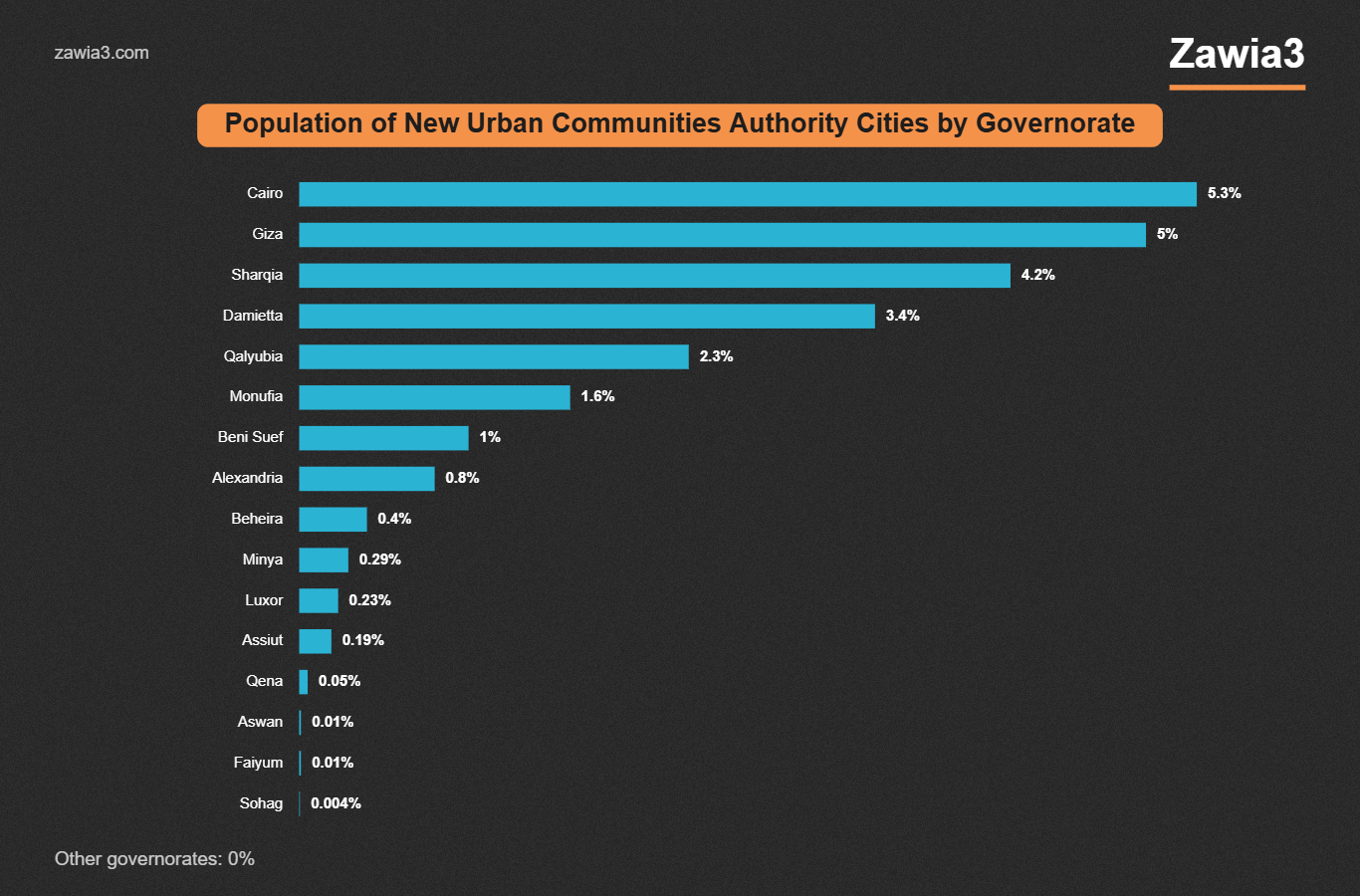
These investments were hoped to relieve population density in the old cities and double Egypt's inhabited area from 7% to 14%, in order to provide various development opportunities and create new urban containers to absorb population growth and all the activities residents need by 2025. But the goal was not achieved: as of the beginning of 2024, 1.7 million people were living in the new cities under the New Urban Communities Authority across the country, according to the Egyptian Urban Observatory. Cairo Governorate had the largest number of new city residents, reaching 550,000, followed by Giza Governorate with 476,000, while Aswan Governorate had the fewest: only 121 people. In addition, no citizens have yet begun to live in new cities in 11 governorates this year, as their implementation has only recently begun.
The projects aimed to populate New Alamein City with about three million citizens, while its population to date does not exceed about ten thousand, and while the government aimed to populate the New Administrative Capital with about six million citizens, the population as of mid-2024 does not exceed about 500 families, expected to reach a thousand families by the end of the year, according to official statements.
Assessing the impact of the New Urban Communities Authority on local urban development requires calculating the area of land owned by the authority as a percentage of Egypt's total inhabited area, which reached about 112,174 square kilometres in mid-2023, nearly 11.2% of the country's total area. The land owned by the New Urban Communities Authority amounts to about 9,001 square kilometres, representing only 8% of Egypt's total inhabited area, a relatively small percentage. The rest of the inhabited land includes existing urban areas, old and reclaimed agricultural land, as well as industrial and tourism development land and energy zones.
The authority's land makes up 100% of the inhabited land in Cairo Governorate, 40.7% in Matrouh Governorate and 31.6% in Suez, while it represents between 20 and 25% of the inhabited area in Qalyubia, Menoufia and Giza. In Upper Egypt, the authority's land does not exceed 5% of the inhabited area, and it has little or no impact in governorates such as Luxor, New Valley, Beheira and Ismailia.
Population Growth Rate in New Cities
| New city | Year of establishment decision* | Initial assumed population | Actual population (2006)** | Years since the decision | Actual growth rate | Target population*** | Years to target*** | Target growth rate |
| 10th of Ramadan | 1977 | 20,000 | 124,120 | 24 | 21.7 | 500,000 | 25 | 96 |
| 15th of May | 1978 | 12,500 | 90,324 | 23 | 27.1 | 250,000 | 20 | 95 |
| Sadat City | 1978 | 20,000 | 27,781 | 23 | 1.7 | 500,000 | 25 | 96 |
| Borg El Arab | 1979 | 20,000 | 41,351 | 22 | 4.9 | 500,000 | 25 | 96 |
| 6th of October | 1979 | 60,000 | 157,135 | 22 | 7.4 | 1,500,000 | 25 | 96 |
| New Damietta | 1980 | 13,500 | 25,944 | 21 | 4.4 | 270,000 | 20 | 95 |
| New Salhia | 1982 | 4,667 | 18,968 | 19 | 16.1 | 70,000 | 15 | 93.3 |
| Badr | 1982 | 21,500 | 17,172 | 19 | 0 | 430,000 | 20 | 95 |
| Obour | 1982 | 20,000 | 43,802 | 19 | 6.3 | 500,000 | 25 | 96 |
| New Minya | 1986 | 10,400 | 4,570 | 15 | 0 | 156,000 | 15 | 93.3 |
| New Nubariya | 1986 | 15,250 | 39,611 | 15 | 10.6 | 305,000 | 20 | 95 |
| New Beni Suef | 1986 | 21,000 | 17,638 | 15 | 0 | 420,000 | 20 | 95 |
| Sheikh Zayed | 1995 | 22,500 | 29,553 | 6 | 5.2 | 450,000 | 20 | 95 |
| Shorouk | 1995 | 20,000 | 20,983 | 6 | 0.8 | 500,000 | 25 | 96 |
| New Cairo | 1995 | 60,000 | 118,678 | 6 | 16.3 | 1,500,000 | 25 | 96 |
| New Aswan | 1999 | 4,667 | 0 | 2 | 0 | 70,000 | 15 | 93.3 |
| New Assiut | 2000 | 8,667 | 1,761 | 1 | 0 | 130,000 | 15 | 93.3 |
| New Sohag | 2000 | 5,400 | 57 | 1 | 0 | 81,000 | 15 | 93.3 |
| New Faiyum | 2000 | 6,667 | 0 | 1 | 0 | 100,000 | 15 | 93.3 |
| New Qena | 2000 | 8,667 | 0 | 1 | 0 | 130,000 | 15 | 93.3 |
| New Tiba | 2000 | 9,333 | 1,000 | 1 | 0 | 140,000 | 15 | 93.3 |
| Total | 780,448 | Average 5.8 | 8,502,000 | Average 94.7 |
A chart showing the population growth rate in new urban cities up to 2018. Source: the Urban Observatory and data from the Central Agency for Public Mobilisation and Statistics.
Lack of Basic Services
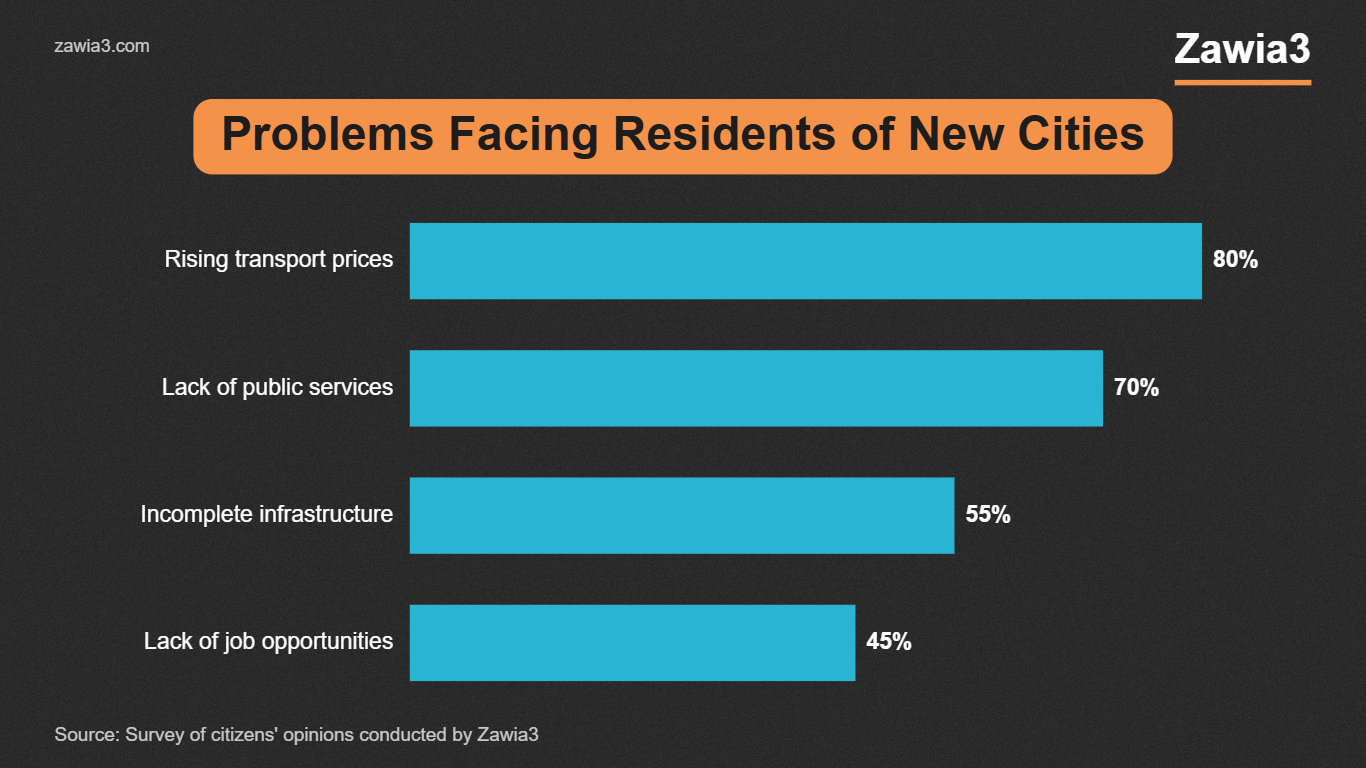
Zawia3 surveyed the opinions of 50 citizens (men and women of different ages) living in the new urban cities to identify the most prominent problems they face, which were the lack of public services, distance from work centres and the unavailability of transport at affordable prices.
Mohamed Bekhit, a resident of the Dahshour area in 6th of October City, tells us: "When I moved to live in the city, I expected life here to be quieter and less crowded than I was used to in central Cairo, but I found that the infrastructure has not yet been sufficiently completed, or has problems and a shortage of services, especially services such as hospitals and schools. Whenever my children need medical care, I have to travel a long distance to reach a good hospital in Cairo or Giza or somewhere outside Dahshour in general."
He points out that public transport is not sufficiently available; most residents rely on their private cars or on private ride services, which are costly, creating an additional problem at the end of work, when congestion on the main roads leading to Cairo or Giza becomes unbearable. With the scarcity of public transport, people who do not own cars face great difficulty getting around, especially late at night, and with rising transport prices the matter becomes even more difficult.
As for Fatma, who moved with her family to Badr City three years ago, she says that "the city's prices were reasonable compared with Cairo, but over time we began to face problems such as rising transport prices and the city's distance from Cairo, as it takes a long time to reach the capital, where my father works, and I also have to wait a long time before I can get to my work in Nasr City. Transport here is scarce and often crowded, which makes daily commuting a big challenge."
She adds: "On the other hand, we suffer from repeated water cuts, and sometimes the electricity networks break down for hours, which prevents us from completing any housework or using online services. I feel that life here is not yet complete; basic services are intermittent, and solutions do not seem to be coming any time soon. I hope that markets and recreational facilities will be developed in the city itself so that we do not have to travel to Cairo in search of our basic needs."
In the same context, Yasser Abdel Bar says: "I was enthusiastic about moving to the New Administrative Capital after promises that it would be a smart and advanced city. Indeed, the buildings look modern and beautiful, but in terms of services, there are still many challenges. For example, in residential areas there are still no integrated health centres or enough grocery shops, which forces us to go to neighbouring areas to meet our basic needs." He pointed to the limited internal transport services between districts, which pushes him to use private cars or ride-hailing apps for most journeys, which can be costly, explaining that the city is not yet complete in terms of the infrastructure and services that make daily life easier.
On 15 October, New Galala City witnessed a tragic accident in which 12 students were killed and 29 others injured after a bus carrying a number of Galala University students overturned on the road to Cairo. While official reports revealed that the accident was caused by excessive speed, observers pointed out that the road was not sufficiently paved, especially as security reports indicated that there were no other vehicles near the bus, meaning there were no other external factors causing the accident.
Galala is one of the new cities that received wide publicity. Official estimates indicate that investments in the Galala project amounted, as of 2022, to about USD 100 million. The investment map launched by the Ministry of Investment and International Cooperation divided Galala City into three sectors: sector (A) on 5,550 feddans, 2,050 feddans for sector (B) and 6,900 feddans for sector (C).
Ghost Cities!
For his part, Seif El-Din Farag, professor of urban economics, believes that "public services and basic infrastructure are among the most important ingredients for the success of new cities, as providing necessary facilities such as hospitals, schools and commercial services ensures that housing in these cities is integrated and not merely a place of shelter. Having work close to the place of residence, and the availability of public transport and suitable roads, helps reduce the distances and time citizens spend reaching their work or meeting their basic needs."
He adds, speaking to Zawia3, that "it is also important that new cities include accessible public transport at affordable prices, because relying only on private cars leads to major traffic congestion, which limits the benefit of roads and infrastructure, and providing safe transport that meets everyone's needs would help increase occupancy rates and make the city more attractive to citizens". In addition, new cities require large investments in basic infrastructure such as drinking water, sewage networks, electricity and gas, to ensure a fair life for citizens; many cities lack these ingredients, which makes them look like "ghost cities", where citizens find themselves surrounded by emptiness without other residents, according to Farag.
The urban expert stresses the need for diversity in job opportunities to suit the various classes and specialisations in society, explaining that high land prices in some cities such as the Administrative Capital or Alamein are aimed at specific groups, so we find neighbouring areas at prices suitable for people with limited income, with the aim of achieving a balance between different economic levels within one urban environment. He says: "In the end, the success of new cities depends on the availability of services, diversity of job opportunities and strong infrastructure, so that citizens feel their life there is complete, and not just a place to live."
A study issued by the Egyptian Center for Strategic Studies indicates that "establishing new cities is a challenge, but attracting suitable numbers of residents to live in them is the bigger challenge, especially as it takes some time and requires special policies that may sometimes be exceptional." The study explains that new cities may have a population far below the target and capacity, and that this phenomenon affects a number of cities around the world in which large real estate investments were pumped but which failed to attract residents, because they could not create a real reason convincing residents to move there permanently, or create attractive incentives pushing economic institutions to make investments leading to sustainable job opportunities there, which leads to a scarcity of available services and the futility of transport even if it has already been implemented.
According to Ahmed El-Kholy, an academic and urban planning expert, in his study published on the Alternative Policy Solutions website, climate change and its associated challenges are among the key issues addressed by urban planning, as planners work to develop land uses and manage urbanisation through technical and political strategies. He adds: "Despite repeated warnings about the risks of rising sea levels and the flooding of the Nile Delta coasts, the government continued to expand urban development projects. For example, in 2017, the government began building New Mansoura City on the Nile Delta coast, as the city extends along 15 kilometres of coastline and covers 6,271 feddans to accommodate 713,000 people, indicating a gross density of 113 people per feddan. Although an environmental impact assessment is carried out for each project, as required by Law 4 of 1994, Law 9 of 2009 and Law 105 of 2015, the National Strategic Plan for Urban Development still suffers from many shortcomings."
According to El-Kholy, planners do not pay sufficient attention to the poor or to the environment. In Heliopolis, the government removed the tram lines and adjacent green spaces to widen streets, then built flyovers to improve traffic, ignoring the principle of graduated street widths. Expanding the road network often leads to an increase in the number of vehicles, contributing to more greenhouse gas emissions and increasing the danger for pedestrians crossing roads. He called on the authorities to adopt a strategy that includes technology suited to the local situation and adaptable to the effects of climate change as part of sustainable urban development, and said the institutional frameworks responsible for decision-making must shift towards enabling the poor to access resources and participate in projects.
Futile Attempts: The History of Desert Development in Egypt
The Egyptian government has launched a set of national strategies with varied approaches in the field of urban development. In the mid-1970s, the national strategy called for establishing new desert cities and rehabilitating the cities of the Suez Canal region. The first generation of new desert cities, including 10th of Ramadan, 6th of October and Sadat, was developed to become industrial centres. Although 10th of Ramadan succeeded in becoming a thriving industrial city, it was unable to attract residents, according to a research paper published by the Alternative Policy Solutions centre.
Between 1982 and 1995, the Egyptian government began developing the second generation of new desert cities, including Sheikh Zayed, Obour and Shorouk, under the slogan of protecting valuable agricultural land and attracting residents from the crowded areas of the Nile Valley and Delta. In 2000, the New Cairo district was established, five kilometres east of Nasr City. Its population today is about two million, and it contains 330 residential compounds.
In addition, the government has worked to establish many new desert cities, including the New Administrative Capital. Alamein City, another desert city under construction, will also occupy an area of 4.813.082 feddans, and is expected to accommodate two million people.
Researcher and journalist interested in urban geography Safaa Ashour says that population policy in Egypt, since 23 July 1952, has focused on expanding the establishment of workers' cities and communities for the middle and poor classes with major facilities, with the aim of providing residents with an alternative to the cities destroyed by war at that time, but these plans focused largely on urban areas in Cairo and Alexandria and did not extend to the countryside, where development efforts were directed more towards agriculture.
She adds, speaking to us: "The laws in that period helped provide suitable housing for the majority of citizens, as the old rent law made the authorities a party to drafting the contract between the owner and the tenant with specific terms and value, which helped provide housing in distinguished areas such as Heliopolis and Maadi, which at the time were the new cities."
She continues that President Mohamed Anwar Sadat also tried to deal with population density by opening new cities, most notably Sadat City, to solve the problem of overcrowding. Egypt was the first country in Africa whose capital's population exceeded one million people, but Sadat's idea did not succeed as a residential city at the time because of the lack of services and infrastructure, though it did succeed as an industrial city.
"In the era of former President Mohamed Hosni Mubarak, population policy was not clearly defined, and in his time trends towards supporting housing for young people began to appear, granting them land as well as housing, but this was not useful. These included the desert hinterland villages, which are the biggest deception of his era: Mubarak launched areas on the desert hinterland to relieve population density in the governorates and provide job opportunities for young people, and services were supposed to be provided in each village, but to date very few of them are populated because of the lack of services", according to Safaa.
The researcher and journalist interested in urban geography continues: "In Mubarak's era, 'compounds' began to appear, representing a major shift in Egypt's housing pattern, but they remained limited to very specific groups because of their high prices. The government did not intervene in them; land was simply offered to investors, who established them and sold them at high prices suited to specific segments."
On the reasons for residents' reluctance to move to the new cities, she adds that it is first necessary to point to the phenomenon of urban poverty from which Egypt and a number of African countries suffer, caused by groups of rural people migrating to cities without integrating into a sufficient state of urbanisation: they resort to cities but usually live on their outskirts and work in a limited number of jobs without undergoing a real pattern of development, and thus negatively affect the cities.
Safaa points out that this class, in addition to the middle class, which represents the majority of Egypt's population, is the basis of the population structure in the new urban cities. The middle class currently finds no attractions in these cities, such as the availability of jobs or services, so there is no motive to leave current places for the new cities, and the government is supposed to offer special privileges to this class in the new cities to entice it to live there. She explained that livelihoods and jobs must be provided for the poor and residents of informal areas who are moved from their homes to other cities.
The urban researcher explains that some new cities, such as the New Administrative Capital, are promoted as investment areas rather than housing for the middle class, and even the employees and workers transferred to the capital prefer to commute daily rather than live there because of the high cost of living.
In the same context, professor of political economy Karim El-Omda says that the urbanisation trend among populations is rising markedly towards cities worldwide, so most governments attach special importance to developing cities and launching new ones while providing the services and infrastructure citizens need to live.
He explains, speaking to us, that "the attractions of cities should be the availability of job opportunities, a higher level of services and all means of a decent and fair living, but the matter appears different in Egypt, with rising inflation and a lower standard of living on the one hand, and high real estate prices and lower purchasing power on the other, which puts citizens between two millstones. As a result, people began returning to the cities or resorting to low-cost informal areas, after the government had come close to eliminating them, so there is a reversal in the movement of housing in Egypt."
El-Omda points to the exaggerated rise in real estate prices in the new urban cities, which pushes citizens back to informal areas, as well as the cities' distance from urban areas and the lack of transport, expecting that the transport network, whether the metro, the electric train or public transport, if available, will contribute to the growth of population movement within these cities in the near future.
Coinciding with the global forum Egypt is currently hosting, citizens are asking about the usefulness of new cities they will not be able to move to, because of the widening gap between social classes in Egypt, at a time when they are also paying the bill for building those cities.