

Two violent incidents within hours on Giza’s Wahat Road in August brought renewed attention to women’s safety in Egypt. In one, young men in cars allegedly chased three women at dawn until their car collided with a truck, leaving one with serious facial injuries. Hours earlier, drivers of a pickup and a microbus reportedly pursued a car carrying a mother and daughter, harassing them and ultimately hitting their vehicle. Although police arrested suspects, the incidents prompted wider questions about hostility towards women in public space and the effectiveness of protection policies.
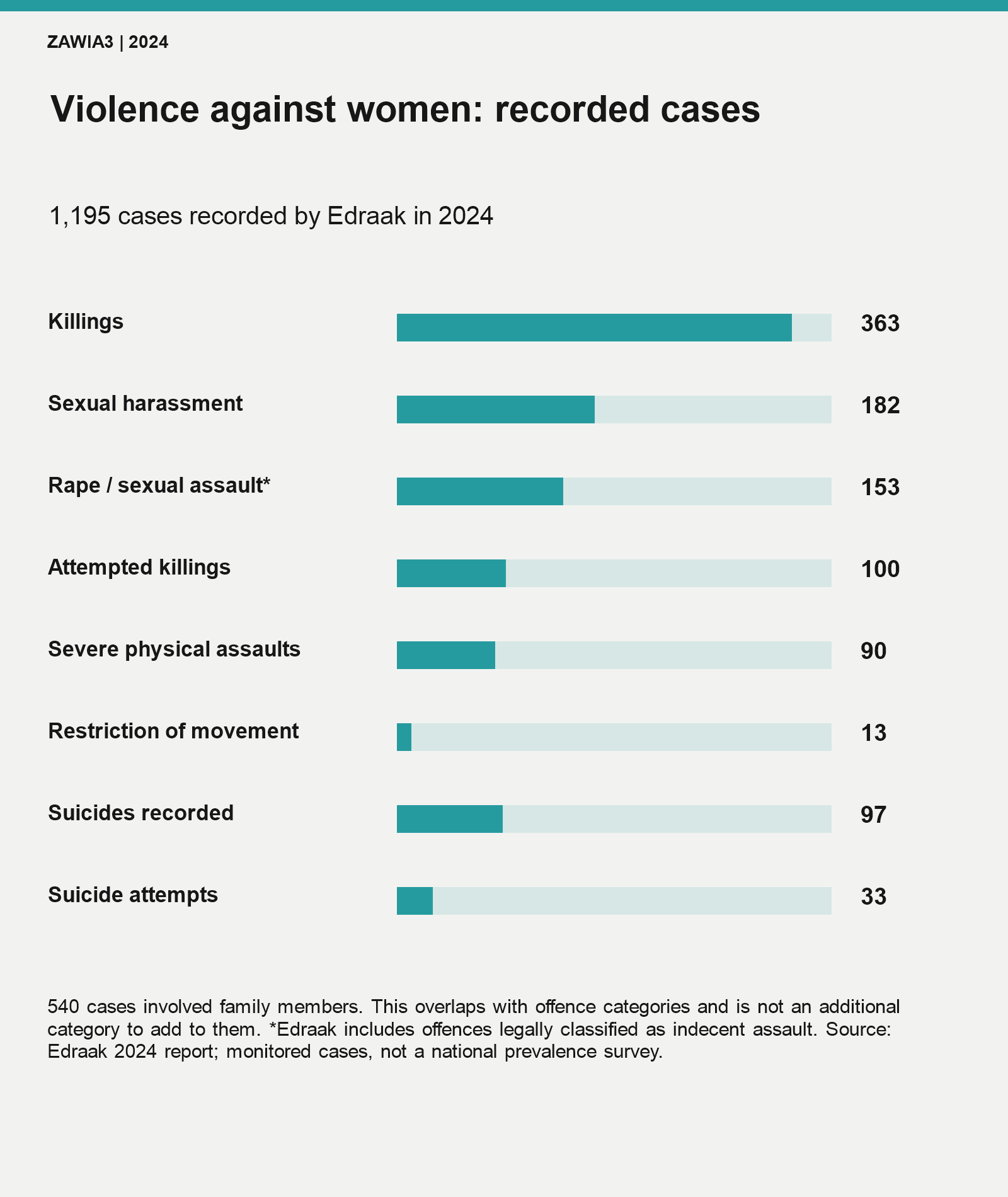
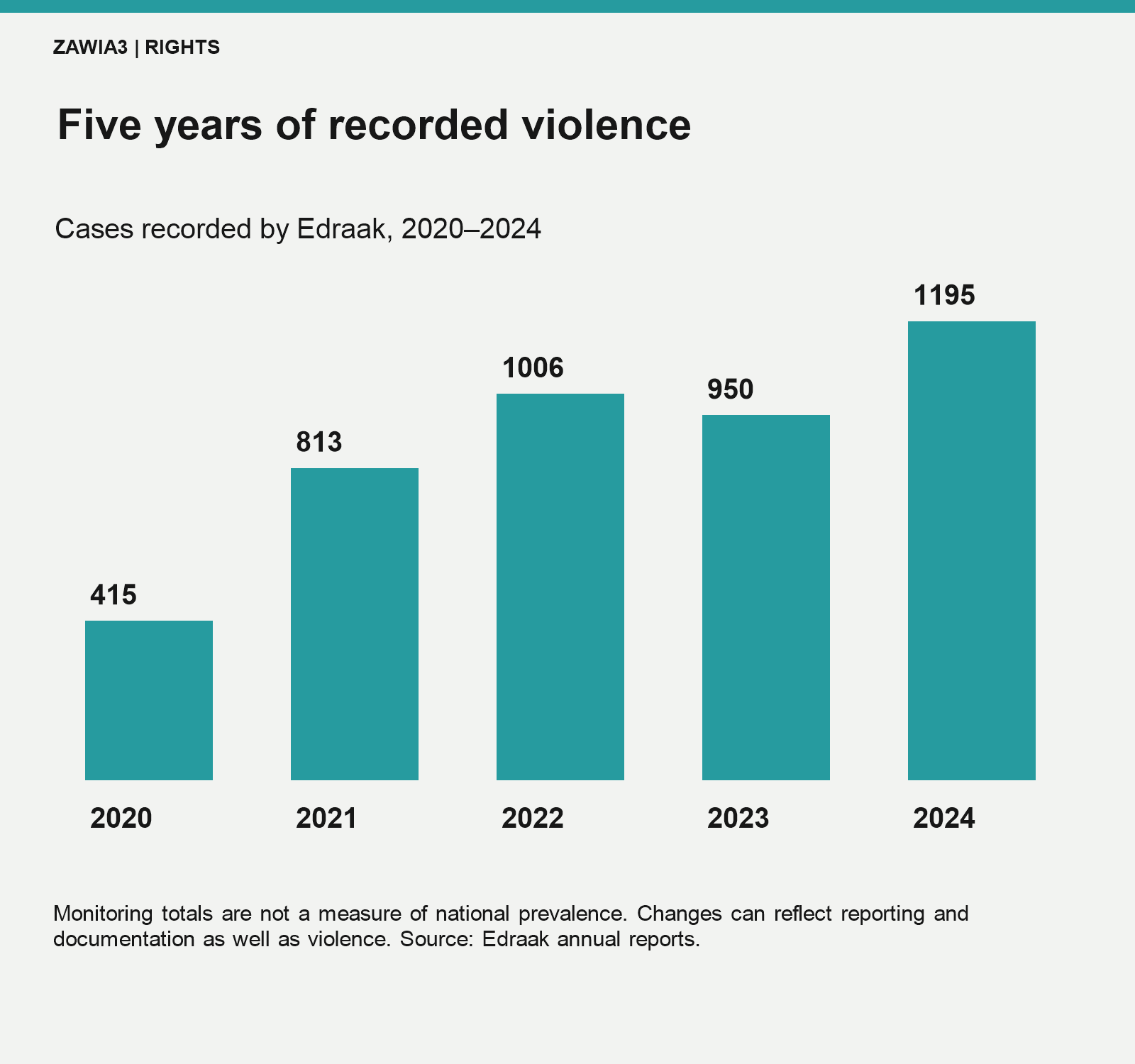
Edraak’s observatory documented 1,195 cases of violence against women and girls in 2024, the highest total in its five-year series. Behind the numbers lies a question: why do promises of empowerment coexist with persistent danger?
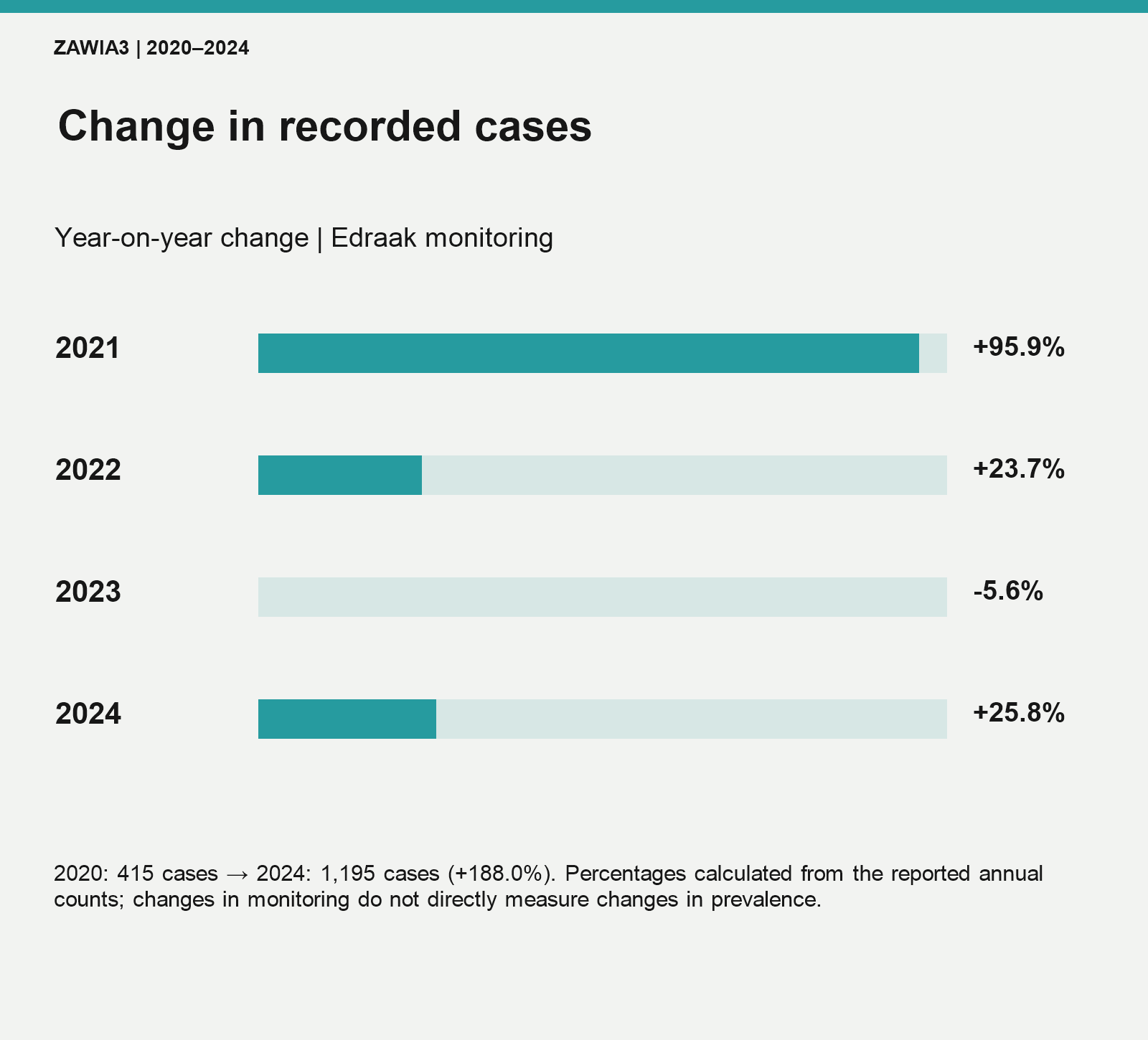
The annual counts rose from 415 in 2020 to 813 in 2021 and 1,006 in 2022, fell to 950 in 2023, then increased to 1,195 in 2024. Calculated from those totals, the changes were +95.9%, +23.7%, −5.6% and +25.8%, respectively. These are cases recorded by an observatory, not a comprehensive national crime count or a population survey; changes in reporting and documentation can also affect the series.
Edraak’s 2024 report recorded 540 cases involving family members. It listed 363 killings, 153 rape or sexual-assault cases, 182 cases of sexual harassment, 100 attempted killings, 90 severe physical assaults causing fractures or disabilities, and 13 restrictions on movement. The family-violence figure overlaps with offence categories and should not be added to them. Edraak’s rape category includes offences classified in Egyptian law as indecent assault.
The report also recorded 97 suicides and 33 suicide attempts among women. Such records underline concern about psychological harm, although a monitoring total alone cannot establish the cause of every death or attempt.
A public space shaped by male domination
Activists interviewed by Zawia3 argue that violence against women cannot be understood simply as isolated incidents. They connect it to cultural assumptions about authority, ownership and women’s place in society. They also point to the expanding “manosphere”: online networks hostile to women, including Telegram groups used for incitement, defamation and ridicule.
Mayar Makki, founder of the Barr Aman group, describes a global phenomenon whose Egyptian expression draws on a culture that legitimises violence. Treating women’s killings as unrelated individual events, she argues, obscures beliefs that husbands, fathers and other relatives are entitled to discipline women.
“In this culture, women’s bodies are not treated as their own property, but as public property subject to the authority of the family and society,” she says. Makki interprets public harassment primarily as an assertion of power: an attempt to tell women they have no right to be there. She says this behaviour crosses class and age boundaries.
Makki argues that perceived impunity encourages abuse. The absence of a comprehensive domestic-violence law, sympathy for aggressors and hostile treatment when women report offences can discourage survivors from seeking help.
Aya Mounir, founder of the Superwoman initiative, says rising violence affects women especially severely because they have less protection and fewer privileges. She links many attacks to a man’s refusal to accept rejection by a partner, wife or former fiancée. Saying “no”, she warns, can become dangerous.
“Harassment has never been purely about sexual desire; it is a form of control and hatred of women,” she tells Zawia3. Stalking and pursuit can escalate to killing, she says. Women pay substantial sums for private cars or ride-hailing services in search of safety, only to find that these options offer no guarantee.
Mounir calls for more than policing alone. She wants media messages that challenge violence, alongside patrols, lighting and surveillance on roads that lack basic safety infrastructure. Economic and social pressures matter, she says, but so does a backlash against women who increasingly understand their rights and refuse subordination. Greater media and rights-based scrutiny also makes previously hidden violence more visible.
A CAPMAS, UNFPA and National Council for Women study estimated that roughly eight million women experienced violence annually. The figure comes from the 2015 economic-cost survey and should not be presented as a fresh 2025 count. Likewise, the often-cited 99.3% harassment figure comes from a 2013 study supported by UN Women and describes the experiences reported by its respondents; it is not a current annual rate.
Gaps in legislation and enforcement
Gender specialist Mai Saleh identifies weak deterrence and a failure to rehabilitate potential offenders as important parts of the problem. Distorted ideas about freedom, guardianship and paternal authority, she says, encourage hatred and online incitement that can spill into physical and sexual attacks.
Women are frequently made an outlet for men’s anger over economic and social pressures, Saleh tells Zawia3, while a patriarchal culture excuses perpetrators and blames victims.
She criticises the use of Penal Code provisions to reduce punishment or justify violence, particularly Articles 17 and 60. Article 17 concerns judicial mitigation; Article 60 concerns acts committed in good faith in exercising a right recognised by law. Neither should be paraphrased as an unrestricted statutory right to beat women. Saleh’s criticism concerns interpretations and practices that she believes permit leniency.
She also objects to reconciliation or withdrawal of complaints in serious cases, arguing that these practices weaken women’s access to justice. In her assessment, inadequate databases and extensive underreporting make the scale difficult to measure. She estimates that no more than 10% of incidents are reported, but provides no survey basis for that figure in the interview. Those who report, she says, may encounter obstacles at police stations and prosecutors’ offices; procedural weaknesses can then prevent accountability.
Nora Mohamed, director of the anti-violence programme at the Center for Egyptian Women’s Legal Assistance, describes misogyny as hostility or violence directed at women because they are women. In Egypt, she says, it appears in practices discussed as discrimination, marginalisation and gender-based violence.
She lists forced marriage, child marriage, female genital mutilation and exclusion from education alongside domestic abuse, public harassment, sexual assault and online blackmail. The common element, in her analysis, is the humiliation and subordination of women.
Victim-blaming questions about clothes, location or the time a woman went out shift attention away from the offender, Mohamed says. Expressions such as “I am raising her properly” or “I am protecting her” can mask control. Safer education, confidence and skills for girls, safe streets and effective protection mechanisms all matter.
Living-cost pressures can push women into unsafe or exploitative work while they shoulder responsibility for family needs. Mohamed also links crowded public spaces and drug use to worsening risks. Despite hotlines, cameras and anti-violence units in some police stations, she sees limited implementation, too few female officers and insufficient psychological and social support.
She acknowledges stronger harassment penalties and electronic reporting channels, but calls for a unified law addressing violence against women. Cases currently fall across different laws and institutions, she argues. Legislation must be accompanied by cooperation between the state, civil society and national mechanisms, and by media coverage that challenges abuse.
Lawyer Entessar El Saeed, head of the Cairo Foundation for Development and Law, says violence is not new but has become more openly visible in streets and institutions. She traces the problem in part to childhood socialisation that treats women as having fewer rights, reinforced by education, drama and religious discourse.
She warns that economic and social pressures can intensify abuse when men direct anger at women and children. In her view, enforcement remains too dependent on publicity, while less visible cases receive inadequate attention and online incitement continues.
A unified law is necessary, El Saeed says, but insufficient on its own. Protection also requires shelters, legal and psychological support, public education and rehabilitation of offenders.
A widening gap between promises and outcomes
Egypt ranked 139th of 148 economies in the World Economic Forum’s 2025 Global Gender Gap Report, down from 135th of 146 in 2024. Its parity score was 62.5%, compared with a global score of 68.8%, placing it among the bottom ten economies covered.
The index compares women’s and men’s outcomes in economic participation, education, health and political empowerment. It does not measure violence directly. The 2025 analysis says Egypt’s economic score remained broadly unchanged as gains and losses across indicators offset one another. Reduced female ministerial representation was a principal driver of the overall decline: the political score fell from 17.6% to 15.7%.
The report also cautions against interpreting every improvement in parity as an improvement in living conditions. Egypt’s literacy and healthy-life-expectancy ratios improved partly because male outcomes deteriorated more than female outcomes. The figures nevertheless point to substantial economic and political exclusion.
Lobna Darwish, women’s rights programme director at the Egyptian Initiative for Personal Rights, argues that deteriorating conditions reflect policies designed for publicity rather than substantive reform. International findings, she says, contradict official celebrations of women’s achievements.
Instead of changing everyday conditions, she argues, authorities prioritise statements intended to win international approval. Strategies often lack sound evidence, monitoring and evaluation, and are replaced without reviewing their results. “What matters is holding the strategy’s launch celebration, regardless of its effectiveness or impact,” she says.
Darwish objects to treating women’s rights as a secondary file rather than a core element of economic and social planning. She says investment decisions can favour sectors that exclude women or create unsuitable jobs, even as officials question low female labour-force participation.
She also challenges the presentation of entrepreneurship as a universal solution. In her view, that approach lacks rigorous evaluation and avoids structural barriers, including discrimination and unfair working conditions in both public and private employment.
Some discrimination originates in state practice itself, Darwish argues, citing travel restrictions affecting poorer women and employment discrimination based on appearance, weight or reproductive status. She contrasts this with the treatment of men and says policy serves an image rather than women’s lives.
“I am not concerned with making the picture look better,” Darwish says. “What matters to me is the reality of women and girls in Egypt.” She describes worsening conditions without a serious response as a double danger.
Mona Ezzat, an economic and social rights researcher and chair of Al Noon Foundation for Family Care, sees the ranking as evidence of persistent structural problems. Falling four places is particularly troubling, she says, when the starting position was already near the bottom.
Economic and political empowerment concern women’s participation in work, unions, parliament and parties. Ezzat argues that strategies and legal amendments have produced little practical impact. “We already have good legislative provisions, but implementation is weak or absent,” she says.
She cites Labour Law 12 of 2003’s prohibition of sex-based wage discrimination, contrasting it with a private-sector pay gap of 17.7% reported in CAPMAS figures she references. The interview does not specify the statistical year or measure underlying that percentage; it should not be read as a verified current like-for-like pay comparison.
More women in parliament or cabinet does not necessarily mean substantive empowerment, she adds. Quotas alone do not ensure political, social or geographic diversity, or equal access to candidacy and leadership within parties and unions. “Empowerment is not just about numbers, but about a political environment that allows free and fair participation.”
The long absence of elected local councils also excludes women from grassroots political opportunities, Ezzat argues. She shares Darwish’s concerns about relying on entrepreneurship without addressing labour-market discrimination. For her, the central failure is the distance between policy on paper and implementation.
Nevine Ebeid, chair of the New Woman Foundation, describes the report as part of a longer pattern of neglect. Its four dimensions could guide meaningful action, she says, if addressed systematically rather than through official rhetoric.
Poverty includes exclusion from education, health care and secure housing, not only low income, Ebeid stresses. Women in informal work, including agricultural labour and market vending, often lack contracts and effective social protection. Domestic workers remain particularly exposed.
She calls attention to delayed legislation on violence against women, domestic work and personal status, alongside the need for a gender perspective in criminal procedure, medical liability and tenancy law. Even social-protection programmes, she argues, do not adequately account for women’s heightened vulnerability to deprivation.
Ebeid also connects pressure on independent unions to the weakening of grassroots feminist organising, particularly in informal sectors. Without meaningful representation, women’s concerns disappear from social and political priorities.
Although Egypt is not a direct belligerent in the regional conflicts she discusses, Ebeid describes its situation as a fragile “negative peace”, with regional and international policies imposing costs on women who have no role in making them. She urges civil society, feminist groups and researchers to develop independent critiques, press for missing laws and offer transparent alternatives to official assessments.
Protection delayed for years
Magda Adly, co-founder of the El Nadeem Center for Rehabilitation of Victims of Violence and Torture, recalls that proposals addressing violence within the family were submitted from 2009. A late-2010 proposal from El Nadeem drew support from more than a hundred Egyptian organisations, as well as Arab organisations, she says. After the revolution, proposals stalled and were submitted again alongside initiatives addressing harassment.
Adly acknowledges progress in defining and penalising sexual harassment in public. Negotiations with institutions including the Justice Ministry, Al Azhar, prosecutors and police changed the proposed text, and disagreement persisted on issues such as the definition of rape. Nonetheless, she considers the resulting legislation a step forward.
Domestic-violence legislation remained more difficult. Even a post-revolution government containing figures activists trusted said it could not pass such a law, she recalls. Arguments about religious authority, male guardianship and contested interpretations were invoked against it.
Adly cites abductions, sexual attacks on children and repeated killings of young women after rejected marriage proposals as signs of profound insecurity. Her interview also invoked a supposed global harassment ranking for Egypt, but no comparable worldwide ranking was established; the survey percentages frequently cited on this issue do not support that claim.
She connects individual conduct to public messages from politicians, media and religious discourse that assign men superior status and leadership roles while confining women to cooking, cleaning and childcare. Drama can normalise violence or harassment, she argues, precisely because its influence is absorbed in everyday life.
Violence can leave lasting trauma, post-traumatic stress and shattered confidence. Recovery may take years and becomes especially difficult if a survivor remains in the abusive environment without somewhere safe to go. Government shelters exist, Adly says, but are limited and difficult to access.
Adly calls for laws that recognise women as fully autonomous people, substantive rights training for law-enforcement agencies, and a thorough review of educational, media and religious messages that reproduce violence.
Challenging a culture that excuses abuse
Political sociologist Saeed Sadek describes violence ranging from domestic abuse and marital rape to street harassment. In his view, patriarchal norms make it easier for witnesses to remain silent or collude, while shopkeepers and security personnel often fail to intervene.
He says women in public are treated as targets for unwanted attention and pursuit. He connects insecurity to impunity and what he sees as the retreat of effective anti-harassment policing. His comparison with policing in the 1950s and 1960s is a historical assessment offered in the interview, not a documented comparison of enforcement levels.
Sadek calls for immediate deterrence, including undercover policing in high-risk locations, effective penalties and action against vehicles used in harassment, alongside longer-term reform of education, media and religious discourse. These are his policy proposals, not a description of penalties automatically available in every case.
Punishment alone will not overcome victim-blaming and pressure for informal reconciliation, he adds. Nor does he accept poverty as an adequate explanation: the problem is rooted in a culture of contempt for women, not simply economic crisis.
He sees a double standard when women are punished socially for dancing or using TikTok while serious misconduct by men is excused. Preference for sons, opposition to women’s employment and killings linked to divorce requests are, in his analysis, different expressions of the same hierarchy.
Sarah El Naggar, a mental-health and family-medicine specialist who writes on women and children, offers a somewhat different interpretation. She emphasises disregard for women and the assumption that they are easy targets, rather than attributing every attack to conscious hatred of women.
Offenders may have no prior connection with the victim, she says, but expect her to avoid confrontation or reporting for fear of disbelief and public blame. El Naggar does not see every act of street harassment as an attempt to force women home; she argues that some aggressors seek opportunities to dominate women in public and gain a false sense of power.
Someone who attacks women may also act aggressively towards children or animals, she adds. This is her interpretation of patterns of behaviour, not a clinical diagnosis of the perpetrators discussed in the report.
Harassment and vehicle pursuits long predate social media, El Naggar says. What has changed is the extent to which recordings circulate, making incidents visible that might once have remained unknown. She calls for public awareness, effective family oversight and consistent enforcement.
Across their different explanations, the interviewees identify a recurring gap: women are told they have rights, but face obstacles when trying to exercise them safely. They argue that a unified law must be accompanied by prevention, support for survivors, accountable institutions and a sustained challenge to the norms that excuse abuse.