


A wave of annulments has pushed Egypt’s parliamentary election into a debate about the legitimacy of the next House of Representatives. After the National Elections Authority (NEA) cancelled the results in 19 individual-seat constituencies on 18 November 2025, the Supreme Administrative Court issued further annulment rulings on 29 November.
Contemporary coverage cited in this report put the additional constituencies at 29, bringing the reported total to 48 out of the 70 individual-seat constituencies in the first phase, across 14 governorates. That calculation is approximately 68.6%, often described as “nearly 70%”. It concerns first-phase individual-seat constituencies, rather than 70% of the national election or of parliamentary seats. Contemporary accounts differed over the court-annulment count; the reported aggregate should not be treated as a final official tally.
Observers interviewed by Zawia3 say the widening geographical reach of the annulments has placed the process under exceptional pressure. They point to the effects across Upper Egypt and to additional challenges in Giza, Alexandria, Beheira, Fayoum and Minya. Their assessments of political legitimacy differ sharply from the view that reruns can restore confidence in the election.
The controversy began with voting on 10 and 11 November 2025, amid complaints of manipulation, vote-buying and pressure on voters. On 17 November, President Abdel Fattah al-Sisi called for close examination of reported incidents and for partial or complete cancellation where voters’ true wishes could not be established. He subsequently described his intervention as a veto against practices of which he disapproved.
During the second phase, the Interior Ministry reported arrests connected with alleged vote-buying and interference in the election. Those announcements intensified concerns about repeated violations; they do not, by themselves, establish that every constituency was affected by fraud.
On 30 November, the NEA announced that preparations were complete for the first-round rerun in the 19 constituencies it had annulled. Voting abroad was scheduled for 1 and 2 December, followed by voting inside Egypt on 3 and 4 December 2025, under its 18 November decision. This timetable was separate from arrangements for constituencies affected by the subsequent court judgments.
Did the election authority fail to manage the process?
Amr Hashem Rabie, deputy director of the Al-Ahram Center for Political and Strategic Studies, describes the election as one of the most difficult electoral moments in Egypt’s recent history. He says the scale of annulments puts the next parliament’s legitimacy under severe strain. At a minimum, he argues, voting must be repeated in every constituency whose result was invalidated. His preferred solution is a nationwide rerun under a different electoral system, because he believes the present system has demonstrated its limitations.
Rabie holds the NEA primarily responsible for the disorder. He cites failures to ensure candidates received vote-count records and what he describes as an inability to constrain parties backed by security agencies, drawing a comparison with elections managed by the Interior Ministry under Hosni Mubarak.
Speaking to Zawia3, he argues that the authority is repeating earlier mistakes by maintaining an election with little meaningful competition, particularly in the list races. In his assessment, real competition is confined to half of the elected seats, while the shortcomings give the Muslim Brotherhood material with which to challenge the process abroad.
He interprets Sisi’s intervention as an attempt to halt a slide towards the practices associated with the 2010 election. He compares its political significance with changes to the list system during Mubarak’s presidency in 1984. These are Rabie’s historical and political assessments.
Rabie also alleges that places on absolute closed lists are openly traded, with some party figures presenting large payments as contributions to the party. He asks how a candidate who has paid tens of millions can represent constituents honestly, or how such a route can support normal party competition.
He sees declining candidate numbers, compared with earlier elections in 2000, 2005, 2010 and 2020, as evidence of diminishing public confidence in parliament’s ability to address economic and social problems. He is also concerned about the inheritance of seats within families and about inexperienced replacements assuming seats through list arrangements.
In his account, electoral money is used extensively, including spending outside declared campaign accounts and distributions of cash or basic goods. He says presidential warnings over street campaigning followed inadequate oversight by the authority.
Rabie warns that a parliament formed without credible reruns in the annulled constituencies would lack a convincing basis of legitimacy. He argues that an institution associated with cheating, deception or vote-buying cannot credibly shoulder constitutional change or the demands of the next political period. He calls for a proportional closed-list system, which he believes would revive party life, constrain electoral money and broaden representation.
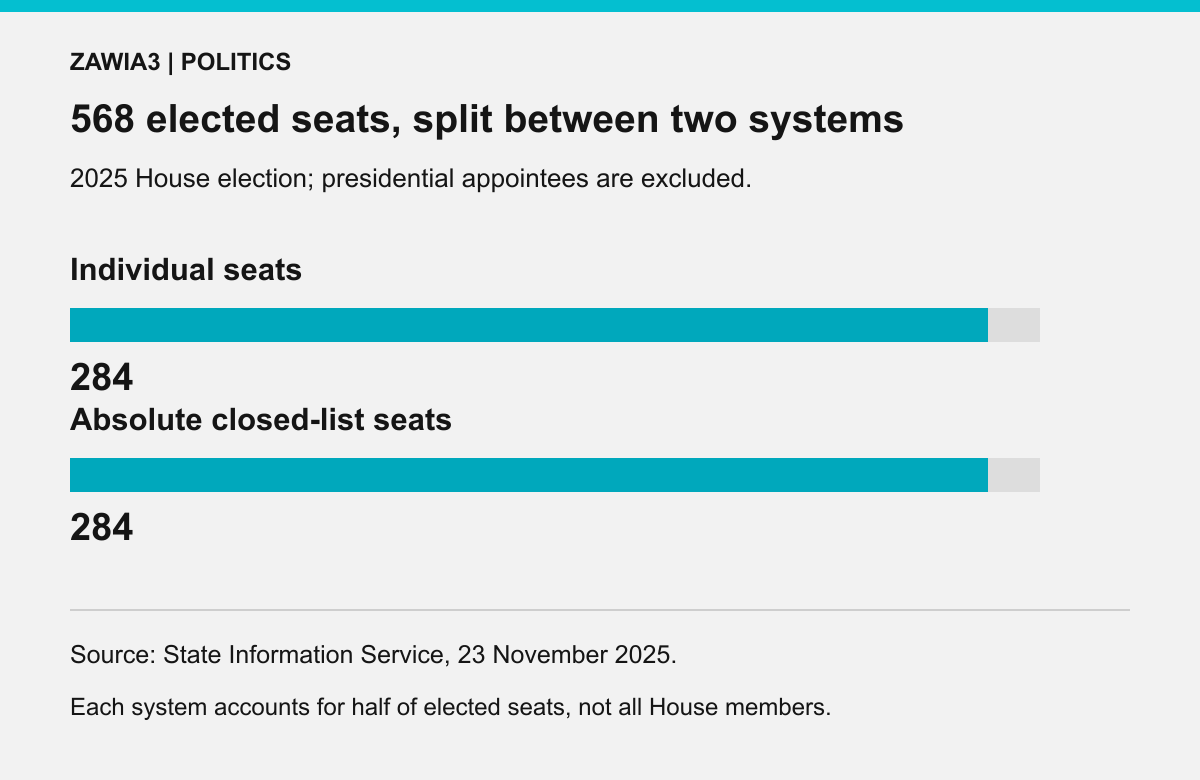
The election allocates 568 elected seats equally between individual contests and absolute closed lists: 284 in each system. Presidential appointees are additional to that elected total. The National List for Egypt, an alliance of 12 parties, is the only competing list across the list constituencies. A sole list is not automatically elected merely because it has no competitor: the legal threshold is votes equal to at least 5% of registered voters in the relevant list constituency, rather than 5% of ballots cast.
What do the court rulings require?
Legal expert Adel Amer, head of the Egyptian Center for Legal and Political Studies, says the annulments mark a significant change in the electoral landscape and create difficult questions about the formation and legitimacy of the next parliament. The NEA’s earlier cancellation in 19 constituencies must be distinguished from the subsequent judicial rulings: they were not all invalidated by a single judgment.
Amer tells Zawia3 that results affected by an annulment cannot simply be treated as valid while the required corrective procedures remain outstanding. In his view, the most likely outcome is a rerun in the affected constituencies, with the House’s composition completed afterwards. He distinguishes the political controversy over legitimacy from the legal conditions governing the institution’s formation.
Annulment does not automatically require constituency boundaries to be redrawn. The corrective action depends on the terms of the judgment and on the applicable election law. Changing electoral boundaries is a separate legal question from repeating a defective vote.
Asked about a nationwide rerun, Amer considers it unlikely because of its political and financial costs. He says it would become a more plausible option if the defects were shown to affect the process as a whole. Repeating an election, however, cannot guarantee that its results will be immune from all subsequent legal challenges.
A further distinction matters when discussing appeals or requests to suspend enforcement. The decisions at issue were issued by the Supreme Administrative Court itself, rather than by a lower administrative court awaiting an ordinary appeal to that court. A final ruling requiring a rerun must be implemented; a hypothetical appeal cannot be presented as an automatic route to preserving an annulled result.
Amer warns that proceeding without implementing a binding final judgment could put the parliament in a legal and political predicament. Any challenge to its composition would still require the appropriate legal grounds, procedure and competent court; invalidation of the whole House is not an automatic consequence of an annulled constituency result.
Legal validity and political legitimacy
Human rights lawyer Halim Heneish argues that the coming parliament has already lost the political legitimacy the authorities hoped to obtain. He attributes this to what he describes as deliberate engineering of the election, through both the list system and the design of individual-seat constituencies.
First, he says the list arrangements accommodate parties loyal to the authorities, including established parties such as Wafd and Tagammu, while shutting out meaningful competition from opposition parties and independents. He alleges that the authorities and security agencies effectively chose the representatives for the list seats in advance. This is his assessment of the process, rather than a judicial finding about every list candidate.
Second, Heneish argues that the large size of individual-seat constituencies weakens the ability of opposition and independent candidates to compete, favouring wealthy candidates associated with the authorities who can sustain expensive campaigns.
He believes the authorities expected these candidates to generate enough participation to confer electoral legitimacy, but says that expectation was not fulfilled. In his interpretation, competition between state-aligned candidates helped bring the reported abuses to the president’s attention.
Heneish maintains that the second phase reproduced and intensified the problems of the first, and that formal legal validity cannot resolve the wider political question. He also alleges that people reporting violations can themselves face detention, referring to a Conservatives Party candidate and Monica Magdy among the cases he invokes. These allegations are attributed to him.
He sees the court rulings and what he describes as weak turnout as further evidence of a legitimacy deficit. With discussion of possible constitutional changes, he argues that the parliament could become a burden on the authorities’ effort to demonstrate popular support. His preferred solution is to repeat the entire election.
Can reruns restore confidence?
Political and legal adviser Mahmoud al-Rouby offers a different interpretation. He sees the presidential intervention, the NEA’s cancellations and the court rulings as evidence of the state’s determination to protect the electoral process and of the judiciary’s role in defending voters’ wishes.
He believes the most likely scenario is an urgent timetable for reruns in the affected constituencies, combined with stronger monitoring and safeguards against the violations that prompted annulment. In his view, credible reruns would strengthen the legal and electoral basis of the next House.
Al-Rouby nevertheless recognises substantial logistical and scheduling pressures. A large number of reruns could extend the electoral timetable, and he warns of representation problems if the House were to convene before voting was completed in all the necessary constituencies.
He says the scale of the cancellations may persuade some political forces that the problem is structural, rather than confined to isolated procedural defects. They may press for tighter controls on political finance, different constituency boundaries or a replacement for the present electoral system. He considers immediate comprehensive reform difficult because of the timing and the intersecting political and constitutional issues.
Another possible response, he says, is to strengthen protections during reruns and subsequent rounds: closer oversight of campaigning, political money and compliance with electoral rules could reduce the risk of a prolonged representation crisis.
Al-Rouby argues that reruns conducted under judicial supervision and NEA oversight would give the completed parliament a stronger legal foundation. That is his assessment of the safeguards; it does not remove candidates’ statutory rights to challenge an election result.
He also sees public participation as essential to improving the process. He believes weak turnout creates greater room for abuses and calls for broader political and legal awareness of parliament’s everyday roles in legislation, oversight and public services.
For him, the president’s rejection of violations and the courts’ intervention demonstrate institutional seriousness. He says citizens must now participate and choose representatives in ways that rebuild confidence in parliamentary politics.
A conflict larger than parliament
Akram Ismail, a founding member of the Bread and Freedom Party, which is under establishment, sees the widening annulments as evidence of deep problems within Egypt’s electoral and political system. He argues that parliamentary legitimacy has historically been shaped more by conflicts between parts of the ruling system than by popular consent, and sees the present crisis as another example.
“There is a major conflict within the system,” Ismail says, arguing that these disagreements directly affect the ability of the bodies responsible for elections to manage the process coherently.
In his view, the next parliament would have limited influence even if the election continues, because the political struggle revealed by the crisis is larger than the institution itself. He points to what he sees as tensions between institutions involved in the election, including the NEA and the administrative courts.
He says those tensions expose weaknesses in political management and raise legitimate questions about the authorities’ ability to complete a credible election. Any assessment of the next House, he argues, therefore requires a broader understanding of the conflicts within the state.
The violations behind the authority’s initial cancellations
On 18 November 2025, NEA chairman Hazem Badawy announced the cancellation of the individual-seat vote in 19 first-phase constituencies. The authority identified serious defects affecting voting and counting, including campaigning outside polling stations, failure to give candidates or their representatives copies of vote-count records, and discrepancies between figures recorded by subcommittees and general committees.
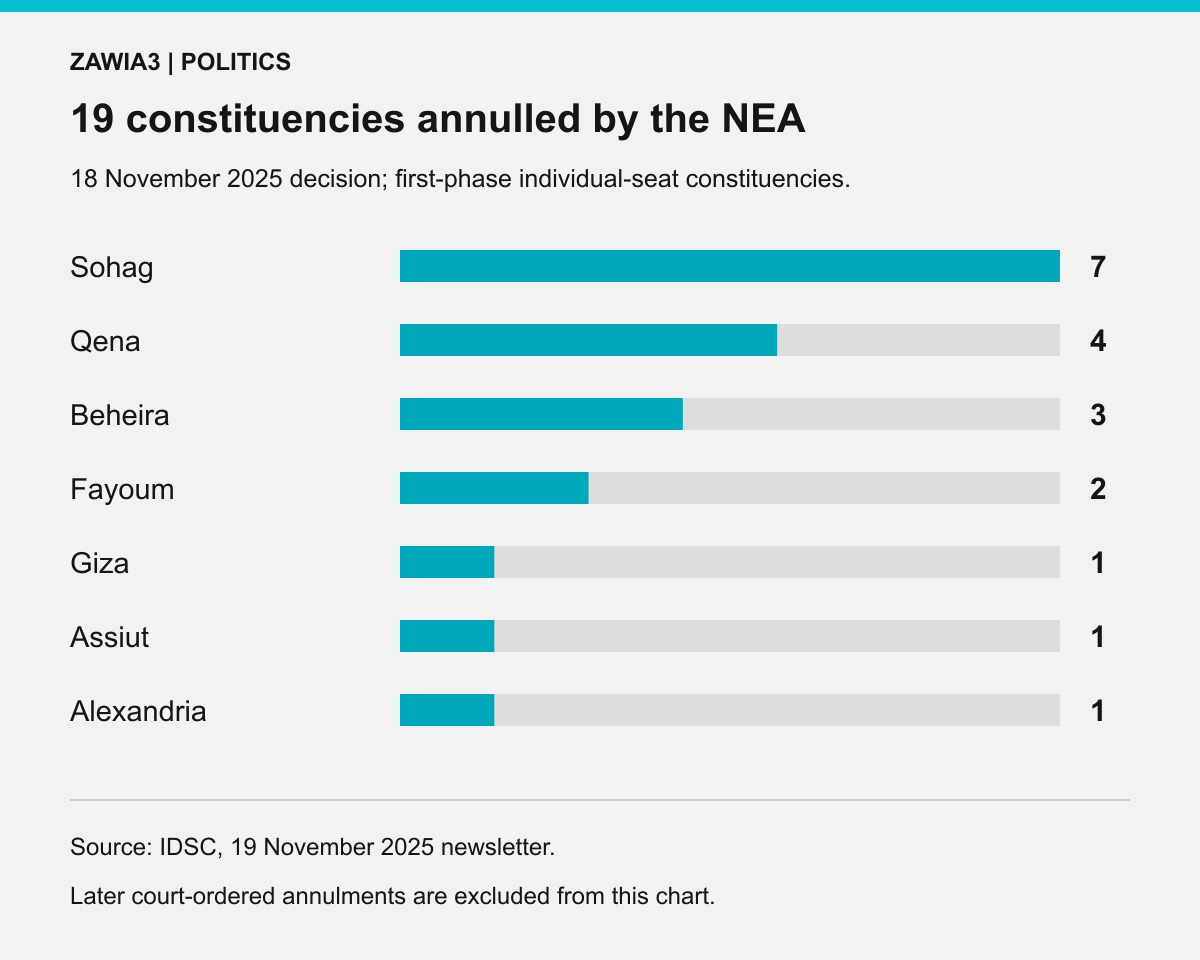
The 19 constituencies were distributed across seven governorates: seven in Sohag, four in Qena, three in Beheira, two in Fayoum, and one each in Giza, Assiut and Alexandria. The decision was based on Article 54 of the Law on the Exercise of Political Rights.
At that stage, NEA executive director Ahmed Bandari said the authority had not identified financial bribery by a candidate, while investigations into the recorded violations were continuing. That statement about the authority’s findings at a particular time is distinct from later Interior Ministry announcements about suspected vote-buying.
Imbaba in Giza was among the constituencies affected. Former MP Nashwa al-Deeb had withdrawn shortly after voting began, alleging that the contest lacked fairness and had been effectively decided in favour of a candidate backed by security agencies.
In Alexandria’s Montazah constituency, Reform and Renaissance Party candidate Ahmed Fathi Abdel Karim appealed to the president after alleging that ballot boxes at Mostafa Mosharafa School had been opened and emptied before counting. The claim circulated with video on social media; it is a candidate’s allegation, rather than an independently established finding in this report.
The political dispute goes beyond the logistics of another vote. Rabie and Heneish call for fundamental electoral reform or a nationwide rerun, Amer focuses on the legal consequences of annulment, al-Rouby sees targeted reruns as a means of restoring confidence, and Ismail interprets the crisis through conflicts within the ruling system.
The immediate task is to implement binding decisions and complete lawful elections in the affected constituencies. Whether that will also restore public trust in parliament remains the central political question raised by the interviewees.