

Outside a small kiosk in Dokki, Giza, Mohamed El-Saady sits watching the street opposite a school where he once regularly saw election-day queues. Asked about the next parliament, the man in his sixties shakes his head: “I do not know the previous MPs, and I do not feel they represent us. I will not take part.”
His response reflects a wider crisis of confidence in Egypt’s representative institutions. Official turnout figures and interviews point to disengagement, while political parties prepare for another parliamentary contest.
Official figures put turnout in the August 2025 Senate elections at approximately 17.1 per cent: around 11.8 million voters out of more than 69 million registered. Valid ballots accounted for about 95.6 per cent of votes cast. Politicians interviewed by Zawia3 dispute the turnout figure, with some estimating actual participation at only three to four per cent. Their estimates are not independently verified counts. They also allege political spending and pressure on students and employees to vote.
Research links disengagement, especially among young Egyptians, to overlapping political, economic and social factors: marginalisation, weak avenues for meaningful participation, pressure to earn a living, fragile parties and distrust of institutions. Analysts also question whether the re-established Senate has persuaded the public of its relevance.
Zawia3 conducted an exploratory survey described as covering 200 people from different governorates to examine attitudes towards the forthcoming House of Representatives elections. Its findings capture the respondents’ views, not a representative estimate of all Egyptian voters. The published material does not provide sufficient sampling information to support national projections.
Who intends to vote?
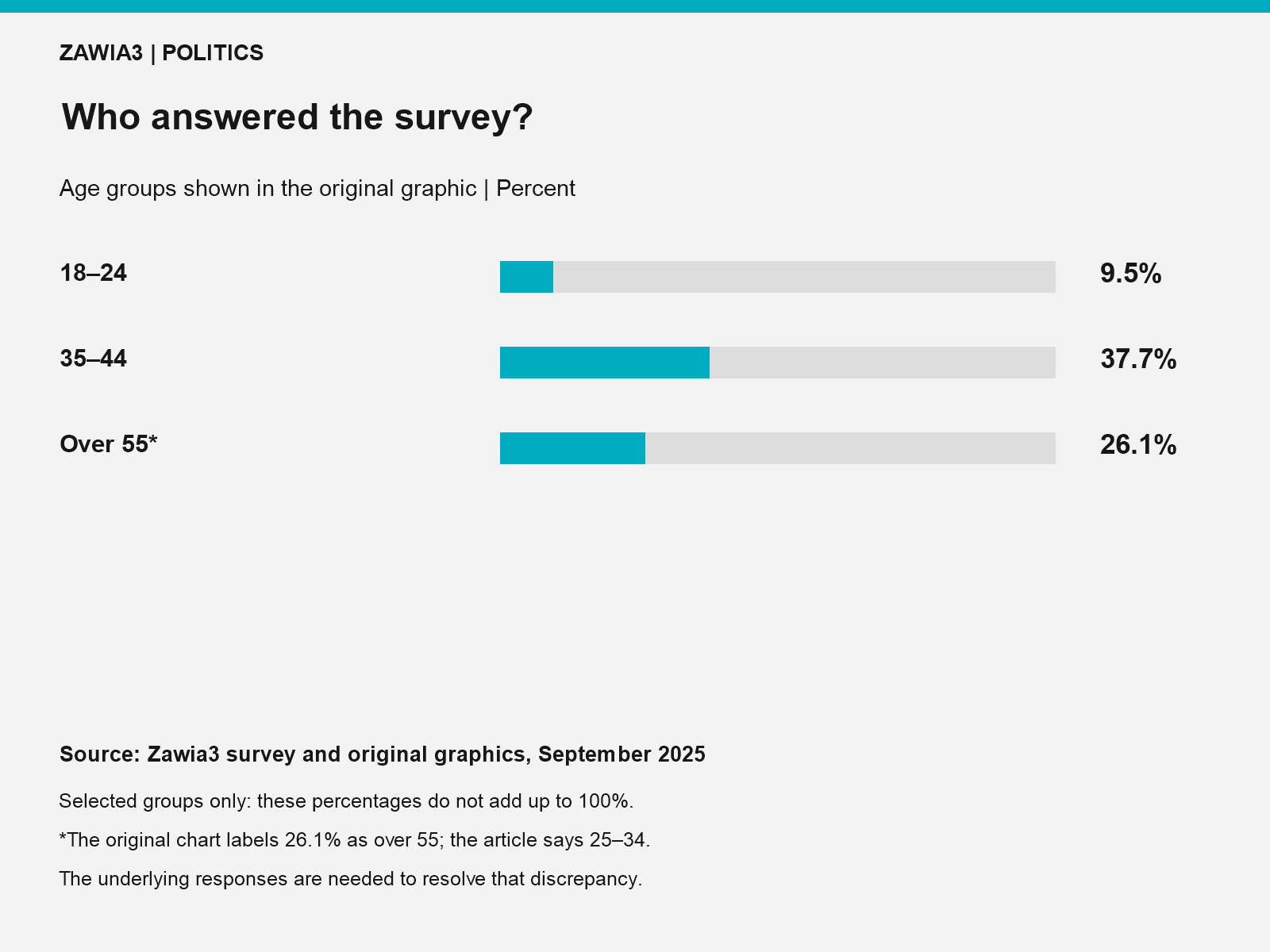
Respondents aged 35–44 formed the largest reported age group, at 37.7 per cent, while those aged 18–24 accounted for 9.5 per cent. The source contains an unresolved discrepancy: the text assigns 26.1 per cent to ages 25–34, but the original graphic labels that share “over 55”. The graphic below preserves its label and flags the difference; resolving it requires the underlying responses.
Men accounted for 56.1 per cent and women for approximately 44 per cent. Around 78 per cent had university or postgraduate education, while 22 per cent had secondary education or less. Self-employed respondents represented 34.7 per cent, private-sector employees 26.5 per cent and unemployed respondents 16.8 per cent.
These figures describe the sample rather than establish its representativeness. The concentration of highly educated respondents raises particular questions about the coverage of less-educated and rural populations.
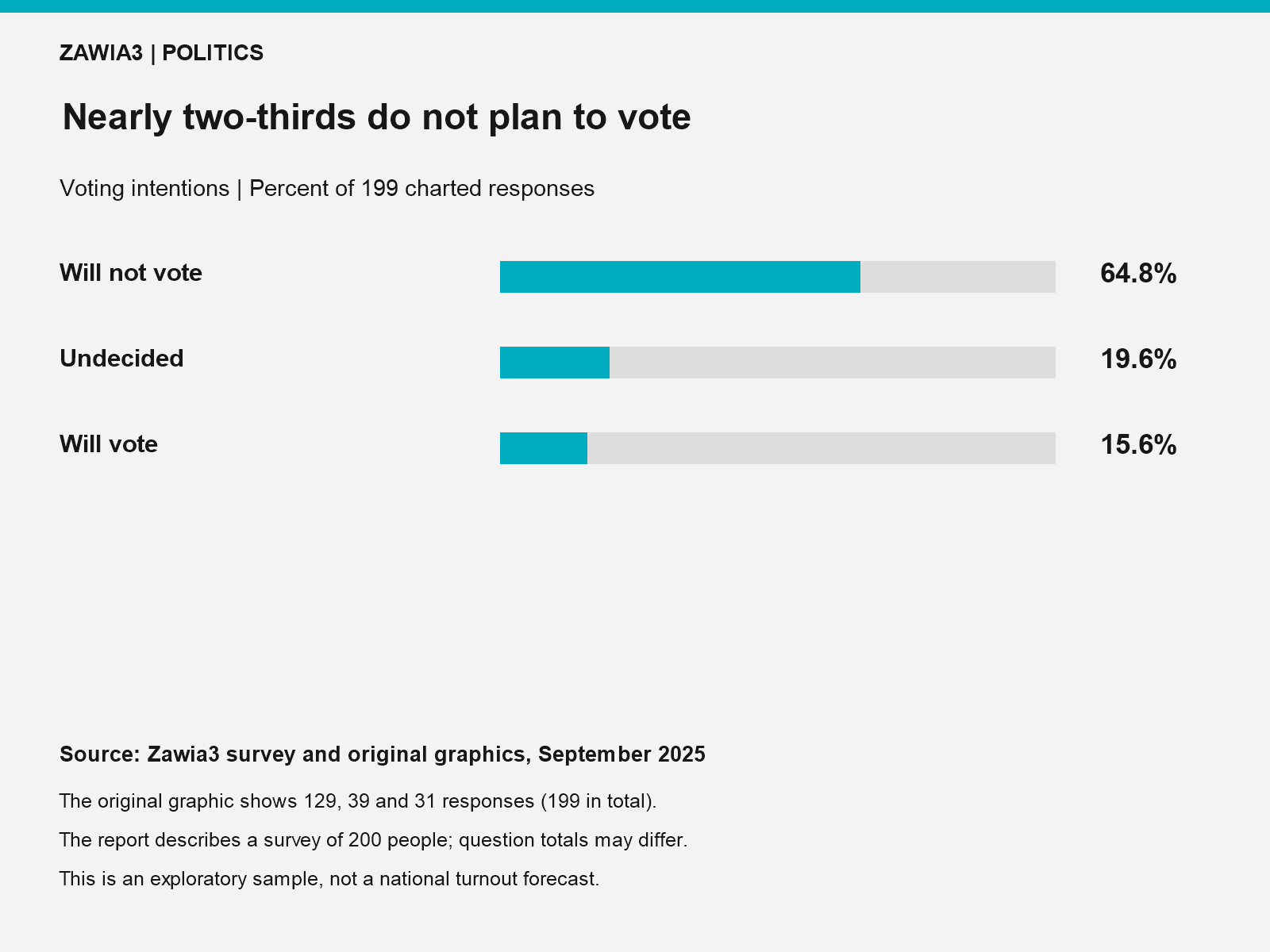
64.8 per cent said they would not vote, 15.6 per cent intended to participate and 19.6 per cent were undecided.
The original voting-intention graphic contains 129, 31 and 39 responses respectively, totalling 199 rather than the 200 people described in the report. The undecided group should not be counted as certain abstainers, and the results are not a national turnout forecast.
Separately, 18.2 per cent reported previously encountering pressure or coercion to vote. Accounts included threats of fines of EGP 200–600, security pressure, electoral inducements and organised mobilisation of students and workers.
Talaat Khalil, general coordinator of the Civil Democratic Movement and a member of the Conservatives Party’s presidential council, tells Zawia3 that public anger reflects both the composition and performance of the outgoing parliament.
He argues that winner-takes-all closed lists allow money to shape candidate selection and bring in figures disconnected from political work and everyday concerns. Citizens, he says, are not merely reluctant to vote but resent the process itself.
Khalil says the National Dialogue called for electoral-system reform, but no alternative satisfying voters was adopted. He criticises legislation passed during the outgoing term, including the old-rent law, as detrimental to ordinary people. Nevertheless, he considers peaceful participation the only route to change, explaining why opposition groups have chosen to compete for individual seats.
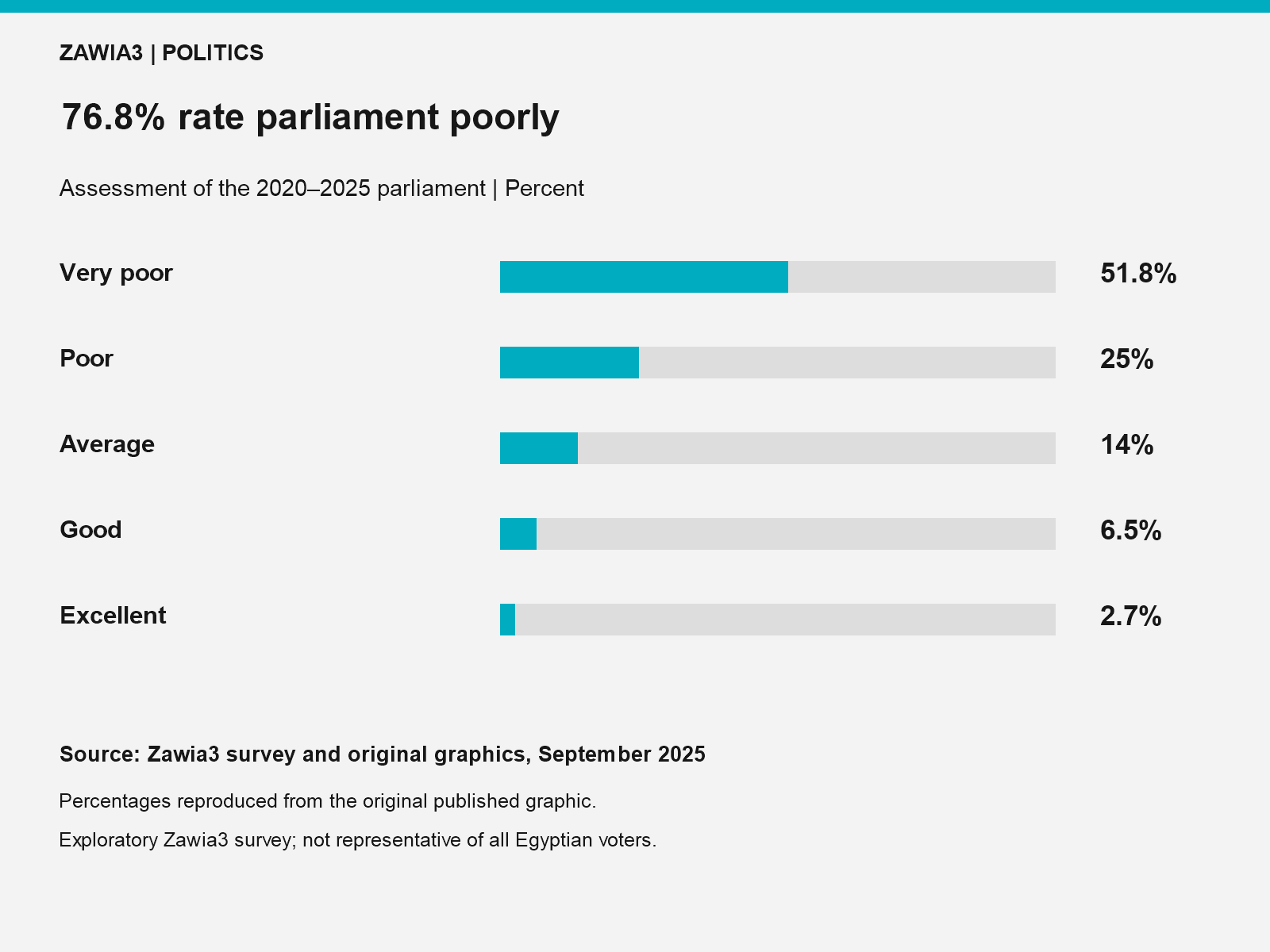
In the survey, 51.8 per cent rated the 2020–2025 parliament’s performance “very poor” and 25 per cent “poor”: a combined 76.8 per cent of respondents. Only 28.1 per cent said they had voted in the preceding elections, while 71.9 per cent had not.
Economist Elhami El-Merghani, deputy leader of the Socialist Popular Alliance Party, says closed lists and security influence over candidates and the process leave citizens feeling elections are staged rather than genuinely competitive. In his view, the greater danger is losing hope in peaceful democratic change through the ballot box.
He links declining participation to restrictions on parties and control of the media, and worries that the forthcoming contest could resemble the alienation surrounding the 2010 parliament. He also criticises unequal constituency boundaries and the financial burden of candidacy, arguing that the system excludes people with limited means.
Tayseer Fahmy, head of the Equality and Development Party, similarly describes very weak public engagement with the recent Senate elections. She says spending power and family or tribal support increasingly matter more than political programmes.
“Money has become central to the electoral process. Whoever has the greatest financial capacity has the best chance of winning. Parliament no longer largely expresses the concerns of the ordinary person.”
Fahmy questions the political experience of some elected figures, including a restaurant owner, and says candidates sometimes seek a parliamentary status symbol rather than a legislative role.
Most people, she argues, neither know the election date nor trust the process. Politics nevertheless shapes everything from household food costs to fuel prices. Her criticism is therefore about lost confidence, not the irrelevance of politics to daily life.
Why do respondents stay away?
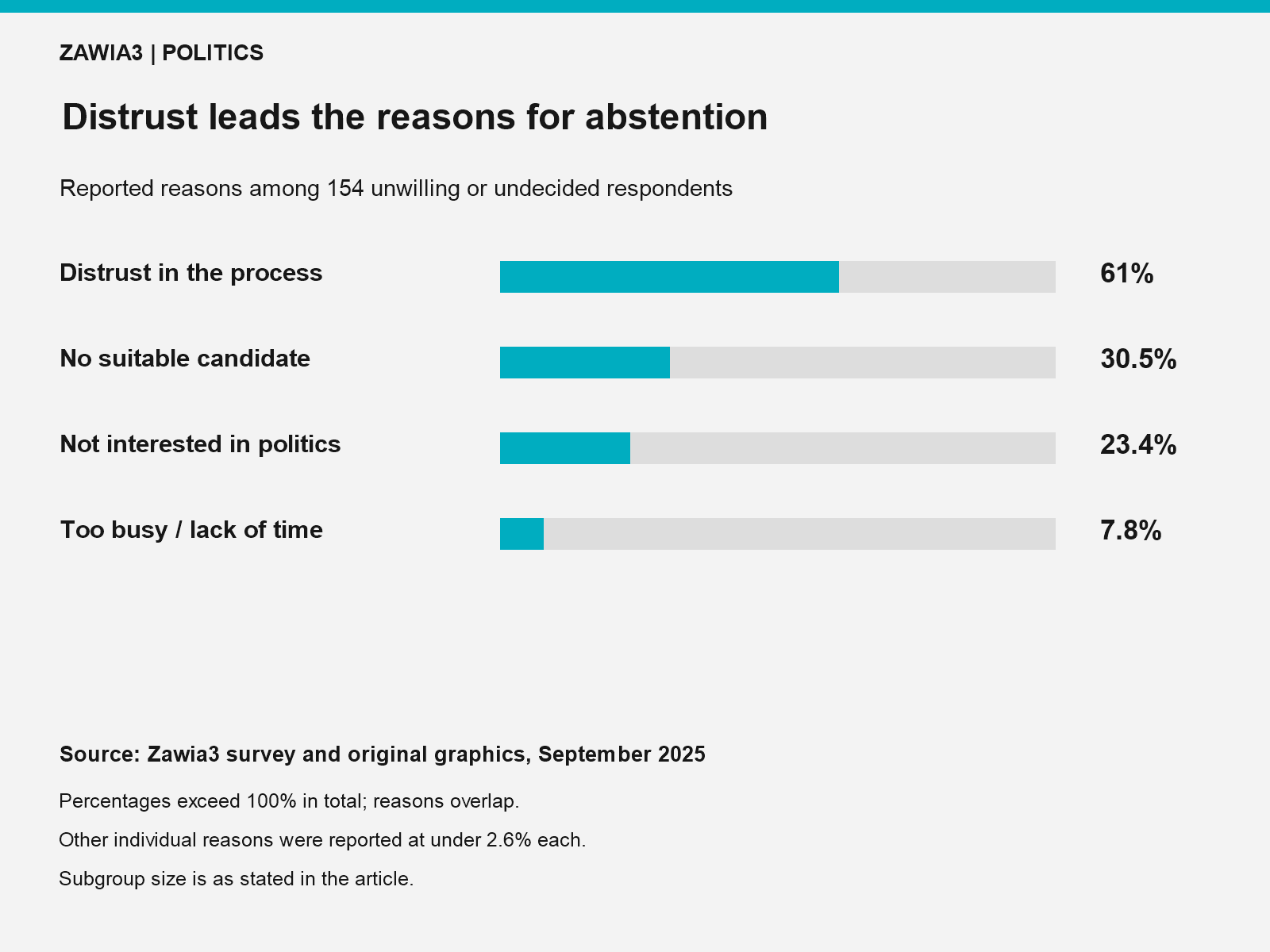
Among a subgroup described in the report as 154 unwilling or undecided respondents, distrust of the electoral process was the leading reason, at 61 per cent. It was followed by the absence of a suitable candidate, at 30.5 per cent; lack of interest in politics, at 23.4 per cent; and being too busy, at 7.8 per cent. The reasons overlap and their percentages exceed 100 per cent in total.
Zohdy El-Shamy, a Socialist Popular Alliance political bureau member and chair of its board of trustees, sees little basis for expecting high turnout. Restrictions on political activity, he argues, have reduced participation compared with the period after the January 2011 uprising.
The House elections may draw somewhat more interest than the Senate contest, he says, but the difference will remain limited. The Senate has limited powers, one-third of its members are appointed, and another third is elected through closed lists, where the government-aligned list faced no competing list. Its large individual-seat constituencies also restricted meaningful competition, in his view.
For the House, half of elected seats are assigned to closed lists. El-Shamy argues that this makes competition over half the chamber largely nominal, while unequal, expansive individual-seat districts further distort representation.
He cites state support for favoured parties, gaps in electoral rules, political money and vote buying as reasons for public doubts. He calls the outgoing parliament a “legislative appendage of the government”, accusing it of weak oversight and passing laws that impose costs and threaten housing security.
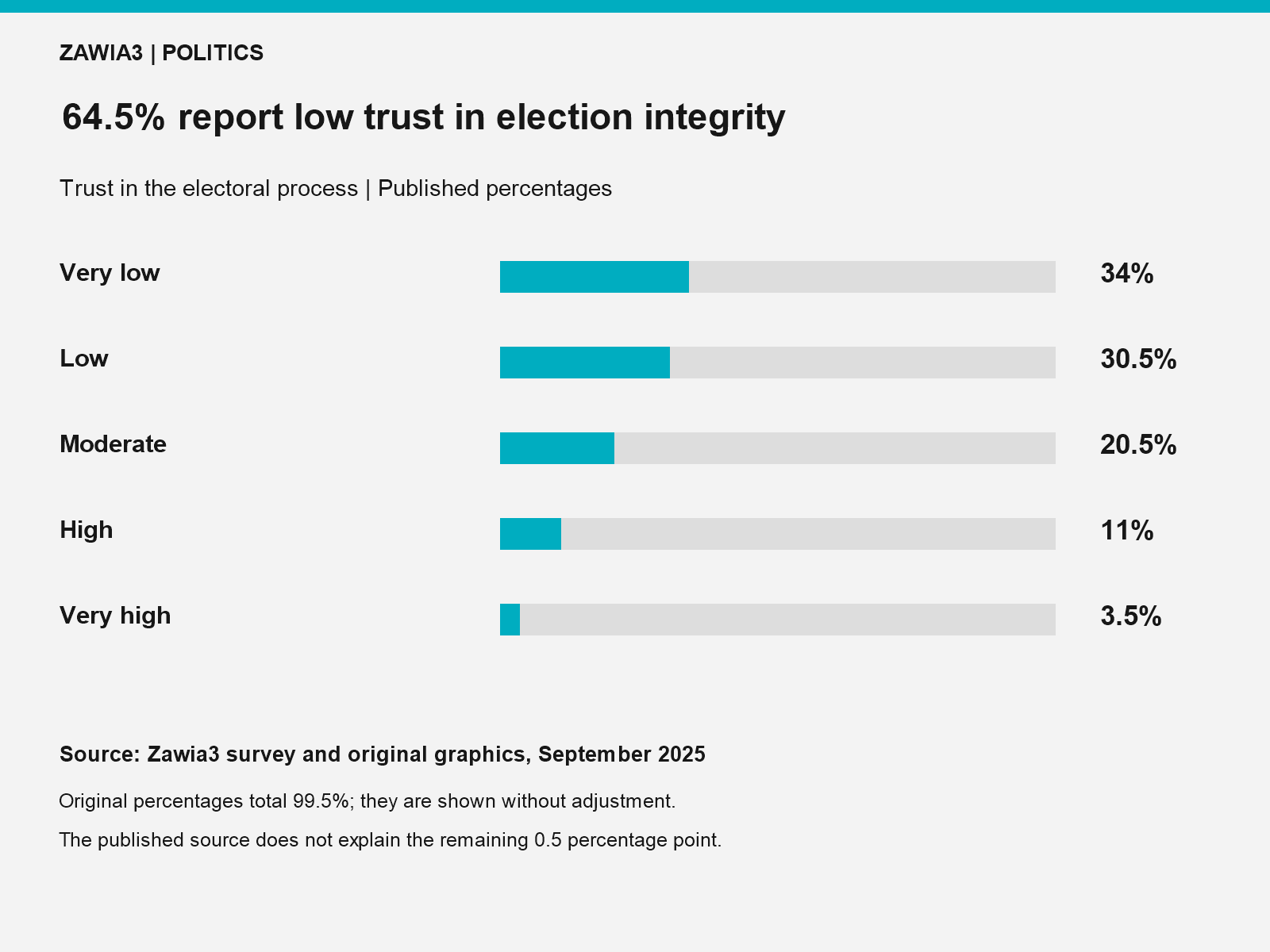
The survey’s published trust figures show 64.5 per cent with low or very low confidence in electoral integrity, 14.5 per cent with high or very high confidence and 20.5 per cent with moderate confidence. These add up to 99.5 per cent; the original material does not explain the remaining half percentage point, and the translation does not silently redistribute it.
Elham Eidarous, a co-founder of the Bread and Freedom Party, attributes weak Senate participation primarily to the absence of meaningful competition. Voters, she says, see little reason to participate when candidates appear to support the same government policies.
She believes alternative lists and candidates openly challenging those policies could attract more engagement. In the current environment, she argues, participation is often driven by money or direct assistance rather than confidence that votes can change outcomes.
What kind of parliament comes next?
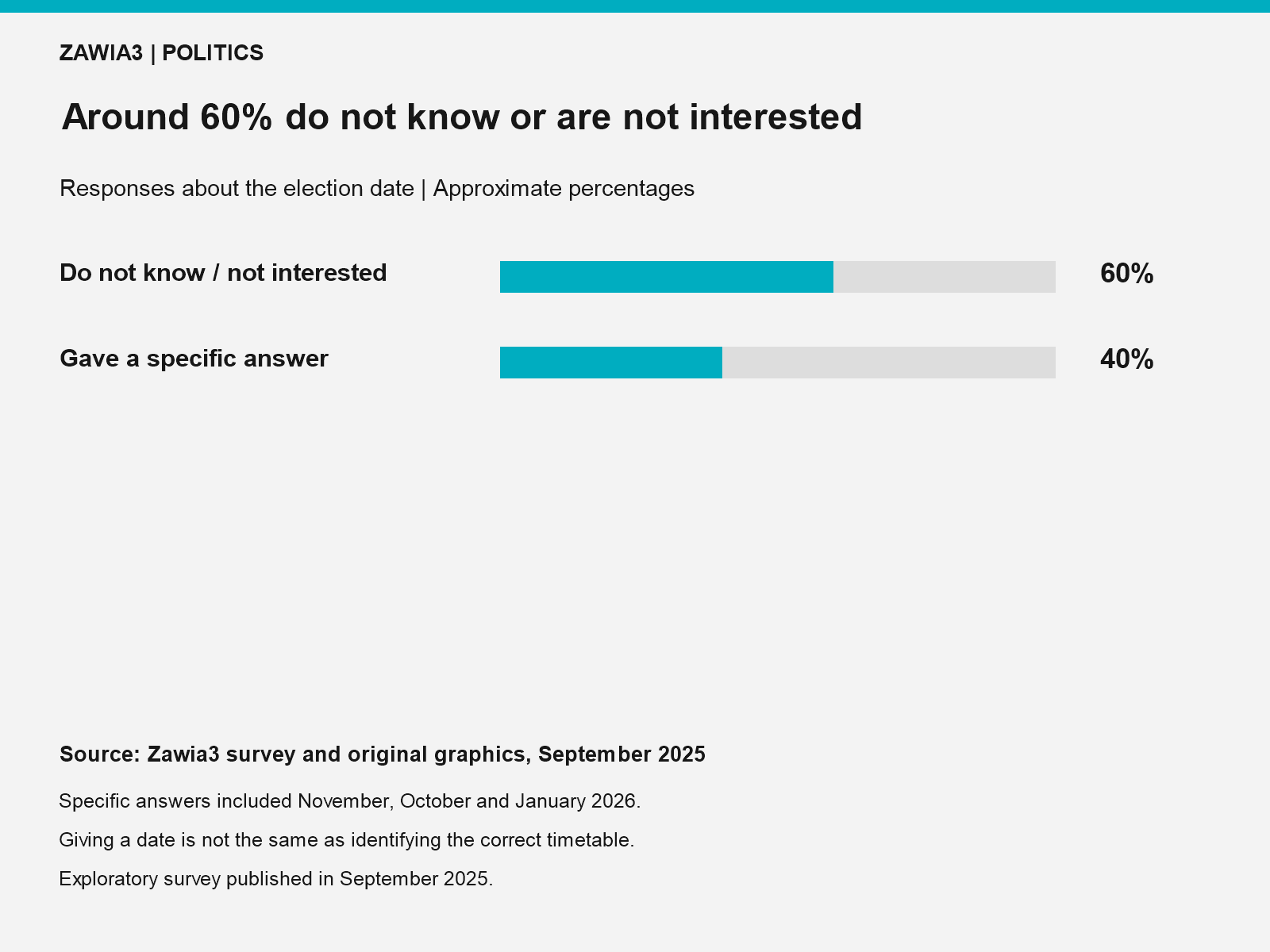
Asked when the next elections would take place, about 60 per cent answered that they did not know or were not interested. Around 40 per cent gave a specific answer, most commonly November 2025. Some answers were inaccurate or sarcastic. Giving a date does not necessarily mean knowing the official timetable.
Egypt was preparing for House elections expected in November 2025, with candidate registration anticipated in October. Article 106 of the constitution gives the House a five-year term from its first sitting and requires the new chamber’s election during the 60 days before that term expires—not at least 60 days before expiry.
The Senate has 300 members: 100 elected through individual contests, 100 through lists and 100 appointed by the president. The House has 568 elected seats, equally divided between 284 individual seats and 284 list seats, with up to 28 presidential appointees. Individual seats are distributed across 143 constituencies and list seats across four. The 448 individual/120 list split cited in an earlier version belonged to an older electoral arrangement.
Parties have been preparing candidates, programmes and campaign teams. Government-aligned parties seek broad coverage through alliances and closed lists, while opposition parties and individual candidates rely on local campaigns and social media to build a presence.
The expiry of the ten-year period specified in Article 210 of the constitution prompted debate over judicial supervision. That expiry does not itself prohibit using judges or establish that the 2025 elections would lack judicial oversight. The National Election Authority’s arrangements and the applicable legal rules determine the actual form of supervision.
Political parties and civil-society groups have called for effective judicial and civic monitoring and other safeguards, reflecting concerns about transparency and confidence in election administration.
Khalil expects the coming parliament to resemble its predecessor, arguing that closed lists will continue to admit candidates acceptable to state institutions. Still, he says opposition parties will contest individual seats in many constituencies and seek to rebuild trust by offering alternatives.
He accuses government-aligned parties of dividing seats as spoils rather than competing to serve citizens. If public distrust persists, he warns, those mobilised through coercion or material inducements will dominate participation. His own estimate that Senate turnout was only three to four per cent sharply conflicts with the official figure and remains an assessment rather than a verified count.
Electoral reform was discussed during the National Dialogue in August 2023, but parties did not agree on a single replacement system. Its board submitted three broad approaches to the president: retaining the existing arrangement; adopting proportional lists throughout; or using a mixed system combining winner-takes-all lists, proportional lists and individual contests.
The forthcoming elections nonetheless retain closed lists and individual seats. Opposition groups consider this exclusionary, yet the Civil Democratic Movement’s parties have opted to contest the election rather than announce a collective boycott.
Turnout between political openings and decline
Reported turnout illustrates the contrast between the relative political opening after January 2011 and subsequent contests. Participation reached around 54 per cent in the 2011–2012 parliamentary elections, then stood near 28 per cent in 2015 and 29 per cent in 2020.
The Senate’s first round in 2020 recorded 14.23 per cent turnout, rather than the roughly 17 per cent stated in an earlier version. The official figure for August 2025 was approximately 17.1 per cent.
Egypt’s parliamentary history reaches back to nineteenth-century consultative bodies, including the assembly established in 1866. The 1923 constitution introduced a bicameral parliament. Under the monarchy, the Wafd often dominated elections, though royal and British intervention and repeated dissolutions constrained parliamentary life and the electorate remained limited.
After 1952, the monarchy’s parliamentary system gave way to one-party politics. The Arab Socialist Union dominated the 1964 assembly, with its worker and farmer quota, and the absence of pluralism limited political competition regardless of official participation claims.
Restricted multiparty politics returned under Anwar Sadat. The National Democratic Party, founded in 1978, subsequently dominated under Sadat and Hosni Mubarak until 2010, amid repeated allegations of rigging and declining confidence.
The January uprising opened the way to the relatively competitive 2011–2012 elections, in which the Muslim Brotherhood won strongly, but that parliament was later dissolved following a court ruling. The 2014 constitution initially restored a single-chamber parliament; the 2019 amendments reintroduced the Senate.
Pro-government forces dominated the 2015 and 2020 legislatures, with Mostaqbal Watan winning a majority in 2020. It did not hold a majority in 2015, contrary to an earlier description in this report.
As parties prepare for November, the survey and interviews expose a recurring tension: constitutional elections continue, while many respondents question whether participation brings meaningful representation. The challenge extends beyond turnout to the relationship between citizens and the institutions claiming to speak for them.