In February, Conservative Party leader Akmal Qortam published a video in which he spoke of what he described as an “encroachment on his property” in the Abu Al-Nomros area of Giza, citing documents he said proved his ownership of the land and the palace built on it along the banks of the Nile. The Ministry of Irrigation denied this, affirming that the palace was built on land belonging to the ministry and that removal procedures were being carried out as part of the response to encroachments on the river’s protected zone.
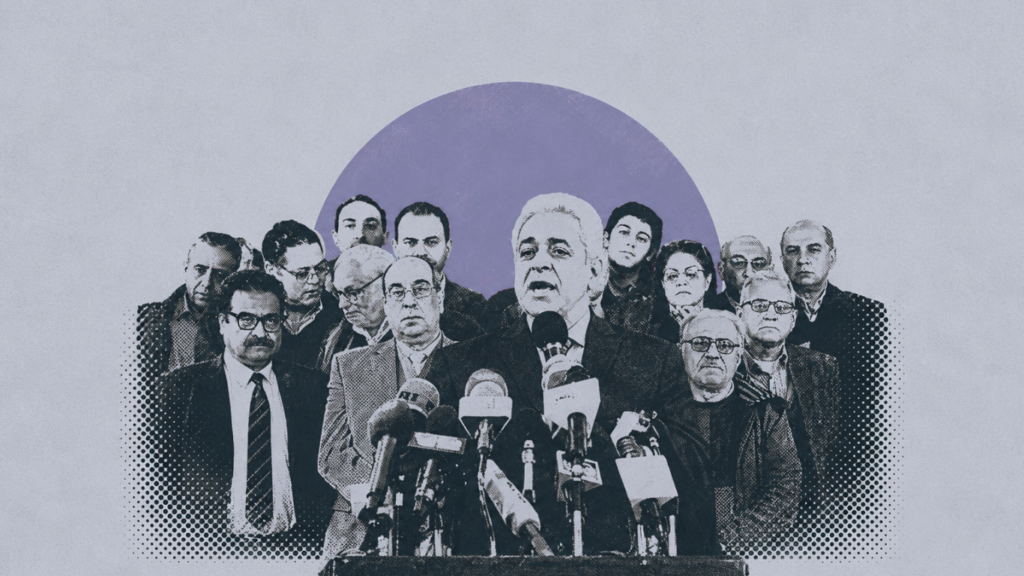
In May, the Civil Democratic Movement issued a statement under the title “Departing from the Constitution and Disregarding the Law,” equating the demolition of Qortam’s building with the cases of residents of Al-Warraq and Al-Qursaya islands and historical cemeteries. The statement was met with sweeping criticism from parties and prominent figures who argued that the Movement had shifted from defending matters of public concern to championing a personal grievance of one of its leaders. The Movement apologized and retracted the statement within two days, declaring that it had “never become a platform for the personal grievances of its leaders.”
The crisis led to the withdrawal of the Justice Party from the Movement entirely, and to other parties distancing themselves from the statement. In its expanded meeting held in the wake of the crisis, the Movement approved a comprehensive restructuring process and began discussing the contours of the next phase and the proposed vision for a new organizational structure, in an attempt to put its internal affairs in order following one of its deepest crises since its founding in 2017.
The restructuring comes as an option for preserving the cohesion of this bloc, which currently comprises nine opposition parties alongside a number of public figures, by addressing the divisions and organizational drift it has suffered, in preparation for recovering its effectiveness ahead of a political phase expected to witness significant developments, foremost among them the renewed talk of introducing constitutional amendments.
A source inside the Movement told Zawia3 that the Movement has yet to resolve its position on the parties that have frozen their participation, chief among them the Egyptian Social Democratic Party and the Reform and Development Party. The Conservative Party’s position also remains in limbo: its leader Akmal Qortam left the private messaging group of the Movement’s Trustees Council, and the party did not participate in the expanded meeting, yet it has not formally notified the Movement of a decision to withdraw.
The Movement has received three restructuring proposals: a proposal by political writer Khaled Talima, a proposal by political figure Alaa Al-Khayyam, and a proposal by the Youth Secretariat that includes expanding the membership base and integrating public figures and leaders from the middle generation, alongside redefining the concept of “public figure,” tying membership to actual participation and stripping it from those who do not engage, establishing an executive office with real powers, and setting standards for political discourse on the grounds that the Movement is a civil rather than an ideological coalition. The source noted that these visions are still under discussion and none has been finalized.
In its meeting held on June 14 at the headquarters of the Bread and Freedom Party, the Trustees Council approved the appointment of Akram Ismail to chair a smaller committee tasked with preparing a comprehensive vision for renewing the Movement based on the proposals submitted, with a deadline of 21 days to complete its work in preparation for presenting it to the member parties before final adoption.
The Civil Democratic Movement had, in June, experienced one of the deepest crises it has faced since its founding, after a statement it issued in solidarity with Conservative Party leader Engineer Akmal Qortam provoked a wide wave of controversy and criticism in political circles and on social media platforms, before the Movement retracted it, apologized, and deleted it from its official page.
The statement came against the backdrop of the crisis over the demolition of a palace owned by Qortam on the banks of the Nile, which he said was subjected to removal constituting an encroachment on his rights, while the Ministry of Water Resources and Irrigation affirmed that the building was constructed in violation of the law and in encroachment upon the Nile’s protected zone.
The incident triggered sharp disagreements within the Movement, prompting a number of parties and figures under its umbrella to announce their objection to the statement or to distance themselves from it. The Conservative Party, led by Qortam, also announced its withdrawal from the Movement, a development that revealed deeper disagreements over decision-making mechanisms, the nature of the Movement’s priorities, and the limits of consensus among its components.
New Faces Inside the Civil Democratic Movement
As part of the Movement’s work toward restructuring, Akram Ismail, representative of the Bread and Freedom Party (under formation) and member of the Civil Democratic Movement’s Trustees Council, says that the main objective of the restructuring is “to revive the Movement as a more active and dynamic political entity than in the previous period,” by developing its organizational structure and enhancing its capacity for political action.
He told Zawia3 that the proposals on the table include a reexamination of the Movement’s organizational structure through the creation of a smaller and more effective executive office alongside the general secretariat, as well as rotating the hosting of Movement meetings between the headquarters of member parties rather than relying on a single venue, thereby enhancing participation among its components.
Ismail adds that the visions under consideration also aim to attract new faces, particularly from younger generations and the middle generation, contributing to a renewal of the Movement’s membership and a broadening of the base of participants in its activities.
On the question of women’s representation within the new structure, Ismail noted that increasing women’s participation, alongside the representation of younger generations, is among the ideas being discussed, but that the Movement is still seeking a formula that achieves a balance between gender and generational representation on one hand, and the nature of the Movement as a coalition of political parties on the other, in a way that ensures the preservation of democratic mechanisms in the selection of its representatives.
Regarding the Bread and Freedom Party’s position on the restructuring process, Ismail explains that the party did not submit an independent paper containing a comprehensive vision for reform, but participates collectively in the discussions on developing the Movement and supports everything that would make it more vital and capable of operating.
Ismail explains that the discussions within the parties belonging to the Movement reflect the existence of two tendencies: the first supports developing the Movement and restructuring it to recover its political role, while the second holds that the Movement has fulfilled the role for which it was established and there is no longer a need for it to continue in its current form. He added that this divergence of opinion exists within more than one party, including Al-Karama, the Popular Socialist Alliance, Al-Dostour, the Conservatives, and Bread and Freedom, arguing that the success of the restructuring process will be the decisive factor in tipping the scales in favor of those supporting the Movement’s continuity.
Regarding the Conservative Party’s position, the Civil Movement figure affirms that the party has informed the Movement that it has not frozen its membership and that it remains, formally speaking, among its components, despite the absence of its representatives from the last meeting.
Politician Ahmed Al-Tantawi, former parliamentarian and former presidential candidate, had previously directed criticism at the working mechanisms of the Civil Democratic Movement, arguing that overcoming its current crisis requires settling two fundamental questions: who are the members of the Movement, and how are its decisions made?
Tantawi said, in a previous interview with Zawia3, that the continued management of the Movement according to the logic of consensus makes reaching decisive decisions extremely difficult, pointing out that numerous political experiences have shown that reliance on consensus can lead to the paralysis of institutions rather than the enhancement of their effectiveness.
He added that making mistakes is natural for any political entity engaged in public activity, whether concerning a statement or a political position, but that the real problem, in his words, lies in stagnation becoming a permanent condition, rather than mistakes being the product of active political engagement subject to review and correction.
Tantawi argued that the Civil Movement today represents the most prominent umbrella encompassing a section of the Egyptian opposition, but that it also includes parties that do not define themselves as opposition in the full sense of the word, which creates a state of ambiguity regarding its political identity. He stressed that the Movement does not hold a monopoly on representing the opposition, citing himself and the “Hope Current” as being outside its organizational framework.
He affirmed that he does not wish for the Civil Movement to fail and that the opposition, from his perspective, must offer alternatives and different policies rather than betting on the state’s failure, because it is the citizen who bears the cost of any failure while the benefits of any genuine reform accrue to society as a whole.
Tantawi also raised the question of whether the Civil Movement is prepared to conduct a comprehensive review of its experience, draw lessons from it, and benefit from the experiences of other countries in political reform and institution-building, warning that the continuation of the status quo will keep the Movement trapped in stagnation, which serves neither the history of the figures belonging to it nor the future of opposition political work in Egypt.
The Movement’s Continuity Is Contingent on Recovering Its Role
In the same context, political journalist and writer Khaled Talima argues that restructuring the Civil Democratic Movement has become an unavoidable necessity, contending that the crisis it is going through extends beyond organizational disagreements to the nature of public space in Egypt, which he argues has over the years been subjected to what he described as “nationalization and encirclement,” a development that has been reflected in party and electoral life, depriving them of the capacity to produce new political leadership.
He argues that this reality has created a sense of a vacuum in the public sphere and a scarcity of political figures capable of representing society and engaging in political competition, warning that the continuation of this situation could have serious consequences if the country faces any sudden transformations, given the absence of political cadres who are ready and capable of bearing responsibility.
Talima affirms his commitment to the Movement’s continuity, rejecting calls for its dissolution, but stresses at the same time that its continuity must be tied to a clear and decisive restructuring. He argues that the first step of reform lies in settling the Movement’s identity as an opposition framework, by excluding the parties that participated within the lists backed by the authorities in the recent House of Representatives and Senate elections, arguing that combining opposition parties with parties that participated in those lists creates a contradiction that weakens the Movement’s credibility and blurs its political message.
In this context, Talima directed criticism at the Conservative Party, arguing that it is among the parties that benefited most from its presence within the Civil Movement, and that its influence and presence would have remained limited were it not for its position within the Movement, calling for the party’s position to be settled and for it to declare that it is no longer among the Movement’s components if the restructuring genuinely aims to redefine its political identity.
Talima also calls for a review of the Movement’s management approach, stressing that what is required is not the removal of current leadership but the injection of new blood and the formation of a more cohesive leadership capable of collective work and presenting different ideas, in a way that allows the Movement to recover its effectiveness and its role in political life.
Talima also criticizes what he described as the absence of democratic practices within some of the parties belonging to the Movement, even those that have frozen their membership, noting that some of these parties adopt democratic discourse in the public sphere while not applying the principles of the transfer of power within their organizational structures, and that some even witness what he described as the “inheritance” of leadership positions, a matter on which the Civil Movement should take a clear stance. He argues that the restructuring represents “a crossroads” that requires the Movement to be more consistent with its own discourse, such that every member party is committed to genuinely democratic practices within its own organizational framework.
Talima noted, in concluding his remarks, that he submitted a paper containing proposals for restructuring the Movement to Trustees Council member Akram Ismail, in preparation for presenting it for discussion in the coming days. He argues that the adoption of serious steps to implement these proposals would restore confidence in the Movement and encourage new groups and figures to join it, while if the reform process stalls, the Movement’s future will remain open to all possibilities, an outcome he does not wish for.
A source within the Conservative Party, who requested anonymity, explains that the party continues to witness internal discussions, not yet resolved, regarding its continued membership in the Civil Democratic Movement.
The source told Zawia3 that there are two tendencies within the party: the first sees the importance of the party remaining within the Movement and participating in its restructuring process, on the grounds that internal reform may contribute to recovering its effectiveness, while the second calls for a final withdrawal from the Movement and a move toward building new political alliances outside its framework. This has meant the party has neither officially announced its withdrawal nor had its representatives attend Civil Movement meetings, given that the party has not yet settled on its final position.
In his interview with Zawia3, lawyer Zyad Elelaimy, former member of parliament, argued that the opposition had for years remained in a reactive position rather than being a party capable of taking the initiative and producing political action, noting that some attempts that adopted more independent visions were unable to sustain themselves.
Elelaimy called on the opposition to move beyond merely opposing policies after the fact, and to instead work on formulating a vision for the future that presents a clear picture of the state it seeks to build, along with a political program around which citizens can rally, so that competition becomes one between different projects and visions rather than between belated reactions to existing policies.
Abolishing the Trustees Council
Zawia3 has learned from its sources that leaders within the Civil Democratic Movement’s Trustees Council have begun consultations and meetings with a number of prominent politicians from the middle generation, known in media circles as the “January generation,” to discuss their joining the Movement, within the framework of the restructuring plan aimed at injecting new blood into its ranks and broadening the circle of participation in its leadership and activities.
According to the sources, these consultations aim to open the door for political leaders who have not played prominent organizational roles in recent years, contributing to a renewal of the Movement’s leadership elite and strengthening the presence of the middle generation within its organizational structures.
For his part, political figure Alaa Al-Khayyam says that he and a number of individuals engaged in public affairs submitted a paper containing a vision for renewing and developing the performance of the Civil Democratic Movement, stemming from a conviction in the necessity of its continuity, despite the errors and challenges that have marked its performance in recent years.
Al-Khayyam told Zawia3 that he rejects calls for dissolving the Movement and establishing a new entity, arguing that the current political circumstances do not permit the creation of new political frameworks, and that the more realistic option lies in reforming the Movement from within and renewing it. He notes that the most recent meeting of party leaders concluded with a consensus on continuity and working to address shortcomings.
Al-Khayyam explains that the reform paper includes a number of organizational proposals, among them the abolition of the Trustees Council and a return to the general secretariat system, which would allow public figures to return to participating in the Movement’s management, along with the abolition of the position of Trustees Council President, which he argues no longer performs a genuine role. The proposals also include holding meetings on a regular basis within the headquarters of the various parties, rather than being confined to a single venue, in an attempt to overcome the problems that emerged during the past period.
Al-Khayyam adds that Akram Ismail, the Civil Movement Trustees Council figure, has been tasked with gathering the proposals and redrafting the Movement’s founding paper in a way that defines its identity more clearly as a framework bringing together political forces that believe in the modern civil state, despite their different intellectual and ideological references.
Al-Khayyam stresses the need to establish clear criteria for membership in the Movement, whether for parties or public figures, in a way that reflects the Movement’s identity as an opposition coalition. He also called for a review of the voting mechanism within the Movement, so that it takes into account the organizational weight of parties rather than equating the vote of a party with the vote of a public figure.
On the question of renewing leadership, Al-Khayyam affirmed the importance of opening the door for the middle generation and younger leaders to take on greater roles within the Movement, noting that figures with a political history within the Civil Movement, including political figure Hamdeen Sabbahi, have expressed their readiness to make way for new generations to lead political work. He argued that the current phase requires drawing on the competencies of the middle generation, given the changes that political life has witnessed in recent years.
Al-Khayyam points out that the crisis did not lie in the absence of an organizational structure for the Movement but in the failure to activate it, which caused, in his words, a lack of clarity in roles and decision-making mechanisms over the past years. He explained that the development process aims to activate this structure through organizing meetings on a regular basis, preparing formal agendas and minutes, and defining clear responsibilities for spokespeople and coordinators.
On the Movement’s priorities in the coming phase, Al-Khayyam says that the freedoms file will remain at the forefront of its concerns, through demands for the release of prisoners of conscience and amendments to the pre-trial detention law, alongside the presentation of alternative visions for addressing the economic crisis. He argues that the current political priority lies in opposing any constitutional amendments that could lead to an extension of terms of governance, in parallel with early preparation to contest the upcoming presidential elections with a consensus candidate representing the opposition forces.
The Civil Democratic Movement was founded in December 2017 as a political coalition that initially comprised 12 political parties alongside a number of public figures, with the aim of uniting the efforts of civil opposition forces, defending the principles of the democratic civil state, the rule of law, and offering a political alternative based on pluralism and the peaceful transfer of power. The number of parties under its umbrella later shrank to nine, after three parties froze their participation, and the latest crisis has opened the door to the largest organizational and political review the Movement has witnessed since its founding.
The restructuring of the Civil Democratic Movement appears to be more than a mere organizational adjustment: it represents a genuine test of the capacity of Egypt’s largest civil opposition grouping to review its own experience, settle its political identity, and renew its tools and leadership. Politicians argue that the success of this review could give the Movement an opportunity to recover its presence in public life, while its failure could deepen internal divisions that may ultimately result in the Movement’s permanent dissolution.