Egypt is witnessing a broad security crackdown that has intensified in recent days, including arrests, trials and summonses for questioning, days before the periodic review of its human rights record at the Universal Periodic Review in Geneva, and ahead of the 14th anniversary of the January revolution.
Since 2014, Egypt has seen tightened security measures ahead of the January anniversary, including campaigns of arrest, detention and searches. These measures have continued for more than ten years, despite the absence of domestic calls for protest and the security agencies’ complete control over the public sphere since the issuance of the Protest Law in 2013.
In this context, the Supreme State Security Prosecution yesterday decided to release Nada Mogheeth, the wife of cartoonist Ashraf Omar, who has been detained for around six months, on bail of EGP 5,000. This came after she was held for long hours and questioned in Case No. 7 of 2025 on charges of joining a banned group and spreading false news. At the same time, the prosecution decided to detain journalist Ahmed Serag, who works for the “Zat Masr” website, for 15 days pending investigation in the same case. This coincided with the Public Prosecution’s decision to refer content creator Ahmed Abu Zeid to the Economic Court on charges of illegally trading in foreign currency outside the banking market.
Last Wednesday, the Egyptian Initiative for Personal Rights announced that its director, Hossam Bahgat, had been summoned to appear before the Supreme State Security Prosecution on Sunday 19 January, without providing further details.
According to rights sources, Zawia3 has learned that around 100 cases have been referred to trial after years of pretrial detention over the past few weeks, among them the case of human rights lawyer Hoda Abdel Moneim, who will be tried for the third time on the same charges. A number of journalists have also been referred to trial after exceeding the legal period of their pretrial detention.
A Press Interview

Security forces yesterday, Thursday morning, arrested Ahmed Serag, a journalist at the “Zat Masr” website, and Nada Mogheeth, the wife of detained cartoonist Ashraf Omar, who has been in prison for around six months. The two were arrested over a press interview that Serag conducted with Nada Mogheeth nearly two months ago.
In the interview, Nada affirmed that the security men who arrested her husband took EGP 350,000 from the house, personal savings set aside for buying a car, but recorded only EGP 80,000 in the official report. In response, the Egyptian Ministry of Interior denied what she said and accused her husband, the cartoonist, of receiving money from the Muslim Brotherhood abroad to distribute to its members in Egypt.
Kamal Mogheeth, an expert in education affairs and Nada’s father, had announced on his “Facebook” page the arrest of his daughter on the morning of Thursday 16 January, saying: “State Security Prosecution is summoning my daughter Nada Mogheeth and she is now in their custody.”
In a related context, political thinker Ammar Ali Hassan published on his “Facebook” page details of the security pursuit to which journalist Ahmed Serag was subjected days before his arrest, which included a security agency questioning people about him at the school where he works as an Arabic language teacher, concluding his conversation with him by entrusting him with his children should anything bad happen to him.
Writer Salah El-Din Hassan, editor-in-chief of the “Zat Masr” website, says that journalist Ahmed Serag’s interview with Nada Mogheeth was published around two months ago and did not attract much attention, nor were its viewing figures high, but in the past few hours, after the arrest of Nada Mogheeth and journalist Ahmed Serag, the number of views has exceeded 16,000.
He tells Zawia3: “Over the past two months, no official has contacted me about this interview. Journalist Ahmed Serag had hosted Kamal Mogheeth, Nada’s father, to talk about education in Egypt. Since he is the father of Nada’s husband, cartoonist Ashraf Omar, who was arrested around six months ago, he referred in his talk to the crisis of his son-in-law’s arrest and its reasons.
Accordingly, Mogheeth suggested that Nada speak herself about her husband’s crisis, which led Ahmed Serag to host her in his interview. He adds: “Ahmed Serag was never preoccupied with political content; he is known primarily for his interest in cultural subjects.”
On the Ministry of Interior’s statement, Salah El-Din Hassan says: “After reading the Ministry of Interior’s statement, I realised that the main reason for the arrest of Ahmed Serag and Nada Mogheeth is Nada’s objection to the arresting force’s seizure of sums of money that were not recorded in the seizure report, in addition to the confiscation of other belongings of hers. It seems that this bothered the Interior Ministry, which led to their arrest.”
He adds: “I do not know why they went back to an old interview conducted two months ago, but in the end the decisions remain unclear and their reasons cannot easily be guessed. At ‘Zat Masr’ we have conducted interviews stronger than this one, which means we may be surprised after a while by an investigation into them.”
The editor-in-chief of Zat Masr points out that he was personally questioned over an interview around five months after it was published, and that he does not know what exactly bothers the authorities because “things happen behind the scenes and we are not privy to them.”
After they were brought before the Supreme State Security Prosecution and questioned for long hours, the prosecution decided to release Nada Mogheeth pending Case No. 7 of 2025 on bail of EGP 5,000, while the prosecution decided to keep journalist Ahmed Serag in detention for 15 days pending investigations in the same case. The State Security Prosecution charged Mogheeth with spreading false news and joining a banned group, while the same charges were brought against journalist Ahmed Serag, in addition to the charge of committing a financing crime.
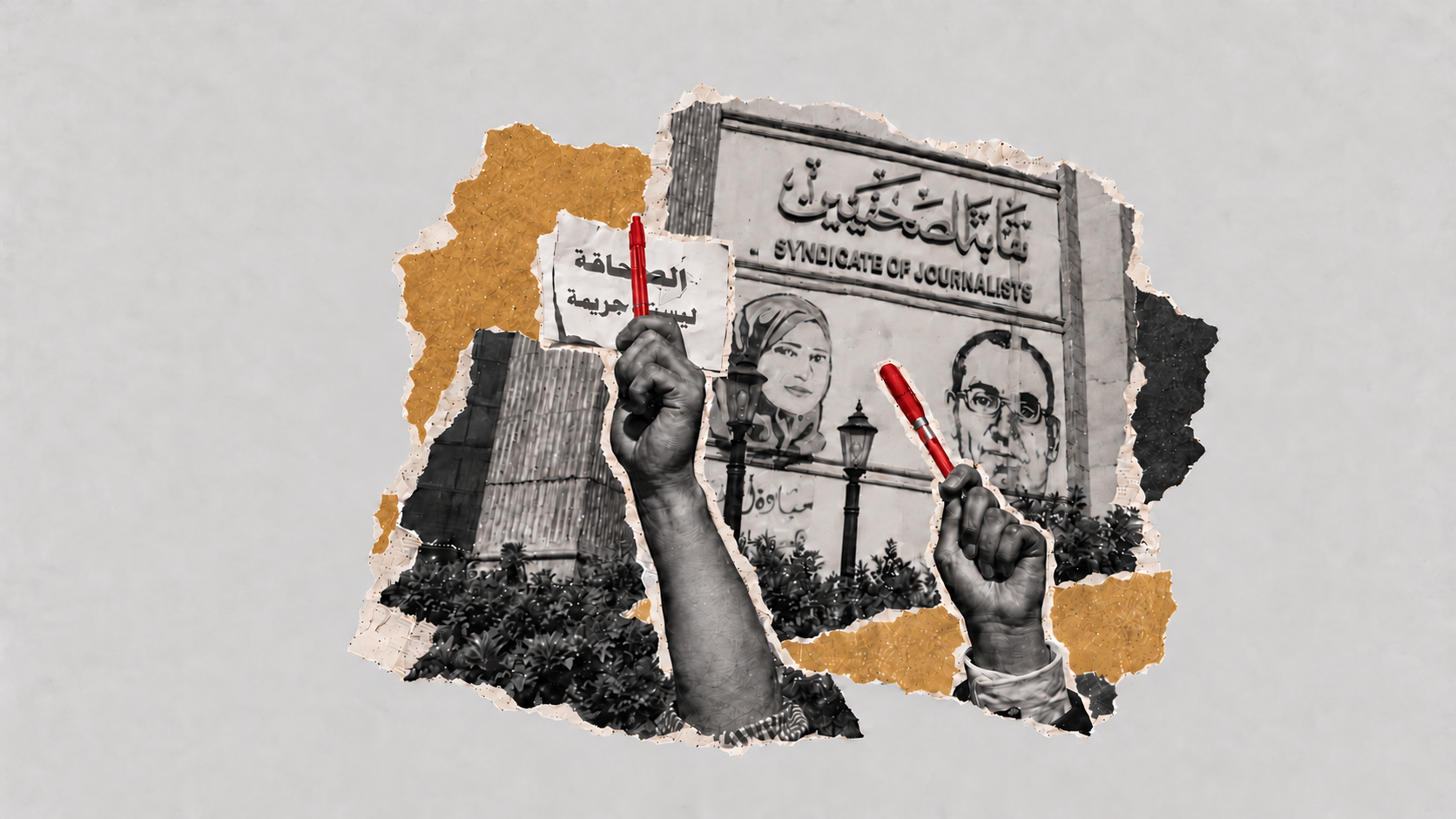
For his part, Mahmoud Kamel, a member of the Journalists Syndicate’s board and head of its freedoms committee, commented on the detention of journalist Ahmed Serag, saying: “This is a clear violation of press freedom; he is a journalist performing his professional role and has not committed any crime that warrants questioning him in the first place.”

He adds, speaking to Zawia3, that questioning Serag over an interview he conducted with the wife of an imprisoned journalist is hard to comprehend: “How can charges relating to financing or joining a banned group be brought against a journalist performing his role?”, questioning the basis of the financing charge: “Where is the evidence for this charge? And what are the details of this alleged financing?”
The Cairo Criminal Court decided, at its session on 6 January this month, to renew the detention of Ashraf Omar and 235 other defendants for 45 days pending investigations. Human Rights Egypt (an international rights organisation based in London) had called on the Egyptian authorities to immediately release the cartoonist and artist Ashraf Omar, who was arrested on 22 July 2024 and is accused in Case No. 1968 of 2024 Supreme State Security Investigations, on charges of joining a terrorist group with knowledge of its aims, spreading false news and data aimed at harming the Egyptian state, and misusing social media.
In a statement it issued on 5 January this month, it affirmed that freedom of opinion and expression is among the rights proclaimed by the Egyptian Constitution, as well as by all international charters, first among them the Universal Declaration of Human Rights.
Summoning the Director of the Egyptian Initiative

Hossam Bahgat, director of the Egyptian Initiative for Personal Rights (a local non-governmental rights organisation), received on Wednesday 15 January a summons to appear before the Supreme State Security Prosecution next Sunday, 19 January. According to the text of the summons, which he received at his workplace at the Egyptian Initiative, the summons comes within the framework of ongoing investigations in a new case, No. 6 of 2025 Supreme State Security.
According to the statement the Initiative published on its official website, the summons did not specify the subject of the new case or the charges attributed to Bahgat within it. The Initiative’s lawyers were unable to obtain any further details when they went to the State Security Prosecution today. The Initiative explained that Bahgat will go, accompanied by his defence team, to the prosecution’s headquarters in the Fifth Settlement on the specified date.
This summons comes one day after the Initiative published a joint report for the UN Universal Periodic Review mechanism entitled “Civil Society Documents a Bleak Picture of the Situation of Women’s and Girls’ Rights in Egypt between 2019 and 2024”.
On 12 January, the Initiative also published another report entitled “Hunger Strike and Refusal to Receive Rations at Al-Asher 6 Prison in Protest at Prolonged Pretrial Detention and Poor Detention Conditions”. In its report, the Initiative called on the Public Prosecutor, Counsellor Mohamed Shawky, to go to the Tenth of Ramadan 6 Reform and Rehabilitation Centre to inspect the prison and hear the detainees’ complaints.
In this context, the Justice Committee also documented a strike by a number of detainees held in political cases at Tenth of Ramadan Prison, in protest at the violations practised against them. The committee stated in a statement that conditions in prisons and detention facilities in Egypt are steadily deteriorating amid the systematic violations practised against detainees, particularly those held in political cases, affirming that prisons have become a harsh environment that does not respect the most basic human rights, where detainees are subjected to multiple forms of psychological and physical torture, in addition to medical negligence and restrictions on visits. It explained that these violations are increasing in frequency, particularly with the rise in cases of arbitrary arrest of individuals from various opposition political currents.
On 15 January, the Commission’s lawyer announced the transfer of Dr Abdel Khalek Farouk, the economist who has been on hunger strike since 9 January this month, to a hospital inside Al-Asher Prison after he suffered a heart attack for the second time.
According to his lawyer, who preferred not to be named, he was transferred because of a suspected narrowing of the coronary artery; this is the second heart attack he has suffered since his arrest last October.
The lawyer explains that after his return from the prison hospital, Farouk was moved to a distant building and eight cells were emptied, as most of those held in the building are criminal detainees, amid inhumane toilets, stressing that his physical and psychological health has deteriorated because of his continued detention in inhumane conditions.
Mostafa Shawky, a politician and human rights researcher, believes that the immediate justification for the escalating security crackdown is the approach of the periodic human rights review in Geneva at the end of this month. He points out that this leads to a major focus on human rights issues in their various forms. Therefore, any news relating to grave human rights violations could significantly affect the image of the Egyptian government during this review, so the authorities try to deal decisively with any allegations raised in this context, considering them baseless claims. Consequently, they launch security attacks against those they regard as promoters of these allegations.
He adds, speaking to Zawia3, that at the same time, and as a result of the current regional tensions, international and regional pressure for political reform and for improving human rights conditions has receded. This decline gives the government the opportunity to get through the review without needing to respond to demands, unlike what happened in the previous review in 2019, noting that Donald Trump’s return to the White House may lead to further marginalisation of human rights issues.
Meanwhile, human rights lawyer Haitham Mohamedein believes that the approaching anniversary of the January revolution has become a source of tension and anxiety for the ruling regime, which is taking pre-emptive measures to intimidate citizens and prevent any thought of commemorating this anniversary or organising any kind of protest, or even expressing opinions and demanding the release of detainees.
The human rights lawyer adds, speaking to Zawia3, that regional events, specifically in Syria, are increasing the regime’s tension, in addition to the continuing war on Gaza, which has always been a motivation for citizens to mobilise and protest. There are many factors that could cause protests to break out, which worries the regime. Therefore, it seeks to deliver pre-emptive strikes, as happened with Nada Mogheeth and journalist Ahmed Serag, and with the summoning of Hossam Bahgat for questioning. I believe these measures will continue until the end of January.
More Than 100 Cases
At the end of 2024, human rights lawyer Hoda Abdel Moneim faced a new development in her case, as she was referred to the Criminal Court for the third time. Her husband, lawyer Khaled Badawi, announced on “Facebook” the referral of Case No. 730 of 2020 to the Supreme State Security Criminal Court, more than a month after the same case was referred for the second time. The charges are those of the same case in which Hoda Abdel Moneim was sentenced to five years in prison, the “Egyptian Coordination for Rights and Freedoms” case (No. 1552 of 2018 Supreme State Security Emergency). Badawi expressed his dismay, saying: “For the second time within a month, the case has been referred to the Criminal Court, the case to which my wife was added after her sentence ended on 31 October 2023.”
In the same context, the Journalists Syndicate was surprised by the referral to criminal trial, while still in detention, of some of the cases in which a group of journalists registered on the syndicate’s rolls, as well as trainee journalists, are being held, even though they have spent more than two years in pretrial detention, and the investigation period in the cases in which some of them are held, and hence their periods of pretrial detention, has stretched to more than 4 years, without their being released for exceeding the period of pretrial detention stipulated in Article (143/4) of the Code of Criminal Procedure, which constitutes a violation of the text of Article (54) of the Constitution.
For his part, Khaled El-Balshy, head of the Journalists Syndicate, submitted a memorandum to the Public Prosecutor containing 3 demands, the first being the release of fellow journalists (syndicate members and non-members) who have been referred to criminal trial and have spent more than two years in pretrial detention, with the syndicate ready to guarantee their appearance before the court when summoned; in addition, the release of journalists who have served the maximum period of pretrial detention stipulated in Article (143 /4) of the Code of Criminal Procedure. El-Balshy also demanded that periods of pretrial detention be counted towards the sentence of everyone against whom a sentence has been issued, and a review of the detention periods of our colleague Mohamed Ibrahim Radwan, known as “Mohamed Oxygen”, who faced a four-year prison sentence in Case No. (1228) of 2021 State Security Emergency Misdemeanours, and an additional year in another case that was brought while he was in detention, especially as he was arrested in September 2019, and counting this period towards his sentence means that his detention has continued beyond the periods imposed, which requires his release.
Meanwhile, the Egyptian Public Prosecution today, Thursday, referred content creator Ahmed Abu Zeid to the Economic Court on charges of “possessing foreign currency and trading in foreign currency outside the banking market”, after USD 163,000 was seized in his possession. The prosecution indicated that Abu Zeid had obtained the money in his possession without any source and without reporting it to the authorities. The prosecution had earlier decided to detain Abu Zeid for 15 days pending the case, after his arrest on 30 December last.
The Egyptian Initiative for Personal Rights condemns the authorities’ decision to renew the prosecution of newspaper publisher Hisham Kassem, a political opponent and former president of the Egyptian Organization for Human Rights, for the second time, by bringing him as a defendant before a criminal court on the same politicised charges and over the same incident for which the judiciary convicted him a year and a half ago and for which he served an unjust prison sentence after a trial that lacked the most basic guarantees of justice.
At the beginning of this month, publisher and political opponent Hisham Kassem learned through online news sites that he had been summoned to appear before the Economic Criminal Court at a session on 10 February in a case referred to the court by the Public Prosecution, accusing him of defaming and deliberately harassing former Minister of Manpower Nahed Ashry. The Egyptian Initiative for Personal Rights, a member of Kassem’s defence team, later revealed that the court’s fifth circuit had in fact held the first session to hear the case (No. 2347 of 2024 Economic Affairs Misdemeanours) on 11 December 2024, in the absence of Kassem or his lawyers, and had decided to adjourn the case to notify him to attend.
For his part, human rights lawyer Haitham Mohamedein reveals that more than 100 cases have been referred to the Criminal Court, each containing dozens of defendants, and in some cases the number reaches hundreds. The regime is expected soon, during the current legislative term, to issue the Code of Criminal Procedure, which includes setting a maximum limit on the period of pretrial detention.
Mohamedein adds that this bill was supposed to be presented during the review of the human rights file at the United Nations, but the current political decision is not to release detainees. He notes that if the law were issued while the detainees are still in pretrial detention, most of them would benefit from it, because they have exceeded the maximum period of pretrial detention. However, given the political decision not to release them, they were referred to the Criminal Court. He points out that this referral gives the regime time to delay the release of detainees, because referring them to trial ensures they remain in detention for no less than a year because of trial procedures.

Egypt is preparing for the review of Egypt’s human rights file before the Universal Periodic Review in Geneva during this month of January. And in November 2024.
The Universal Periodic Review is a review mechanism under which UN member states make recommendations to the country under review on how to improve its human rights record, in light of the country’s international commitments.
In the previous review in 2019, Egypt received 372 recommendations from 133 countries. Of these recommendations, Egypt supported 270, noted 71 and partially supported 31. Of the 71 recommendations it noted, Egypt described 15 as “incorrect”, 24 as “already implemented” and two as “unimportant”. Two of these recommendations were described as “hostile”, and during the adoption of the Universal Periodic Review, Egypt’s representative at the UN refused to discuss them on the grounds that they “contain incorrect and politicised allegations”.
Last November, the Sub-Committee on Accreditation formally adopted its recommendations, which included downgrading the National Council for Human Rights to category (B).
The committee expressed serious concerns about the council’s failure to comply with the Paris Principles, particularly with regard to its independence, effectiveness and transparency. It explained that the council lacks independence because its members are appointed directly by the executive authority through a process that is neither transparent nor participatory, which severely weakens the council’s ability to work without government interference. It also pointed to the council’s ineffectiveness in addressing critical human rights issues, including its failure to respond adequately to complaints relating to cases of enforced disappearance and arbitrary arrest, which significantly undermines its mission of protecting human rights.
Furthermore, the committee criticised the council’s lack of transparency, noting that it has not published any reports since 2020, which hinders the ability of civil society and international bodies to evaluate its work. As part of its recommendations, the committee called for fundamental reforms to bring the council into line with the Paris Principles, stressing the need to implement a transparent and inclusive appointment process, strengthen the council’s response to human rights violations, and ensure the regular publication of public reports to enhance accountability.
Editorial correction: The first version of the report stated that the Protest Law was issued in 2014; in fact, it was issued in November 2013 by Decree-Law No. 107 of 2013.