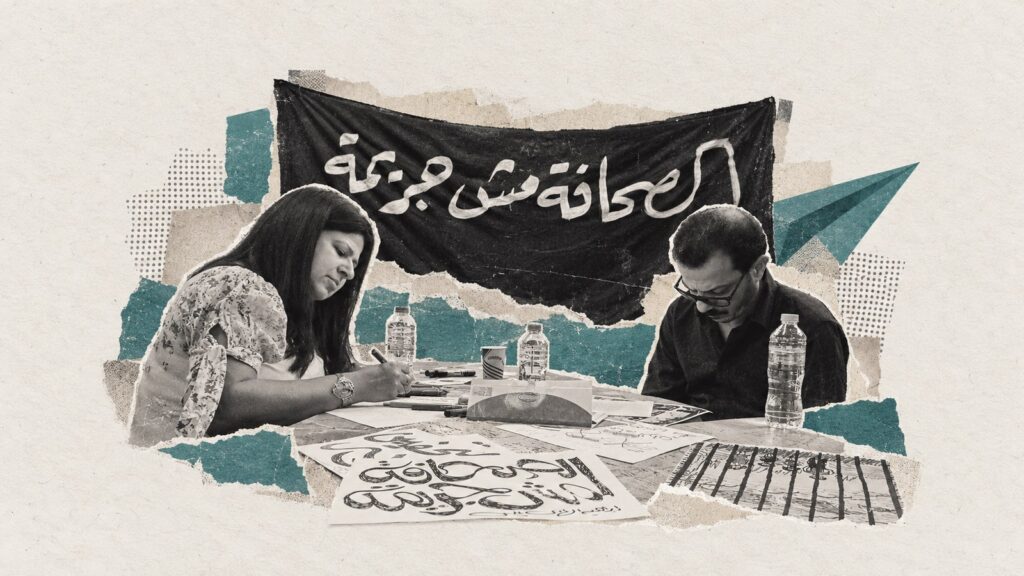
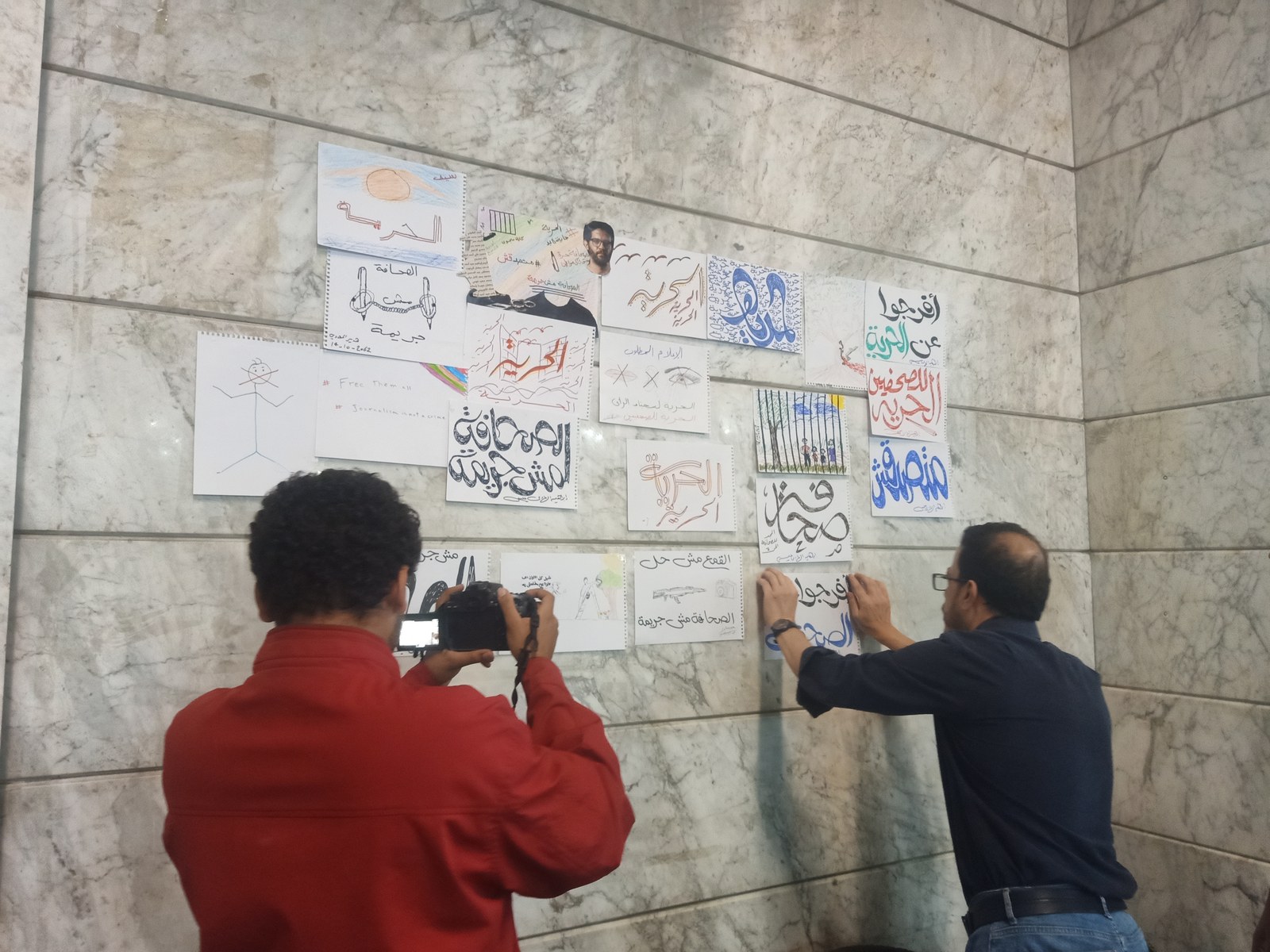
The pictures hanging on the walls of the Journalists Syndicate’s foyer on Wednesday evening, 14 October, were more than exhibits in an art show. The slogans on the posters were more than protest phrases recalling earlier professional battles. Between cartoons in solidarity with imprisoned journalists, photographs taken by journalists now behind bars, and placards bearing detainees’ names and demands for their release, the exhibition sought to turn imprisonment from a recurring item of news after each judicial decision into a broader question: where are the limits placed on journalism, what becomes of the public’s right to know, and what can the syndicate do when journalists themselves become the subjects of investigations and detention?
The evening came at a particularly sensitive moment for Egypt’s journalists, following the arrest of six journalists, the entire editorial team of Matsda2sh, a platform specialising in fact-checking and investigative journalism. On 13 October, the Supreme State Security Prosecution renewed their detention for another 15 days, according to the Egyptian Initiative for Personal Rights. Solidarity with the platform’s team was integral to the programme: their detention was the latest case confronting the profession.
Human Rights Watch described the arrest of an entire newsroom as a development raising concerns about the space available to independent journalism. The organisation said the arrests were initially accompanied by uncertainty about the journalists’ whereabouts and an inability for their families and lawyers to contact them. It called on the authorities to disclose where they were being held and ensure access to legal representation.
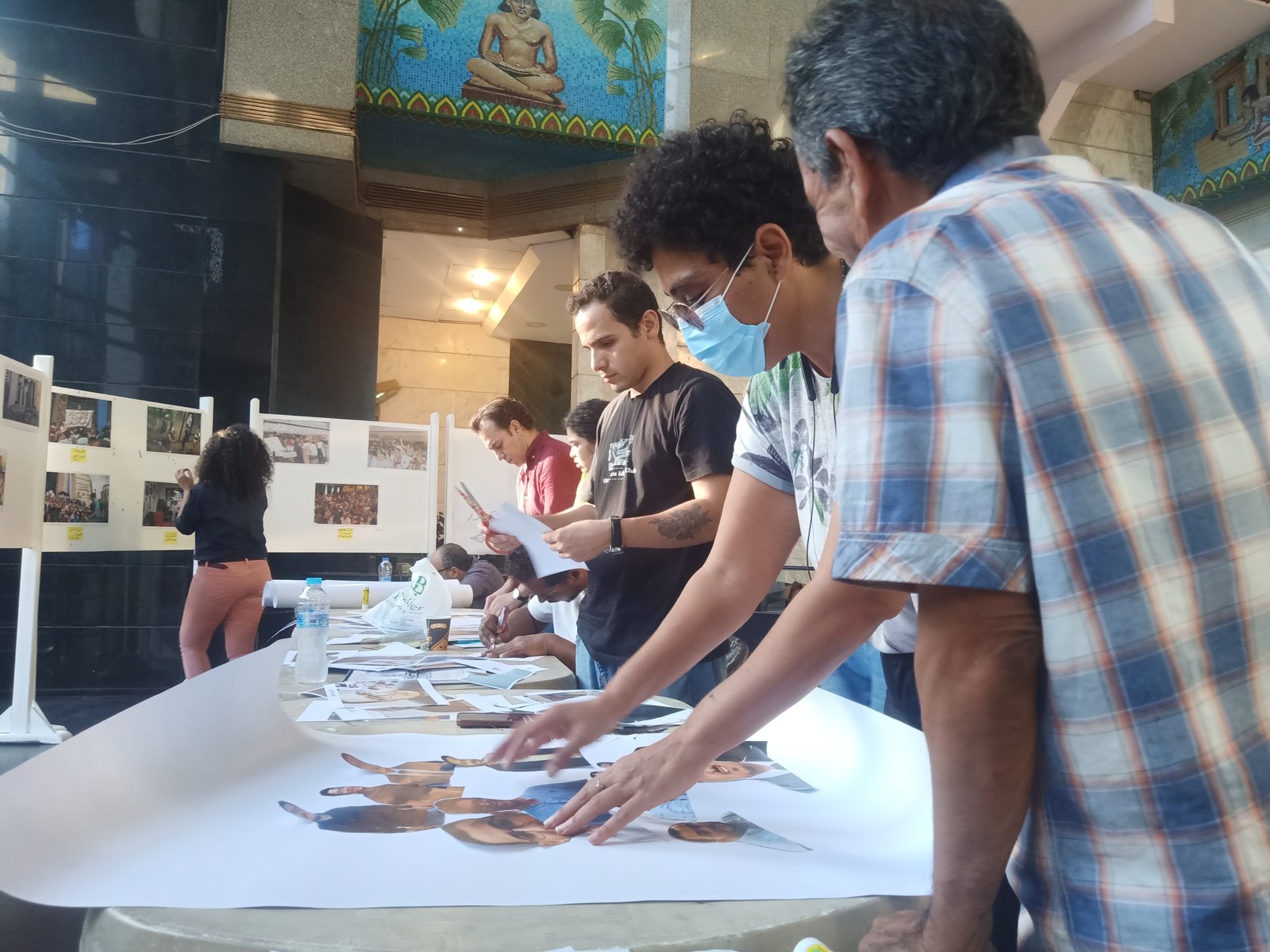
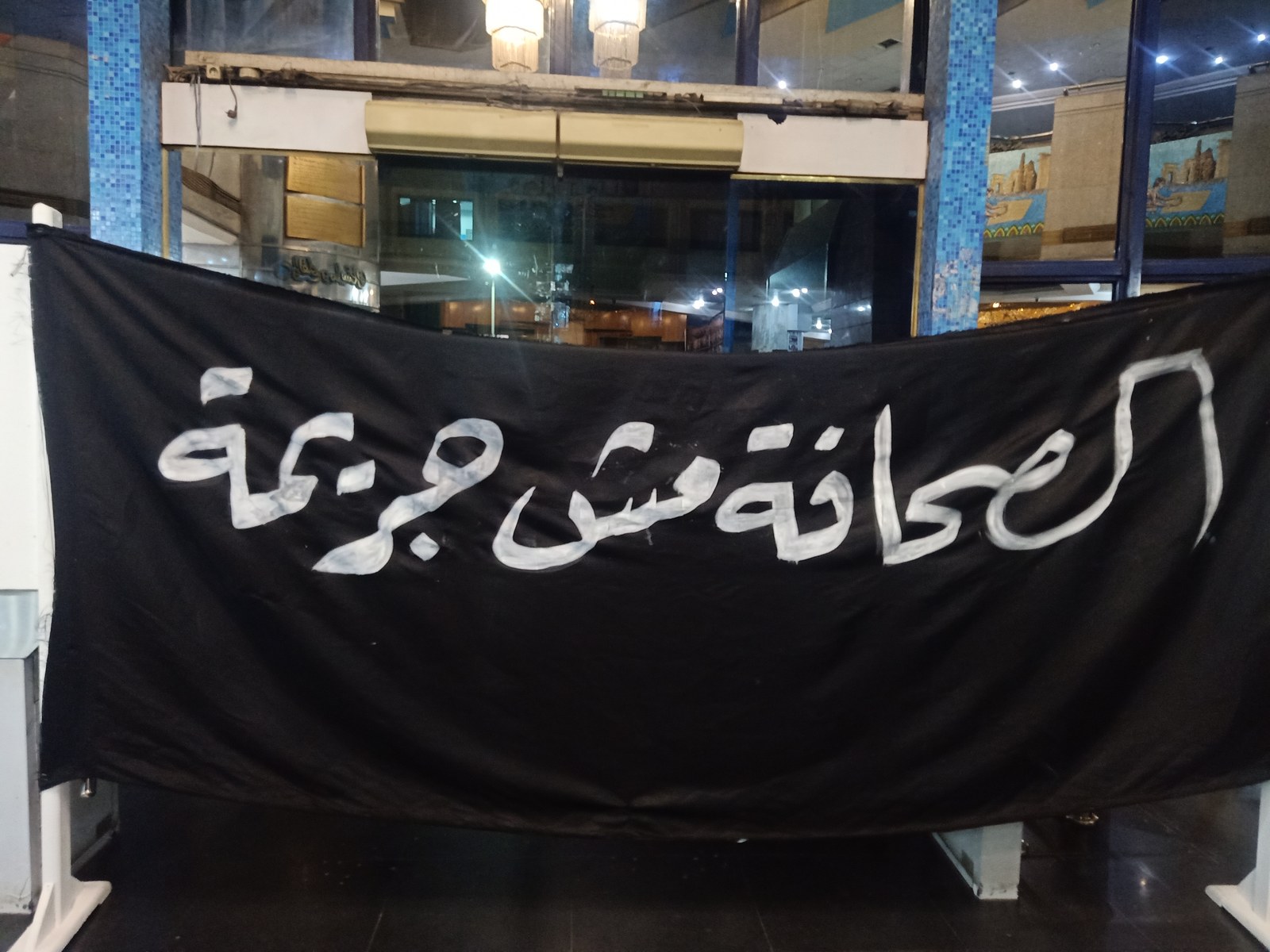
Security personnel in uniform and plain clothes were visible along the streets leading to the syndicate from different directions, alongside police vehicles and civilian cars. There was also a security presence around the building. Inside, dozens of journalists took part in activities lasting from around 5pm until after 9pm: an exhibition of photographs, cartoons and solidarity posters, followed by a discussion in the foyer where veteran journalists recalled imprisonment, protests and battles over laws governing the press.
This was not a conventional event with speakers taking turns on a platform set apart from the audience. All the activities unfolded in the foyer, where exhibition and discussion shared the same space. Pictures and placards reminded those attending that the ordeal facing Matsda2sh’s journalists was part of a longer struggle over press freedom.
Imprisoned journalists’ work at the heart of the syndicate
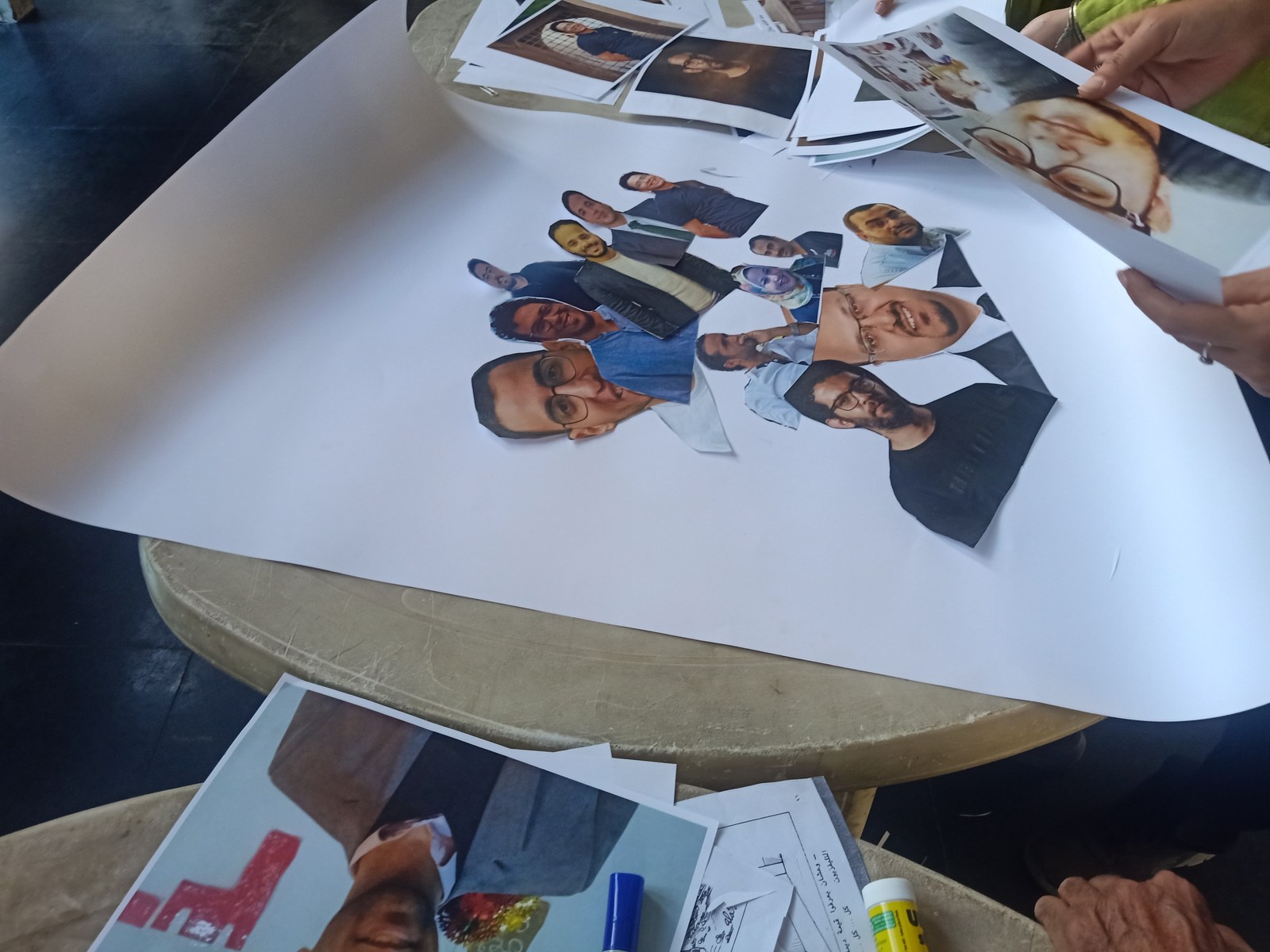
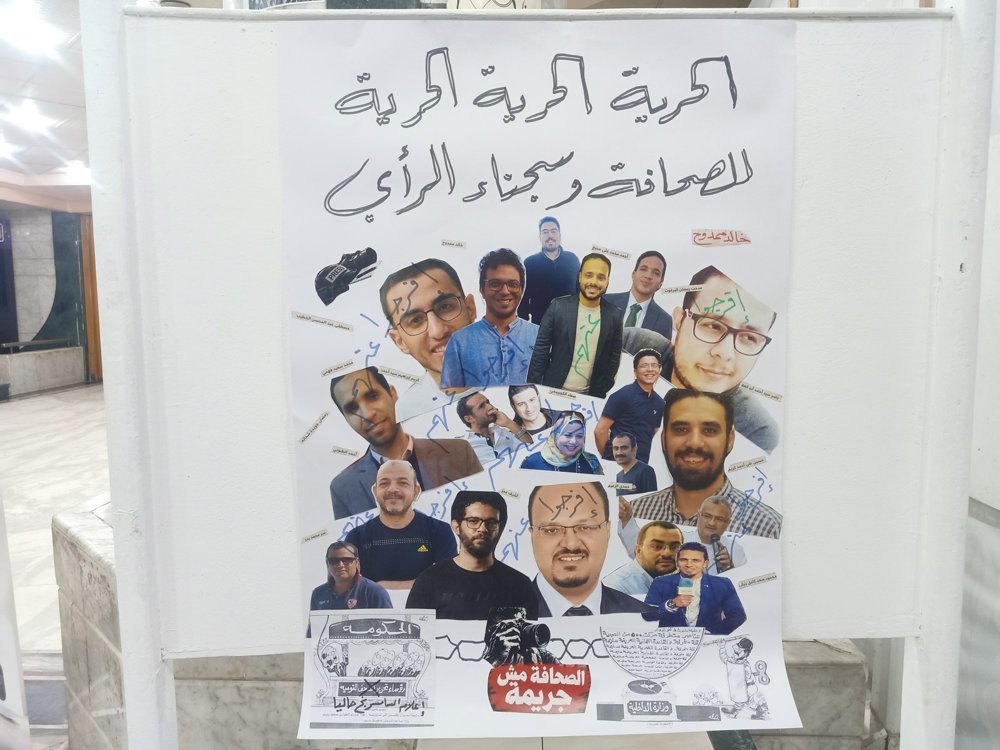
The event began at around 5pm with an exhibition featuring cartoons in solidarity with imprisoned journalists, including Ashraf Omar, alongside photographs taken by journalists now in detention, including Haider Qandil. Rather than appearing only in legal statements or lists circulated among people following their cases, detainees’ images and work were displayed in the place intended to bring journalists together to defend their professional interests and rights.
Alongside the artworks were posters bearing direct slogans: “Journalism is not a crime”, “Long live press freedom”, “Down with journalism by instruction”, “Long live journalists’ struggle” and “Down with Samsung journalism”.
The phrases “journalism by instruction” and “Samsung journalism” evoke a widely circulated video of Extra News presenter Noha Darwish reading a statement from the public prosecutor. She also read out “Sent from a Samsung device”, an automatic email signature that had remained in the text. The clip prompted criticism of how the script had been prepared before broadcast.
The photography exhibition included images of sit-ins held inside the syndicate by families of imprisoned journalists, attacks by thugs on the syndicate in May 2016, journalists’ solidarity demonstrations with Gaza in October 2023, and the 2013 “A Nation Without Torture” conference. It also featured photographs from several syndicate general assemblies. Banners bearing portraits of detained journalists and demands for their release were hung alongside them.
Law 93 of 1995: a battle that remains in living memory
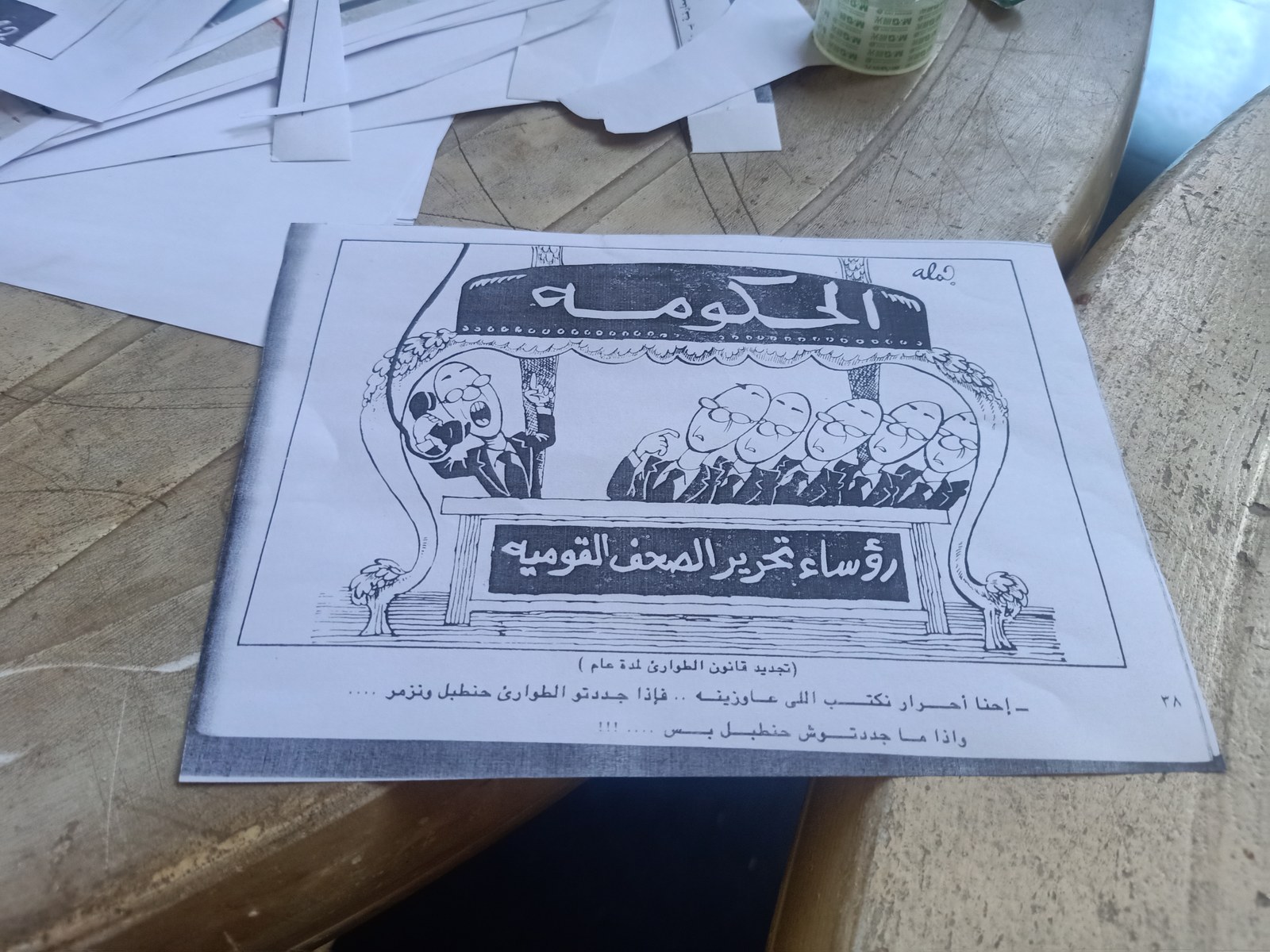
The programme included a documentary about the syndicate’s history and journalists’ struggles. It focused on their mobilisation against Law 93 of 1995, remembered within the profession for tightening restrictions and penalties on journalism. Opponents called it, among other names, the “law to assassinate the press” and the “law to protect corruption”. Against this backdrop, participants recalled earlier syndicate protests, including battles over press legislation and imprisonment for publication offences.
Alaa Al-Attar: the freedom to establish newspapers underpins other freedoms
At the discussion moderated by Hadeer El-Mahdawi in the foyer at around 7pm, journalist Alaa Al-Attar opened by describing the freedom to establish newspapers as the mother of freedoms, because it creates room for a plurality of news organisations and the development of the profession. He linked that freedom to journalists’ ability to build independent institutions, rather than having their future confined to a limited number of employers.
Al-Attar pointed to the constitution’s provision for establishing newspapers and publications by notification. In discussing print newspapers and websites, he argued that constitutional guarantees were not reflected in practice. Restrictions on establishing newspapers, he said, affect pay, independence and professional dignity. When opportunities to create new organisations narrow, journalists become more dependent on a small number of employers and less able to move elsewhere or build an independent journalistic project.
From this perspective, Al-Attar argued that improving journalists’ conditions should not be limited to the technology allowance or demands for a new pay structure. It should also involve opening the way to establish newspapers and expand employment opportunities.
His argument resonated with some of those attending as the discussion turned to Matsda2sh. A news organisation’s survival depends not only on having an editorial team, but also on the room available for it to operate, publish, obtain information and address mistakes through clear professional and legal procedures.
Medhat El-Zahed: defending journalists protects everyone’s rights
Journalist Medhat El-Zahed recalled an episode that remained vivid for several participants: the iron and steel factory case, solidarity with its workers, and the arrests of journalists Mohamed Sayed Said, Mostafa El-Saeed and El-Zahed himself. He presented it as an example of how journalism does not operate in isolation from society. Reporting on workplaces or social protests can expose journalists to risks extending beyond their own organisations, making syndicate intervention necessary to protect them.
The Egyptian Iron and Steel Company witnessed two workers’ sit-ins in July and August 1989 over incentive payments and administrative decisions, amid disagreements with the union committee about how workers’ interests were represented. The first sit-in ended on 12 July with commitments to increase incentives. The second expanded on 1 August, involving around 16,000 workers, before security forces stormed the company at dawn on 2 August. Worker Abdel-Hay Mohamed was killed, dozens were injured and hundreds of workers were arrested.
In El-Zahed’s account, these events were not simply a dispute between journalists and the authorities. They concerned the public’s right to receive information and different opinions. A citizen unable to access multiple accounts of a public issue does not have the same tools to understand and assess it, he said. Press freedom, in his view, is not a sectional demand confined to syndicate members; it is bound up with society’s right to know.
Press freedom is not a sectional demand confined to syndicate members; it is bound up with society’s right to know.
El-Zahed also discussed pretrial detention in cases concerning expression. He argued that its justifications fall away when the published material is known and available and there is no genuine risk of evidence being destroyed or an investigation being obstructed. He recalled a syndicate delegation’s prison visit during Makram Mohamed Ahmed’s tenure as chairman, when detained journalists, including Mohamed Sayed Said, were being subjected to torture. The chairman’s intervention despite political differences with the detainees, he said, illustrated why the syndicate’s role should not depend on political affiliation or position.
For El-Zahed, the value of syndicate action becomes clearest when it defends someone whose views differ from those of its leadership. Professional protection loses its meaning as a general safeguard if it changes according to a journalist’s proximity to decision-makers. The syndicate principle, by contrast, is that fair legal treatment and professional defence do not depend on political agreement.
Gamal Fahmy: can newspapers suspend publication in protest when they are already blocked?
Journalist and writer Gamal Fahmy recalled newspapers’ collective suspensions of publication in 2006 and 2007, when more than 20 newspapers and other publications took part on each occasion. He connected the first action to commitments concerning the abolition of imprisonment for publication offences, then discussed the later protest against custodial sentences handed down to journalists, including editors-in-chief.
On 9 July 2006, 25 independent and party newspapers in Egypt suspended publication to oppose proposed legislative amendments that retained prison penalties for publication offences. Journalists dubbed the proposal a law to assassinate the press. The escalation came amid a dispute between the government and the syndicate over provisions permitting imprisonment, particularly for allegations impugning a person’s financial integrity. The syndicate considered the wording vague and liable to be used to protect corrupt individuals and restrict freedom of expression.
On 7 October 2007, 22 independent and party newspapers suspended publication in protest at court rulings sentencing seven journalists, including five editors-in-chief, to prison on charges of insulting the ruling party. The action sought to highlight restrictions on press freedom and demand the abolition of custodial penalties for publication offences. Nineteen international organisations also expressed support for Egyptian journalists, while the International Federation of Journalists called for that date to become a worldwide day of solidarity with them.
Fahmy moved from recalling those experiences to asking whether they could be repeated today, when newspapers and websites that might join a collective protest are already blocked or restricted. Organising broad professional action therefore becomes harder. He criticised what he saw as a retreat in the freedom to establish newspapers and discussed the use of false-news accusations in cases concerning journalism, as well as prolonged pretrial detention in some cases.
Journalist Nour El-Hoda Zaki added her own account of a brief detention during a solidarity action for Palestine in Tahrir Square, in the context of events in Sheikh Jarrah. She said she and a friend went to the square to raise the Palestinian flag and were detained with others for around four hours. According to her testimony, they were beaten and insulted. She said intervention by public figures and journalists, including Khaled El-Balshy, Gamal Fahmy, Diaa Rashwan, Hussein Abdel-Ghani, Hossam Eissa and Gamal Zahran, among others, helped secure their release.
Karem Mahmoud: the syndicate’s defence extends beyond its members
Journalist Karem Mahmoud spoke about the syndicate’s role beyond formal membership. He recalled his arrest in 1981, when he was a university student working at Al-Shaab newspaper and was not registered with the syndicate. He said the arrest followed an incident in which he damaged Israel’s pavilion at the book fair, then held at the site now occupied by the Cairo Opera House. Galal Aref, who was the syndicate’s deputy chairman at the time, visited him at Qasr El-Nil police station in that capacity, he said, and a syndicate lawyer attended the interrogation.
Mahmoud also described events on 26 January 2011, when he, Mohamed Abdel-Quddous and others, including students and journalists who were not syndicate members, were detained in a security-force camp near the Arab Contractors area. He recounted managing to telephone chairman Makram Mohamed Ahmed, who, according to Mahmoud’s testimony, went to Interior Minister Habib El-Adly’s office to demand the journalists’ release and refused to leave before it happened. Mahmoud said syndicate members refused to leave detention until the students were released too, and that 812 students left with them at around 2am.
He also recalled syndicate visits to imprisoned journalists, including Hany Salah El-Din, Mohsen Rady, Badr Mohamed Badr and Ibrahim El-Darawy. The syndicate’s board, he said, decided to organise weekly visits bringing food and other necessities. He linked these experiences to the need for syndicate protection to extend to non-member journalists, bloggers and students when they are detained over expression or public activity.
Mohamed Abdel-Quddous: solidarity requires follow-up, not a single occasion
Participation was not limited to those in the foyer. Writer and journalist Mohamed Abdel-Quddous apologised for being unable to attend for health reasons following surgery and sent the following letter:
To my dear colleagues at the meeting to defend the arrested journalists, greetings, with all appreciation and respect.
I apologise for being unable to attend because of my health following an operation that, thanks to God, was successful. I have specific proposals on this matter to put before you:
1. Contact the families of imprisoned journalists who are prisoners of conscience, to declare the Journalists Syndicate’s full solidarity with them and its readiness to serve them.
2. Issue a new statement responding to the slanders made against our wronged, imprisoned journalist colleagues and send it to three groups:
• Credible newspaper columnists, who are unfortunately few in number.
• The various respectable news websites, of which, thank God, there are many.
• Foreign news agencies that have followed what happened to our colleagues, and human rights organisations concerned with this issue.
3. Hold a rights seminar on the obstacles to press freedom in Egypt, with journalists joined by specialists in the field and patriotic public figures known for opposing restrictions on freedoms.
4. Hold a patriotic arts event in solidarity with our imprisoned colleagues, centred on songs expressing love for Egypt, alongside patriotic poetry if possible.
5. Examine how to broaden the front of solidarity with our imprisoned colleagues. I am absolutely certain that most journalists reject what has happened, but fear governs them, preventing them from openly expressing solidarity under the harsh conditions prevailing in our country. The question is: how can this fear be overcome?
6. Finally, ensure that journalists meet regularly, every two weeks, for example, to follow the latest developments in this painful matter. One of our country’s afflictions is that everything in Egypt is forgotten after a while. But we will never forget our honourable arrested colleagues.
Every oppressor will meet their end, God willing.
Your sincere brother, Mohamed Abdel-Quddous.
The journalists present agreed to organise recurring solidarity evenings, to be announced later, while the open-ended sit-in continues to demand the release of Matsda2sh’s journalists and all journalists detained in cases concerning expression and publication.
The Committee to Protect Journalists (CPJ) has reported 25 journalists imprisoned in Egypt, placing it among the Middle Eastern countries with high numbers of detained journalists. In CPJ’s records of allegations of torture and beatings of journalists in prison since 1992, Egypt comes third, after Iran and Israel.
In the 2026 World Press Freedom Index, published by Reporters Without Borders (RSF), Egypt ranked 169th out of 180 countries, compared with 170th in 2025. In its report on the 2026 rankings, RSF said global press freedom had fallen to its lowest level in 25 years and that the legal indicator had deteriorated in more than 60% of the countries assessed.
In its 2026 World Report chapter on Egypt, Human Rights Watch said journalists working for independent media faced security and judicial harassment, and that the authorities continued to target journalists, human rights defenders and opposition politicians for expressing their views. The organisation also highlighted prolonged pretrial detention in a number of cases.