
At one o’clock on a hot summer morning, Ali embraced his wife and son before she brought him a bag in which she had packed simple canned food, a few bottles of iced water and work clothes. The worker hurriedly bade his family farewell and left to join a car waiting for him on the outskirts of the village, carrying a number of other workers with the same physical features and dark complexion, signs that they work in toil and hardship.
Dozens of gold sieve workers (who prospect for and extract gold from mines and mountains) gathered, moving in small groups and in cars that carry them along mountain tracks towards the mountain areas between the Red Sea and Qena, where gold mines unknown to many citizens lie. What is striking is that the contractors of the sieve workers know these rugged mountain tracks by heart and use astronomical calculations to travel through these passes, accompanied by dozens of workers from the toiling class.
On that journey, the contractors use dilapidated cars to transport the workers to their work areas, with hardly any protection, as described by workers we spoke to. They say each of them carries his belongings and some water and food, as their work trip in those areas lasts about three months, but it becomes gruelling in light of the climate change Egypt and the world have witnessed in recent years.
Zawia3 reveals the details of the gold sieve workers’ journey… So what happens to them?
Harsh Nature and Unprotected Labour
According to official data, there are about 120 mines that Egypt has used to extract gold since the time of the ancient Egyptian state and which still exist today, distributed across four sectors: the northern sector with three sites, the central sector with 62 sites, the south-eastern sector with about seven prospecting sites, and the southern sector with 19 sites, in addition to undisclosed sites.
Ali Mansy, one of the contractors of gold sieve workers in the Red Sea Governorate, says that workers are chosen according to the nature of the work in each area, as physical characteristics and age are determined accordingly. In some areas deep in the mountain, some young men are required to endure the hardship of working with primitive tools, especially as they work in secret and avoid the security patrols that set out from time to time along the mountain tracks.
He explains, speaking to Zawia3: “We often use fire and firewood along with large lighting devices, but not permanently, so that we are not exposed or robbed by mountain dwellers who have criminal sentences against them, because most of them carry weapons and have men in those rugged mountain areas, which may endanger the workers’ lives.”
He adds: “Sometimes the workers’ families may be threatened by gold-prospecting groups or the traders who run this trade, many of whom are based in Nag Hammadi district and in the gold market or goldsmiths’ market in Qena Governorate, and have been working through their own workshops for decades.”

According to Mansy, women also take part in delivering gold grains after extraction and selling them to traders, who turn them into gold bars and sell them at the peak of gold jewellery and bullion prices.
Zawia3 tried to obtain information by analysing newspaper data to identify cases of gold sieve workers being arrested, but the most famous incident, which caused a stir in the first third of this year, was the news of the arrest of Romani Issa, known as the gold emperor of Egypt, as the case revealed that he and his partner, businessman Hisham El-Hazek, obtained gold through a partnership between them in the “Hamash” mine in the Eastern Desert, near the city of Marsa Alam in the Red Sea Governorate.
The investigations showed that the two men had used chemical methods to extract large quantities of gold, in violation of the laws the authorities had set in this regard, which reveals that there are influential parties heading this illicit trade (perhaps also in violation of the duties of their positions).
By monitoring the Egyptian newspaper Al-Ahram in the period from 2008 to this year, 2024, it became clear that most of the cases announced by the police were concentrated in the Aswan and Red Sea area, especially Marsa Alam, and ranged between the arrest of gangs engaged in illegal gold prospecting and smugglers on the road carrying dozens of tonnes of gold ore in vehicles.
Our monitoring showed that between 2008 and 2013 this phenomenon was not widespread and did not dominate the media scene, but between 2013 and 2015 the intensity of secret and illegal gold prospecting became evident, especially in the mountains of the Red Sea, Qena and Aswan. During the research period between 2008 and 2024, we also recorded the arrest of about 1,800 defendants, including 23 holding Arab nationalities.
The period between 2016 and 2018 saw an escalation in prospecting operations, and Egypt recorded several collapses of unlicensed mines. The number of deaths from illegal prospecting accidents between 2017 and 2022, according to news published in Al-Ahram, is estimated at about 25 people, distributed between Aswan, Marsa Alam and the mountain village of Qift in southern Qena.
Barefoot on a Bridge of Gold
Nasser Mohamed Sayed, one of the gold sieve workers, explains how they sift the sand and sort the gold. He says they sieve sand containing gold grains and other minerals, which are separated and sifted through sieves designed for this purpose after being ground in small mills, and collected with a “loader” they bring with them.

He continues: “Everyone walks along a single mountain path, and the group must be homogeneous and know each other well, out of concern for security, secrecy and agreement among them. Food and drink must be prepared in quantities suited to the time the trip may take. We move before the dawn call to prayer, and the group consists of about ten people, divided between the driver, sieve workers, porters and machinery assemblers.”
He adds: “We have a gold detector with us, and we move from the Fawakhir area in the Red Sea mountains until we reach the designated point for descending into the mountain. Most of the time the contractor is the only person who knows the target location and the way down to it, and he may bring with him a guide from the area’s residents. Most of the time we do not know where we are heading, except for the few of us who have worked in this profession for several years, and the way becomes clear through signs and numbers placed by antiquities prospectors in these mountain areas, which of course can only be seen in the morning, given the difficulty of seeing at night.”
Saber Ali El-Kesir, another worker, picks up the conversation and adds: “We arrive in small groups at the designated place after a journey that takes hours and may reach about five days, because of the difficulty of moving directly. We stop to rest, eat and relieve ourselves, and after reaching the desired place we wait for the reconnaissance teams to secure it, then we pitch the tents in which we will stay.”
Sadek Adly, a sieve worker, points out that they go without bathing for long periods, are exposed to inhumane living conditions in the desert and sleep in the open in cloth tents. He describes the winter cold as harsh at those times, while they are exposed to heat stress during summer days, so they prefer to work at night in that season. On top of all these hardships, they also face the danger of scorpion stings and venomous snake bites.
He calls for regularising the status of those working in this field, to preserve mineral and human wealth, but this requires concerted efforts and support from the authorities for the initiatives that everyone should adopt to succeed.
Amer Mohamed, one of the workers, picks up the conversation with us, explaining that they take some medical tools and remedies with them, especially folk ones; before setting off they obtain necessary medicinal herbs, and they may be accompanied by a snake charmer (a person specialised in dealing with dangerous reptiles and scorpions).
The worker points out that they are outside the state’s social and insurance protection system, as they work as a category of informal labour engaged in the state’s parallel economy. He adds that they know their profession is illegal; therefore, anyone among them who is injured or dies receives no compensation, neither he nor his family, and dozens of them have indeed suffered serious injuries or death as a result of grinding, prospecting and sieving operations.
According to Egypt’s Minister of Labour, Mohamed Gebran, the authorities have recently focused on calling for irregular workers to be registered in their system, and announced the registration of about 1,164,012 workers as of last September, 2024. The ministry grants these workers six periodic grants a year, in addition to two grants in Ramadan and at Christmas. Through Labour Law No. (12) of 2003, it also stresses that these workers must receive their wages and compensation of up to EGP 200,000 in case of disability or death.
Commenting, lawyer Ahmed Abdel Ghani, who specialises in labour affairs, stresses that the contractor or employer must provide protection for the worker, the wage must be fixed, and there must be a contract between the worker and the owner. But he points out that in the case of sieve workers there are no guarantees for workers, whether from the contractor or the traders, because their work is illegal.
The labour lawyer notes that a worker in this profession receives no fixed wage, and they are aware that they are doing illegal work, so they accept only the wage they get from the contractor or employer.
Trackers on the Gold Diggers’ Journey
Emad Abu Gabal, one of the trackers in Qena Governorate in Upper Egypt, says, speaking to Zawia3: “We walk in the mountains of the Red Sea area, specifically Marsa Alam, Hurghada, Quseir and Ras Gharib. Our job is very important for those who do not know the rugged mountain roads well: we identify the places, the kinds of animals that live there and the tracks vehicles can travel along, until reaching the target location.”
He points out that he has witnessed incidents in which people were found dead while working in the mountains in sieving, prospecting, breaking and grinding work.
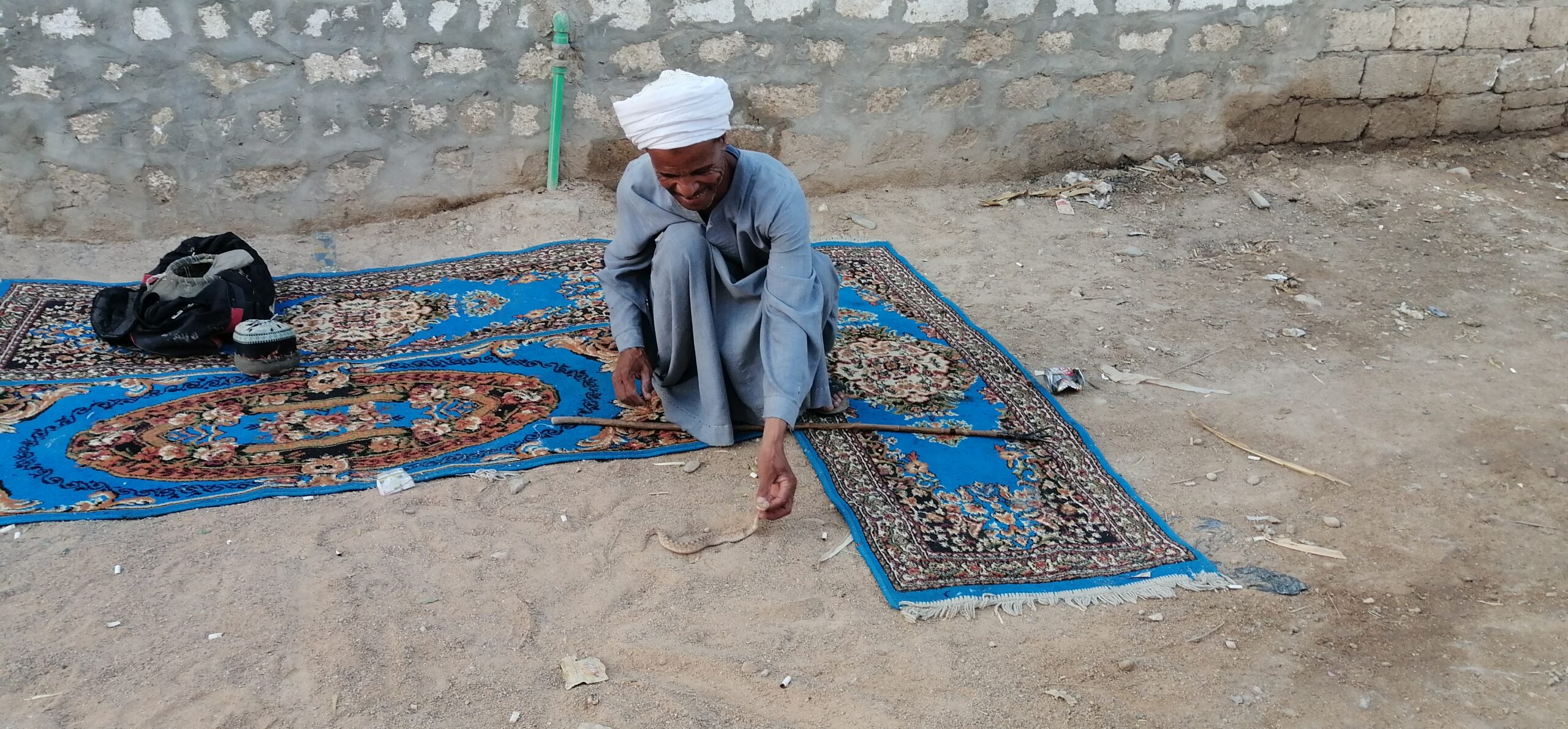
Mohamed El-Saghir, a snake charmer, explains, speaking to Zawia3, that he has worked in this profession for about 45 years and has a special charm prepared from folk medicine that is used to treat those stung or bitten. He adds: “I charm or fortify the place: when we are in a mountain area and know that there are pests and venomous animals, we fortify the place so that if a snake or scorpion comes near it does not bite or sting any of the workers. Sometimes we clean the place safely using pebbles on which there is what we call in Upper Egypt ‘al-karfa’, the same thing we use for treatment, in addition to the Rifai oath, which we know by heart. Work in the mountain is not free from the risk of stings or bites, so most of us live in mountain areas and move from place to place.”
Commenting, Mostafa Mahmoud Ismail, a consultant in geological and environmental sciences, stresses, speaking to Zawia3, that this work is illegal and anyone involved in it is a criminal, as it constitutes an assault on the state’s wealth. As he describes it, gold belongs to all Egyptians, and some traders have no right to seize it for themselves alone.
He points to the Golden Triangle project, part of which extends along the Qena-Safaga road for 160 kilometres and a second part between the cities of Qift and Quseir for 167 kilometres. In his opinion, the base of the triangle could be widened so that its apex is at the city of Zaafarana in the north and its base at Halayeb and Aswan, describing it as a basket of precious and valuable minerals that prospectors seize.
The geological and environmental sciences consultant notes that the area contains more than 30 minerals, including phosphate, iron and gold, adding: “The area has more than 100 sites for silver alone, in addition to other minerals such as manganese, chromium, nickel, titanium, copper, lead, tin, quartz, white sand, sulphur, potassium and diatomaceous clay, as well as building materials such as sand, gravel, limestone, shale, gypsum and cement raw materials, and ornamental stones including all kinds of marble and semi-precious stones.”
Ismail explains that he presented to the former Governor of Qena, Adel Labib, a proposed project with many maps confirming that Egypt is the third country in stone resources and the fourth in ornamental stones, which, if invested, would change Egypt’s economic map.
This is confirmed by Abbas Mansour, former president of South Valley University and a geological expert, who comments, speaking to us: “The project will protect Egypt from the phenomenon of the illegitimate exploitation of some of the country’s wealth, and will also increase tourism activity, especially as Qena Governorate has many archaeological areas dating back to the ancient Egyptian, Coptic or Islamic eras, in addition to the urban communities that could be established.”
Why the Golden Triangle Project Stopped
According to what Zawia3 has learned, the Golden Triangle project stopped after the Regeni incident, the Italian student who was killed in 2016. The Egyptian government had commissioned the Italian company “D’Appolonia” to carry out a study on the project and identify the sites for extracting minerals that could be exploited. The company was scheduled to hold a meeting to determine implementation mechanisms, but the Regeni case affected the project and stopped it.
Ahmed Soltan, a specialist in oil and energy affairs, presents in a study the importance of the Golden Triangle area between Qena, Safaga and Quseir. He says the base of the triangle on the Red Sea is 80 kilometres long, between Safaga and Quseir, the Qena-Safaga road forms one side of the triangle, 164 kilometres long, and the second side is the Qift-Quseir road, 174 kilometres long.
The project is to be implemented in six phases, with the first phase taking five years and the project as a whole 30 years, and the authorities sought to benefit from the project in every way that achieves economic, social and mineral development, as the area alone holds 72% of Egypt’s minerals.
Hamada El-Gebalawy, deputy head of the Energy Committee, called for protecting mineral wealth, opening the file of gold prospectors and preventing the exploitation of workers in any illegitimate work that may lead them to their deaths. He also called for a timetable and a complete map of gold locations to be offered to investors, asking: “Does the Ministry of Petroleum have information about the places being searched, so as not to repeat the mistakes of granting more than 80 kilometres for gold exploration, which in the end were left to the gold diggers to search without a studied basis?”
During its meetings in April this year, the Egyptian Parliament announced the draft budget of the General Authority for the Golden Triangle Economic Zone for the 2024/2025 fiscal year, totalling EGP 32 million. The draft budget of the authority for the new fiscal year amounted to EGP 32 million, compared with EGP 10 million in the current fiscal year 2023/2024, an increase of EGP 22 million. The draft budget allocated EGP 9,255,000 for wages, EGP 3,954,000 for expenses and EGP 800,000 for raw materials, supplies, fuel and spare parts, and total costs and expenses amounted to EGP 32 million.
No Health Guarantees
Returning to gold sieve workers as a category of irregular labour, Mohamed Ahmed Saber, a physician at a government hospital, comments that officially registered irregular workers can receive treatment at government hospitals, but it is difficult for sieve workers to obtain this because their work is illegal and therefore they cannot be registered with the Ministry of Labour. So, when injured, they resort to clinics or unofficial places for treatment, for fear of prosecution.
Juliet Ayyad, a physician at the Hagar El-Gabal health unit of the Nag Hammadi health administration in Qena Governorate, Upper Egypt, explains that she often meets citizens who have been stung by scorpions or bitten by snakes because of the mountain environment they live in, but as for gold sieve workers, she has never encountered them, because they work in remote mountain areas, especially as they resort to folk remedies instead of modern treatments.
Ahmed Abdel Ghani, a lawyer before the Court of Appeal who specialises in labour affairs, comments, speaking to Zawia3, on the legal status of these workers and prospectors, saying that under Law No. 141 of 2017 on the control of precious metals and valuable stones, severe penalties have been imposed, reaching five years’ imprisonment and a fine of up to EGP 10 million, on those who unlawfully extract any of the metals and stones such as gold, silver and platinum.
The labour lawyer adds that under Article (22 bis) of Law No. 141 of 2017, anyone who unlawfully extracts any precious metals or valuable stones shall be punished with imprisonment of no less than two years and no more than five years, and a fine of no less than EGP 5 million and no more than EGP 10 million. The same article of Law No. 141 of 2017 punishes anyone who establishes a facility for that purpose with the same penalty, and in all cases the seized items shall be confiscated.
Despite knowing their unlawful legal status, these workers carry on with their work in pursuit of a living, according to what they told us, as they receive wages ranging between EGP 4,000 and 5,000, which may increase depending on the period the worker spends and the degree of danger and difficulty he faces. Even so, they complain that they are exposed to great dangers, while the traders alone obtain the gold grains, and the gold sieve workers hope for a legal and legitimate framework for their work, so that they do not continue to offer more victims or face legal prosecution.