

Egypt’s August heatwave made earning a living an ordeal for workers who could neither avoid the sun nor afford to stop. Forecasts in mid-August put temperatures in the far south in the high forties Celsius. Across construction sites, streets, factories and poorly cooled offices, workers described exhaustion and illness with few practical protections.
Ten workers and employees interviewed by Zawia3 said repeated heatwaves had affected them severely. Their accounts describe workplaces without adequate cooling, insufficient breaks and financial pressure to keep working despite symptoms.
Heat stress occurs when the body accumulates more heat than it can dissipate. Hot weather, humidity, physical exertion and clothing can all contribute. It can cause conditions including cramps and heat exhaustion, while heatstroke is a potentially fatal emergency. Headache, dizziness, fatigue and nausea should not be dismissed as simply part of a summer working day.
Outdoor agricultural, construction and sanitation workers face particular exposure, but enclosed workplaces can also be dangerous when machinery adds heat or ventilation is poor. Older people and those with chronic illnesses may be especially vulnerable. Workers’ accounts turn a health issue into a question about income, enforcement and the right to a safe workplace.
Deaths, estimates and the scale of exposure
The World Health Organization cites studies estimating approximately 489,000 heat-related deaths annually worldwide over 2000–2019. This is a modelled historical average, not a count of occupational deaths in a single recent year.
The International Labour Organization’s 2024 reporting separately estimates 18,970 work-related deaths and 22.85 million occupational injuries each year attributable to excessive heat. Its exposure estimate covers more than 2.4 billion workers globally.
A 2023 study in The Lancet Planetary Health estimated Egypt’s annual heat-related mortality burden at about 2,591 deaths. That is a research estimate, not an annual register of medically certified heatstroke deaths.
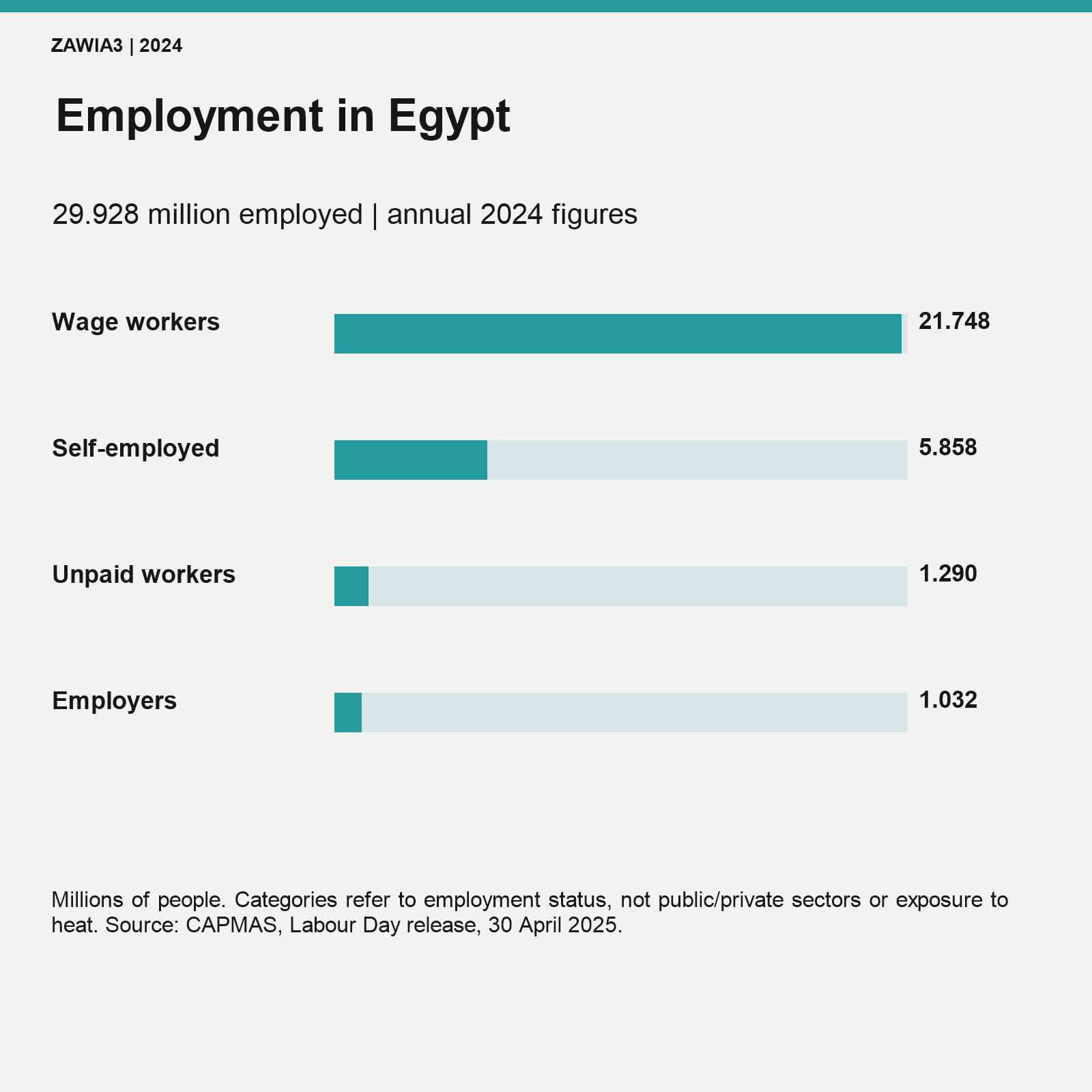
Egypt’s employment figures also require a consistent reporting period. CAPMAS’s 2024 annual figures, reported in April 2025, put total employment at 29.928 million, including 21.748 million wage workers. These figures describe employment status, not how many people have adequate heat protection.
Agriculture, construction, transport, waste collection and some manufacturing jobs combine physical effort with substantial heat exposure. Informal workers often have fewer effective routes to protection or compensation. Office work reduces direct sun exposure but does not guarantee a safe indoor temperature.
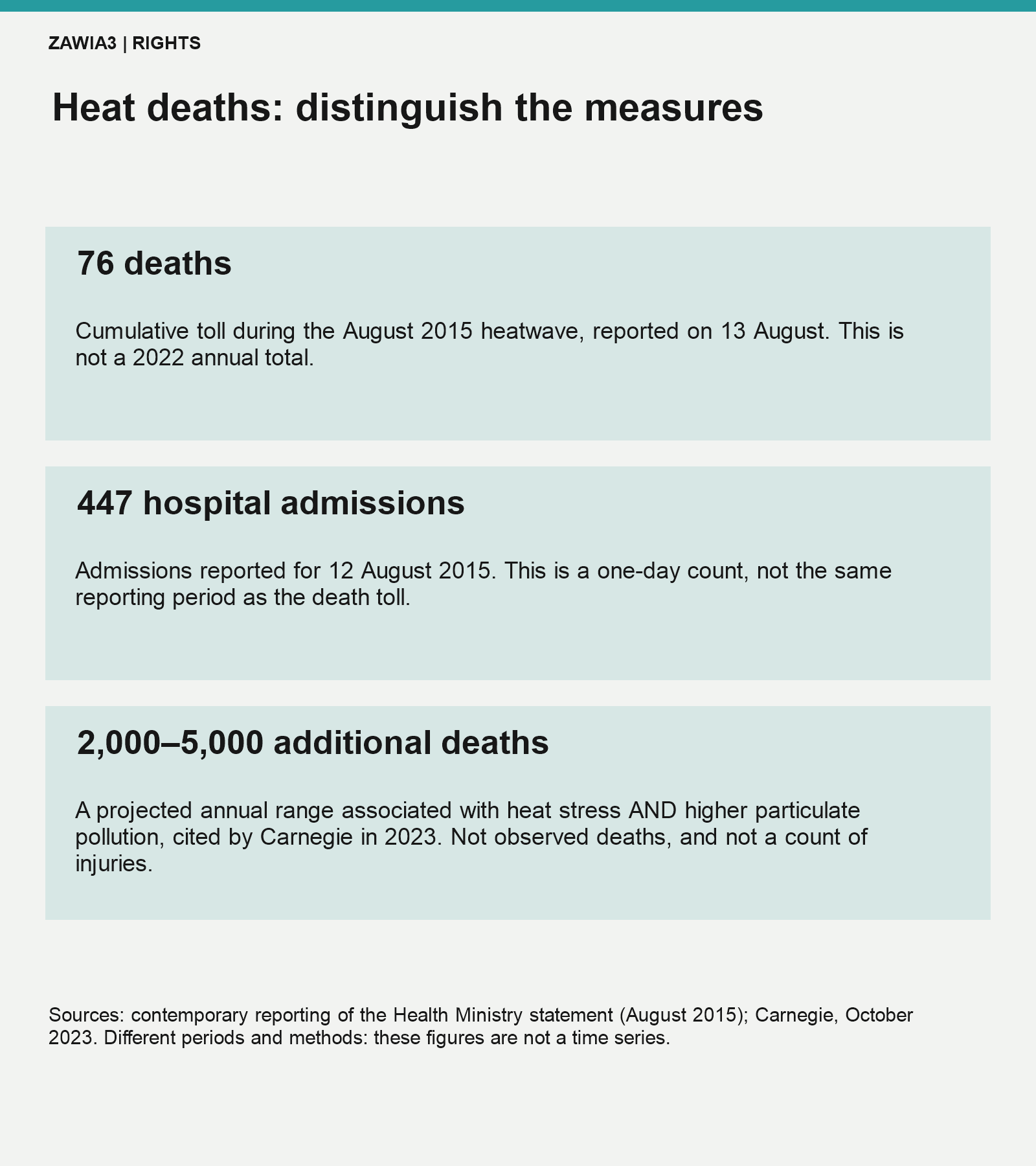
Historical casualty reports should not be treated as a comparable annual series. A Health Ministry statement reported on 13 August 2015 put the cumulative toll in that heatwave at 76 deaths and recorded 447 hospital admissions for the preceding day. Those figures were incorrectly attributed to 2022 in the original account. They describe different reporting periods within the same 2015 event.
A secondary academic paper cited 95 deaths and 1,400 injuries as 2020 figures, but the underlying official record was not established in this review. Those numbers are therefore not used here to plot a trend.
A 2024 paper on waste-disposal workers discusses projections of increasing heat-related illness and mortality under warming scenarios. Its references to future increases are conditional estimates, not observed outcomes.
Similarly, a 2023 Carnegie paper cites research projecting 2,000–5,000 additional deaths a year and losses equivalent to EGP 20–48 billion from the combined effects of heat stress and increased particulate pollution. The range should not be relabelled as injuries or attributed solely to hot winds and drought.
From building sites to bank offices
Mohamed El Sayed, a construction worker in his thirties from Giza, starts at 7am, sometimes earlier. The morning initially feels manageable, he tells Zawia3. As noon approaches, the sun becomes almost unbearable.
“We may work for more than nine hours, with only an hour in the middle of the day to rest and eat,” he says. He describes worsening discomfort in recent summers, including stomach and skin complaints. He also says workers heard that a colleague at a construction company in 6 October City had died from heatstroke; that reported death was not independently verified for this article.
Office staff have a different experience of the same pressure. Mona Abdel Razek, who works at a state-owned bank in Cairo, says she must wear formal, full-length clothing throughout the working day, even in extreme heat. A broken or weak air conditioner, combined with crowded customer areas, can turn the branch into what she calls a closed oven.
In summer 2022, she says, she abruptly left her desk after severe dizziness and weakness. Doctors subsequently diagnosed acute dehydration. Colleagues face similar discomfort, she adds, with stress and poor concentration making interactions with customers more difficult.
Mona calls for more flexible dress rules and workplace emergency plans. For her, adequate heat protection is a matter of health and life, rather than a luxury.
Microbus driver Emad Hassan, who has spent more than twenty years behind the wheel, describes long hours surrounded by hot glass, seats and a steering wheel heated by the sun. Exhaustion and lost concentration, he says, threaten passengers and pedestrians as well as drivers.
He recalls a colleague’s serious accident in 2021 after the driver fell asleep at midday. The account illustrates his concern about fatigue, although it does not establish a medical finding that heat caused the crash.
Stopping costs money. Drivers’ earnings depend on the number of journeys they complete, Emad explains, and higher fuel prices push them to work longer. “The heat is destroying our health day after day, but we have to drive to live.”
In a textile factory in Mahalla El Kubra, Ahmed Abdel Ati says heat from machines compounds the weather outside. A few fans offer little relief, while air conditioning remains out of reach.
He describes repeated headaches and dizziness among workers, with some colleagues taken to hospital after collapsing on production lines. Others hesitate to report symptoms for fear of being judged unfit for work. In his view, the absence of effective prevention leaves workers to absorb the risk themselves.
Delivery rider Karim Mostafa, in his twenties, describes hours on a motorcycle in traffic until his clothes are soaked with sweat. He says episodes of severe dehydration have forced him to stop temporarily, but fear of losing income pushes him back to work. Strict delivery deadlines add to the pressure.
Colleagues carry chilled water or use damp cloths in an attempt to cope. Karim says these improvised measures provide only temporary relief and do not replace company responsibility. He considers delivery workers overlooked by a system that fails to provide effective protection as conditions become harsher.
A workplace hazard that cannot be dismissed
Occupational safety consultant Tamer Sheraky and labour researcher Hassan Barbary agree that heat stress is no longer a minor seasonal complaint. They tell Zawia3 that rising temperatures expose weaknesses in workplace practice and institutional protection.
Sheraky describes dehydration and the loss of salts through sweating as important risks during strenuous work. He warns about cramps, exhaustion and heatstroke. These are distinct heat-related conditions; they do not necessarily occur in a fixed three-stage sequence.
Early symptoms can include fatigue, headache, nausea, heavy sweating, a rapid heartbeat and dizziness. Confusion, loss of consciousness or seizures in an overheated person require urgent attention.
NIOSH guidance published in 2010 makes clear that heatstroke can occur with hot, dry skin or with profuse sweating. Waiting for sweating to stop can therefore delay recognition of an emergency. Emergency medical help and rapid cooling are essential when heatstroke is suspected.
Sheraky identifies prolonged exposure, humidity, heavy physical work and unsuitable clothing as risk factors. Older workers and people with conditions such as heart disease or diabetes may be especially vulnerable. Protective arrangements must account for both the environment and the demands of the job.
The gap between law and protection
Barbary’s comments were made during the transition to Labour Law 14 of 2025, which took effect on 1 September 2025, before this article’s publication. He argues that the transition heightened uncertainty over implementation, inspection and compensation. It should not be understood as a complete absence of occupational-safety obligations.
He says the new framework contains stronger provisions relating to workplace hazards, working time, injury recording and compensation, but questions whether those protections will reach workers in practice. “Do we apply the old law or wait for the new one?” was his description of the uncertainty workers faced at the time of the interview.
He points to daily risks in factories, farms and outdoor sites, and cites a reported death of a sanitation worker in Sharqia while working in the sun. His concern is that the danger remains concrete while institutional responses lag behind.
Barbary criticises the slow development of a national occupational safety and health strategy. He says promises about reducing accidents, extending inspections to small workshops and informal work, protecting women and promoting safety awareness had not, in his assessment, translated into sufficient practical change.
He also questions the effectiveness of consultative and oversight structures and the availability of reliable accident statistics. Local decisions to shorten sanitation workers’ daytime hours are welcome, he says, but scattered decisions do not resolve uncertainty over compensation or establish consistent nationwide enforcement.
Prevention requires changes to work itself
Sheraky calls for clearer government rules governing work during peak heat, stronger inspection and employer action. Regular access to drinking water, shaded or cooled rest areas and schedules adapted to weather conditions should be part of ordinary workplace management.
Barbary advocates frequent breaks in shade and moving heavy work to cooler hours where feasible. Clothing should be appropriate to heat while maintaining any protection required by the job. He criticises heavy uniforms that add to sanitation workers’ burden.
Workers also need training to recognise symptoms in themselves and colleagues. Looking out for one another can help prompt earlier intervention, but responsibility cannot be shifted entirely to individuals whose pay or deadlines prevent them from resting.
A worker cannot meaningfully choose to avoid dangerous heat if stopping means losing the day’s income. Prevention has to include the way work is organised, not just advice to drink water.
On 12 August 2025, the Egyptian Center for Economic and Social Rights welcomed measures by some governorates to protect workers, especially street cleaners, during peak heat. It described restrictions on midday street work as a step in the right direction.
The centre called for reduced hours during the hottest periods, more breaks, shaded or cooled rest areas, work during cooler periods, drinking water and health monitoring. It urged that these become institutional safeguards rather than temporary responses to individual heatwaves.
Sheraky warns that heat also damages productivity and increases absence and occupational injury. Barbary argues that weak oversight and uncertainty about practical protection intensify the danger. Both see effective prevention as a combination of enforceable policy, employer compliance and worker awareness.
For the workers interviewed, the issue is immediate: whether they can earn an income without putting their health at risk. Protecting them from heat is therefore a workplace-rights and social-justice question as much as a medical one.