


Three months after a vaginal delivery involving an episiotomy—a surgical cut to the perineum—Reham Ali, 32, felt compelled to return to a doctor for another operation to address what she described as vaginal widening. Her husband was pressuring her and repeatedly threatening divorce or marriage to another woman because the aftermath of childbirth had affected their sexual relationship. Despite her intense fear of surgery, those threats left her feeling she had no choice.
Women commonly call the operation Reham sought the “husband stitch,” because it is often undertaken at a husband’s request without a medical or health indication. Most women fear undergoing it, according to those interviewed by Zawia3.
The term describes a non-medically indicated, professionally condemned practice in which one or more extra stitches are added to narrow the vaginal opening when tears are repaired after vaginal delivery, with the aim of increasing male sexual pleasure. According to the Sexuality Forum, it is classified internationally as a form of medical violence and a violation of women’s bodily rights, often performed without the mother’s consent or knowledge.
Dr. Amal Fahmy, executive director of Tadwein, told Zawia3 that discussion of the practice is primarily connected to episiotomy: a surgical incision that may be made during vaginal delivery to facilitate the baby’s head emerging. Doctors repair that incision after birth, she explains. Sometimes one or more additional stitches are added during the repair, popularly described as a “husband stitch.”
In the absence of official statistics on how many women undergo vaginal tightening after childbirth in Egypt, women’s social media groups reveal substantial interest in these operations. One group has more than 6,200 members, and some posts attract more than 350 comments from women seeking doctors or exchanging experiences.
Another group has about 27,000 members and hosts almost daily discussions about cosmetic gynecological procedures. A third has roughly 6,600 members, while a closed group has about 11,000 women sharing experiences and doctor recommendations.
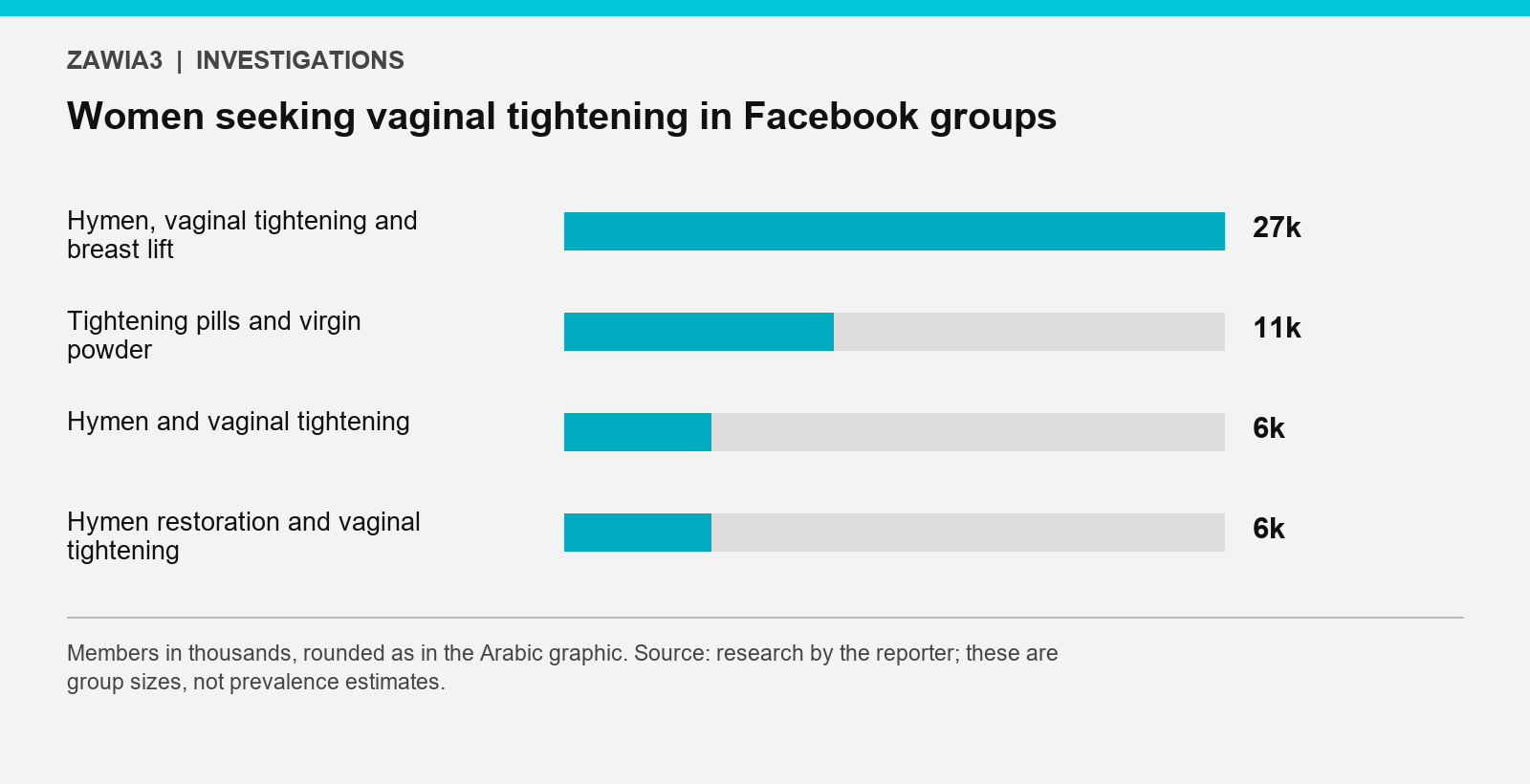
These figures are not statistical evidence of the practice’s prevalence. They nevertheless indicate demand for such procedures and a belief among some women that vaginal childbirth requires surgery to restore the vagina’s appearance and function.
Fahmy emphasizes the lack of accurate data. There are no official figures on the number of doctors adding extra stitches, the number of women subjected to them, or how many explicitly consented. Without that information, the scale cannot be scientifically assessed. She calls for mandatory hospital databases to monitor these practices and protect women from violations and physical violence.
Women between fear of surgery and pressure from husbands
Women interviewed by Zawia3 say these experiences are not isolated exceptions. They describe a practice increasingly encountered in recent years as husbands pressure women to undergo surgery.
Mona Abdullah, 29, had not considered surgery after her first child’s birth. She believed recovery needed time. Her husband’s repeated remarks about how their relationship had “changed” undermined her confidence and made her question her body. She told Zawia3 she tried to explain that her doctor had said her symptoms were normal after childbirth and that most changes gradually improve in the first months. His comments continued: he compared her with her pre-pregnancy self and demanded a “quick solution.”
The pressure was not confined to her husband. Women close to her advised vaginal tightening, saying it had become common after childbirth. As these conversations continued, she searched online and in women’s social media groups for doctors and other women’s experiences, then booked an appointment at a private clinic.
At the consultation, the doctor said the procedure could improve the tissue’s appearance and potentially their marital relationship. He did not adequately explain its limitations or the possibility that surgery was medically unnecessary. After weeks of hesitation, she agreed, seeking to end tension at home rather than treat a health problem.
“I was looking for stability more than cosmetic improvement,” Mona said. “I felt my body had become responsible for whether my marriage continued.”
Sara Mahmoud, 35, a mother of two, says vaginal tightening had not occurred to her until years after her last vaginal delivery. A passing comment from her husband about their sexual relationship became a repeated complaint, followed by a demand that she see a gynecologist.
She had no health problems, urinary incontinence or pelvic organ prolapse. The doctor nevertheless offered surgery to improve the “quality of married life.” A second doctor gave broadly the same opinion, strengthening her belief that the operation had become a routine option.
The cost—which in some cases reaches EGP 20,000—was high relative to the family’s income. Sara borrowed part of the money from her sister, believing family stability mattered more than the financial burden. She needed weeks to recover. The results fell short of her expectations, and the tension did not entirely disappear.
Her experience showed her that the problem was not solely physical but also concerned the absence of dialogue and unrealistic expectations of women’s bodies after birth. “If I could go back, I would first seek specialist advice or pelvic floor physiotherapy before considering surgery,” she said.
By contrast, Hasnaa Salem says she requested vaginal tightening of her own accord. “After vaginal delivery, I felt the relationship was no longer the same, and I was uncomfortable myself. I started looking for a specialist doctor.” She told Zawia3 nobody forced her decision; she saw it as a way to regain comfort and confidence.
Fahmy draws a careful distinction between these situations. Cosmetic gynecological procedures women choose voluntarily, especially after repeated births, are legitimate cosmetic operations provided they are performed by a specialist licensed to undertake them and the woman is an adult over 18 who has given full consent. Ethically and professionally, she says, this distinguishes a free decision from an intervention imposed or undertaken under pressure.
Is there a medical need?
An obstetrics and gynecology specialist who requested anonymity told Zawia3 that many women sustain tears around the birth canal as the baby’s head emerges. He describes the purpose of a doctor’s intervention as making a clean incision to prevent damage to the supporting muscle or urethra. After birth, tissue is sutured whether the tear occurred naturally or the doctor made the incision. This repair, he says, has nothing to do with the husband or sexual relations.
He distinguishes this from cases in which women complain after childbirth of dissatisfaction with sex—their own or their husband’s—and request tightening as a minor cosmetic procedure. That intervention, he says, is performed at the patient’s request.
The body undergoes many postpartum changes as it approaches its pre-pregnancy condition, he explains. The vagina may naturally tighten over time, sometimes causing pain during sex before recovery proceeds gradually. Problems arise when husbands rush this period and intercourse takes place while a wound remains relatively fresh and therefore painful.
He regards the “husband stitch,” in its precise sense of adding a stitch where there is no wound solely to tighten the opening, as unethical medical practice warranting accountability if established. Assessing it is difficult, however: ordinary postpartum suturing and the so-called husband stitch can be technically very similar, with the difference being the degree of additional narrowing.
“Without a wound, the procedure is certainly unnecessary. With a wound, suturing is normal repair,” he said. He stresses awareness that actual wounds require medical suturing. In his assessment, the key distinction is whether a wound exists: if a doctor sutures or tightens despite there being no wound, the problem is clear.
Magda Suleiman, director of the health and reproductive rights program at the Center for Egyptian Women’s Legal Assistance, told Zawia3 she had not previously heard the term “husband stitch,” but knew the practice: adding extra stitches after vaginal birth to narrow the opening, supposedly to increase the husband’s sexual satisfaction.
A cut or tear during vaginal childbirth is medically repaired afterward, she explains. Adding extra stitches to narrow the vagina for a husband’s satisfaction is the idea referred to by this term.
Asked about its rights implications, Suleiman says it cannot be separated from wider violations of women’s bodily autonomy. From childhood, women encounter multiple forms of guardianship and interference in their bodies and personal decisions.
Girls face restrictions concerning appearance, clothing, posture and movement from an early age, extending to intimate reproductive health and medical choices. The idea of women having full authority over their bodies still faces major challenges in society, she says.
Such interference extends beyond childbirth and marital relations to contraception. Women bear the possible physical and psychological effects of methods, including bleeding and other complications, yet are often asked whether their husbands approve or know.
Interference can even extend to treatment and medication, she adds, with a husband’s opinion treated as relevant to decisions directly concerning a woman’s body and health, despite her being the person affected physically and psychologically.
After reviewing advertisements and centers promoting vaginal tightening, Suleiman says the phenomenon reveals a broader tendency to organize medical offerings around male sexual pleasure while overlooking women’s needs and desires. The prevailing discourse often presents women as a means to men’s comfort and pleasure rather than equal partners. She asks whether the same questions are raised about women’s enjoyment, comfort or the effects of these procedures on them, noting how often their needs disappear from the discussion.
She sees a chain of social and cultural practices prioritizing men’s sexual interests: control over girls’ bodies, pressures associated with marriage and childbirth, and procedures such as vaginal tightening or the “husband stitch.”
The problem also extends to unresolved legal and social debates, including marital rape. Suleiman says it has been debated for many years through legal and rights discussions, but criminalization continues to face conflicting legal, religious and social interpretations, leaving the issue unresolved.
Fahmy insists that any medical intervention must respect professional and ethical rules. Episiotomy itself should not be routine or automatic during vaginal delivery. Modern medical standards restrict it to cases where it is medically indicated.
An episiotomy without medical necessity, or solely to make delivery easier for the doctor, is professionally and ethically unsound, Fahmy says. Adding extra stitches to narrow the vagina without the woman’s explicit consent is entirely unacceptable. Any intervention in a person’s body, whether woman or man, requires clear, informed consent from that individual. Consent is a fundamental right that cannot be bypassed.
A woman undergoing episiotomy already faces pain and possible complications. Additional stitches without consent can have various adverse effects, including painful intercourse and other health complications, Fahmy says.
She stresses the distinction between individual practices and phenomena established by research and data. Accurate studies are needed on episiotomy rates in Egyptian hospitals, its routine use and doctors’ adherence to medical protocols. Clear data could reveal the scale and support accountability for practices violating professional and ethical standards.
Specialists in cosmetic gynecological surgery are legally required to obtain an adult woman’s consent before intervention, she says. This does not remove the need to make women aware of psychological and social pressures that may lead them to decisions reflecting emotional or psychological violence within marriage rather than their free wishes.
Egypt has seen substantial demographic and medical change in delivery methods, with cesarean rates rising sharply over the past decade. According to the Egyptian Family Health Survey and official Health Ministry data cited in the report, the rate rose from 52% in 2014 to 72% in 2021. Projections cited in the report suggested it could reach about 80% in 2025.
Egypt has among the world’s highest cesarean rates. The government launched initiatives aimed at reducing the rate to 40–50% by the end of 2026 by encouraging vaginal delivery and raising awareness of the risks of unnecessary surgery.
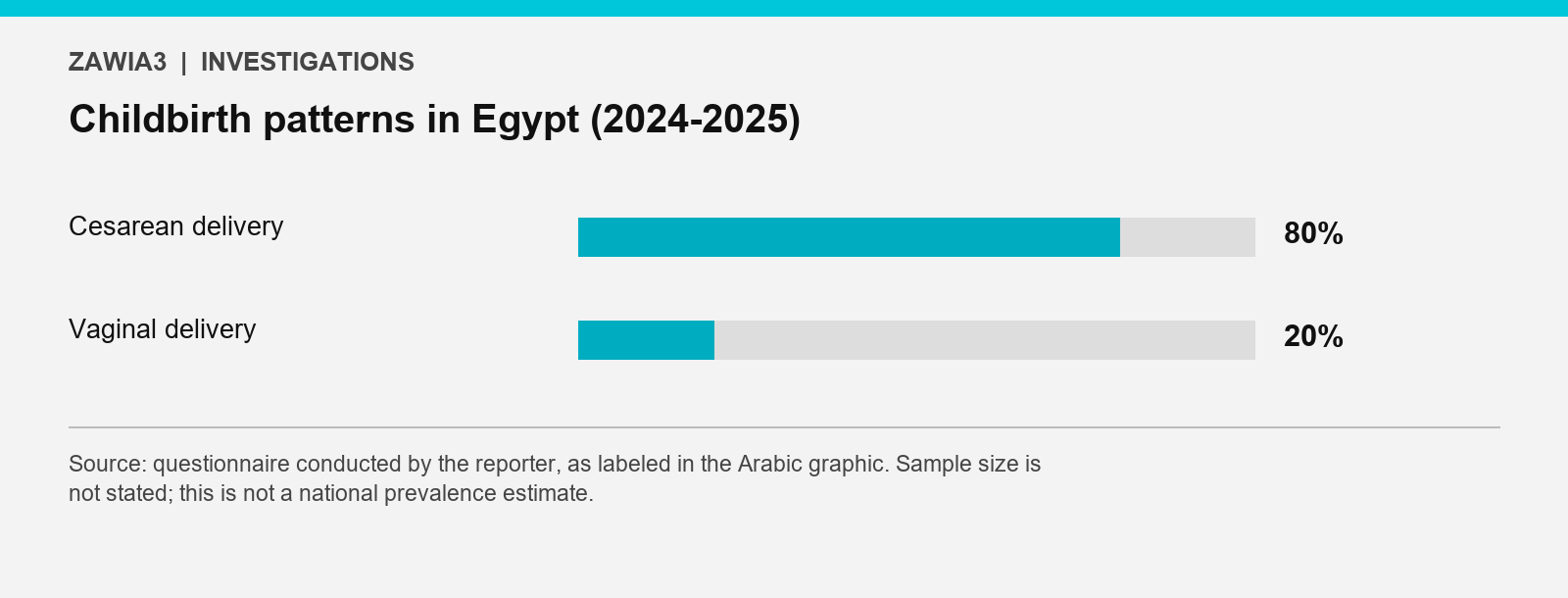
Fahmy says these high cesarean rates mean vaginal deliveries form a relatively smaller share in Egypt. Episiotomy is nevertheless still performed in some vaginal deliveries, both in Egypt and elsewhere, and remains directly associated with the “husband stitch.”
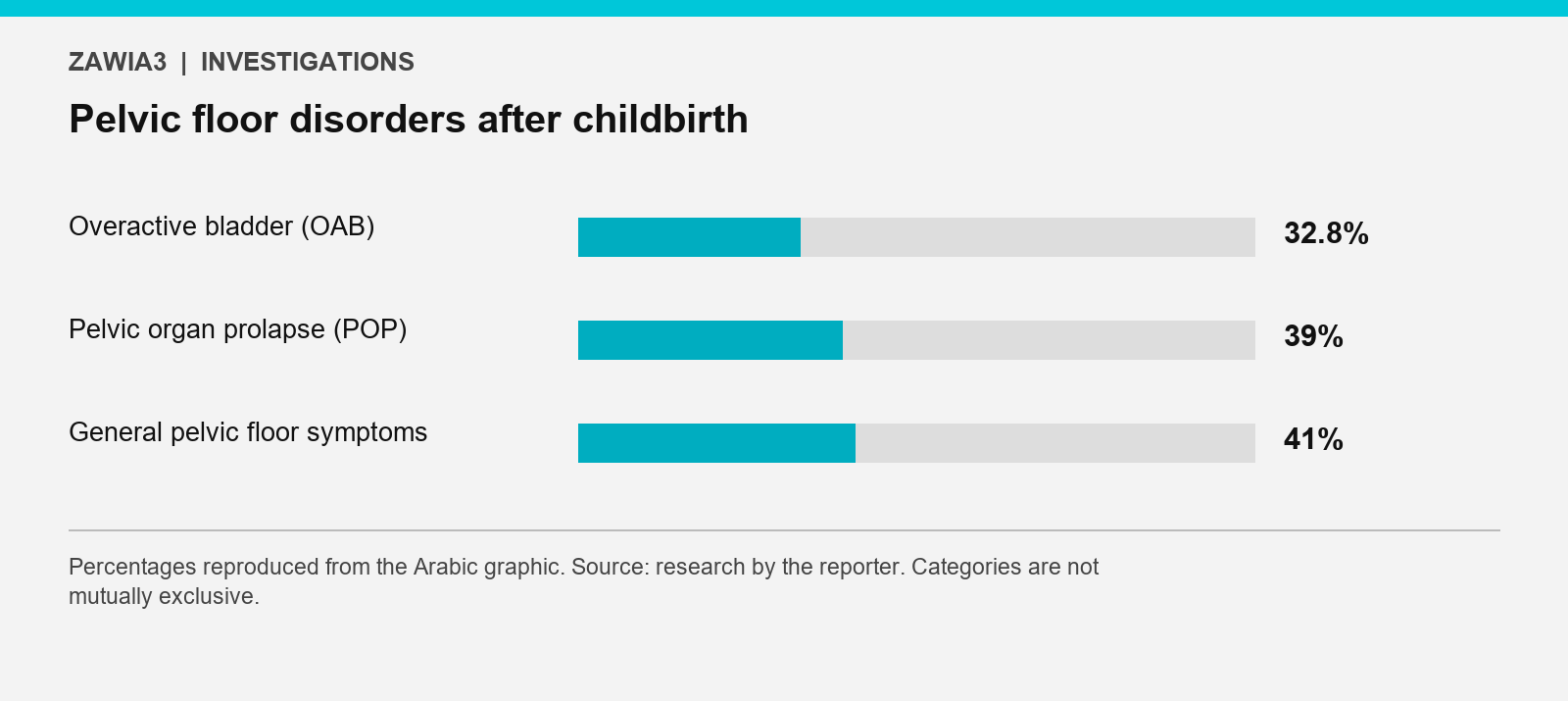
Pelvic floor disorders (PFDs) comprise conditions affecting women’s quality of life after childbirth. Studies cited in the report put their prevalence among women who have given birth at 30–50%. Egyptian research found an overall rate of approximately 41%. Conditions include overactive bladder and pelvic organ prolapse, and are closely related to the number of births and medical interventions during delivery.
The global cosmetic gynecology sector is growing rapidly, encompassing functional and psychological aspects as well as appearance. Its market was estimated at about USD 1.01 billion in 2025, with projected annual growth of 16.07%.
Labiaplasty leads demand for cosmetic gynecological operations, with a reported 45% global increase, followed by vaginal tightening and rejuvenation, which increasingly use non-surgical techniques such as lasers and high-intensity focused ultrasound (HIFU).
Women’s accounts and the views of doctors and rights advocates show that debate over the “husband stitch” extends beyond a surgical procedure to women’s right to make decisions about their bodies free of social or marital pressure. Specialists distinguish informed, voluntarily chosen cosmetic surgery from interventions imposed or undertaken without consent. The lack of official statistics, monitoring and accountability still obstructs assessment and action.
As calls grow for stricter adherence to medical protocols and informed consent before any intervention, the issue reflects a more complex relationship between medicine and social culture. Many women’s bodies are still judged against expectations beyond their health needs. Medical decisions that should be personal become responses to social and psychological pressures whose impact may be no less significant than surgery itself.