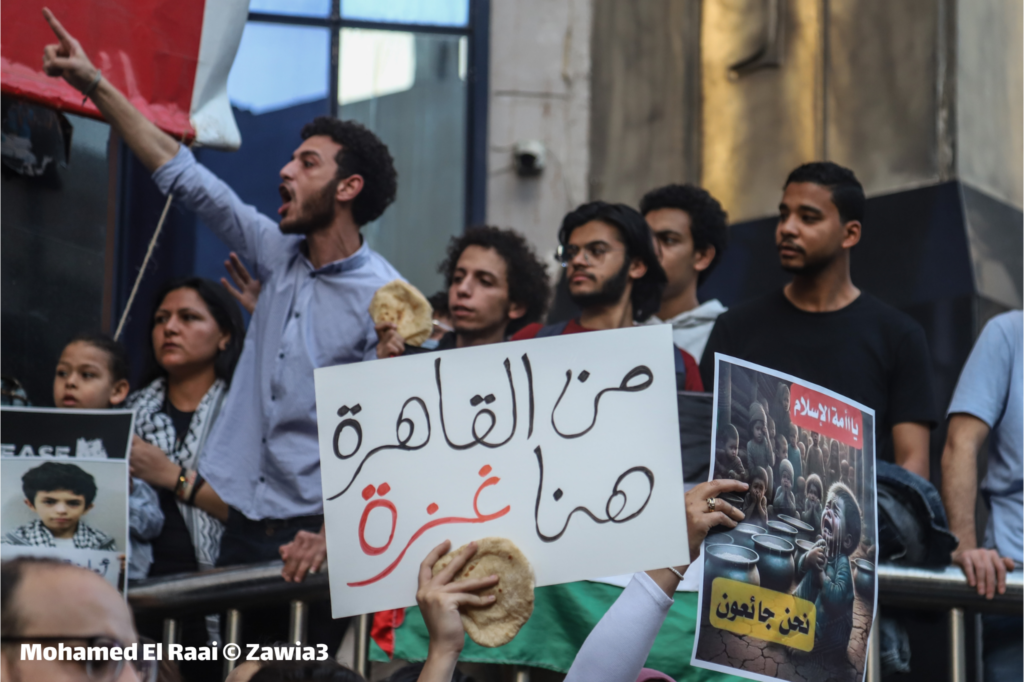

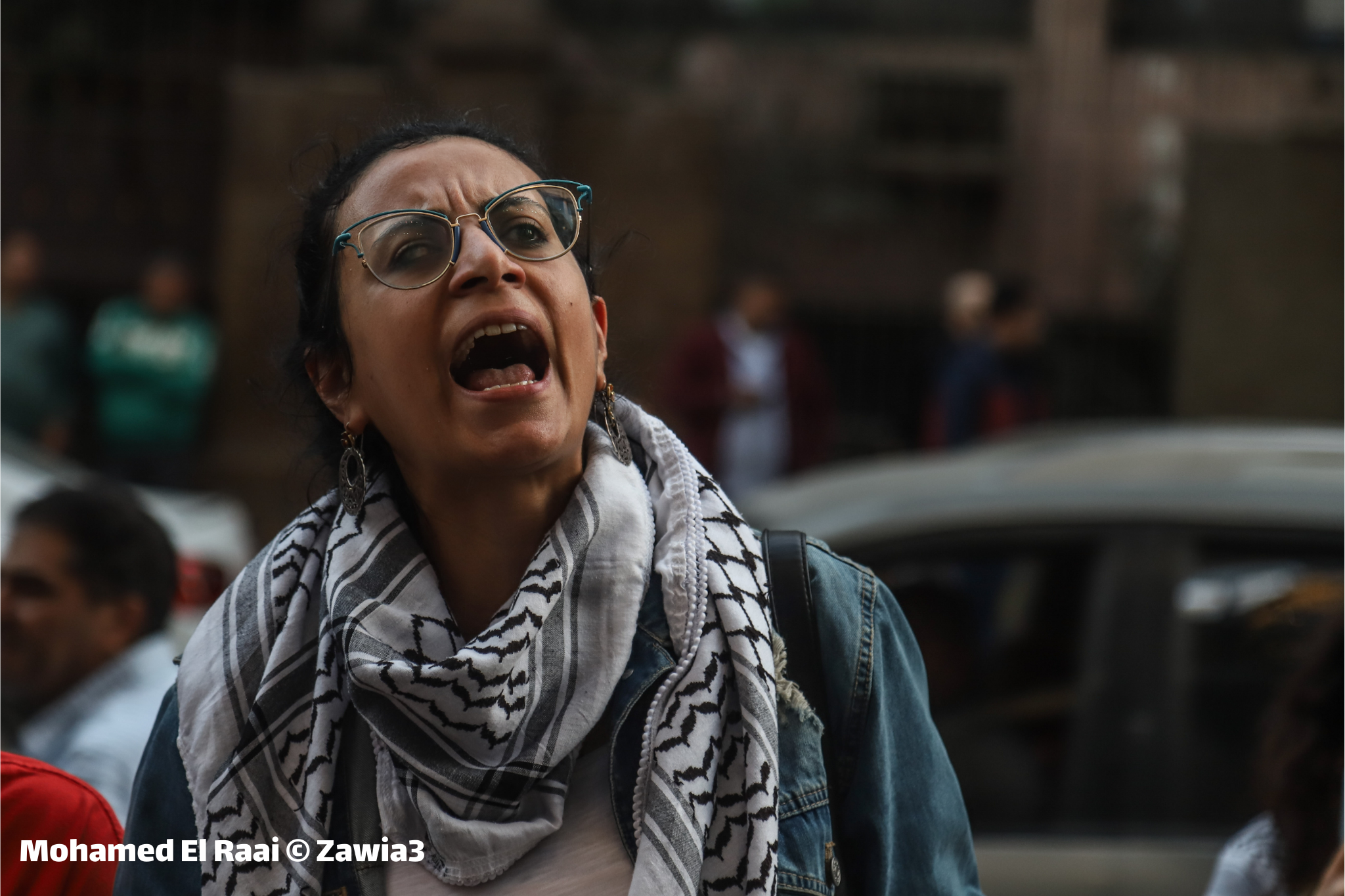
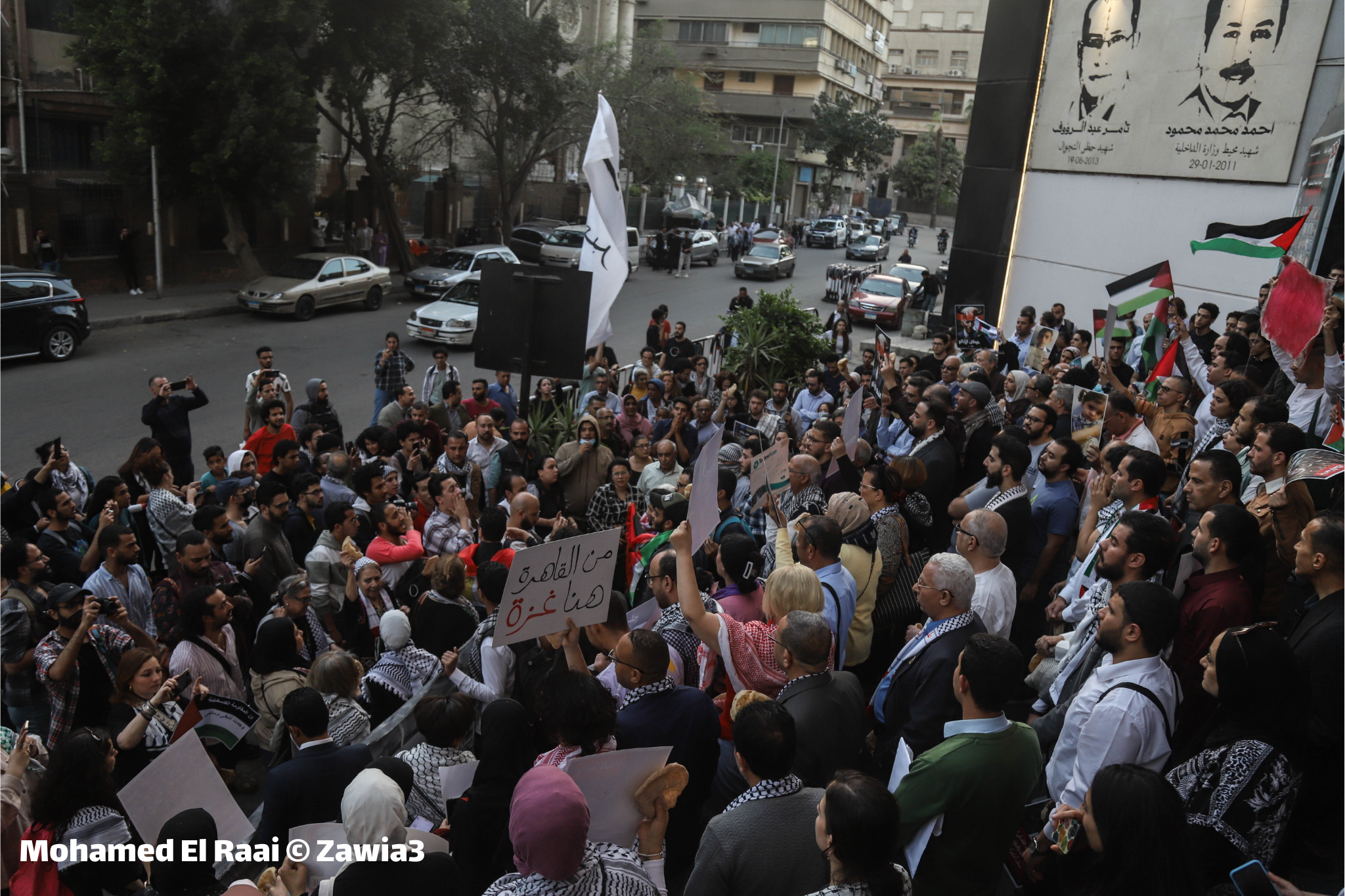
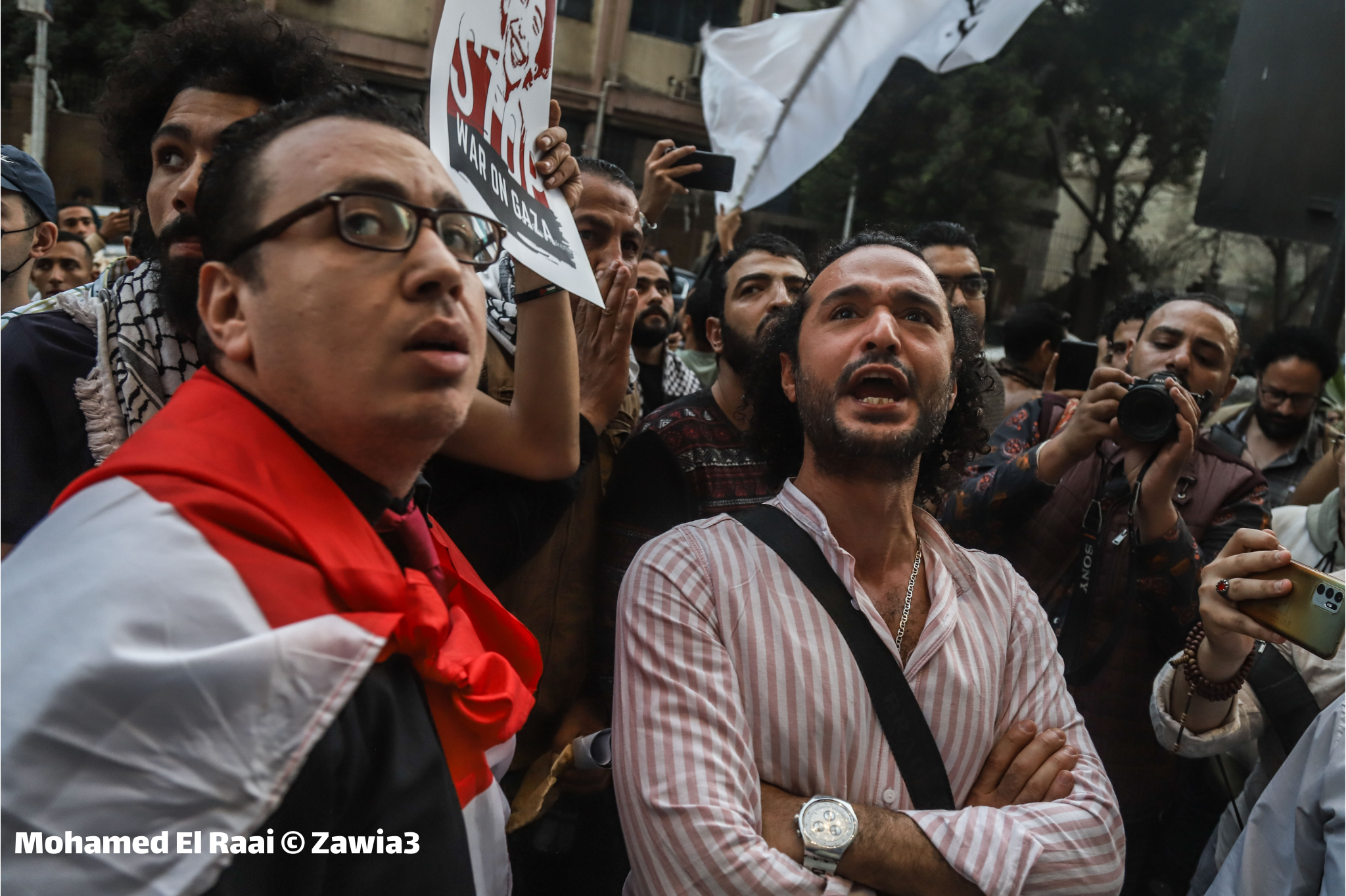
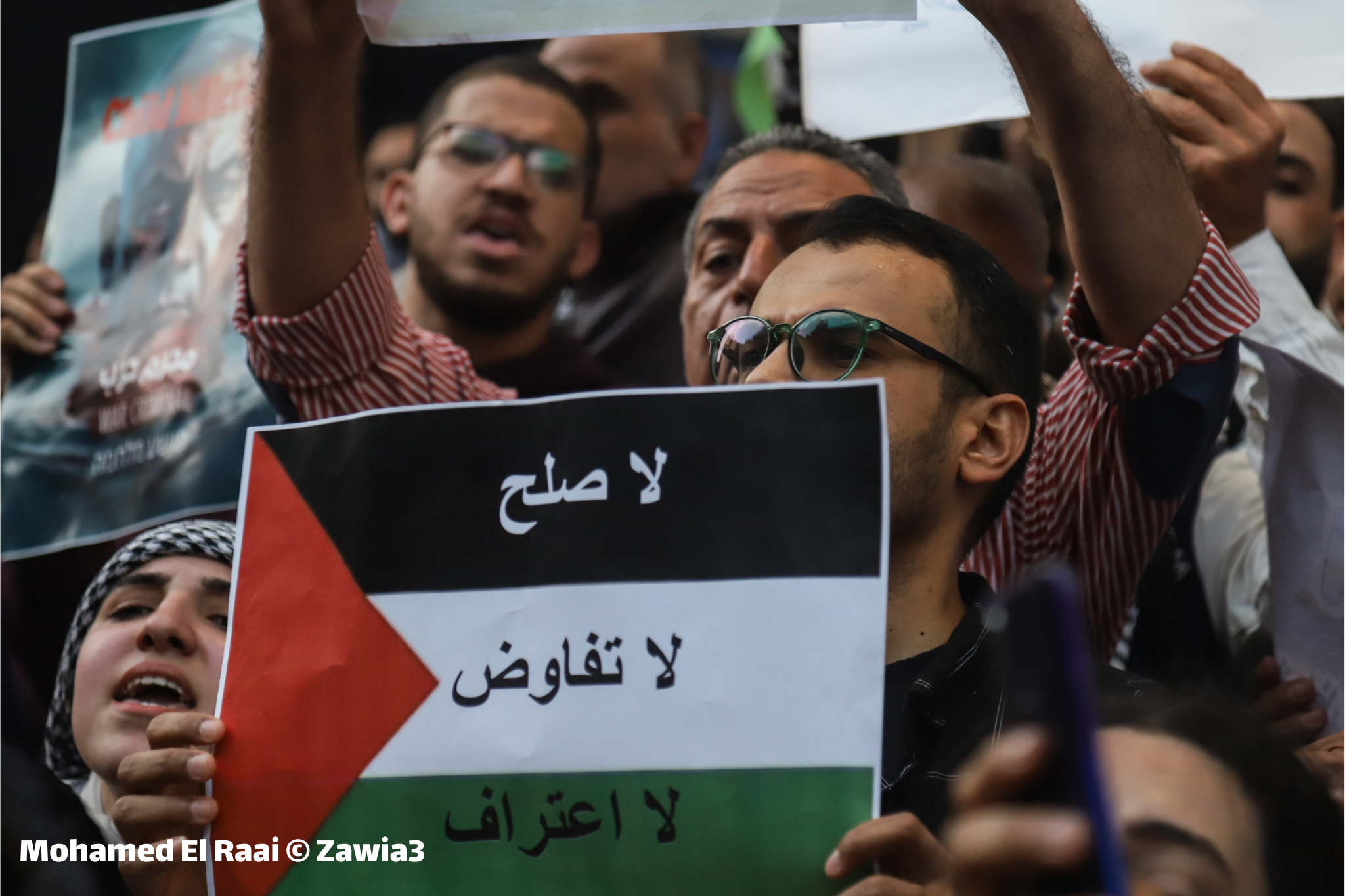
Activists and journalists took part today, Wednesday, in a demonstration at a symbolic Ramadan iftar of water, salt and bread in front of the Egyptian Journalists’ Syndicate, as a symbolic expression of sharing the suffering of the victims of the war the Israeli occupation army is waging on Gaza, and in condemnation of the policy of starving the Strip. Participants in the protest called on their country’s authorities to open the Rafah crossing to relieve Palestinians and bring aid into the Strip under the siege imposed, and also raised demands relating to the expulsion of the Israeli ambassador from Egypt and the complete severing of relations.
In 2016, in the wake of a last popular uprising after the signing of an agreement under which the Egyptian authorities agreed to cede the two islands considered gateways to the Sinai Peninsula, Tiran and Sanafir, Egyptian security forces stormed the Journalists’ Syndicate for the first time in its history since its founding in 1941.
This was for two reasons. The first was the syndicate’s support for the protesters on the day of the “Friday of the Land“, which took place in mid-April 2016, when security forces attacked the protesters and arrested a number of them, while the Journalists’ Syndicate protected dozens of them after they took refuge there and closed its doors for fear of their arrest. The second was the arrest of journalists Amr Badr and Mahmoud El-Sakka, who had begun an open-ended sit-in inside the syndicate for fear of being arrested over accusations that they had incited demonstrations against the agreement to sell the two islands at the time.
Since that date, the authorities have exerted pressure on journalists and their syndicate, closing the public sphere and carrying out something like a nationalisation of the press, especially with the rise of the United Media Services group, which represents the authorities’ media and press arm and has taken full control of the scene inside Egypt, becoming effectively the state’s official media.
The following year, a mass demonstration was launched on the steps of the Journalists’ Syndicate, led by a number of journalists and politicians belonging to the Egyptian left, along with Egyptian citizens. It was in condemnation and rejection of the US decision to move the US embassy from Tel Aviv to Jerusalem, as a first step towards recognising Jerusalem as the capital of the occupation. As a result, security forces arrested five journalists from the top of the syndicate’s steps: Ahmed Abdel Aziz, Hisham Ahmed, Mohamed Khaled, Islam Ashry and Hossam El-Swaify.
That incident marked the effective end of the syndicate opening its doors and engaging with issues of public opinion and politics in Egypt, as the syndicate was shackled and closed its doors from then on, even to journalists who are not members, as one manifestation of the state’s authority over it.
In March 2023, Khaled El-Balshy, a journalist with leftist leanings, was elected, along with a number of journalists associated with the union independence current that opposes the authorities’ interference in Egyptian press affairs. This was a new hope for reviving the syndicate and activating its role in engaging with the public sphere and its various issues.
The recent Gaza war, which began last October, became a new beginning for the syndicate’s presence in local and regional public events. The syndicate’s council organised a protest in solidarity with the Gaza Strip about ten days after the war began, on the day after the targeting of Al-Ahli Baptist Hospital, which killed more than 500 people, most of them women and children who had taken it as a safe haven.
Since then, dozens of journalists and politicians have regularly come to the steps of the Journalists’ Syndicate and held protests, chanting slogans, most notably: “Bread, freedom, cancel the agreement, open the Rafah crossing”. Some of these protests were proposed by the syndicate’s council, and some of its members took part in some of them, while others came from popular efforts by citizens and some members of different political currents.
But the most prominent was the organisation of a protest every Tuesday since the start of this Ramadan, in which a number of participants stand and hold a symbolic iftar of just some bread and water.
Zawia3 contacted journalist and writer Nour El-Hoda Zaki, who launched the Tuesday initiative, which gave rise to the group “Journalists for Palestine”. She says: “We are all watching the daily massacres in Gaza that have exceeded all limits, and we were ashamed to stand idly by without offering any kind of support, even in the form of protests and solidarity with the people of Gaza, which left us feeling helpless and oppressed. So the idea emerged of calling for a gathering on the second day of Ramadan just before sunset, and holding a symbolic iftar on the steps of the Journalists’ Syndicate with only water and bread, as a form of solidarity with the hungry in Gaza. A group of journalists such as Sayed Saber and Karima El-Roubi joined me”.
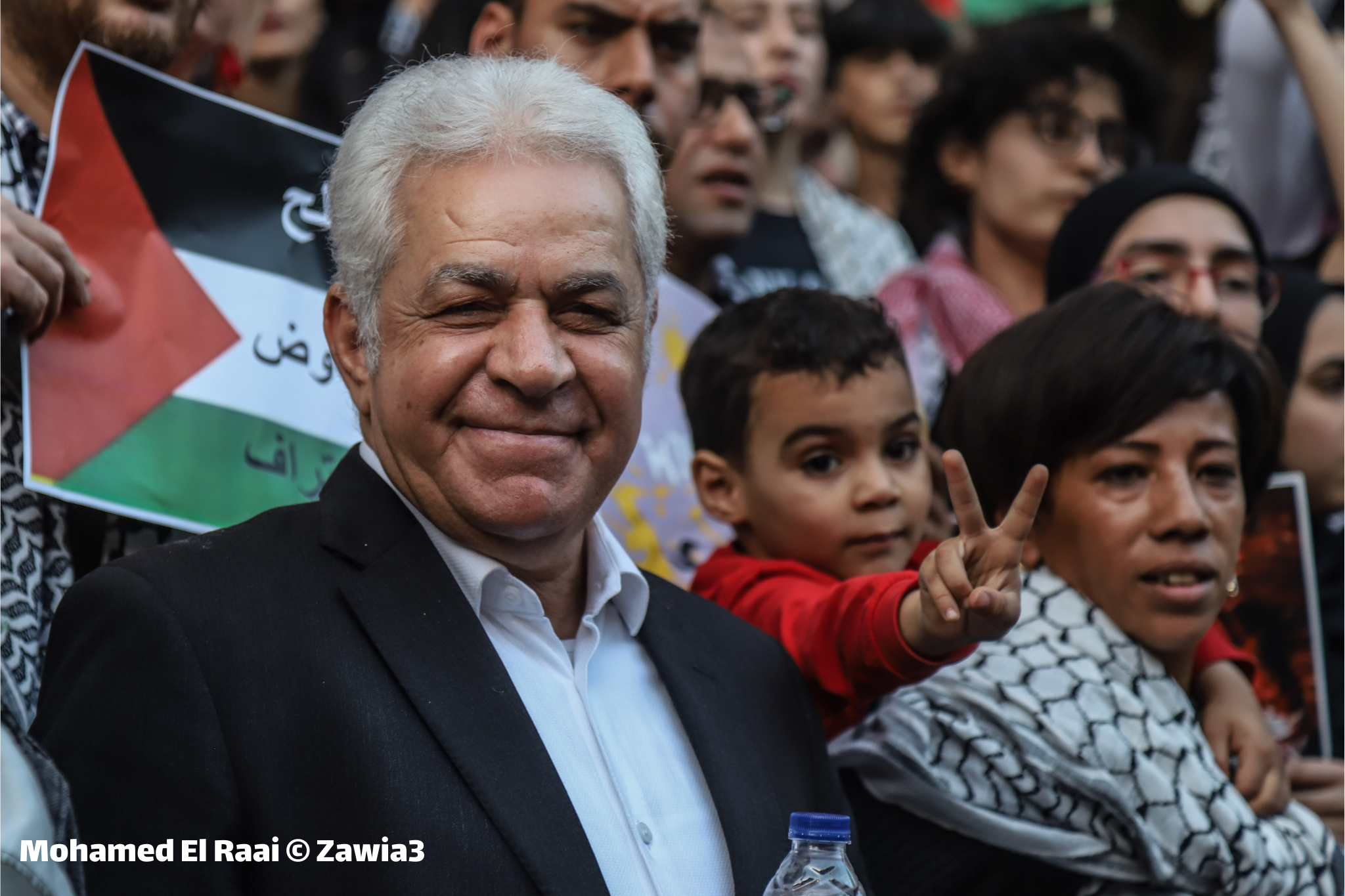
Nour El-Hoda Zaki, who was arrested in 2021 in Tahrir Square in central Cairo for raising the Palestinian flag in solidarity with the martyrs of Jerusalem and Gaza at the time, but was soon released the evening of the same day, adds: We have kept up the protests since the start of this Ramadan. At the first protest we were no more than 25 journalists, and Ahmed Tantawy, former head of the Karama Party, joined us, but the following week a number of journalists and politicians joined us, led by journalist and former presidential candidate Hamdeen Sabahi, Gamal Zahran, professor of political science and former MP, and Khaled Dawoud, journalist and former head of the Constitution Party.
She goes on: “The Journalists’ Syndicate was a major destination for all social and political currents, from 2000 during the second Palestinian intifada, then the invasion of Iraq in 2003, through the 2005 constitutional amendments and the founding of the Kefaya movement, and the events of El-Mahalla El-Kubra in April 2008, ending with the Egyptian revolution in 2011. The syndicate’s steps became a refuge for expressing citizens’ concerns and championing their complaints, and many marches set out from the syndicate to the square. Then we entered a phase of shrouding the Journalists’ Syndicate and turning it into an ugly building surrounded by scaffolding on every side. The syndicate remained besieged, especially since 2017, to the point that journalists were driven out of their syndicate and could not sit inside it, and the authorities in Egypt managed to turn it into a neglected, dark place with no capacity for professional, political or human interaction, under flimsy and false pretexts”.
Zaki believes that the victory of Khaled El-Balshy and his council in the Journalists’ Syndicate elections last year gave the syndicate the kiss of life, which she likened to a miracle. As she describes it, El-Balshy, whom some pro-government press blocs feared, has so far succeeded in presenting a respectable image and giving the impression that he is the head of all journalists without bias. He has also worked to return the syndicate to its right path, both in its internal affairs and the organisation of journalists’ affairs, and in balanced engagement with public issues outside it.
She adds: The syndicate regained its spirit during the Gaza events and became the bright spot where all patriots, journalists or citizens, gather to announce their demands to the Egyptian authorities. So I say it has returned strongly to its pioneering role, unlike other unions and parties that have turned into closed rooms. She criticises the performance of the Egyptian media over the past few years and amid current events, saying: “Enough of media that only promotes lies, whether at the level of daily life, national belonging or national security without regard for citizens, or at the level of what is happening in neighbouring Gaza, as it deliberately obscures and hides everything that is happening”.
Nour El-Hoda Zaki stresses that the Journalists’ Syndicate council has nothing to do with organising the Tuesday protests, which emerged as an independent movement aimed at offering the simplest forms of psychological support and solidarity to the Palestinian people.
In the same context, Khaled Dawoud, journalist and former head of the Constitution Party, answers our question about the syndicate regaining its role: “Certainly, the Gaza war has restored the importance of the syndicate as a national institution concerned with the issues that preoccupy citizens, above all the Palestinian cause. It is regrettable that the Egyptian people, unlike Arab peoples, except the Gulf states, have been completely prevented from demonstrating in solidarity with Palestine, given the current security conditions”.
He draws attention to the historic role the steps of the Journalists’ Syndicate played for many years before the January revolution, explaining that with current developments and the presence of an independent syndicate council and head, there was an opportunity for the steps to once again host Egyptians in solidarity with Gaza to express their views peacefully and freely. He hopes for the lifting of the current restrictions on freedom to demonstrate and show solidarity with the people of Palestine or on Egyptian citizens expressing their issues, concluding: “We must preserve the space we have gained”.
Commenting, Mahmoud Hisham, a journalist and member of the Socialist Popular Alliance Party, says that the massacres that took place in Gaza, and are still taking place, helped Egyptian groups, above all the journalistic community, to move. This was translated through the conferences, concerts and demonstration called for by the syndicate and attended by representatives of Palestine, such as Palestinian journalists and the Palestinian ambassador. He adds: All this came as consequences of the war, followed by calls for protests in front of the syndicate to show solidarity and demand the opening of the crossing and the entry of humanitarian aid, especially after the call of the World Conscience Convoy launched by the head of the Journalists’ Syndicate personally.
He adds: After a while, the calls were no longer limited to journalists; a number of citizens and different currents joined, and the numbers taking part grew. Despite this, there were many risks and threats of security targeting that followed some participants, stressing: “There were concerns about inviting some people, to avoid them being persecuted”.
He continues: All this came as a result of journalists choosing an independent head who restored the syndicate’s spirit and drew everyone to take part in union and public activities after years of hibernation, coinciding with the war of genocide in Gaza.
At the same time, according to information we received, a group of journalists loyal to the authorities tried, at the Journalists’ Syndicate’s annual iftar and through some closed journalists’ groups, to attract other journalists to sign a memorandum aimed at preventing pro-Palestine demonstrations except through the council and in an official way.
The memorandum that some journalists intend to submit to the council states: “It has been noted recently that the pace of protests on the syndicate’s steps has been rising without prior coordination with its council. Notably, most of the participants are not members of the journalists’ general assembly and belong to political trends, which has diverted the calls for solidarity with Gaza into outbidding the state’s position and adopting Zionist and American claims alleging that Egypt is deliberately closing the crossing. We must therefore call on the head and the council to take decisions regulating the use of the syndicate’s steps, to prevent them being drawn into agendas imposed in the name of journalists by non-union figures”.
That memorandum and others met with angry reactions from journalists, who refused to sign, calling for the syndicate’s role in public work and engagement with current and future events to continue. Despite this, the last protest of Ramadan on the steps of the Journalists’ Syndicate in central Cairo is being held today, after it was postponed yesterday because of the celebration of President El-Sisi’s inauguration for a third term.