Hady Mohamed, in his twenties (23, owner of a poultry farm in Fayoum Governorate, in the North Upper Egypt region, 90 kilometres from the capital, Cairo), has suffered losses of about EGP 500,000 (about USD 10,479) because of power cuts to his farm under the load-shedding plan that the government in Cairo has been implementing since last July, 2023, which it justified by record consumption coinciding with the heatwave hitting the country, while the gas pressure needed to generate electricity fell.
The power cuts have killed about 3,300 chickens since they began, according to Mohamed. He tells Zawia3: “This pushed me to buy a generator to try to reduce the losses caused by the cuts, which directly raised the cost of labour, as working hours increased to make up for the outages. Despite that, I pay the electricity company a monthly bill of about EGP 8,000 (about USD 167.6), which has turned the project I started eight years ago, in 2016, into a burden on my shoulders instead of a source of livelihood.”
Rising Prices
Tharwat El-Zeiny, vice president of the Poultry Producers Union, says the poultry sector has been hit by the power cuts under the load-shedding plan, telling us: “Small producers cannot afford generators costing EGP 2 million each.”
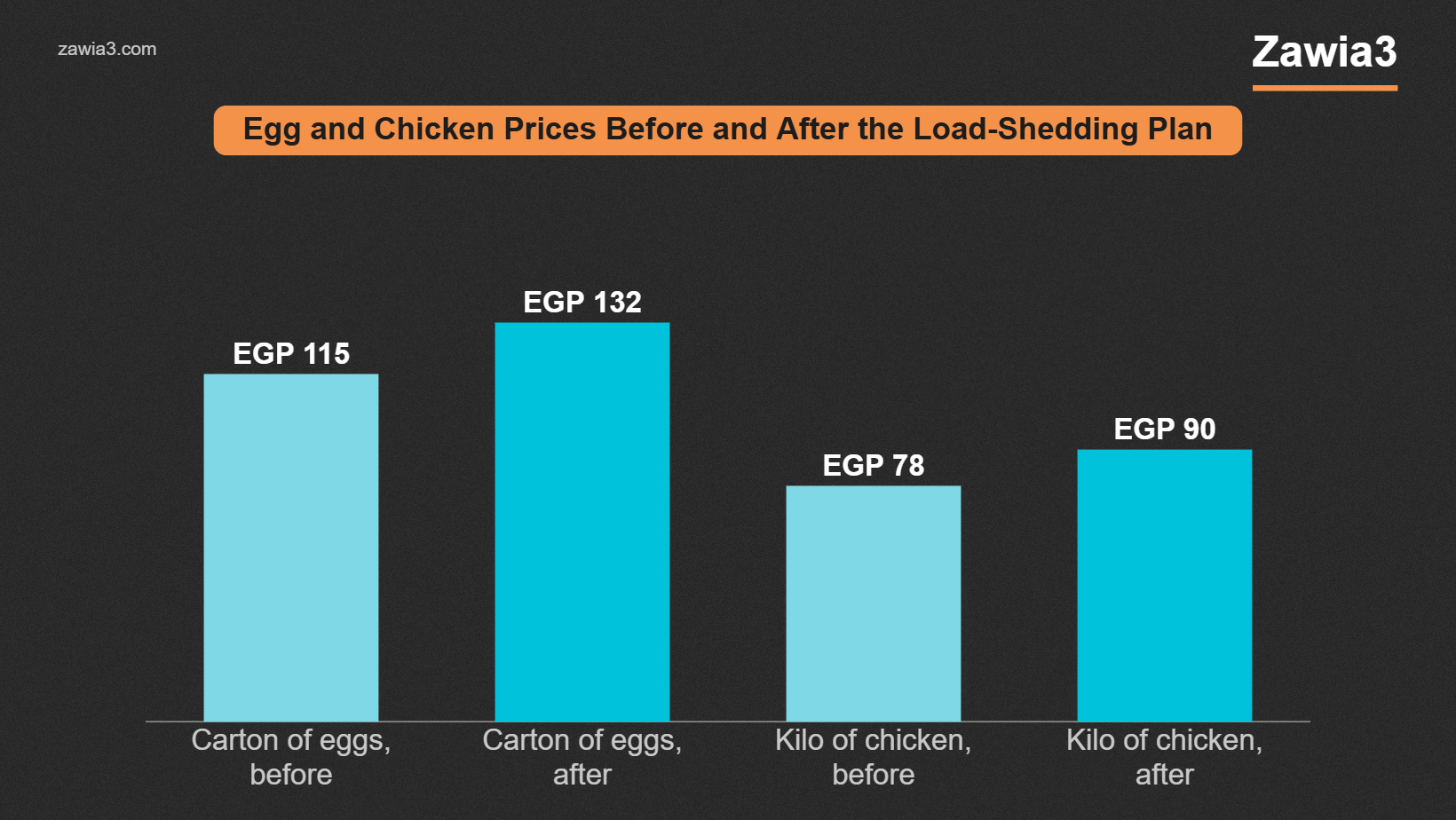
El-Zeiny points out that the normal temperature for raising poultry is between 22 and 25 degrees, at a time when the state has applied the load-shedding plan without taking into account different sectors such as agriculture, causing large numbers of birds to die, so that poultry and egg prices rose by 20% to 25%, and the poultry sector is affected by these cuts at the same rate (the price of a kilo of poultry rose because of load shedding and high temperatures to about EGP 90 from EGP 78, USD 1.8 – 1.6, and a tray of eggs rose from EGP 115 to EGP 132, USD 2.4 – 2.7).
According to the poultry exchange last year, before the Egyptian government implemented the load-shedding plan, poultry prices on the local market were estimated at EGP 69 to 70 per kilo at the farm (about USD 1.4), local (baladi) poultry ranged between EGP 90 and 95 (about USD 1.9), and Sasso poultry stood at EGP 90 for consumers (about USD 1.8). By comparison, according to the exchange today, Saturday, chicken prices on the local market reached about EGP 88 to 89 per kilo at the farm (about USD 1.8), local poultry ranged between EGP 120 and 125 (about USD 2.6), and Sasso poultry reached EGP 120 for consumers (about USD 2.5).
According to information available on specialised websites on poultry farming, the temperature should not exceed 32 degrees Celsius in the first period of the rearing cycle, then fall to between 21 and 24 degrees Celsius at most for the rest of the rearing period. High temperatures expose poultry to what is known as heat stress and cause breathing difficulties, which negatively affects their health and performance.
The union’s vice president adds: “It makes no sense to cut power to save hard currency, causing poultry to die, and then import a replacement with dollars,” denying any prior coordination between producers and the Ministry of Electricity on the load-shedding plan applied to them.
According to an earlier statement by the Ministry of Electricity, load shedding saves about USD 35 million a month, by rationalising gas consumption and exporting it abroad in order to secure hard currency to import fuel for power stations.
Huge Losses for Breeders
The union vice president’s description matches what Sayed Mohamed says. He co-owns a poultry farm in Sharqia Governorate with his brother, a project they launched five years ago, and complained about the power cuts, which killed large numbers of birds and pushed him to buy a generator to solve the problem of outages at his farm. He tells us: “A five-minute power cut to closed poultry farms is a disaster for the breeder, who will not be able to make up for his losses from the deaths of large numbers of birds, because the farms contain coolers and extractor fans that need electricity 24 hours a day.”

According to a study by the Egyptian Center for Strategic Studies published in April 2023, Egypt’s poultry industry includes about 10,731 licensed farms, with total investment in the sector reaching about EGP 100 billion. Egypt’s poultry production in 2021 reached about 1.5 billion chickens (broilers) and about 13 billion table eggs, while an earlier study by the centre found that the total number of poultry facilities in Egypt had reached about 38,000, including farms, feed mills, slaughterhouses and outlets selling veterinary medicines and vaccines. The farms are concentrated in the Delta, with Sharqia Governorate having the largest number of poultry farms, 5,800, followed by Qalyubia Governorate with 2,500 farms (in 2021).
Abdel Aziz El-Sayed, head of the poultry division at the Cairo Chamber of Commerce, attributes the 11% to 12% rise in poultry prices to two factors: first, the higher price of chicks, and second, the power cuts, which accounted for 5% to 6%, as he put it.
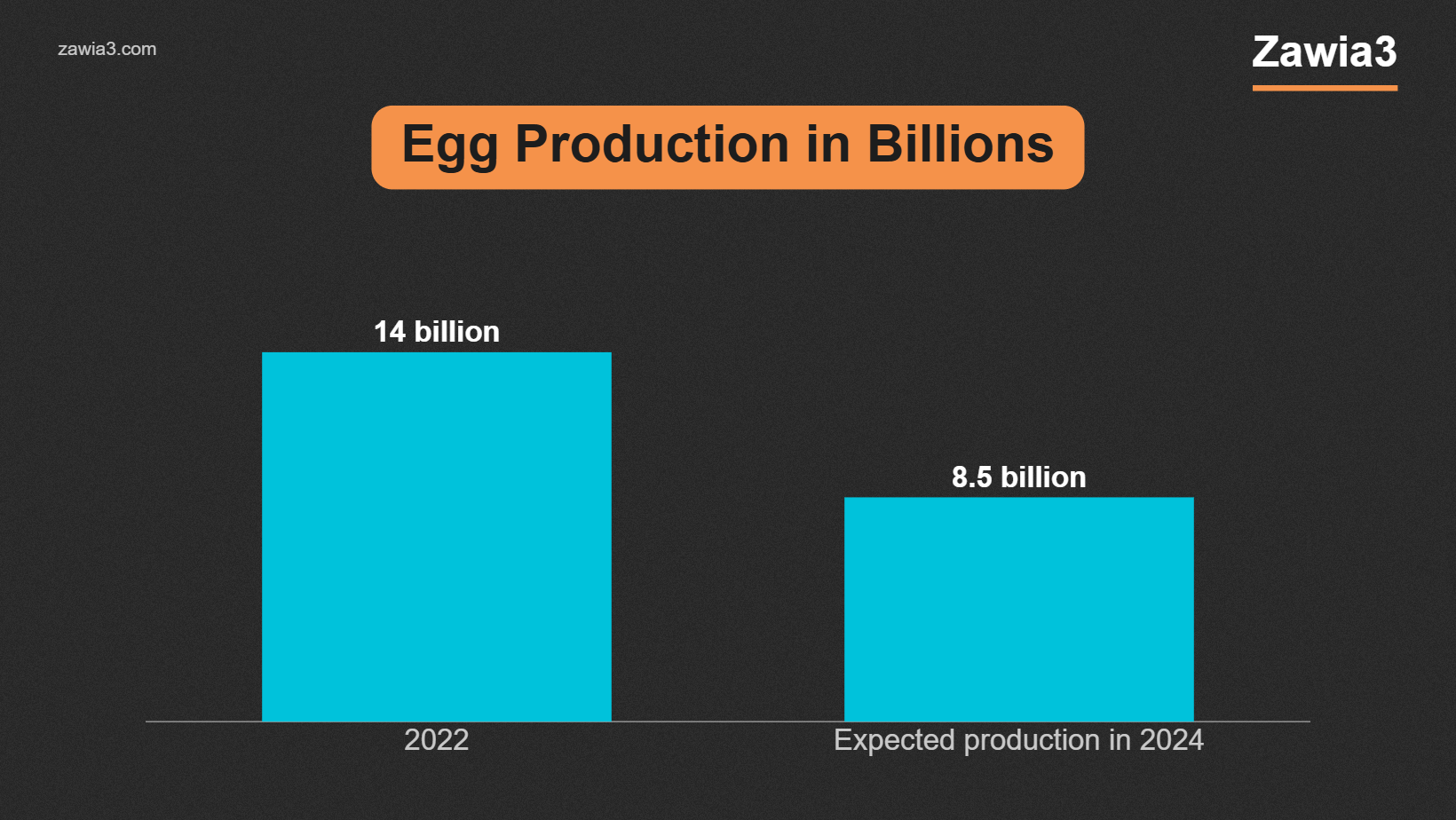
According to El-Sayed, Egypt’s poultry production ranges between 850 and 900 million chickens in the first half of 2024, while egg production is about 8.5 billion eggs this year, which represents a deficit. He adds: “We used to produce 14 billion eggs a year, according to 2022 statistics.”
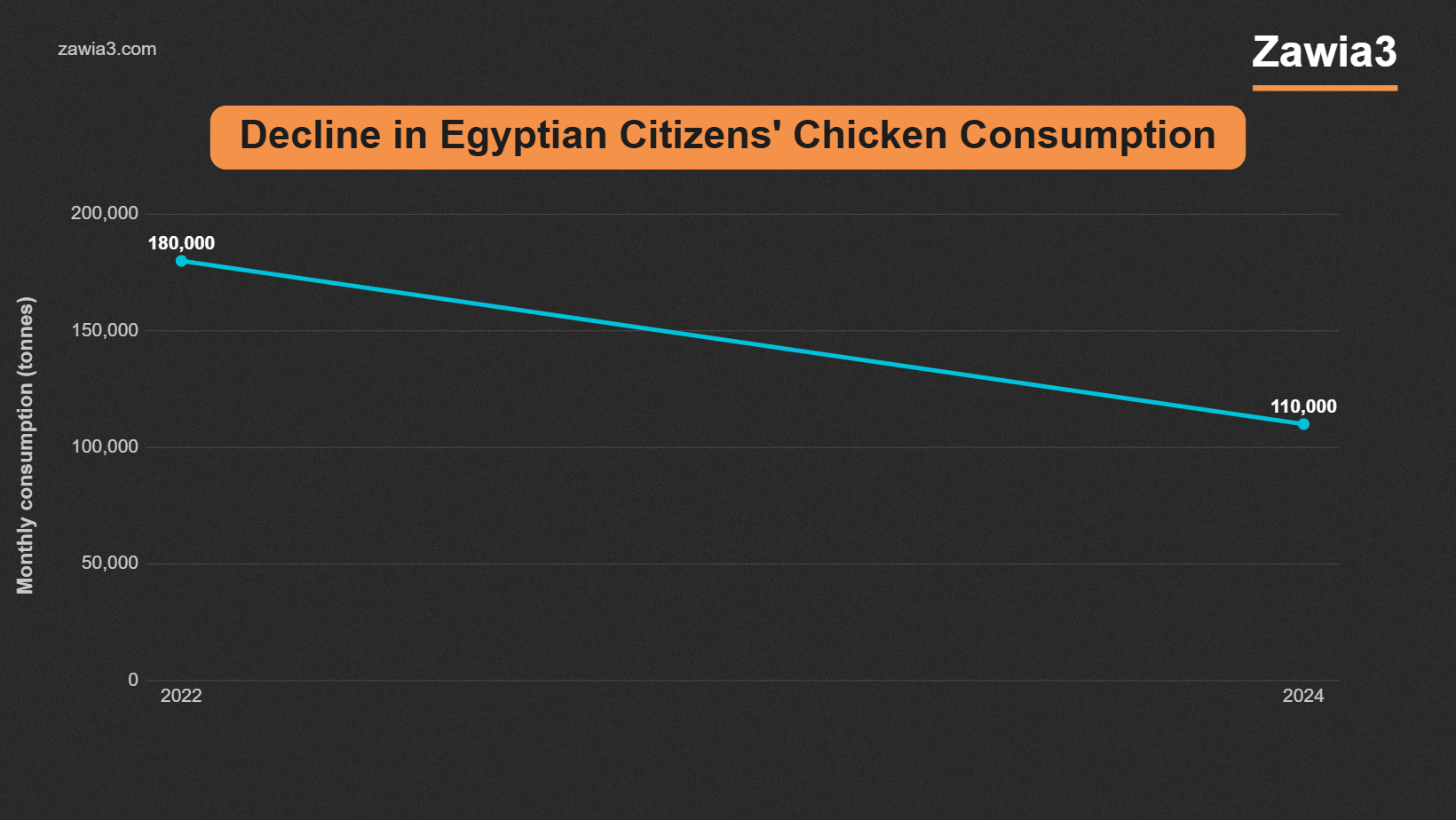
He goes on: “Consumption follows the purchasing power of Egyptian citizens; we used to consume about 180,000 tonnes of poultry a month at the start of 2022, but now, with citizens’ purchasing power down by 40%, consumption has fallen to about 110,000 tonnes a month.”
Between three million and three and a half million people (direct and indirect labour) work in the poultry sector, with small breeders accounting for about 70% of them. Labour is concentrated in large companies rather than small facilities, as small breeders cannot buy generators, and even if they obtain a loan under the 5% presidential initiative, they may not be able to repay it.
The Central Bank of Egypt launched an initiative to support small companies and facilities working in agriculture, agricultural processing, dairy, feed, fisheries, poultry and livestock, at a declining interest rate of 5% without commission, for those with annual sales from EGP 250,000 to less than EGP 50 million (USD 5,239 to USD 1 million).
El-Sayed says that if selling prices stabilise, breeders can develop and restructure, which requires a real exchange on the ground and branch exchanges in all governorates, calling on the Minister of Agriculture in the new cabinet to set up an exchange present in every governorate.
He points to the need for a new mechanism to resolve the power cut crisis that is hurting the poultry sector, and not to raise the price of electricity supplied to this vital sector, along with expanding the cultivation of yellow maize and soybeans, setting a three-year plan to raise productivity over that period, and providing serums and vaccines.
The head of the poultry division at the Chamber of Commerce asks about an epidemiological map that would identify the diseases spreading in each area so they can be contained and properly dealt with, which would ultimately benefit citizens if applied. He denied reports that mortality on farms had reached 40% because of power cuts, explaining that large breeders’ farms operate on a closed system, with backup power units that start immediately when the power is cut.
Major Losses
For her part, Shereen Zaki, deputy head of the General Syndicate of Veterinarians and former head of the syndicate’s food safety committee, tells Zawia3 that the appropriate temperature is from 25 to 33 degrees depending on the age of the chicken, at a time when the temperatures Egypt has experienced, or is expected to experience in the coming period, are unsuitable for raising poultry.
It is well known, according to Zaki, that deaths increase in winter because of diseases such as respiratory illnesses and IB, which strikes farms that do not take precautions, while in summer large numbers die because of high temperatures, which pushes breeders to install additional ventilation outlets and reduce the effect of high temperatures so that more birds do not die. She adds: “Load shedding will cause great damage to farms.”
According to earlier statements by Wafaa Abdel Fattah, a researcher at the Reference Laboratory for Veterinary Quality Control on Poultry Production at the Animal Health Research Institute, IB is an acute, highly contagious viral disease that affects the upper respiratory tract of poultry, causing respiratory, kidney and reproductive problems accompanied by respiratory symptoms. The disease causes serious economic losses because of the high mortality it causes in flocks, and also causes a sharp drop in egg production and quality.
The deputy head of the General Syndicate of Veterinarians warns that some of those who have suffered heavy losses may sell dead poultry, which would leak into the markets, placing a heavy burden on the veterinary directorates responsible for monitoring markets.
This comes at a time when the number of veterinarians carrying out inspections of markets and points of sale is estimated at 100, as no veterinarians have been appointed since 1995, according to Zaki.
If this poultry leaks into the markets, citizens will eat carrion, which is religiously forbidden, with organs and muscles congested with blood, a source of contamination and disease, and anyone who eats it believing it to be healthy poultry that did not die on its own may be poisoned.
Zawia3 contacted the head of the General Authority for Veterinary Services, Momtaz Shahin, by phone to ask about the extent of deaths on poultry farms and the recent appearance of diseases, but we had not received a response by the time this report was published. Meanwhile, sources at the Poultry Producers Union, who preferred not to be named, said that power cuts had raised mortality among poultry on small farms to about 20%, and on some farms to 40%.