


On April 22, 2023, Egypt’s cabinet introduced a requirement for new appointees across state sectors, bodies and institutions to complete a six-month qualification course at the Military Academy in Cairo. The requirement also covered recruits to judicial institutions, including the Public Prosecution, State Council, Administrative Prosecution and State Lawsuits Authority.
Judicial appointments had previously been governed by the relevant statutory conditions. Articles 38 and 116 of the Judicial Authority Law contain no requirement to complete a military-college course. Conditions include Egyptian nationality, full civil capacity, an Egyptian law degree or an equivalent foreign qualification with the necessary equivalency examination, good character and reputation, and no conviction or disciplinary ruling for a dishonourable offence, even following rehabilitation.
Age rules depend on the post: Article 38 sets minimum ages of 30 for courts of first instance, 38 for courts of appeal and 41 for the Court of Cassation. The law also provides for an examination, set by the justice minister with Supreme Judicial Council approval, for direct appointment to assistant prosecutor other than through the prosecution associate route. These are distinct conditions, not a single age limit for all judicial positions.
The military-course requirement provoked objections from judges, who rejected Prime Minister Mostafa Madbouly’s decision to include judicial recruits in training required for government employment.
Zawia3 obtained a confidential official letter dated July 9, 2023, from then Judges Club chair Mohamed Abdel Mohsen to then Court of Cassation president and Supreme Judicial Council chair Mohamed Eid Mahgoub.
The letter argued that the decision explicitly undermined judicial independence and allowed government interference in selecting and training judicial personnel. It noted that newly appointed prosecutors already received intensive professional training at a dedicated prosecution training centre.
Abdel Mohsen asked the council’s chair to intervene and prevent interference in judicial affairs.
The letter maintained that the Supreme Judicial Council alone should set the rules for judicial appointments, without another authority sharing or contesting that responsibility in a way that compromises judicial independence.

Judges’ children fail the screening
Despite the objections, the requirement remained in place. With its implementation, some judges’ children failed medical screening for entry to the military course, according to four judicial sources interviewed by Zawia3.
The affected groups included the Public Prosecution’s 2021 intake and earlier appeals, Administrative Prosecution appeals for the 2020 intake, and a State Council intake.
Reported exclusions among judges’ children
| Judicial body or intake | Number reported by judicial sources |
|---|---|
| State Council | 47 |
| Administrative Prosecution appeals intake | 26 |
| Public Prosecution intake and appeals | About 100 |
| State Lawsuits Authority | Results not yet issued at the original publication date |
The exclusions renewed judges’ anger. They demanded removal of the training condition, arguing that it allowed other branches of government to interfere in judicial appointments.
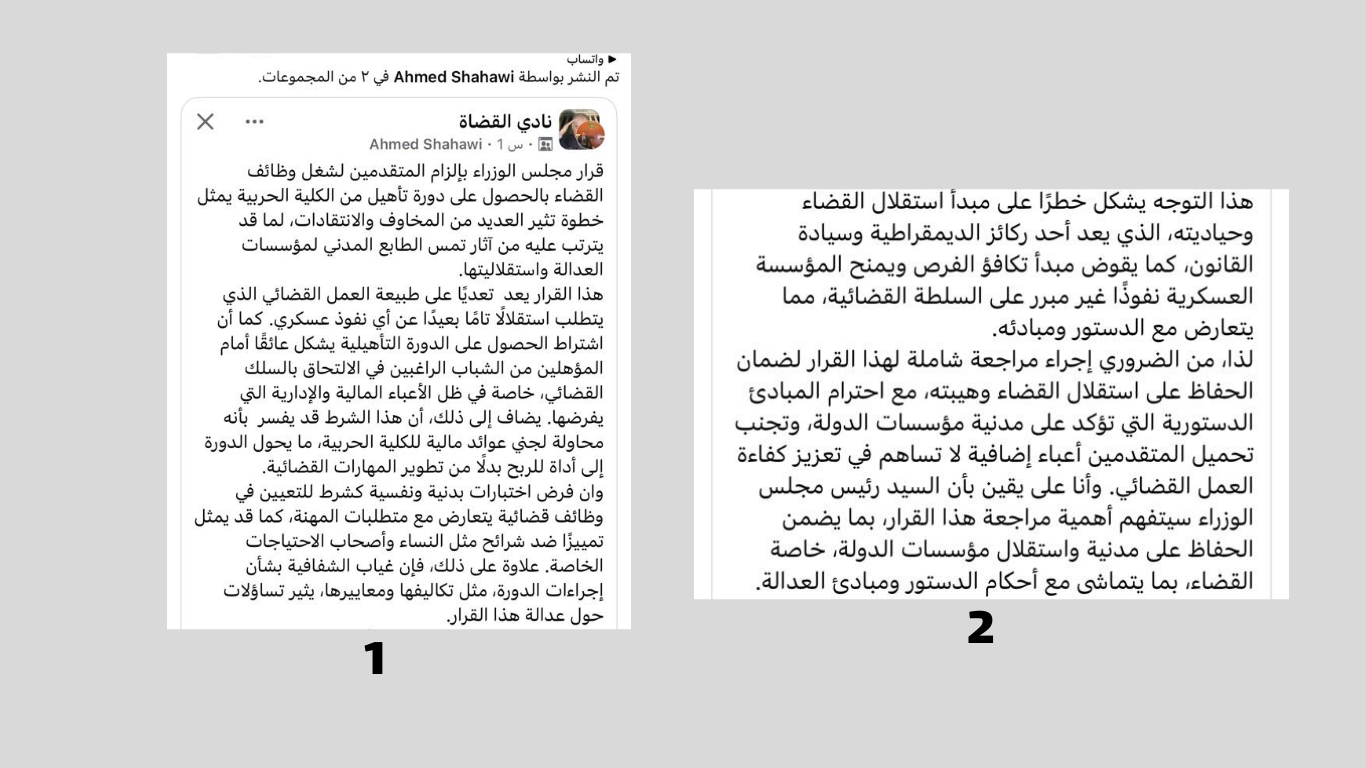
In a January 9, 2025, comment in the closed Facebook group “Judges Club,” obtained by Zawia3, judge Ahmed Shahawi, an appellate-level judge at Egypt’s Economic Court, called for the compulsory course requirement to be abolished.
He argued that military training threatened the civilian character and independence of justice institutions, whose work should remain free of military influence. It also created financial and administrative obstacles for qualified young applicants.
Shahawi suggested that the requirement could be interpreted as a means of generating revenue for the Military College, turning training into a profit-making instrument instead of improving judicial skills. This was his criticism, rather than a verified finding about the institution’s finances.
He also opposed physical and psychological tests as prerequisites for judicial jobs, saying they could discriminate against women and people with disabilities. Unclear costs and assessment criteria compounded concerns about transparency, equal opportunity and military influence over judicial recruitment.
Shahawi called for a comprehensive review to preserve judicial independence and the civilian nature of state institutions, without imposing burdens unrelated to applicants’ professional competence.
Seeking exceptions for judges’ children
Judges then sought intervention from senior executive officials. Judges Club chair Abu El Hussein Adly Qayed announced in the club’s official Facebook group and a WhatsApp group for club news and offers that he had contacted Justice Minister Adnan Fangary.
The intervention concerned exceptions and appeals for judges’ children who had failed the sporting assessments required for admission to the qualification course.
“Regarding the discussion about our children from the 2021 intake who were not notified of the sporting test, the justice minister has been contacted to resolve the matter,” Qayed wrote, asking judges to send him their children’s details privately.

After Qayed’s January 9 posts, all seven competing candidates withdrew from the race for club chair, according to the report. Campaigning had already begun in elections to renew one third of the board.
The chair’s election would fill the remainder of the board’s term, ending in late 2025. Voting also covered two seats for counsellors, two for court presidents and judges, and two for prosecution members. The timing prompted questions about the relationship between the intervention and the withdrawals; it does not by itself establish why each candidate withdrew.
Administrative Prosecution Club chair Abdel Raouf Moussa also announced intervention with officials. In a January 10 comment on the club’s official Facebook page, he said the crisis was on its way to resolution and that progress had been made on the children’s medical screening.

Military courses and judicial independence
Several judges interviewed described an account circulating among colleagues that former justice minister Omar Marwan, then head of the president’s office, had proposed the requirement.
According to that account, the Military Academy’s director told some trainees that Marwan had requested the proposal, rather than it originating as a government or presidential initiative. Zawia3 attempted to contact Marwan for a response to these allegations, but received none before the original report was published. The account remains attributed to the judges interviewed.
Nasser Amin, head of the Justice Support Foundation at the Arab Center for the Independence of the Judiciary and the Legal Profession, strongly opposes the courses.
He describes subjecting judicial recruits to training in military institutions as an unprecedented assault on judicial independence in Egypt’s modern judicial history, dating from 1883. His description is a legal and historical assessment.
Amin argues that making military training an appointment condition conflicts with the constitution, the Judicial Authority Law and international standards governing selection of judicial personnel. He says professional curricula and training should be designed and supervised by the judiciary, rather than executive bodies.
He invokes the UN’s 1985 Basic Principles on the Independence of the Judiciary and calls for the courses to end immediately. In his view, executive involvement in forming and qualifying prosecutors could distort their professional knowledge and later affect the courts.
Amin says the council’s leadership, the justice minister and club members will be judged by history for accepting the arrangements. He fears lasting damage to the judicial system.
Amin identifies two central objections: a breach of the separation of powers and interference with judicial independence, extending from appointment and training to the conduct of judicial work, transfers and secondments.
The original interview refers to constitutional Articles 165, 166 and 173 when discussing judicial independence. Those references correspond to the numbering of the earlier 1971 constitution; the argument should not be mistaken for a quotation of the same article numbers in the constitution in force in 2025.
Equal rights to appeal—or preferential treatment?
Human-rights lawyer Saleh Hasaballah, who practises before the Court of Cassation and Supreme Constitutional Court and formerly advised the Ain Shams University Independence Movement, considers special exceptions, reviews or repeat tests confined to judges’ children a separate constitutional violation.
“If the courses themselves violate judicial independence, the discrimination now taking place is an additional violation,” he says. “They must either be abolished for everyone or applied to everyone without discrimination.”
He cites Article 53 of the constitution, which guarantees equality before the law in rights, freedoms and public duties, prohibits discrimination on grounds including religion, sex, origin, disability, social status and political or geographical affiliation, and requires state action against discrimination.
Mostafa El Sayed Alwan, chair of Rights for Legal Consultations and International Arbitration, argues that using club office to pressure decision-makers to reconsider only judges’ children’s files violates equal access to public employment, particularly judicial posts.
He says applicants must satisfy professional requirements and that selective reconsideration creates resentment and directs access to justice towards a privileged group, contrary to constitutional and international equality principles.
Alwan suspects that intervention was intended to influence the ongoing club elections. He points to its timing and the withdrawal of all rival candidates, questioning whether it served the public interest. This is his interpretation of the sequence of events.
International-law specialist Mohamed Mahmoud Mahran, a member of the American and European societies of international law, distinguishes between the right to appeal and unequal treatment.
Appealing an adverse decision is a fundamental right protected by Egyptian law and international instruments, he says, but it cannot be restricted to one section of society. Selective retesting would contradict Article 53.
Judges, as parents, have the same right as other citizens to defend their children’s interests, Mahran stresses. Their requests must nevertheless remain within the law and guarantee equality and equal opportunity for everyone.
If repeat testing is granted, all applicants should benefit under uniform, transparent criteria—not only the children of members of the judiciary.
Between compulsory military qualification, judges’ opposition and promises of special treatment for their children, the dispute raises two questions: whether exceptions would deepen unequal access to public office, and whether the training requirement itself interferes with constitutionally protected judicial independence.