

In a residential neighbourhood, a woman who works as a domestic cleaner described her distress at the rising cost of cooking gas. She said a cylinder was costing her EGP 300. “We are exhausted by these prices. Have mercy,” she pleaded. Her account of what she paid differs from the official price of a household cylinder, which excludes delivery.
Outside a health unit in Cairo, other residents complained about the latest fuel increase, saying that filling a car’s tank now cost more than EGP 1,000. Anger was evident as people discussed the difficulty of meeting basic needs after successive waves of price rises. Around the announcement, prices dominated everyday conversations.
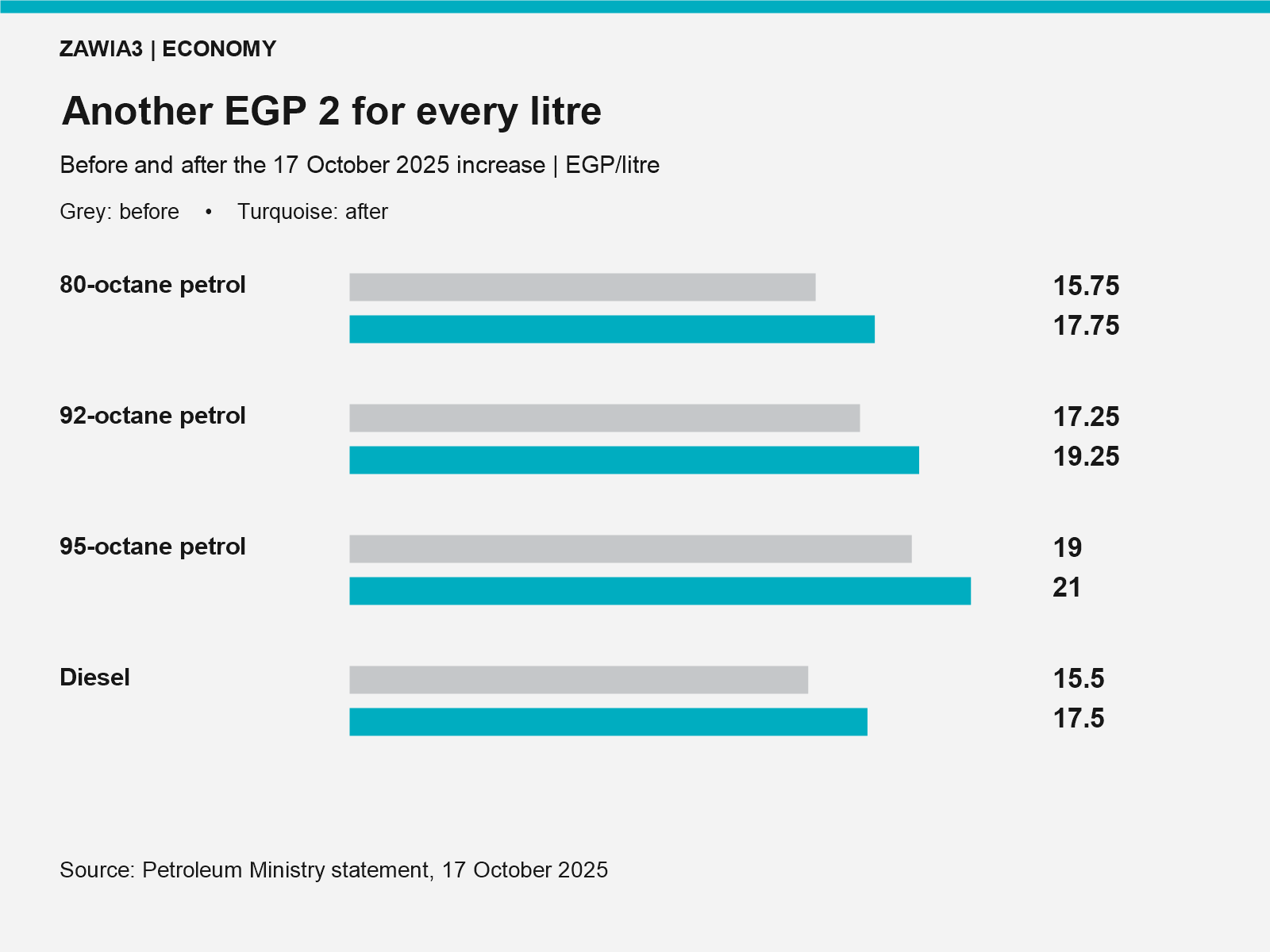
On 17 October, the government raised fuel prices for the second time in 2025 under its automatic pricing mechanism. The new prices were EGP 21 a litre for 95-octane petrol, EGP 19.25 for 92-octane, EGP 17.75 for 80-octane and EGP 17.50 for diesel. Vehicle natural gas rose to EGP 10 per cubic metre.
The increase comes amid severe pressure on living standards. Poverty figures require care: the source previously cited in the Arabic report does not substantiate an official rate of “more than 37%”. Tafnied’s review distinguishes the 29.7% recorded in the 2019–2020 income and expenditure survey from a later estimate of 35.7% for 2022–2023 presented by statistics adviser Heba El-Laithy.
The government said the increase narrowed the gap between fuel prices and production and import costs, citing shipping costs and exchange-rate fluctuations. It also announced that prices would be held for at least a year. That promise did little to calm residents already struggling with the cost of essentials.
The increase nevertheless came as international oil prices were falling. Brent futures traded at USD 60.98 a barrel in early trading on 17 October. The contrast raised questions about the pricing formula and the relative weight of global prices, the exchange rate and other costs.
Repeated increases
Fuel prices have risen repeatedly, including three increases in 2024 and two in 2025. But a chronology of pricing decisions is not a count of increases: the sequence since 2019 also includes freezes and reductions. It cannot accurately be described as “20 consecutive increases”.
In April 2025, 80-octane petrol rose to EGP 15.75 a litre, 92-octane to EGP 17.25 and 95-octane to EGP 19. The October decision added another EGP 2 to each, as well as to diesel, bringing their prices to EGP 17.75, EGP 19.25, EGP 21 and EGP 17.50 respectively.
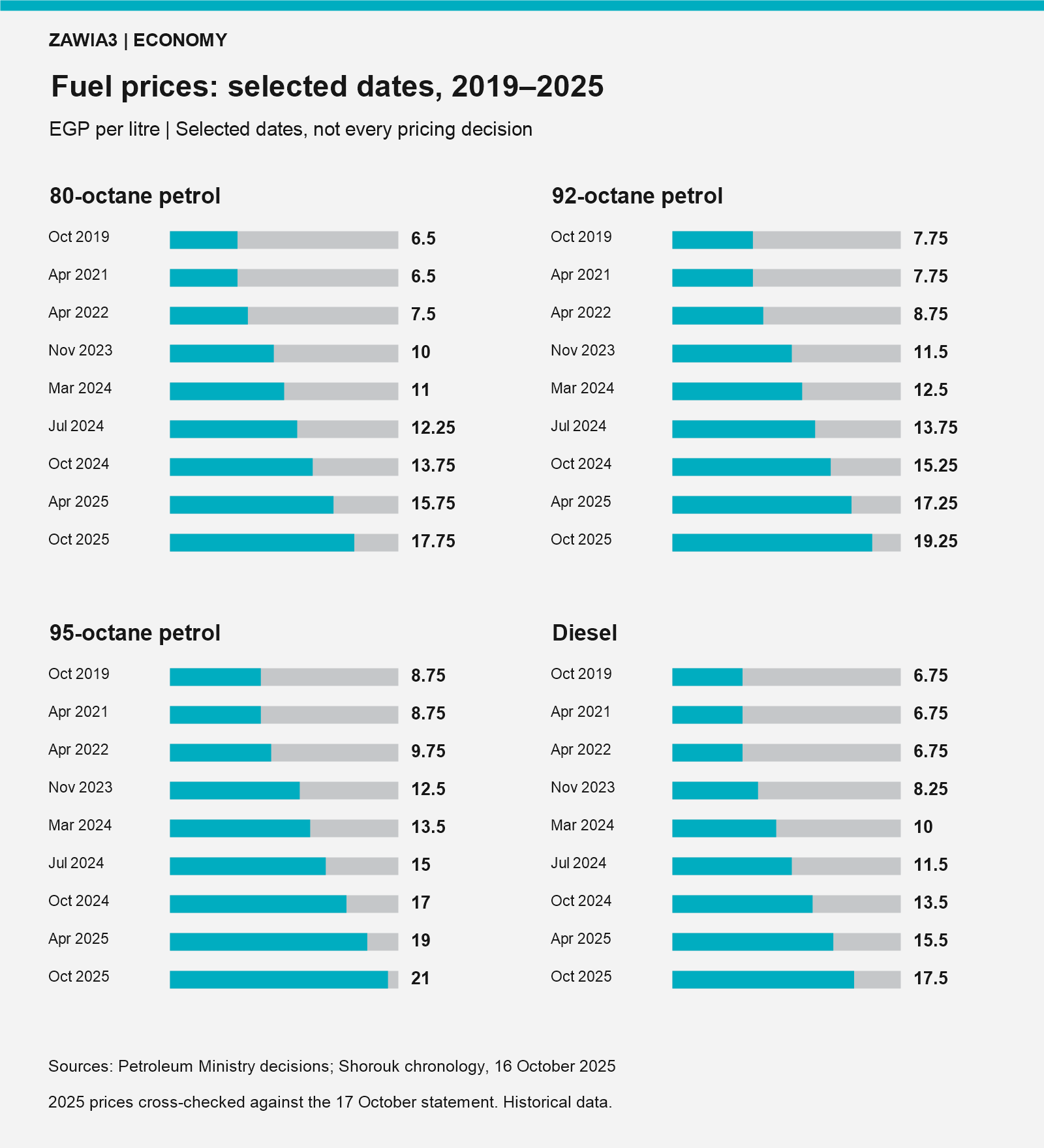
Energy subsidy reform began in 2014. Petrol prices were held steady in late 2020, during the economic disruption caused by COVID-19, before increases resumed in 2021. The automatic pricing mechanism was designed around periodic reviews taking account of international oil prices and the exchange rate, as part of efforts to bring domestic prices closer to costs.
The size of the increases has varied by decision and product. Diesel is particularly consequential because of its role in moving both people and goods. Raising its price affects the operating costs of buses, microbuses, agricultural activity and industry.
The government presents these measures as necessary for fiscal sustainability and for releasing resources for social protection, including Takaful and Karama. Critics argue that the resulting pressure on transport and production costs reaches households through food and other essentials. A precise share of food inflation cannot, however, be attributed to diesel alone on the evidence cited in this report.
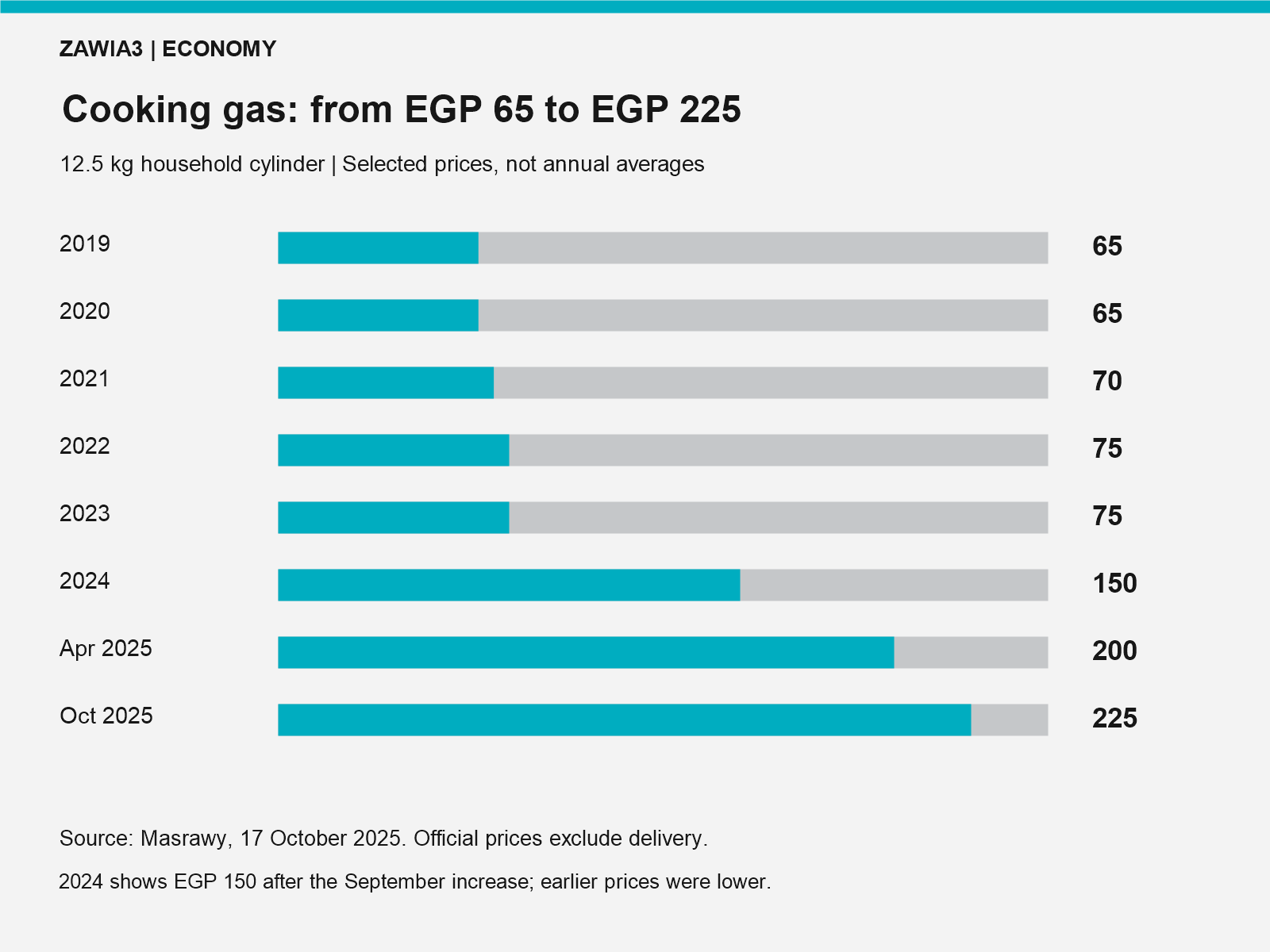
Cooking gas has also become considerably more expensive. The official price of a 12.5 kg household cylinder rose from EGP 65 in 2019 to EGP 225 in October 2025. The latest increase was EGP 25, following the rise to EGP 200 in April. These official prices are distinct from the additional amounts households may pay for delivery.
Fuel costs feed into the price of transporting and delivering food and other goods. Businesses may pass additional operating costs on to customers, connecting changes in energy prices, the exchange rate and subsidy policy to the cost of everyday life. The effect varies by route, service and business; there is no single national fare for every form of transport.
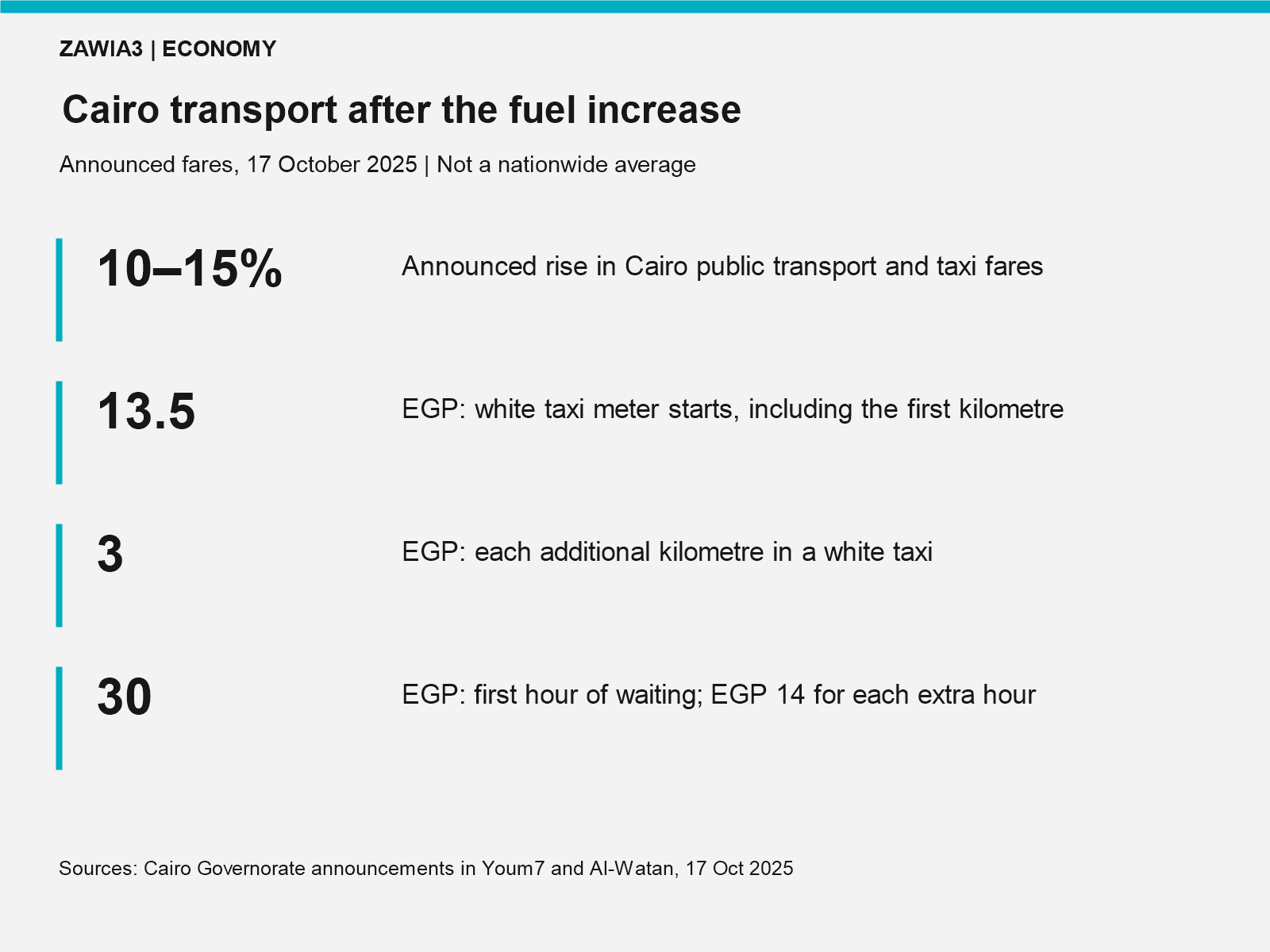
In Cairo, the governor announced fare increases of 10–15% after the fuel decision. The city’s published white-taxi tariff set the initial meter charge, including the first kilometre, at EGP 13.50, with EGP 3 for each subsequent kilometre.
In parliament, MP Freddy El-Bayadi, deputy leader of the Egyptian Social Democratic Party, submitted an urgent question to the government. In the document reviewed by Zawia3, he described the decision as a continuation of an approach that extracts ever more from citizens without fulfilling constitutional social-protection obligations.
El-Bayadi invoked Article 101 of the constitution on parliamentary oversight and Article 8 on social justice and a decent life. He questioned whether IMF instructions were being placed above constitutional protections and citizens’ rights.
He demanded to know what formula sets fuel prices, why it is treated as a state secret, and why local prices rise when international oil prices fall.
His five questions also asked whether implementing IMF requirements took precedence over constitutional social protection; how the government would compensate those most affected; and how long citizens would remain the financiers of every crisis without a fairer economic approach.
“An unjustified increase”
Political economy professor Karim El-Omda told Zawia3 that fuel subsidies were among the most sensitive issues in the Egyptian economy and were subject to continuing IMF scrutiny. He pointed to five increases over two years as a heavy burden on a population already under financial strain.
In his view, the latest increase was unjustified. He argued that statements by IMF officials did not establish an urgent need for this particular rise at this particular moment. That assessment of its timing is distinct from the broader programme commitment to fuel cost recovery.
El-Omda questioned how firmly the government could guarantee that this would be the last increase, arguing that further exchange-rate or international oil-price changes could create renewed pressure. Fuel subsidies, he said, had been a difficult issue for governments since President Anwar Sadat, but the present administration had gone especially far in withdrawing support, with consequences for inflation and living standards.
Electricity and fuel underpin industry and production. El-Omda argues that retaining a reasonable measure of energy support is necessary when low-income households cannot absorb repeated price shocks.
He cited short urban journeys costing EGP 6–7 and longer commutes costing employees and students more than EGP 50 a day as examples of the burden. These are examples from his assessment, not a uniform tariff across the country.
El-Omda said repeated increases added to inflationary pressures, a persistent challenge for successive Egyptian governments. He also criticised the pace of reforms in transparency, governance, anti-corruption and the state’s withdrawal from economic activity through asset sales.
For accuracy, the IMF’s fourth programme review had already been completed on 10 March 2025. The fifth had not been completed at the time of this report; it is incorrect to describe both reviews as still postponed.
El-Omda’s broader criticism is that the government has chosen the easier route of raising petrol and electricity prices rather than undertaking difficult structural changes. He sees this as a failure of economic management, compounded by a parliament that does not effectively scrutinise decisions with direct consequences for everyday life.
The wrong moment
Economic journalist and researcher Mirvana Maher told Zawia3 that the government justified its decision by pointing to the cost of petroleum products to the budget. She considers the underlying motive to be reducing energy-subsidy expenditure amid mounting fiscal pressure.
She argued that the timing was particularly poor. Official measures of inflation may be slowing, but that does not mean prices themselves are falling: prices can continue to rise at a slower rate, leaving households facing persistently high bills.
Maher described the EGP 2-per-litre increase as substantial. Higher diesel costs, she said, affect transport and production and can spread through the prices of goods across the market.
The decision also followed central-bank interest-rate cuts, which she said affected pensioners and middle-class savers who relied on returns from bank savings certificates. Lower returns and higher living costs could squeeze the same households simultaneously.
“Economic decisions sometimes appear contradictory”: lower interest rates put pressure on savers while higher fuel prices increase their living costs, Maher said.
She criticised the government for choosing an administratively easier option instead of considering fairer alternatives. In her assessment, the IMF had not expressly demanded this particular increase at this moment. She suggested reviewing export-support spending, restructuring special funds whose finances she regards as opaque, and developing mineral resources to generate more stable public revenue.
Every economic decision has several dimensions, Maher said, but repeatedly relying on quick revenue or expenditure measures such as price increases reflects a lack of long-term vision. Social justice and more imaginative public-finance policies, she argued, should be central to reform.
Who bears the cost?
Economist Zohdi El-Shami, a leading figure in the Socialist Popular Alliance Party, offered a different emphasis. He told Zawia3 that the immediate reason for the petrol, cooking-gas and vehicle-gas increases lay in the government’s commitments under its IMF agreement.
He sees those commitments as reinforcing a wider policy of increasing tax and non-tax burdens on citizens rather than pursuing fairer and more durable structural solutions.
El-Shami said the absence of effective institutional opposition, amid what he described as severe restrictions on public freedoms, allowed such decisions to pass without meaningful political resistance or oversight. In his assessment, that weakens society’s ability to challenge policies that directly affect people’s lives.
He expects higher energy costs to increase transport charges and the prices of food, manufactured goods and services, adding to the pressure on low- and middle-income families. He criticised what he sees as the government’s inability to contain inflation and pointed to concerns about further price rises in the following months.
El-Shami traced the approach not only to the past decade but also to the economic opening of the 1970s, which, in his view, entrenched reliance on borrowing and foreign assistance while neglecting a strong domestic productive base. He argued that repeated reliance on prescriptions from international financial institutions had failed to deliver lasting improvements in living standards.
For El-Shami, addressing the crisis requires a change in economic philosophy: social justice, support for those bearing the greatest losses, and stronger national control over economic choices.
The IMF programme does include a commitment to bring fuel prices towards cost recovery by December 2025, alongside wider fiscal and structural reforms. The Fund reiterated that commitment during its March briefing. This is the relevant programme context, even where interviewees dispute the necessity or timing of the October increase.
The government, meanwhile, has said it intends to continue supporting diesel because of its importance to public transport, agriculture and industry, while using the pricing of other products to help cover the gap. Its stated aim is to limit the impact on essential services and lower-income groups.
The USD 8 billion IMF arrangement links disbursements to programme reviews and reform commitments. Energy pricing sits alongside calls for stronger fiscal transparency and social protection, including targeted cash transfers. For households, however, the central concern is the gap between living costs and actual income.
The debate is therefore about more than the price displayed at a petrol station. The government speaks of fiscal sustainability, while residents describe daily financial exhaustion. Without adequate protection, stronger incomes and clearer explanations of how decisions are made, each fuel increase risks reinforcing the perception that economic crises are resolved at the expense of those least able to pay.
Editorial correction: Fuel-chart figures, the Brent price and the status of the fourth IMF review have been checked. The transport graphic now uses identified Cairo fares announced on 17 October 2025; a misleading pie chart combining prices from different years has been removed. This report retains its original October 2025 context.