
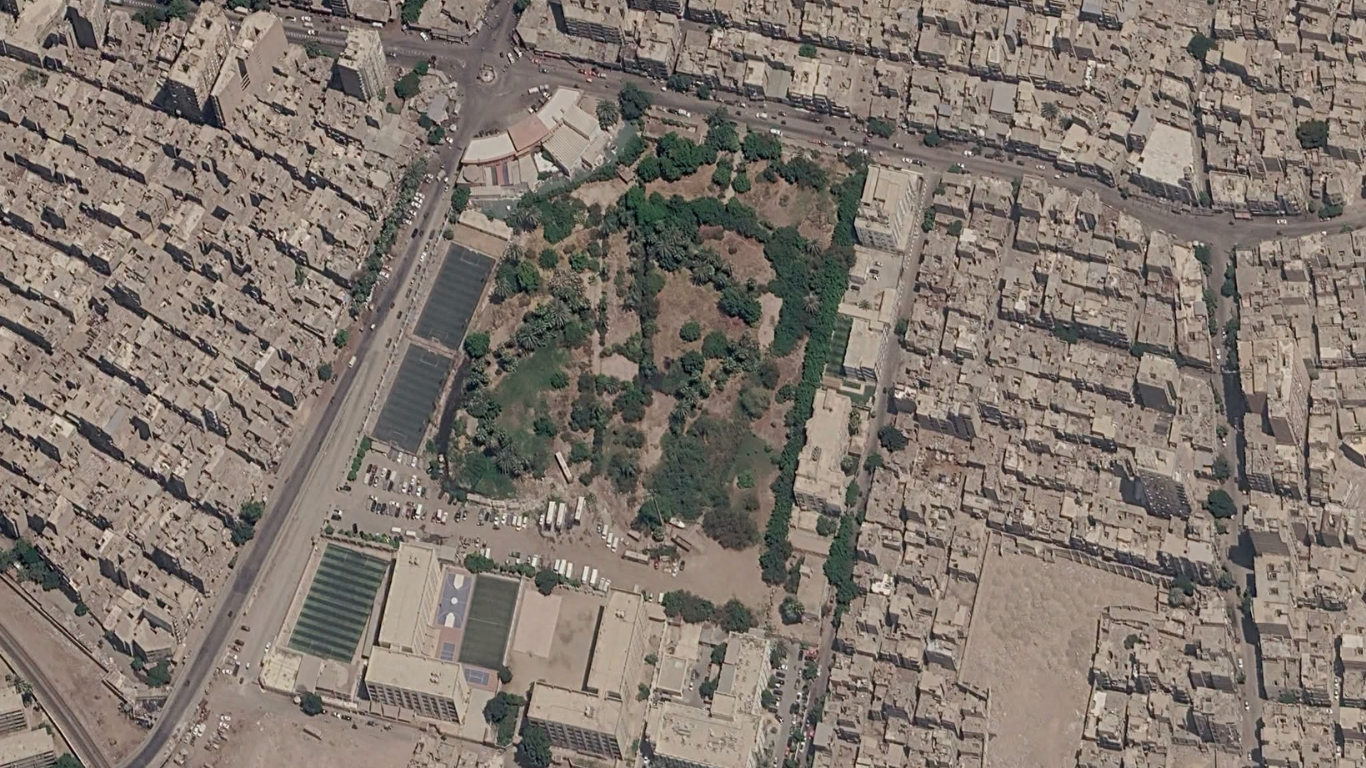
The August 31 deadline set by the Egyptian Endowments Authority for property developers to submit proposals to exploit the 41,000-square-metre Rawdh Farag Park in partnership with the authority has passed.
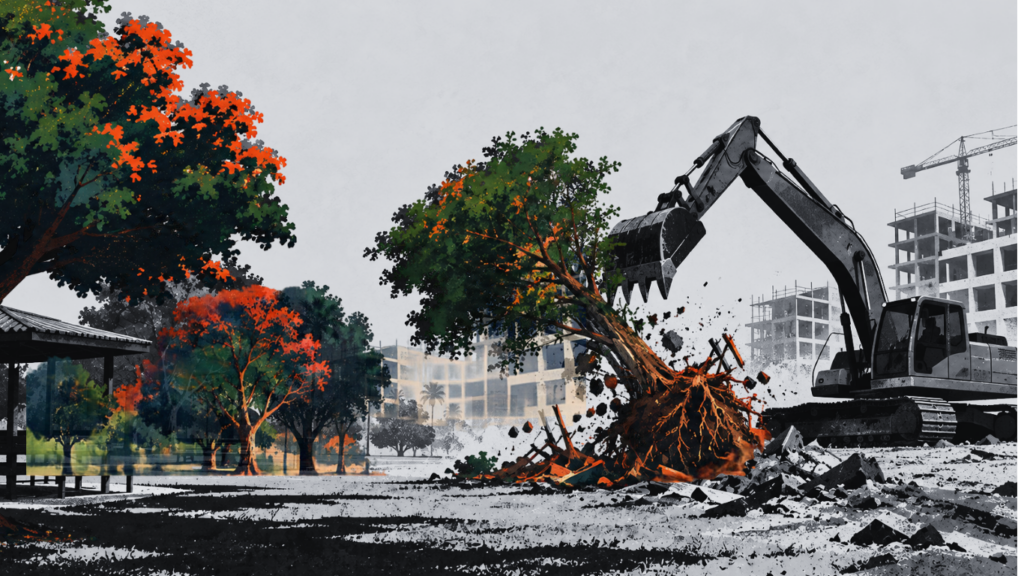
The authority’s August 6 announcement calls the site “Rawdh Farag Park (the former Rawdh Farag market)” and seeks “optimal exploitation of the entire land area” through a “distinctive investment complex.” Press reports say possible uses include hotels, office buildings and towers. A month before the announcement, constituency MP Mohamed Abdel Rahman Radi had urged the authority in parliament to invest in land that had “turned into a forest of trees.” After the announcement, he questioned the legality of the offering. In the authority’s announcement and published statements reviewed by Zawia3, there is no mention of what will happen to the park’s two football pitches and existing trees, or whether any green space will remain.
The land was once the Rawdh Farag wholesale market. Service facilities were subsequently built there, including a medical centre, a school for children with intellectual disabilities, a hospital and the Rawdh Farag Culture Palace. Part became a public park inaugurated in 2018 by Major General Mohamed Sultan, then head of Cairo Governorate’s specialised parks project. It covered ten feddans and included two football pitches. In 2021, the Endowments Authority recovered the land under a State Council judgment.
On July 8, 2026, the House of Representatives’ Religious Affairs and Endowments Committee discussed a parliamentary briefing request submitted by Radi, secretary of the Defence and National Security Committee and MP for Rawdh Farag and Bulaq Abu al-Ela, about the market land. Radi said the authority had received 42,000 square metres from Cairo Governorate around four years earlier without investing in them, leaving them to become a “forest of trees.” “The Endowments Authority does not make good use of its assets, and the Rawdh Farag market land is the clearest example,” he said.
Radi added that the trustee of the endowment—the endowments minister—was not monitoring it. He said the ministry receives 75% of endowment returns and requested an account of how that share had been spent in the previous financial year. He described “administrative confusion” between the ministry as trustee and the authority as investment manager, and relayed committee members’ calls to review how endowment funds are managed.
Four weeks after that session, the authority invited major property developers to propose “a distinctive investment complex through strategic partnership, to make optimal use of the entire land area.” It requested a comprehensive study covering the development vision, master plan, optimal division of the site and “investment feasibility for maximum exploitation of the land.” Proposals were due by August 31, 2026, at its headquarters at 109 Tahrir Street in Dokki.
According to Enterprise, the offering is part of a plan to put forward around 20 investment opportunities in the second half of 2026, involving land and buildings suitable for reuse. The Endowments Ministry’s portfolio is estimated at EGP 1.04 trillion (approximately US$21.5 billion), including agricultural land worth about EGP 759 billion (US$15.7 billion), property worth approximately EGP 137 billion (US$2.8 billion), and vacant land worth more than EGP 141 billion (US$2.9 billion). These are the approximate dollar equivalents reported in the Arabic article.
MP: Only 5% of the Site May Be Built On
On August 19, Radi submitted a question to House Speaker Hisham Badawi, addressed to the prime minister, the minister of local development and environment, and the endowments minister, about the August 6 announcement. He said examination of the announcement revealed four grounds for questioning the offering’s legality.
First, the announcement did not specify which rules would govern the contract: the authority’s internal regulations or Law No. 182 of 2018 regulating public bodies’ contracts, particularly after the Cabinet approved standard contract models for state entities and authorities. Second, it was unclear whether the offering had been presented to the authority’s board, investment committee and committee responsible for protecting endowment assets, or whether its purpose was to upgrade the park or change its use.
Third, the authority had not clarified whether it had obtained licences and approvals from the Environment Ministry and Cairo Governorate, either to improve the park or to develop property beyond the building proportion permitted by the site’s master plan: 5% of its total area. Fourth, it had not explained its plans for services already occupying part of the land: a hospital, culture palace, telephone exchange, school complex and youth centre.
If the 5% limit in the master plan is observed, the dispute would concern what is built on roughly 2,000 square metres and how the remainder is used, rather than whether the park exists at all. If the offering exceeds that limit, this is precisely what the MP is questioning.
In September 2026, Amr Rabie, head of the timber trees department at the Horticulture Research Institute, cited Central Agency for Public Mobilisation and Statistics data putting Egyptians’ green-space provision at around 1.2 square metres per person, compared with a nine-square-metre minimum commonly attributed to the World Health Organization.
A 2022 study, “Quantity and Distribution of Public Green Spaces in Cairo,” found that the city lost about 910,000 square metres of greenery between 2017 and 2020, reducing provision per resident from 0.87 to 0.74 square metres. More than half its residents lived in areas with less than half a square metre per person. Reuters cited the study in August 2024.
Other reports, including a 2022 Egyptian Initiative for Personal Rights study and statistics previously cited by Zawia3 up to 2020, circulate a far lower figure of 17 square centimetres per person. These estimates differ markedly in scale and should not be treated as interchangeable measures. The Human and City Foundation for Human and Social Research estimates Egypt needs approximately 58 million square metres of gardens, while only around 5.4 million are available, citing the statistics agency.
The Arabic report calculates that the park’s ten feddans represent the green-space share of around 35,000 people. That calculation corresponds to about 1.2 square metres per person; using the separately cited Cairo figure of 0.74 square metres would produce a different result. The park’s area is described as 41,000 square metres in the authority’s announcement and 42,000 square metres in the MP’s earlier account.
On a wider scale, Global Forest Watch data show Egypt lost approximately 1,800 hectares (18 square kilometres) of tree cover between 2001 and 2024, equivalent to 1% of its 2000 extent, associated with around 560,000 tonnes of carbon-dioxide-equivalent emissions. The platform measures different types of tree cover, including agricultural trees, rather than urban parks alone.
The Egyptian organisation ESLA attributes 33% of those losses to urban development. London-based Al-Arab reported that around 2,500 trees were removed in Heliopolis in 2019–2020 during road expansion, while the Goethe-Institut documented clearance of parts of Merryland Park. In January 2026, IQAir listed Cairo among the world’s ten most polluted cities by fine-particle concentration.
Environment Law No. 4 of 1994 requires at least 1,000 square metres of state land in every district and village to be allocated to a tree nursery. Article 28 prohibits cutting, damaging or trading in protected wild plants, or destroying their habitats. This protection concerns wildlife and plants on protected-species lists; the law contains no provision specifically dedicated to urban trees and public parks. Experts interviewed by Zawia3 therefore call for separate legislation. The law defines air pollution as any change in natural air’s characteristics or specifications that poses a risk to human health or the environment.
An Environmental Lawyer Calls for Specific Protection
Environmental lawyer Ahmed al-Saeedi, head of the Egyptian Foundation for Environmental Rights, places the offering in the context of earlier government policies that he believes fail to provide enough green space, particularly in older Cairo neighbourhoods such as Rawdh Farag, Shubra and Matariya. “Egypt has lost many green spaces over the past ten years. Research reports have documented shrinking green areas in different parts of Greater Cairo, including Nasr City, Heliopolis and road medians,” he told Zawia3.
He believes the Environment Ministry and Egyptian Environmental Affairs Agency have fallen short over the past two years in protecting green spaces, whether through decisions, recording violations or acting against encroachments. He argues that merging the environment and local development ministries reduced the priority of environmental protection in some local development policies. Local Development Minister Manal Awad was assigned the environment portfolio in July 2025 before the two were combined into a single ministry under her in 2026.
Al-Saeedi warns that residential areas without open green spaces face health, psychological and social problems. He links their absence to mental distress and violence, and calls for parks to be treated as an environmental, health and social issue requiring legal protection and clear policies, rather than merely a matter of beautification.
He sees a gap between the “Go Green” and “100 Million Trees” initiatives and what happens on the ground. Existing trees have consumed resources over many years and cannot easily be replaced by new planting. “Tree-planting initiatives have good intentions, but that does not mean cutting down existing trees and then launching campaigns to plant replacements. This contradiction reflects a problem in the environmental policies being implemented,” he said.
He proposes a shift from felling to choosing species suited to their environment, pruning and propagating them, and increasing tree cover in new cities. He also advocates restricting cars in congested areas and closing some streets to motor vehicles in favour of pedestrians and bicycles, as in other countries.
Civil society, rather than investors alone, should participate in developing parks, he says, in line with the constitution’s commitment to sustainable development involving citizens and associations in decision-making. His foundation has taken legal action over Zahriya Garden and intends to challenge other parks redeveloped in breach of the law, including Obelisk Garden, listed in Cairo’s register of buildings of distinctive architectural character. He says it has been turned into restaurants, shops and pitches amid soil clearance and the removal of some trees. He urges MPs to legislate for the protection of trees and public parks, describing the absence of such a law as one of the greatest crises facing green spaces.
Heat Islands and the Human Cost
Architect Yehia al-Zeini, founder of Diwan al-Mimariyeen, believes recent development and urban expansion projects have reduced greenery inside cities. He warns that replacing tree cover with hard surfaces and buildings raises temperatures, lowers air quality and worsens urban heat islands: cities becoming hotter than their surrounding countryside, by between two and ten degrees Celsius in his estimate.
He attributes this to urban expansion, reduced vegetation and heat-absorbing materials such as asphalt and concrete, which increase energy consumption and pollution. He told Zawia3 that many property projects treat trees as decorative or marketing elements rather than structural components of urban design. Many new cities and residential compounds fail to use trees to shade pavements and provide safe pedestrian routes, making cars a daily necessity.
Asmaa al-Halwagi, chair of the Tree Lovers Association, told Zawia3 that offering the park for property investment raises environmental and human concerns because the surrounding area is densely populated and needs green spaces to improve air quality and reduce pollution. She calls on the authority to consider the “human dimension” and put residents’ health before financial returns.
“Green spaces must not be encroached upon. Egyptian laws criminalise building on green spaces, including open areas in clubs and elsewhere. Existing trees, shrubs and green spaces must be preserved, especially in densely populated residential areas,” she said. This is her assessment of the legal protections; al-Saeedi separately identifies a gap in legislation specifically protecting urban trees and public parks.
Al-Halwagi believes urban expansion should extend into the desert alongside planting. She questions compliance with legally required environmental impact assessments and warns about heat stress, particularly among older people.
Rania Fathy, an environmental protection consultant and secretary-general of the Ain al-Beea Association, explains that green spaces in residential areas provide shade and moisture, absorb carbon dioxide and create habitats for wildlife and birds—benefits especially important in a desert country such as Egypt. “Residential compounds and tourist villages must maintain a proportionate balance between built-up and green areas,” she told Zawia3.
She says her association has repeatedly submitted a carbon-reduction project, including a green area in each of Egypt’s 27 governorates, to the National Initiative for Smart Green Projects. She does not oppose every project requiring part of a green space for a public-interest use or road construction, provided it is accompanied by other emissions-reduction projects or tree planting elsewhere.
A Climate Expert Questions Policy Consistency
Hisham Eissa, Egypt’s former national focal point for the UN climate convention and head of the specialised council for climate change and sustainable development, notes that Egypt has signed the Paris climate agreement, the convention to combat desertification and the biodiversity convention. He believes property investment inside a green park conflicts with these commitments. He criticises the Environment Ministry for failing to stop the offering, as the body responsible for international environmental agreements.
“Green spaces help limit rising temperatures and heat stress, while reducing the need for energy to operate air conditioning. They are linked to confronting climate change and improving residents’ environmental and social conditions,” Eissa told Zawia3.
He warns that continued removal of greenery could undermine confidence in Egypt’s climate commitments when it seeks international climate finance. When the state says it needs more greenery and less heat stress, then removes green spaces for other projects, it “sends a signal that policies are inconsistent.”
In a related move, MP Heidi al-Maghazi, representing the Coordination of Youth Parties and Politicians and the Justice Party, submitted a question to the minister of local development and environment about repeated tree cutting in Cairo and Giza, despite instructions prohibiting felling or excessive pruning without consulting technical bodies.
She asked who has authority to order felling, what removal criteria apply, and whether inspections, technical reports and committee approvals actually precede work. Protecting trees “requires a unified, binding system, rather than random decisions from one district to another,” she said, calling for oversight, accountability and a tree-stock database.
Al-Maghazi requested that the government disclose how many trees were cut in Cairo and Giza over the past two years, broken down by district, with reasons and approvals, and publish the rules governing felling.
Between an announcement seeking “maximum exploitation” of the whole site and a master plan that, according to the constituency MP, permits construction on no more than 5%, Rawdh Farag Park awaits the authority’s decision after reviewing developers’ proposals. Its two pitches and trees—which the same MP described two months earlier as a forest—also await government answers to two parliamentary questions that remain unanswered.