In 2016, Youssef Shaaban was planning to return to Egypt after years abroad when he bought 42 feddans on the Cairo–Alexandria Desert Road from the European Countryside Agricultural Development Company, owned by businessman Abdullah Saad, to invest his savings in farming. A feddan cost around EGP 400,000 at the time. Unable to pay the full EGP 16.8 million purchase price at once, he paid it in instalments over two years.
But in March 2018, Presidential Decree No. 113 reassigned 31,952.90 feddans of state-owned land near the Cairo–Alexandria Desert Road to the New Urban Communities Authority (NUCA) to establish a new urban community in Giza Governorate. Situated between kilometres 48 and 56 of the road, it became known as New Sphinx City. Like other European Countryside landowners, Youssef was shocked to discover that his land fell within its boundaries.
Youssef holds a title deed registered with the Real Estate Registration Office. Other owners in the area have different circumstances: some hold officially registered ‘green’ deeds, some have regularised their agricultural land and paid the instalments and fees, while others’ land came under the Supreme Committee for Recovering State Land and Dues, chaired by Ibrahim Mahlab.
In October 2018, NUCA announced the start of procedures to regularise the position of owners within New Sphinx City’s 31,900-feddan boundary, covered by Presidential Decree No. 113. Owners found themselves facing two options: continue agricultural activity, or convert to residential use and obtain utilities in return for approximately EGP 1,185 per square metre, nearly EGP 5 million per feddan, as Youssef recalls.
‘Those unable to pay in cash were offered the option of surrendering part of their land under an in-kind arrangement, or receiving around 50% of its area within the urban boundary. They also had to obtain building permits, submit designs to NUCA and contract with a developer licensed to work in the city,’ he tells Zawia3.
Youssef and other owners were later surprised to be asked to sign rental contracts. He subsequently stopped farming his land, on which he had spent around EGP 11 million on reclamation, drilling a well, installing irrigation networks, a solar-power system and an electricity transformer, in addition to the cost of crops planted before activity stopped.
The crisis lies in the high amounts government bodies demand from owners to regularise land and change its use, according to Mahmoud El-Shalqani, a New Sphinx landowner. He says most bought their land under contracts with the state before the January 2011 revolution, when official policies encouraged desert reclamation and the expansion of agriculture and settlement.
In 2008, Mahmoud visited the Ministry of Agriculture to inquire about land available for agricultural reclamation on the Cairo–Alexandria Desert Road. Following guidance he received at the ministry, he chose a plot in the ‘Green’ area and bought two feddans for EGP 2 million. He cultivated them and built a house there.
In 2013, however, he and several owners approached the Ministry of Agriculture, which had administrative jurisdiction over their land, seeking permission to build on 7% of it. They were surprised to learn that the land had been placed under a lease-to-own arrangement, requiring tenants to cultivate it for seven years before receiving final title deeds.
Between 2013 and 2015, a committee was formed at the Ministry of Justice, chaired by then Deputy Justice Minister Fathi Bayoumi, to examine owners’ entitlement to retain their land, according to Mahmoud. It ruled in favour of dozens of owners. Ultimately, however, they were obliged, he says, to pay for the use of land they considered their own.
He explains that owners began reclaiming and cultivating the land, constructing buildings, roads, water, sewage and electricity networks, and drilling wells, relying on the contracts and documents they had obtained. They hoped the state would support the transformation of desert areas into productive agricultural settlements, before the authorities moved to change land use from agricultural to urban.
New Sphinx City’s general strategic plan was first approved by Ministerial Decree No. 910 of 2020 on 1 November 2020. An amended plan covering 76,931.03 feddans, equivalent to around 323.17 million square metres, was subsequently approved by Ministerial Decree No. 485, issued on 8 June 2022.
The plan was based on Presidential Decree No. 61 of 2019, which reassigned 59,417.77 feddans of state-owned land near the Cairo–Alexandria Desert Road to NUCA, and Presidential Decree No. 566 of 2020, which reassigned another 17,513.26 feddans and transferred jurisdiction over them to the authority.
‘Owners did not object to complying with planning rules that protect private property and the rights of the state and citizens. But the amounts demanded began at around EGP 250 per square metre, then jumped to EGP 700 and gradually rose to EGP 1,000, before reaching around EGP 1,750 today,’ Mahmoud tells Zawia3.
He adds: ‘That means regularising one feddan costs more than EGP 7 million. If the land falls within an area allocated to the armed forces, owners are asked to pay another EGP 1,500 per square metre, bringing the total to around EGP 13 million per feddan.’
He believes these measures have created uncertainty for owners, particularly as the bodies responsible for managing the land have changed and demands and procedures have multiplied, requiring them to prove ownership of land obtained through official documents.
Alongside rising regularisation fees, owners face difficulties buying, selling or granting lawyers powers of attorney to dispose of their property. Mahmoud attributes this to restrictions on land transactions in the area, which, in his view, have reduced its market value.
How did the crisis begin?
NUCA began regularising the position of New Sphinx landowners in October 2018. But Presidential Decrees 61 of 2019 and 566 of 2020 reshaped the legal and administrative position of land near the Cairo–Alexandria Desert Road. In May 2019, the authority opened applications to regularise it. In December 2019, it began receiving applications from those who had previously acquired interests through sale contracts or ownership documents in New Sphinx.
Owners subsequently submitted applications to the New Sphinx City Authority for plot allocation and regularisation following the land-reassignment decrees. Copies reviewed by Zawia3 stated that the land had been purchased under contracts with the state. Owners submitted the applications, required documents and maps, paid fees and applied for reconciliation over building violations, paying a 25% deposit towards the assessed violation charge as evidence of their commitment to reconciliation.
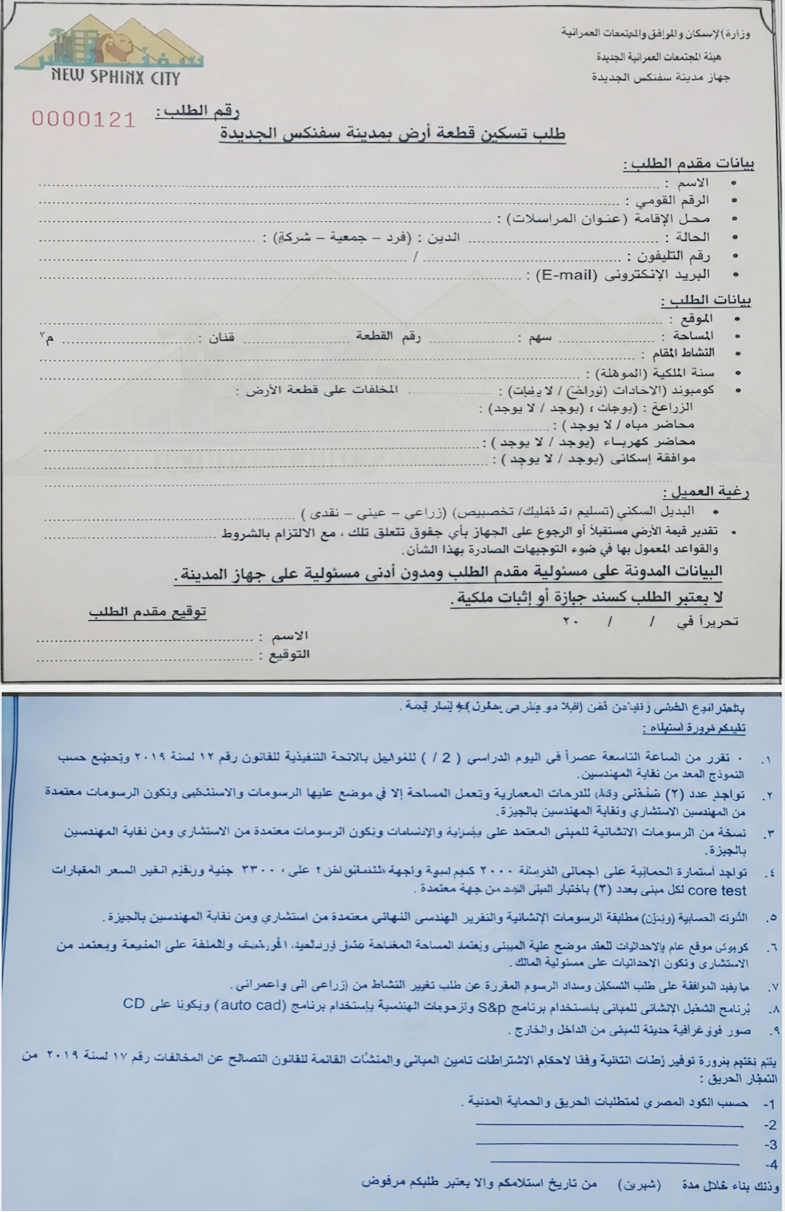
The city authority’s ‘Application for allocation of a land plot in New Sphinx City’ requires information about ownership, the land and its existing use, including location, area, plot number and year of ownership. It also requests information on cultivation, water and electricity records, residential approval and the applicant’s preferred alternative, with agricultural, in-kind and cash options. A further clause concerns the future valuation of the land or claims against the authority relating to rights over it, under the applicable rules and directives.
The form requires documents, drawings and reports concerning existing buildings, including approved architectural and structural drawings, an engineering report, a general site sketch with coordinates, evidence of residential approval and payment of prescribed agricultural-to-urban conversion fees. Recent interior and exterior photographs are also required, alongside compliance with building-safety requirements under Civil Defence rules and the Egyptian fire code. Applicants have two months to complete the procedures or their applications are deemed rejected.
After it emerged that European Countryside land lay within New Sphinx City, Khaled Abdel Rahman, the investigating judge assigned to land-corruption cases, ordered a supplementary inspection mission on 2 June 2020. It included engineers from the New Sphinx City Authority and was tasked with inspecting the European Countryside Agricultural Development Company’s land on the Cairo–Alexandria road, owned by Abdullah Saad, to reprice it and assess the extent of the company’s violations.
The investigating judge ordered a travel ban on the businessman, placed his name on watch and arrival lists, and ordered his arrest if he attempted to leave the country. The measures concerned a case accusing him of appropriating public funds, illicit profiteering and intentionally damaging public funds after changing the use of land acquired from the state from agricultural land to residential resorts.
The case dates back to the purchase by an Egyptian joint-stock company owned by businessman Abdullah Abdel Hamid Saad, the European Countryside Agricultural Development Company, of 2,105 feddans, 16 qirats and 15 sahms on the Alexandria Desert Road from the General Authority for Reconstruction Projects and Agricultural Development. A final contract was registered in May 2005 for EGP 10.5 million, at EGP 5,000 per feddan, for reclamation and cultivation.
In 2008, the European Countryside company sold part of the land and constructed buildings, changing its use from agricultural to residential in violation of the law. It used more than 7% of the land for property development, exceeding the permitted 2%, while leaving more than 50% unreclaimed and uncultivated.
As applications opened for New Sphinx landowners to regularise their position, Presidential Decree No. 566 of 2020 allowed the armed forces to retain any land they owned within the decree’s boundaries. Presidential Decree No. 98 of 2023 then allocated them 3,647.43 feddans near New Sphinx City, north of the Tahya Misr corridor, transferred from land previously under NUCA’s jurisdiction.
How did land-use conversion charges rise?
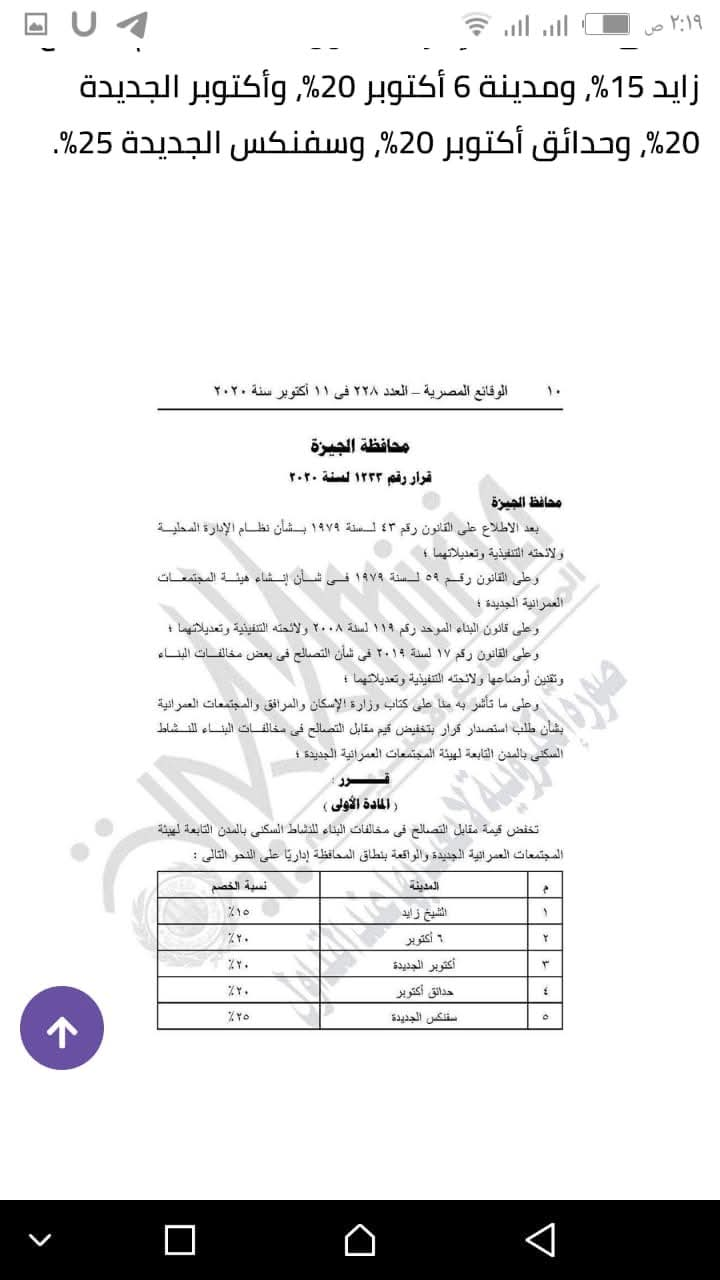
Giza Governorate Decision No. 1233 of 2020, published in issue 228 of the Egyptian Gazette on 11 October 2020, reduced reconciliation charges for residential building violations in New Sphinx City by 25%. In 2021, however, NUCA set agricultural-to-urban conversion premiums ranging from EGP 700 to EGP 1,175 per square metre, depending on plot size and building conditions, including the cost of utilities.
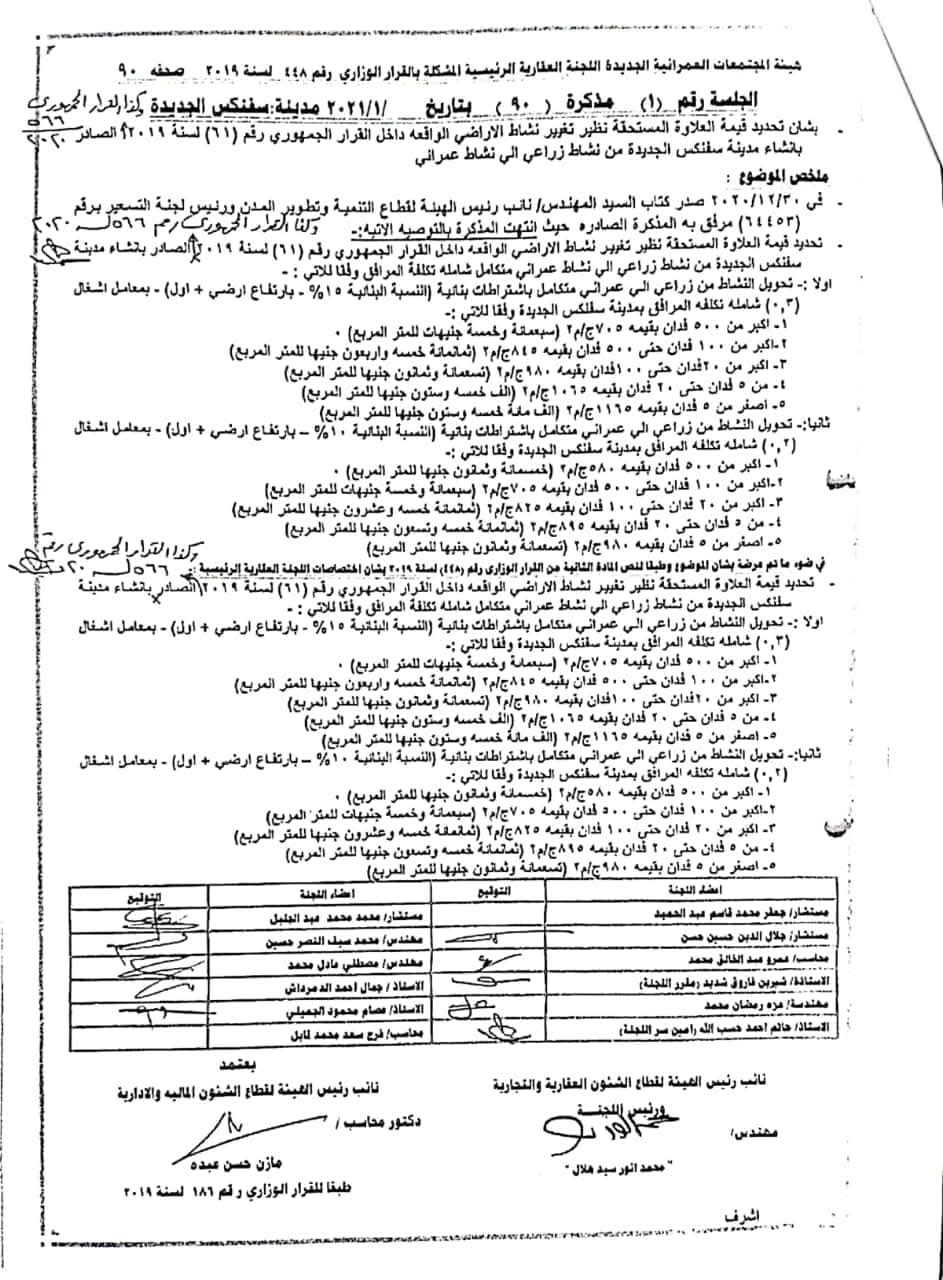
A memorandum issued by NUCA’s Main Real Estate Committee on 1 January 2021, reviewed by Zawia3, set conversion premiums for changing agricultural use to integrated urban use under two schemes. The first permitted 15% building coverage, a ground floor plus one upper floor, and a floor-area ratio of 0.3.
Premiums were set at EGP 700 per square metre for plots exceeding 500 feddans, EGP 845 for 100–500 feddans, EGP 980 for more than 20 up to 100 feddans, EGP 1,070 for 5–20 feddans, and EGP 1,175 for plots smaller than five feddans.
The second scheme permitted 10% building coverage, a ground floor plus one upper floor, and a floor-area ratio of 0.2. The committee set premiums at EGP 580 per square metre for plots exceeding 500 feddans, EGP 705 for 100–500 feddans, EGP 825 for more than 20 up to 100 feddans, EGP 980 for 5–20 feddans, and also EGP 980 for plots smaller than five feddans.
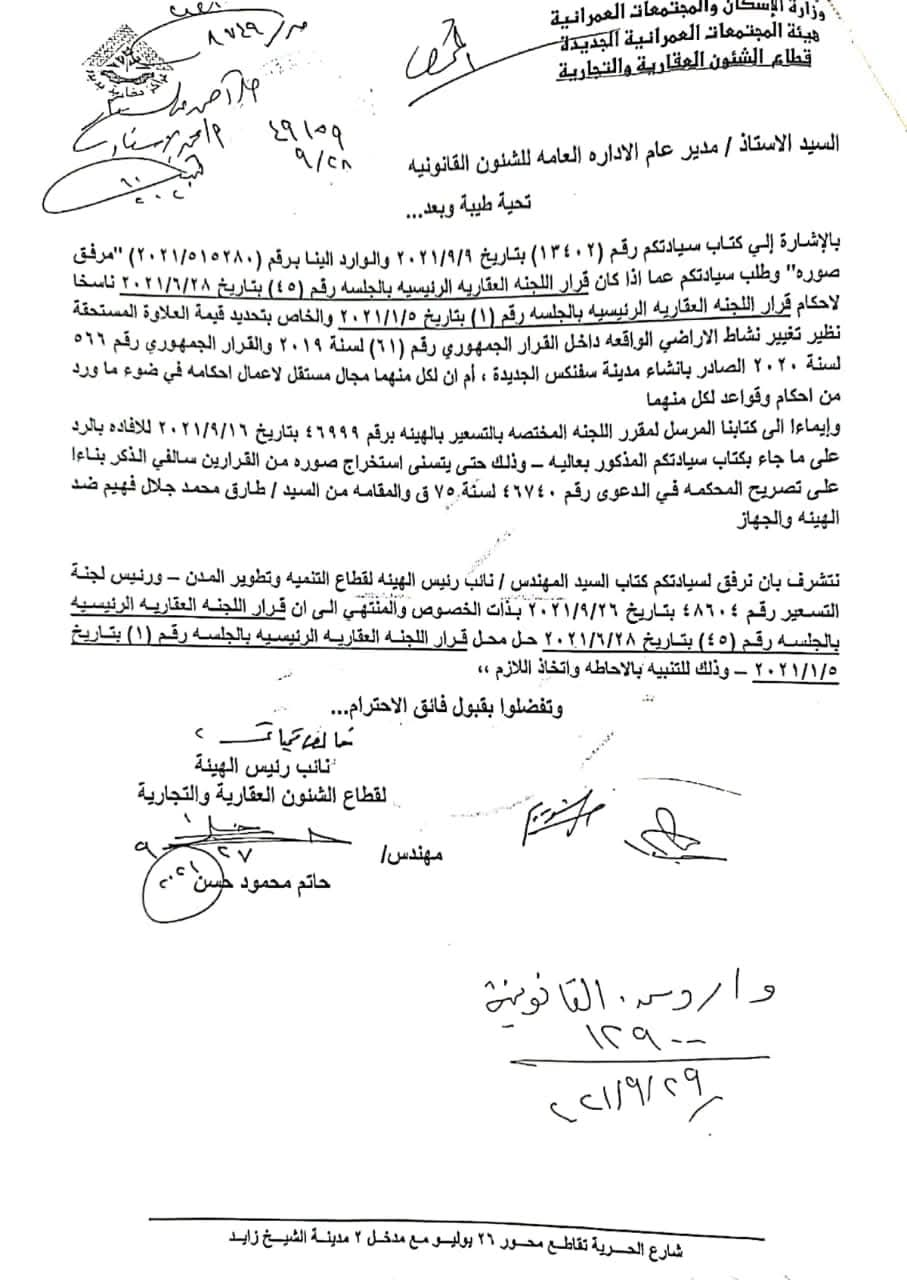
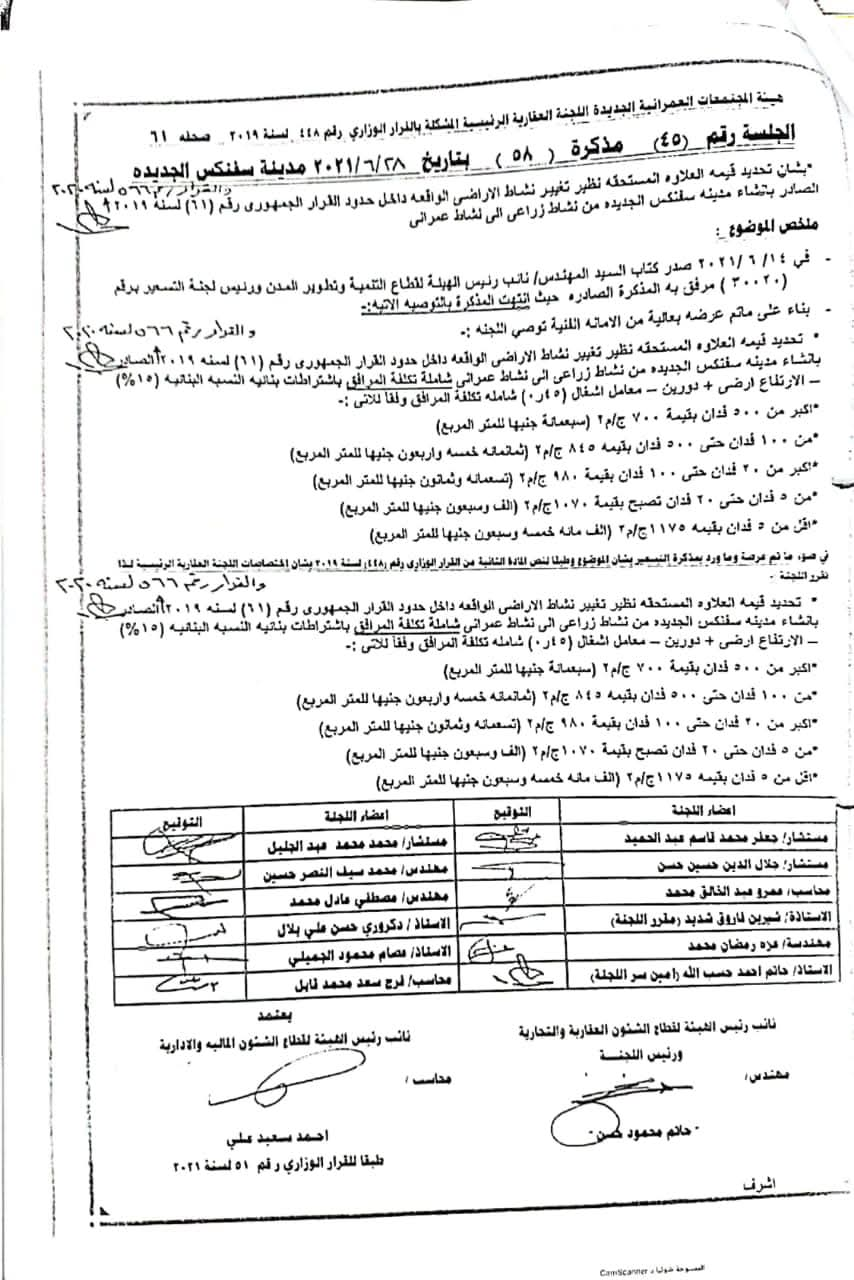
But the Main Real Estate Committee’s memorandum from session No. 45 on 28 June 2021 superseded the earlier memorandum. It retained the agricultural-to-urban conversion premiums for plots starting at 20 feddans through 500 feddans and above, while raising them to EGP 1,175 per square metre for plots smaller than five feddans and EGP 1,070 for 5–20 feddans. Specified planning conditions included 15% building coverage, a ground floor plus two upper floors, and a floor-area ratio of 0.5, with utilities included in the premium.
In September 2021, a subsequent legal memorandum from the authority’s Real Estate and Commercial Affairs Sector sought clarification on whether the committee’s decision of 28 June 2021 superseded its January decision. In response, the authority’s deputy chairman for city development and chair of the pricing committee confirmed in letter No. 48604, dated 26 September 2021, that the decision of session No. 45 on 28 June 2021 replaced that of session No. 1 on 1 January 2021.
The city’s strategic and detailed plan, announced by Housing, Utilities and Urban Communities Minister Sherif El-Sherbiny, included five sectors covering more than 73,000 feddans. These comprised residential urban areas, residential-agricultural areas, industrial and logistics zones, regional-service areas and others for investment activities.
Alongside expanding the city’s boundaries and approving its strategic plan, the New Sphinx City Authority offered applicants seeking allocation of European Countryside plots three routes to regularise their position and change land use: continue farming; convert to residential use with utilities under an in-kind arrangement, surrendering 50% of the land to NUCA; or convert to residential use with utilities under a cash arrangement at the applicable prices and rules.
A later official letter from NUCA’s Planning and Projects Sector, however, provided for settlement of agricultural-to-urban conversion charges and utility-provision costs for plots exceeding five feddans through cash or in-kind consideration, amid rising costs of utility sources and distribution networks.
The letter instructed city authorities, when examining regularisation cases, to locate the state’s share, represented by NUCA, in the most desirable part of the land concerned. It restricted regularisation to in-kind rather than cash settlement, at percentages varying according to plot size.
NUCA’s minimum share was set at 75% for plots of five feddans or less, 65% for plots exceeding five and up to 20 feddans, and 50% for plots exceeding 20 feddans. The required in-kind surrender therefore differs from the 50% stated in the New Sphinx Authority’s 2022 notice: the later memorandum specifies higher percentages for plots smaller than 20 feddans.
In a letter to the head of the Manshaat El-Qanater Real Estate Registration Office, the New Sphinx City Authority stated that it had completed registration by deposit of the three presidential decrees. They were registered on 11 December 2021 as No. 2286 of 2021 for Presidential Decree 113 of 2018, No. 2287 of 2021 for Decree 61 of 2019, and No. 2288 of 2021 for Decree 566 of 2020. It asked the office not to register transactions or issue powers of attorney concerning the affected land without referring to NUCA and the New Sphinx City Authority as the bodies with jurisdiction, warning of legal action in the event of non-compliance.
As a result, 3,000 families owning land in the European Countryside within New Sphinx City found themselves affected by regularisation fees. In 2021, they began issuing appeals for a reduction in agricultural-to-property conversion fees, then EGP 1,165 per square metre, and rejecting demands to surrender portions of their land. The city authority said it was studying their requests. During November and December that year, owners held protests outside NUCA, which reopened applications in July 2022.
A complaint submitted by a landowner and reviewed by Zawia3 reveals objections to the conversion mechanism communicated to him. He says he learned through the New Sphinx City Authority’s official page of a charge of around EGP 1,165 per square metre for changing land use and extending utilities, or alternatively surrendering 50% of land he owned under contracts with the state.
The applicant objects to what he considers an infringement of private property and asks the authority to specify the amount demanded, whether for building violations or other land-related charges, identifying the source of those amounts and the legal basis for requiring him to pay them.
For its part, the New Sphinx City Development Authority warned citizens against misleading advertisements by individuals, companies, associations or other entities offering plots within New Sphinx’s boundaries on the claim that they own them, following Presidential Decrees 61 of 2019 and 566 of 2020. In August 2026, the board of the National Centre for Planning State Land Uses approved the allocation of 62,224.25 feddans to adjust the city’s boundaries.
Changing land allocation
Housing and urban-environment policy researcher Yahia Shawkat, director of the Built Environment Observatory, explains that Desert Road land, including the European Countryside, was originally allocated by the Ministry of Agriculture’s reclamation-projects body for agricultural reclamation at low prices. Building was capped at 2.5% of the land area and restricted to purposes connected with agricultural activity.
He tells Zawia3 that some developers and individuals circumvented this condition, subdividing and selling plots for holiday homes and gardens in violation of the allocation conditions and the agricultural purpose for which the land had been assigned.
He says the Ministry of Agriculture failed to address these violations effectively at the time. The land was later reassigned to NUCA, which began treating the existing situation as a change of land use and imposed financial charges, or what he describes as land-use conversion violations, on owners. In his assessment, however, the original problem lay in the agricultural allocation, its conditions and the failure to address violations when they occurred.
Maha Ahmed, a human-rights lawyer specialising in housing rights, argues that European Countryside owners and possessors cannot all be treated as having the same legal status. There are differences between someone with a registered deed, someone holding a contract, allocation or previous transaction with a government body, and someone relying on possession or occupation. Determining each case’s legal position requires examining the deed for each plot and the chain of transactions affecting it, as well as matching its location to the maps and coordinates in the relevant decrees.
She stresses the need to distinguish between changing the allocation of state-owned land and expropriating land established to be privately owned. The state may legally draw up urban plans and change the use of its own land. Where established private ownership is concerned, however, Article 35 of the Constitution permits expropriation only for public benefit and against fair compensation paid in advance, in accordance with the law.
She explains that Presidential Decrees 61 of 2019 and 566 of 2020 reassigned areas of state land to NUCA to establish New Sphinx City. Decree 61 provided for transferring documents relating to earlier transactions to the authority, inventorying existing properties and collecting state dues for the change in land allocation in cash or in kind.
She tells Zawia3: ‘Issuing the two decrees does not in itself extinguish all earlier rights, nor does it independently determine the validity of every contract or title. That depends on the source of the right, whether its procedures have been completed, and the location of the disputed land.’
She adds that Decree 566 reassigned specified areas of state land, including areas previously allocated to government bodies, to NUCA. Its issuance alone, however, is insufficient to establish the extinction of a private right secured by a valid deed.
She stresses that merely changing the description of land from agricultural to urban does not by itself justify any financial charge or repricing. A demand must rest on a legal basis and published rules applicable to the case, with an explanation of the valuation method and the basis for calculating dues. Decree 61 of 2019, she notes, left collection rules to a decision to be issued by the prime minister.
The lawyer also distinguishes between the ‘in-kind consideration’ in Decree 61, concerning what the state may receive in exchange for changing land allocation, and compensation owed to an owner whose property is expropriated. In-kind consideration should not automatically substitute for compensation to someone whose ownership is established. Any in-kind settlement must rest on clear legal rules and a published valuation mechanism that protects the parties’ rights.
She says the legal route varies with the nature of the dispute. It may involve challenging a final administrative decision before the State Council, observing the relevant deadlines; seeking compensation for an unlawful decision and resulting damage; or bringing proceedings before the competent court to determine ownership or contractual validity. More than one legal route may be available in the same case, but choosing the correct one first requires accurately classifying the documents and the decision being challenged.
She concludes that replanning or transferring jurisdiction over land does not independently determine the fate of pre-existing rights. Proper legal treatment of European Countryside cases requires examining each owner’s deed, matching the land against official coordinates and maps, and identifying the legal basis for any financial demand or measure affecting possession or ownership.
The European Countryside’s journey into New Sphinx City’s boundaries reveals a crisis involving more than rising conversion fees. It encompasses changing land status, multiple authorities exercising jurisdiction, and the resulting differences in owners’ legal positions and regularisation mechanisms.
While the state has the right to replan its own land and change its uses, the cases documented in this investigation show that determining the fate of thousands of owners requires distinguishing between those holding registered deeds, those relying on contracts or previous transactions with the state, and those with possession alone. As valuations and in-kind surrender percentages continue to change, the clearest outcome remains the absence of a clear, consistent settlement balancing the state’s planning rights with protection for rights arising under earlier contracts and documents.