An economy that the president says does not exceed 2% of output, that its budget says is a military secret, and that the International Monetary Fund says needs semi-annual accounts, an annual tax report and asset declarations from its heads in order to become an economy that can be measured.
On 10 January of this month, the International Monetary Fund published its staff report on the new loan agreement for Egypt worth $3 billion, and in its annex the Memorandum of Economic and Financial Policies that the Egyptian government committed to in return for the loan. Between the lines of the memorandum is a commitment that no Egyptian government had ever before signed in front of an international body: that the “definition of the state” in the State Ownership Policy Document will include all entities wholly or partly owned by a state-affiliated body, whatever the institutional framework under which they were established; that army-owned companies are mentioned by name among what this definition covers, alongside public sector companies, public business sector companies and economic authorities; that the tax exemptions for all these entities will be lifted; that they will submit semi-annual financial accounts to the Ministry of Finance, which will make them public; and that their senior officials will submit asset declarations, according to a reading by Yezid Sayigh, a researcher at the Carnegie Middle East Center, of the report and the memorandum. President Abdel Fattah El-Sisi had approved the State Ownership Policy Document on 29 December, days before the publication of the agreement, which treats it as a structural benchmark for assessing compliance with it.
This investigation reassembles what the press, researchers and official documents know about this economy, whose owner denies its enormity and at the same time refuses to have it counted, from the first official estimate of its size to the latest promise to float its companies on the stock exchange, at the moment when it has, for the first time, become a clause in an international agreement.
The Figure No One Has
There is no single agreed figure for the size of the economic activity of the Egyptian armed forces, and all the figures in circulation come from three sources, none of which can be verified: the presidency, the military establishment itself, and external estimates. On 24 December 2016, at a ceremony inaugurating the expansions of the Al-Nasr Company for Intermediate Chemicals in Abu Rawash in Giza, a company affiliated with the National Service Projects Organization, El-Sisi said that the army’s economic activity represents between 1.5% and 2% of a domestic output that he estimated at three to four trillion pounds, and that it had been said that the army’s economy equals 20 or even 50% of the economy, adding: “I wish it did,” and stressing that the army pays taxes on all its projects and is subject to oversight. Calculated on the figures cited by the president himself, that meant activity of between EGP 45 billion and EGP 80 billion a year (between $2.4 billion and $4.3 billion at that day’s rate), a figure for which no official body has issued a single document either supporting it or breaking it down.
Four years earlier, on 27 March 2012, the Supreme Council of the Armed Forces made the clearest official statement in the history of this file. At a press conference held by the council, Major General Mahmoud Nasr, Assistant Minister of Defence for Financial Affairs and a member of the council, said that the armed forces had provided state bodies with loans amounting to EGP 2.352 billion and had contributed EGP 12.199 billion to supporting the economy since February 2011. Then, in response to demands that the army’s economic activity be subjected to parliamentary oversight, he added: “The sweat of 30 years we will not leave to anyone else to destroy, and we will not allow others, whoever they are, to come near the armed forces’ projects.” Describing the projects as “the sweat of the Ministry of Defence” rather than “state funds” was not a slip of the tongue but the doctrine that governs the file to this day: revenues generated on state land, with the labour of its conscripts and with exemption from its taxes, and then treated as the private property of the institution.
External estimates, for their part, vary in a way that reflects the absence of data, not a difference in methodologies. In 2013, Al Jazeera English reported that estimates put the army’s share at between 10% and 40% of the economy, and that US diplomatic cables published by WikiLeaks quoted former Minister of Military Production Sayed Meshaal as saying that his ministry’s revenues from the private sector alone amounted to about EGP 2 billion a year and that it employed 40,000 civilians. In March 2018, Minister of Military Production Mohamed El-Assar said that sales by his ministry’s companies had reached EGP 8.9 billion in 2017 and that it was targeting EGP 12 billion in 2018; this is the ministry that oversees 20 companies and factories, while the Arab Organization for Industrialization owns at least 12 other companies, and the Ministry of Defence controls dozens through its agencies, according to an extensive investigation published by Reuters in May 2018 entitled “From war room to boardroom”.
When Yezid Sayigh examined all these figures in his study “Owners of the Republic”, published by Carnegie in November 2019, which is the most comprehensive work written on the anatomy of the Egyptian military economy, he concluded that the estimates of the president and defence officials of between 1% and 2% of output most likely refer to the gross value of the goods and services produced by the three military bodies (the Ministry of Military Production, the Arab Organization for Industrialization and the Ministry of Defence with its agencies), but that they do not measure what is more important: the managerial role the army has come to play in dozens of the state’s major projects as a general contractor and as a manager of contracts and distributor of them to the private sector, and the land its agencies own and their right of veto over its use. Sayigh wrote that empowering the army under El-Sisi may bring it to a point beyond which it becomes impossible to extract it from the economy. The opacity is compounded by the fact that the armed forces’ budget is discussed only in the National Defence Council and is entered as a single figure in the state’s general budget under Article 203 of the constitution, so neither parliament, nor the Central Auditing Organization, nor the public knows what goes into this figure and what stays out of it.
Three Arms and One Agency That Grows Every Year
The military economy is distributed across three arms of differing legal nature. The first is the Ministry of Military Production, with its National Authority for Military Production and its more than 20 factories. The second is the Arab Organization for Industrialization, which Egypt, Saudi Arabia, Qatar and the UAE founded in 1975 with capital of more than $1 billion to build an Arab defence industry; the three countries then withdrew from it in protest at the peace treaty with Israel, and it remained purely Egyptian, managing about 12 companies spanning the military and the civilian, from the Sakr, Kader and Helwan factories for developed industries to “SEMAF” for railway cars, the Abu Zaabal wood factory and the Arab Company for Renewable Energy. The third arm, the largest and least transparent, is the Ministry of Defence with its four agencies engaged in economic activity: the Engineering Authority, which manages the state’s major projects; the Armed Forces Land Projects Agency, which owns the land; the Financial Affairs Authority; and the National Service Projects Organization, which owns the companies.
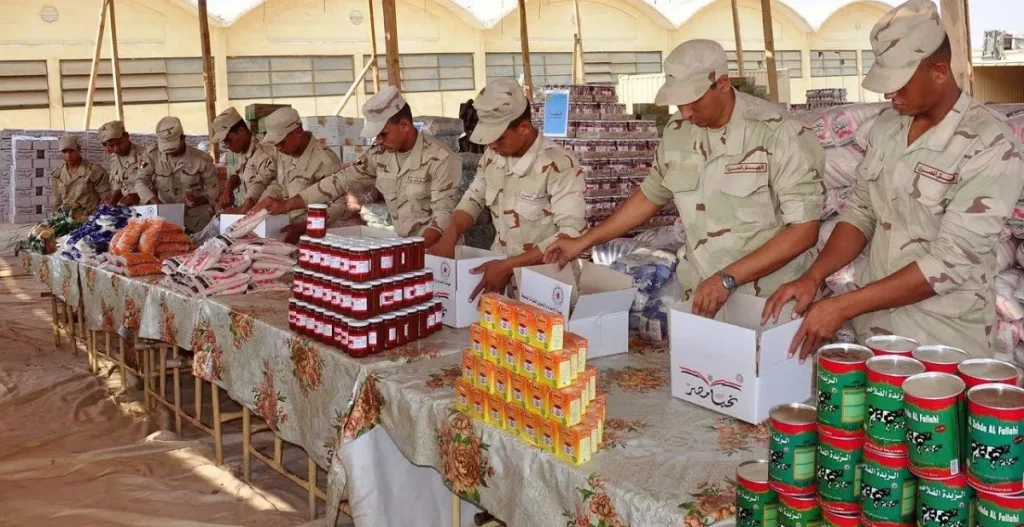
The National Service Projects Organization was established by Presidential Decree No. 32 of 1979, in the year the peace treaty was signed, with the declared aim of achieving relative self-sufficiency in the armed forces’ needs and offering surplus production capacity on the local market. Four decades later, the Financial Times wrote in January 2022, as reported by Al Jazeera, that the organisation controls 32 companies, a third of which were established after 2015. Reading what the organisation announces about itself is enough to see how far the production surplus has strayed from the soldiers’ needs: the Al-Nasr Company for Services and Maintenance, “Queen Service”, in which the organisation owns 75% and which works in security and guarding, cleaning, the management of hotels, tourist villages and garages, and supplies; the “Queen Pasta” company, with nine factories, 18 production lines and no less than 150,000 tonnes a year; the egg production complex, with four units producing 120 million eggs a year; the National Company for Food Industries in Rafah, with four factories for jams, juices and olive oil; the “Safi” mineral water company, with three factories and 24 sales outlets in Greater Cairo; the Wadi El-Sheeh farm in Assiut, on 10,000 feddans; the National Company for Desert Land Reclamation in East Owainat, on 110,000 feddans, with 15 sheep farms, five cattle farms, 30 apiaries and 612 housing units for armed forces personnel; the Upper Egypt Company for Agricultural Manufacturing, with cheese, tomato paste and animal feed factories in Assiut, Sohag and the New Valley; the National Company for Refrigeration and Supplies, established in 2015 for refrigerated transport; and the National Petroleum Company, established in 1993, with 71 operating fuel stations, 17 under construction and a declared target of reaching 125 stations.
In industry: the Al-Nasr Company for Intermediate Chemicals, with a complex of nine factories in Kom Oshim in Fayoum for alum, sulphuric acid, superphosphate fertilisers and potassium sulphate, and a complex of five factories in Abu Rawash for chlorine and medical and industrial gases; the Arish Cement Company in Gabal Libni, south of Arish, with a capacity of about 3.2 million tonnes a year; the Arab International Optronics company in El-Salam City, in partnership with the French group “Thales”, which owns 49%; the plastic tarpaulin factory in Almaza, producing 1,500 tonnes a year; and the National Batteries Company, which El-Sisi inaugurated in 2015. In construction and roads: the National Company for General Contracting and Supplies in Almaza, which has built schools, youth centres, health units and sports grounds, and the National Company for the Construction, Development and Management of Roads, which built the Cairo–Ain Sokhna road and the Helwan–Kureimat–Western Assiut road; Presidential Decree No. 233 of 2016 allocated 21 roads to the Ministry of Defence, after the government of Hazem El-Beblawi in 2014 had transferred the maintenance of 27 bridges and tunnels, at a cost of EGP 4.47 billion, to the Engineering Authority. In mining: a sector in Nasr City that extracts bentonite, glass sand, kaolin and dolomite, and the Egyptian Black Sands Company, established under General Authority for Investment certificate No. 769 on 15 February 2016 to concentrate and separate economic minerals from beach sands, in which, alongside the organisation, the Nuclear Materials Authority, Kafr El-Sheikh Governorate, the National Investment Bank and the Egyptian Mineral Resources Company hold shares.
The story of fish farming reveals how land turns into a company. In 2016, Presidential Decree No. 270 was issued reallocating 2,815.14 feddans of state land in the Ghalioun area in Kafr El-Sheikh to the National Service Projects Organization for fish farming, together with Decree 332 reallocating 107.55 feddans in the Diba Triangle west of Port Said for the same purpose; then the National Company for Fisheries and Aquaculture was established in 2015 to manage the project, which its head, Staff Major General Hamdy Badeen, said comprises, in the Ghalioun pond, 453 ponds for marine fish, 626 ponds for shrimp, 186 ponds for fortification and a hatchery producing 20 million fry and 2 billion shrimp units. Along the same path, Presidential Decree No. 446 of 2015 enabled the Armed Forces Land Projects Agency, for the first time, to establish companies of all forms, alone or in partnership with national or foreign capital, and the agency launched a $150 million fish farming company named the “International Company for Marine Products”, in partnership with the Saudi investor Mohamed Amer Al-Jari and a German tuna farming company. On 2 December 2015, the same agency announced the sale by public auction of residential and commercial units and parking spaces in Zahraa Nasr City, the Tenth District, the Safwat El-Methaq towers, El-Nozha, El-Gabal El-Akhdar, El-Helmeya, the Rabaa El-Adawiya extension and Alexandria, with a 35% down payment and the remainder in instalments over three years at 7% interest, that is, with the same tools used by any private real estate developer, with one difference: the land was not bought.
The Capital the Army Owns
The New Administrative Capital is the clearest example of this mechanism. After the Emirati businessman Mohamed Alabbar, chairman of “Emaar”, withdrew from the plans to build the capital because no agreement satisfactory to both sides was reached, Presidential Decree No. 57 was issued in February 2016 designating the lands of the New Administrative Capital and the Sheikh Mohamed bin Zayed Urban Community, 16,645 feddans south of the Cairo–Suez road, as new urban community areas, and providing for the New Urban Communities Authority, the National Service Projects Organization and the Armed Forces Land Projects Agency to establish a joint-stock company to plan and build the capital, with the value of the land being the land agency’s share of the capital. On 8 May 2016, the founding general assembly of the “Administrative Capital for Urban Development” company held its first meeting, with a paid-up capital of EGP 6 billion and a board of directors of 13 members, four of them representing the armed forces: Staff Major General Kamel El-Wazir, head of the Engineering Authority; Major General Amir Sayed Ahmed, adviser to the Minister of Defence for projects; Major General Mostafa Amin Ali, director of the National Service Projects Organization; and Staff Major General Mohamed Abdel Latif, who became the company’s managing director. Ownership of the company is divided between the New Urban Communities Authority (49%), the National Service Projects Organization (29.4%) and the Armed Forces Land Projects Agency (21.6%), meaning that the army owns the majority with 51%, and its land portfolio amounted to about 174,000 feddans in January 2022. The project presented to the public as the state’s new capital is, in the register of the General Authority for Investment, a joint-stock company subject to Investment Law No. 8 of 1997, the majority of which the army owns and whose land it sells.
Under Law No. 143 of 1981 on desert lands and its supplementary decrees, the state’s desert lands, which make up the overwhelming majority of the country’s area, may not be disposed of without the approval of the Ministry of Defence, which decides what is “of strategic importance”. A report by the Al Jazeera Centre for Studies in November 2016 documented that the armed forces, as the body controlling state land, obtain the land needed for their economic projects without paying its price to the treasury, in addition to customs and tax exemptions and the almost free labour of conscripts, factors which together give them advantages available neither to other state companies nor to the private sector. A paper by Shana Marshall, published by Carnegie in April 2015, indicates that the interim government led by Hazem El-Beblawi allocated, during the ten months following the ousting of Mohamed Morsi, projects worth about $770 million to the army and its institutions and companies, and that after July 2013 the army entered new economic sectors and took over large projects that had long been distinguished by the presence of big capital.
Privileges by the Letter of the Law
The competitive advantage of the army’s companies does not need to be inferred: it is written into the laws. The law on the tax on built real estate exempts, by the text of its article on exemptions, “the clubs and hotels of the armed forces, arms houses, military complexes, medical centres, hospitals and clinics, the built real estate within their perimeter, and other units proposed by the Armed Forces Operations Authority”, and adds that these bodies are not, in any case, subject to the work of the inventory and assessment committees, “in accordance with what is required by considerations of defence affairs and the requirements of national security”. Minister of Defence Sedki Sobhi issued on 19 April 2015 Decree No. 68 specifying the exempted units. The armed forces’ imports are exempt from customs under Law 186 of 1986, and its purchases are exempt from value added tax. In his reading of the IMF agreement, Sayigh summarises that the military companies enjoyed exemptions broader even than those of other state companies: from income, real estate and value added taxes, customs and administrative fees, exchange rate ceilings and road tolls, and that the government memorandum now promises to remove all tax exemptions from them.
The second advantage comes from the tenders law itself. The Law Regulating Public Contracts, No. 182 of 2018, allows direct contracting between public bodies, the door through which the Engineering Authority passes as a public contractor that receives national projects by direct order and then distributes them to subcontractors. Reuters documented in its 2018 investigation how private sector investors complain of competition for which they lack the tools, while the Minister of Military Production told the agency that Egypt needs private companies as the “backbone” of industry and the economy. The third advantage is human: the largest proportion of those working in the army’s economic projects are conscripts performing compulsory service for a token wage, which makes the cost of production at the pasta factory or the fuel station incomparable with its cost for a competitor who pays the minimum wage and social insurance.
The Flotation That Never Comes
Since El-Sisi said in 2016 that the army “has nothing to hide”, floating its companies on the stock exchange has become the promise that is repeated every year without being carried out. In October 2019, the president called for some armed forces companies to be floated on the stock exchange so that citizens could own shares in them; in February 2020, the Sovereign Fund of Egypt signed a cooperation agreement with the National Service Projects Organization; and in March of the same year, the fund’s chief executive, Ayman Soliman, said that the fund was evaluating ten companies owned by the organisation to offer to investors and that the plan aimed to sell close to 100% of their shares. Then Minister of Planning Hala El-Said announced in December 2020 that the fund had chosen only two of the ten companies: “Safi” for water and “Wataniya Petroleum”. In January 2022, Soliman told Bloomberg that the two companies would be ready for flotation after Eid al-Fitr; in July 2022, the Cabinet approved their “qualification” for flotation; and on 15 November 2022, El-Sisi met with Prime Minister Mostafa Madbouly, the head of the Armed Forces Financial Affairs Authority, Major General Ahmed El-Shazly, the director of the National Service Projects Organization, Staff Major General Walid Abul Magd, and the heads of the two companies, Major General Mohamed Anwar and Major General Yasser El-Gamal, and presidential spokesman Bassam Rady said that the president had been briefed on “the start of the procedures” in preparation for offering stakes in the two companies. In other words, the procedures that started in February 2020 started again in November 2022, and not a single share has been floated to this day.
Sayigh offers two explanations for this delay. The first is that the army rejects the levels of financial disclosure that flotation imposes, even partial flotation, which he analysed in a paper entitled “Will the Egyptian Army’s Companies Be Floated?” in April 2020. The second is that the “Wataniya Petroleum” company is in effect being stripped of its assets, as its stations are being replaced with “Chillout” stations, also owned by the army, which reduces the interest of any Gulf buyer in it. He adds that the army is known for its hostility to the sale of any state assets, let alone its own assets, and that this explains the loud objections in parliament to the government’s plans to privatise companies affiliated with the Suez Canal Authority, which the army considers its exclusive economic domain.
This month’s agreement differs from previous promises in one thing: it is written down. The State Ownership Policy Document, whose draft was published in June 2022 and which promised the state’s complete exit from 79 sectors and the reduction of its presence in 45 sectors, has become the structural benchmark for the loan; the military companies have come within the definition of the state by name; and the government must now prove every six months that it is applying it. Former Deputy Prime Minister Ziad Bahaa El-Din said, in an article in Al-Masry Al-Youm, that most of the mechanisms proposed by the document have been officially approved many times over the years without any tangible effect. Sayigh points out that a review of military expansion since June 2022 alone contradicts the government’s promise that no new public companies will be established except transparently and within the framework of the ownership policy; that the army clings to its own off-budget funds, whose liabilities the IMF has acknowledged it is unable to estimate; and that the government memorandum left open for itself the door of “clarifying the terms of direct contracting between public bodies” under Law 182, which is the door the army needs in order to remain as it is.
What makes the test harsher this time is its price. The pound, which was worth 15.7 to the dollar a year ago, is trading today at about 30; the loan, which in 2016 was $12 billion, became $3 billion in 2022 on heavier terms; and the two companies whose flotation was announced in December 2020 are still at “the start of the procedures”. Between the figure the president cited in 2016, two per cent, and the commitment his government signed in January 2023, to present the accounts publicly, stands the paradox around which this whole file revolves: an economy that does not exceed two per cent of output does not need seven years of promises and an international loan in order to be counted, unless the counting itself is what is feared.