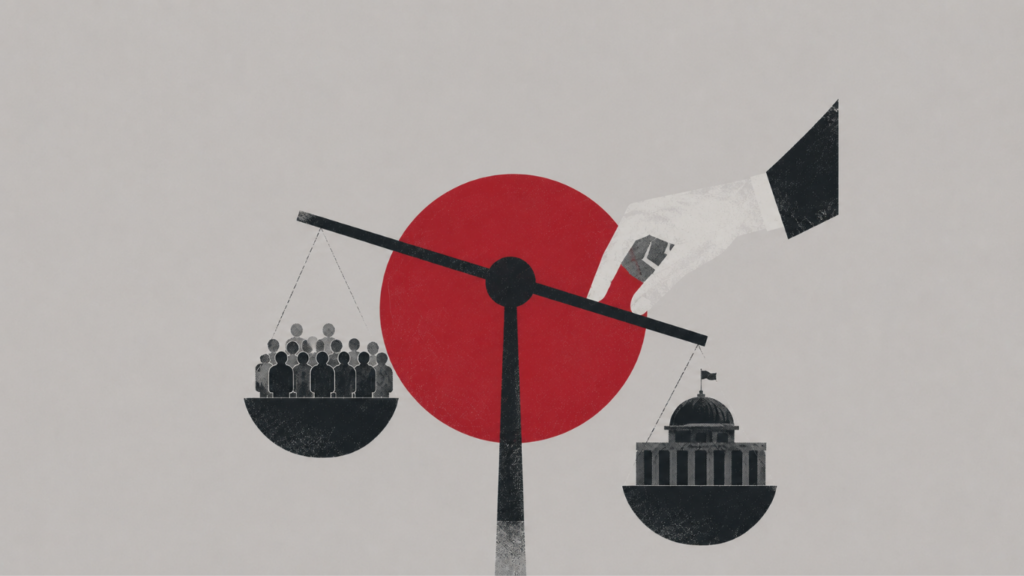

Debate over state intervention in Egypt’s unions has renewed after legislative changes affecting the timing and length of labour union terms. Supporters see the measures as promoting institutional stability and giving unions more time to implement programmes. Opponents regard them as further government interference undermining independence and workers’ right to choose representatives freely and periodically. The dispute belongs to a long controversy over the trade union law’s compatibility with the constitution and International Labour Organization standards.
On 10 June 2026, President Abdel Fattah El-Sisi ratified Law No. 74 of 2026, extending the current terms of labour union boards elected under Law No. 213 of 2017 by six months. The Official Gazette text requires the call for elections for the next term at least sixty days before the extension ends.
At the end of April, the cabinet had approved a bill extending the current term by six months and amending the 2017 trade union law to change future terms from four to five years.
The government cited forthcoming international and regional events, including the Arab Labour Conference in May and the International Labour Conference in June. Its statement said the measures would empower boards, help achieve their objectives and develop their members’ skills.
Both the temporary extension and permanent change attracted criticism. Labour figures and organisations interviewed by Zawia3 consider the justification insufficient for what they describe as intervention in union affairs and a broader effort to engineer organised labour.
Union freedom and international standards
Law No. 213 of 2017 followed government commitments to reform union legislation after years of domestic and international criticism of Law No. 35 of 1976. The earlier framework was accused of restricting freedom and confining representation to a single union structure. The new law recognised pluralism and independent unions for the first time in decades, responding to ILO observations.
Although welcomed as modernisation, the law drew criticism from unionists, rights groups, labour organisations and MPs for complicated establishment and compliance conditions, particularly membership thresholds that obstructed small and independent unions.
Law No. 142 of 2019 subsequently reduced several thresholds. A workplace union committee required fifty workers instead of 150. Establishing a general union required ten committees instead of fifteen, and 15,000 members instead of 20,000.
The minimum for a federation fell from ten general unions to seven, and from 200,000 workers to 150,000. The changes attempted to widen opportunities to establish unions.
These amendments partially responded to concerns about freedom of association and efforts to avoid renewed scrutiny through the ILO’s supervisory process. Debate continued over whether the changes addressed the law’s structural problems.
Karam Abdel-Halim, labour leader and president of the union for Suez Canal Authority club workers in Ismailia, calls the latest extension and future term change “blatant interference” contrary to union freedom and international conventions Egypt has ratified.
He tells Zawia3 that workers should choose their representatives and independently set their union rules. Instead, the state continues to determine election dates, term lengths and organisational arrangements.
The problem extends beyond the law to its implementation, he says. The Labour Ministry has “intervened in everything,” including obstructing independent unions and halting their activities.
Abdel-Halim sees no genuine development or empowerment justification for changing four-year terms to five. Some leaders in the Egyptian Trade Union Federation, he notes, have remained for decades without improving workers’ conditions or union performance.
If the purpose was legal reform, the debate should have addressed controversial provisions on establishment, membership requirements and organisational independence, rather than term extensions.
He describes the decision as continued “engineering of union life,” controlling the timetable and organisational framework in ways that restrict leadership renewal, especially in independent unions. In his view, the state favours an administratively controlled model instead of supporting genuinely independent representation.
He questions the government’s right to decide or extend terms, arguing that assemblies and workers should determine them through internal rules. Government should not assume the assembly’s role by granting renewed legitimacy to boards whose elected mandates have expired.
Unionists and rights advocates appealed to MPs not to approve the proposals, calling them a circumvention of the substance of organising rights and an entrenchment of administrative interference.
The appeal, signed by unionists, workers and labour advocates, said the Social Dialogue Council recommendation endorsed by the cabinet on 29 April and parliament’s Manpower Committee on 11 May raised concerns about independence and free, periodic choice of representatives.
Signatories argued that the proposals ignored procedural restrictions and administrative obstacles faced by independent unions. They called for wider public dialogue on reform consistent with the constitution and ILO standards.
Beyond the wording of the law
Abdel-Halim warns that continuing this approach could hollow out union democracy by entrenching current leaders or limiting genuine elections. Independent unions remain suspended or inactive, he says, including his own Suez Canal clubs union and unions representing ambulance and road transport workers. He asks what will happen to them without real consultation.
Kamal Abbas, director of the Center for Trade Union and Workers Services (CTUWS), says term length should be determined by each organisation’s general assembly through its internal regulations, rather than imposed uniformly by legislation or government.
He tells Zawia3 that the 2017 law granted union committees legal personality. Democratic organisation therefore requires workers to choose whether their boards serve two, three or more years, subject only to a maximum. A uniform term directly interferes with independence, he argues.
Abbas finds the government’s justifications unconvincing. Linking extensions to administrative arrangements or international conference dates, he says, serves particular leaders’ organisational interests rather than workers’ needs.
Social and labour researcher Wafaa Ashry considers postponement and extension direct interference with union freedoms. Unions should be independent from the executive and represent workers in bargaining over pay, leave, safety and conditions. Imposing one election date undermines independence and the assembly’s management of internal affairs, she says.
Continuing boards without meaningful performance assessment or a response to workers’ demands—despite increasing protests—allows structures with few tangible achievements to remain, she adds.
Ashry criticises the same timetable being applied to newly founded and longstanding unions. It weakens emerging organisations’ ability to build stable membership before elections and damages equal opportunities.
She also believes undisclosed political considerations lie behind postponement. Continuing the approach may prolong existing leadership without real renewal, limiting representation and weakening the movement’s dynamism.
Independent unions, she says, face major difficulties in registration and legal recognition, administrative barriers and delays, while traditional organisations affiliated with the federation remain dominant. That imbalance weakens real pluralism.
The Egyptian Center for Economic and Social Rights also rejected extension, describing it as a fundamental breach of democratic rotation and workers’ right to choose representatives freely and periodically.
Its statement argued that the priority should be legislative and organisational shortcomings exposed by implementation, including a clear, effective framework for electoral complaints and appeals and meaningful judicial resolution of disputes.
The centre called for election oversight and appeals to return to State Council courts, criticising their transfer to labour courts. It said oversight had been weakened, particularly without election timetables that accommodate filing and deciding appeals.
It also urged explicit provisions preventing direct or indirect administrative intervention in candidacy and voting, ensuring integrity, equal opportunities and independence from outside influence.
Conference costs and limited returns
On Egyptian union delegations to ILO meetings, a reason given for the six-month extension, Abbas says attendance alone does not improve conditions or ensure compliance with international conventions, especially Nos. 87 and 98 on organising rights.
Sometimes participation becomes a “financial burden without real returns,” he says, questioning benefits relative to the costs and allowances borne by unions and whether attendance produces positions supporting workers’ rights in Egypt.
Abbas recalls that the 2017 law emerged under pressure from ILO observations, decent-work programmes and economic effects on some sectors, without a fundamental change in the approach to union freedoms. Membership thresholds for general unions and federations, he says, continue to obstruct genuinely independent organisations under a dominant single model.
He criticises bureaucratic registration and Labour Ministry approval as incompatible with freedom of association, proposing judicial registration or establishment by notification without administrative guardianship.
The problem is practice as well as text, he stresses. Continuing interference empties union freedoms of substance and undermines independent organisations that genuinely represent workers.
ILO Convention No. 87 protects workers’ freedom to establish and join organisations of their choice and their organisations’ autonomy in internal rules, elections and programmes. Convention No. 98 protects organising rights and collective bargaining. These standards require protection from interference rather than merely formal recognition.
Supporters argue for stability
Magdy El-Badawy, deputy president of the Egyptian Trade Union Federation, defends the extension and five-year terms. He says the proposal followed an institutional route through the Social Dialogue Council, chaired by the labour minister and including government, employer and union representatives.
He tells Zawia3 that worker representatives reached agreement on five-year terms instead of four to give organisations more time to work and implement programmes effectively.
The approach aligns with other elected bodies such as the House of Representatives and Senate, he says, and some foreign unions also use five-year terms.
El-Badawy stresses that the five-year rule would begin with the next term, not the current one, so voters would know its duration before voting. He attributes the temporary six-month extension to scheduling conflicts with the Arab Labour Conference, ILO conference and Labour Day celebrations requiring extensive official arrangements.
For him, elected representation is the essential criterion: an organisation or individual without an electoral mandate cannot truly speak for workers. He says the federation respects unions elected by their membership, inside or outside its umbrella, but rejects representative status for entities without a clear electoral base.
He considers criticism exaggerated. Six extra months, he argues, will not make a fundamental difference, while five-year terms offer more opportunity for work and stability. Advance knowledge of the term before democratic elections, he believes, is enough to clarify the rules.
Fears of exclusion in the next elections
The 2022–2026 union elections generated substantial controversy over organising freedoms. In its final report, CTUWS said they fell short of expectations and were not genuine elections, alleging that government agencies preferred hollow decorative structures and had undermined integrity.
The report said that, in the view of independent unionists, the elections did not broaden democratic participation or renew leadership. They reproduced weak pluralism and the dominance of particular organisations. Legal recognition of independent unions remained constrained by procedures that limited its practical effect.
Abdel-Halim describes interventions since the 2018 elections, including candidates and independent unionists being prevented from standing, removed from lists or excluded, and assemblies being obstructed. He considers this evidence that freedom is absent in practice despite legal and international commitments.
Abbas similarly criticises administrative intervention in earlier election cycles, saying it undermined integrity and free competition. He fears the pattern will recur.
Article 76 of the Egyptian constitution protects democratically established unions and federations, their legal personality and freedom to act, and their role in improving members’ skills, defending rights and protecting interests. It guarantees independence and allows dissolution of boards only by court ruling.
Article 77 requires democratic organisation and independence of professional syndicates. Article 93 gives ratified international human rights agreements the force of law, reinforcing the relevance of international organising standards.
The latest changes thus extend a longstanding struggle over labour movement independence. Government sees revised schedules and terms as enhancing stability and effectiveness. Union and rights critics argue that the real issue is free organisation, genuine competition and an end to administrative interference, rather than the number of years in a term.